
Article 4 directions are one of the most misunderstood elements of UK planning policy. To most property developers, they’re a hard “no” — a regulatory wall that turns straightforward HMO and conversion projects into impossible ones. As a result, most operators screen out properties in Article 4 areas entirely, before even evaluating the opportunity.
That blanket avoidance is a mistake. Article 4 is not a blanket prohibition. It’s a targeted policy tool designed to address a specific problem — and properties that fall outside the problem the policy was designed to address can still be developed successfully, including for the very uses the Article 4 was intended to restrict elsewhere.
This guide explains what Article 4 directions actually are, the specific problem they’re designed to solve, why most developers misunderstand the policy and walk away from viable deals, how the Mozarts conversion at 76 Walter Road, Swansea was consented despite sitting in an Article 4 conservation area, and the structural reason commercial-to-residential conversions are the strongest play in Article 4 environments.
What an Article 4 direction actually is
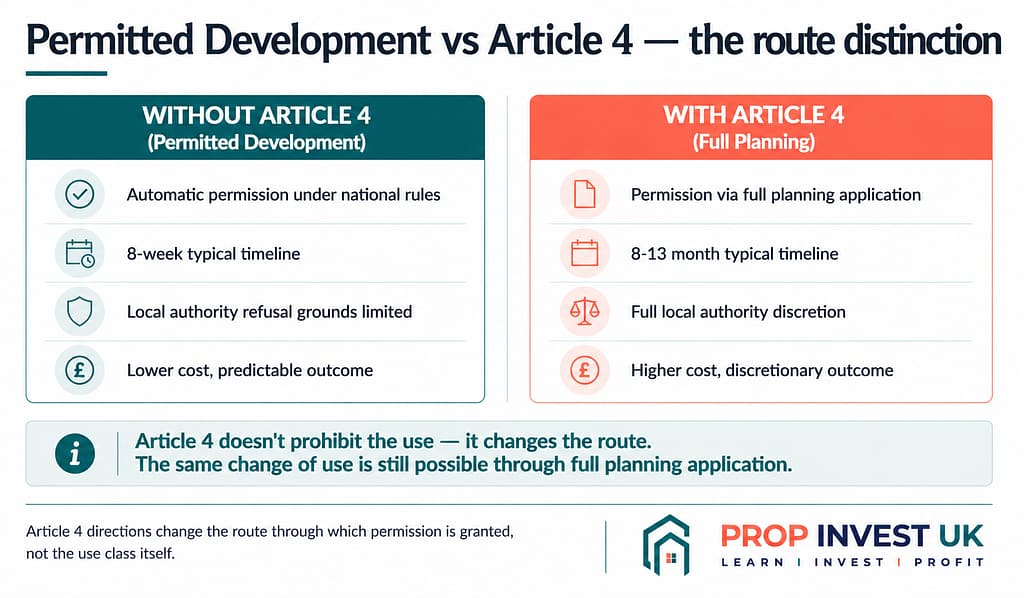
In UK planning law, certain changes of use don’t require a full planning application. They fall under Permitted Development Rights (PDR) — rights granted nationally by central government that allow specific types of development without going through the local planning authority. The PDR framework is what allows, for example, conversion of certain commercial properties to residential under Class MA, without needing the full planning consent process.
An Article 4 direction is a tool that lets a local planning authority withdraw specific Permitted Development Rights within a defined geographic area. Once an Article 4 direction is in place, the change of use that would normally be permitted under national rules now requires a full planning application instead.
In practice, this means:
- Without Article 4: A property owner can convert their family home to an HMO (under the relevant permitted development right) without seeking planning permission.
- With Article 4 in place: The same conversion requires a full planning application, which the local authority can refuse.
The Article 4 doesn’t change the use class itself or block the change of use. It changes the route through which permission is granted — from automatic permission under national rules to full planning application under local authority discretion.
This distinction matters enormously for property developers and is the source of most of the misunderstanding around Article 4. A property in an Article 4 area is not undeliverable. It’s undeliverable through Permitted Development, but it can still be delivered through full planning application.
The specific problem Article 4 is designed to solve
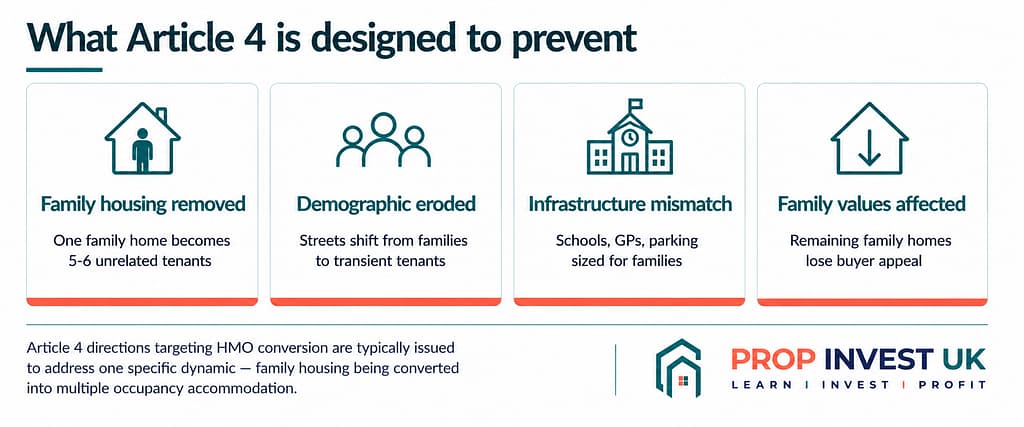
Local planning authorities don’t issue Article 4 directions arbitrarily. They’re issued in response to specific local pressures, and the most common pressure in UK Article 4 designations targeting HMO conversions is the same across most of the country:
The loss of family housing to small-scale HMO conversion.
Here’s the policy problem an Article 4 typically addresses. A residential street with established family homes — three-bedroom houses with gardens, owned and lived in by families — is attractive to small-scale property investors. The investor buys a family home, converts it (often via permitted development right, depending on the size) into a 5-6 bedroom HMO targeting students or young professionals, and rents it out at substantially higher yield than the family home would have produced.
The economics of this conversion are appealing to the investor. The problem from a local authority perspective is that:
- Family housing stock is removed. A house that was previously occupied by one family is now occupied by 5-6 unrelated individuals.
- The local family demographic is eroded. Streets that used to house families now house transient HMO tenants.
- Local infrastructure assumes family housing. Schools, GP practices, parking provision, community facilities were all sized around family households. HMO conversion changes the demand profile.
- Property values for remaining family homes can be affected. Streets characterised by HMO conversion become less attractive to family buyers.
Article 4 directions targeting HMO conversion are typically issued in areas where this dynamic is already underway — university towns, professional rental areas, town centres adjacent to family-housing streets. The policy intent is to slow or stop the conversion of family housing into HMOs in those specific geographies.
The implication for developers
Once you understand the problem Article 4 is designed to solve, you can see what it’s not designed to solve.
Article 4 is designed to stop family homes from being converted into HMOs. It’s not designed to stop any HMO development in the area. A development that doesn’t remove a family home — that converts a different category of property into HMO accommodation — doesn’t trigger the policy problem the Article 4 was issued to address.
This is the strategic gap most developers miss. They see “Article 4 in this area” and read it as “no HMOs allowed here.” The reality is more nuanced. Article 4 makes converting family homes into HMOs much harder. It does not make all HMO development impossible.
Why most developers walk away from Article 4 areas
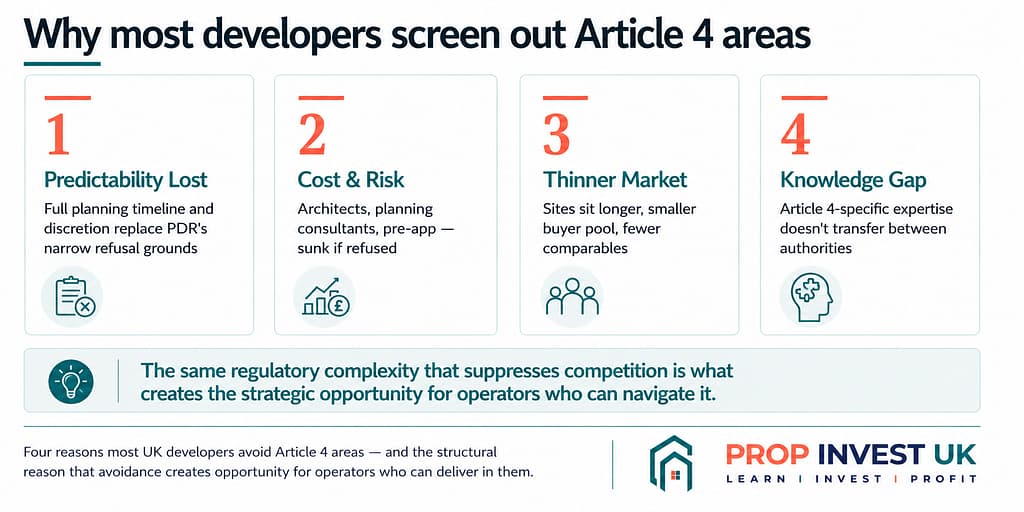
Most UK property developers screen out Article 4 areas at the deal-sourcing stage. The reasons are operational, not strategic.
1. Permitted Development is faster, cheaper, and more predictable. When PDR is available, the planning timeline is typically 8 weeks and the local authority can only refuse on a narrow set of grounds. Full planning applications take 8-13 months and the local authority has full discretion. For a developer running a pipeline of multiple projects, the predictability of PDR is operationally valuable.
2. Full planning applications carry higher cost and risk. Architect’s fees for full applications are higher. Planning consultants may need to be engaged. Pre-application advice may be required. The application itself can be refused, in which case the costs are largely lost. For a developer working on thin margins, the risk premium on full planning isn’t always justified.
3. The deal terms reflect the difficulty. Properties in Article 4 areas typically sit on the market longer, sometimes at lower prices, because the universe of buyers is smaller. This sounds like an opportunity — and it is — but only for operators capable of converting the regulatory complexity into delivered projects. Most aren’t.
4. The institutional knowledge isn’t widely held. Successfully delivering projects in Article 4 areas requires understanding of the specific Article 4 in the specific local authority, the planning policy framework that sits behind it, the application history of similar projects, and the appetite of the local authority for different types of proposals. This knowledge is operator-specific and doesn’t transfer easily.
The combined effect: most operators screen out Article 4 areas as too hard. Which is exactly the dynamic that makes those areas valuable for operators who can navigate them. The same regulatory complexity that suppresses competition for sites is what allows acquisition prices to leave room for substantial forced appreciation — which we covered in detail in our forced appreciation article.
The Swansea Uplands Article 4 area — a worked example
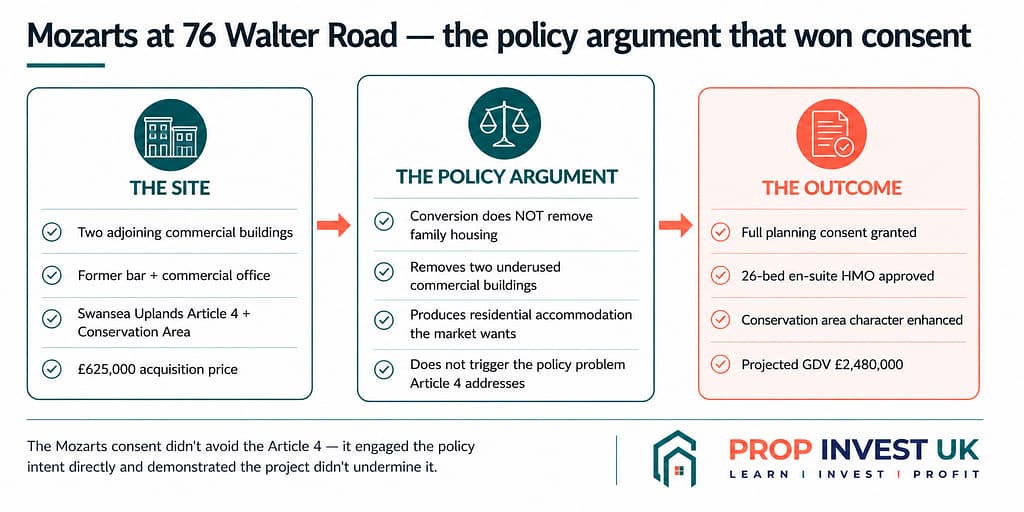
The Mozarts conversion at 76 Walter Road, Swansea (which we’ve covered from multiple angles in our conversion, overrun, security, and forced appreciation articles) is a clean illustration of how an experienced operator delivers a project in an Article 4 environment that most other operators would have walked away from.
The site sits in the Uplands area of Swansea, which has an Article 4 designation targeting HMO conversions. The area is also a designated conservation area, layering additional planning complexity on top of the Article 4.
For most developers, this combination is a categorical “no”:
- Full planning application required (Article 4)
- Conservation area constraints on external alterations
- Discretionary local authority decision
- Historic local resistance to HMO expansion in the area
The straightforward read: don’t even evaluate sites here. Most operators wouldn’t have looked at 76 Walter Road. The pricing reflected that — £625,000 for two adjoining commercial buildings with no obvious path to value creation for a generalist buyer.
But the policy intent behind the Swansea Uplands Article 4 is the same as most UK Article 4s targeting HMOs: protecting family housing from being converted into multiple-occupancy accommodation. The policy was issued in response to family homes in residential streets being converted by small-scale investors, with the effects on neighbourhood character and family housing stock described earlier.
76 Walter Road is not a family home. It’s two commercial buildings — a former bar and nightclub, and a commercial office building — that have been operating commercially for decades and that have no realistic prospect of returning to commercial use given current market conditions for that type of building in that location.
Converting these buildings to a 26-bed HMO doesn’t remove a family home. It removes two underused commercial buildings that the local market doesn’t want as commercial space, and produces 26 units of residential accommodation that the local market does want.
This is the policy argument that the planning application was built around. The conversion is structurally different from what the Article 4 was issued to address. The HMO use is being delivered through a route the policy didn’t anticipate prohibiting — converting commercial buildings, not family homes.
The application was made under full planning consent (because PDR wasn’t available in the Article 4 area), supported by the policy argument above, with design proposals that respected and enhanced the conservation area character rather than detracting from it. Consent was granted.
What this illustrates
Three things worth taking from the Mozarts example:
1. Article 4 doesn’t prohibit the use. It prohibits the route. Mozarts converted commercial to HMO — exactly the use class the Article 4 made harder to achieve in the area. But the route was full planning, not Permitted Development, and the policy argument was that the specific conversion didn’t trigger the policy problem the Article 4 was designed to address.
2. The policy argument is half the battle. Most planning applications in Article 4 areas focus on the design and the technical compliance. The applications that succeed also engage directly with the policy intent behind the Article 4 — demonstrating that the proposal doesn’t undermine the policy goal, even if it pursues a use category the policy generally restricts.
3. Commercial-to-residential conversion is structurally favoured in Article 4 environments. Because the Article 4 problem is family-housing-loss, conversion projects that don’t involve family housing sit on different policy ground from conversions that do. This is the strategic insight most generalist developers miss — and it’s the reason commercial-to-residential conversions in Article 4 areas are some of the most consistently deliverable forced appreciation opportunities in UK property development.
The strategic principle: commercial-to-HMO works where house-to-HMO doesn’t
Step back from Mozarts specifically and there’s a broader principle worth understanding.
UK Article 4 directions targeting HMO conversion are typically a response to family-housing-to-HMO conversion. The policy is designed to slow or stop that specific transaction. The geography of an Article 4 designation reflects where that transaction has been most active — typically residential streets adjacent to professional or university populations.
But those same residential streets often contain non-residential buildings as well — former pubs, retail premises, offices, light industrial units, hospitality venues, religious buildings. These are usually in the Article 4 catchment area because of the geographic boundary, not because converting them was the policy concern.
The result: in most UK Article 4 areas, commercial-to-residential conversion sits on materially different policy ground than house-to-HMO conversion, even though both produce HMO end states.
Five practical implications:
1. The acquisition price reflects general avoidance
Properties in Article 4 areas are priced as if they’re undeliverable. The buyer pool is smaller and the deal terms reflect it. Commercial buildings in Article 4 areas are often priced as commercial properties with no residential conversion premium — even though residential conversion may be the most valuable use.
2. The competition for sites is thinner
Most developers screen out Article 4 areas. The developers that don’t are usually local specialists with knowledge of the specific Article 4 and the local authority’s planning approach. The competitive dynamics are completely different from sites where everyone can play.
3. The planning argument is structurally favourable
A commercial-to-residential conversion in an Article 4 area can argue that it doesn’t undermine the policy intent of the Article 4 — because it doesn’t remove family housing. This is the policy argument that wins. Generic “we want to do an HMO” applications in Article 4 areas don’t win. Specific “we want to do an HMO that doesn’t trigger the policy problem the Article 4 was designed to address” applications do.
4. The conversion economics are stronger
Because Article 4 areas are typically established residential areas with strong rental demand, the rental yields on HMO conversions in these areas tend to be strong. Commercial-to-HMO in an Article 4 area combines the suppressed acquisition pricing (from general developer avoidance) with strong end-user demand (from the established residential market). The forced appreciation potential is substantial.
5. The community impact narrative is favourable
Local authorities reviewing planning applications in Article 4 areas often face local concerns about HMO expansion. A commercial conversion can be presented to the community as removing a problem building (the underused commercial property) rather than removing housing — which changes the political dynamics around the application significantly.
What this means for operator selection
For investors evaluating UK property operators, the question of how they approach Article 4 areas is genuinely diagnostic.
Operators who avoid Article 4 areas entirely are running a simpler operation, but they’re systematically passing on the deal flow that produces the strongest forced appreciation outcomes. Their pipeline depends on competitive open-market acquisitions where they’re bidding against every other generalist developer. The economics get squeezed accordingly.
Operators who claim to “specialise” in Article 4 areas but can’t articulate the policy framework are usually inexperienced. Specialisation in this context means knowing the specific Article 4 in the specific local authority, having relationships with the local planning team, and being able to construct policy arguments that survive scrutiny. Marketing language about “Article 4 expertise” without evidence of delivered projects is a warning sign, not a credential.
Operators who can deliver Article 4 projects consistently — with named completed projects, full planning consents secured, and conversion outcomes that match the original modelling — are operating at a different level. The deal flow available to them is structurally better than the deal flow available to generalist operators, because the regulatory complexity acts as a competitive moat.
The Mozarts project is one example of this approach in our portfolio. The same pattern — commercial-to-residential conversion in regulated planning environments — runs through other completed and active projects across the South Wales and South West regional markets. Article 4 environments are not a category we avoid; they’re a category where our planning capability produces consistent forced appreciation opportunities at attractive acquisition pricing.
How to evaluate any opportunity in an Article 4 area
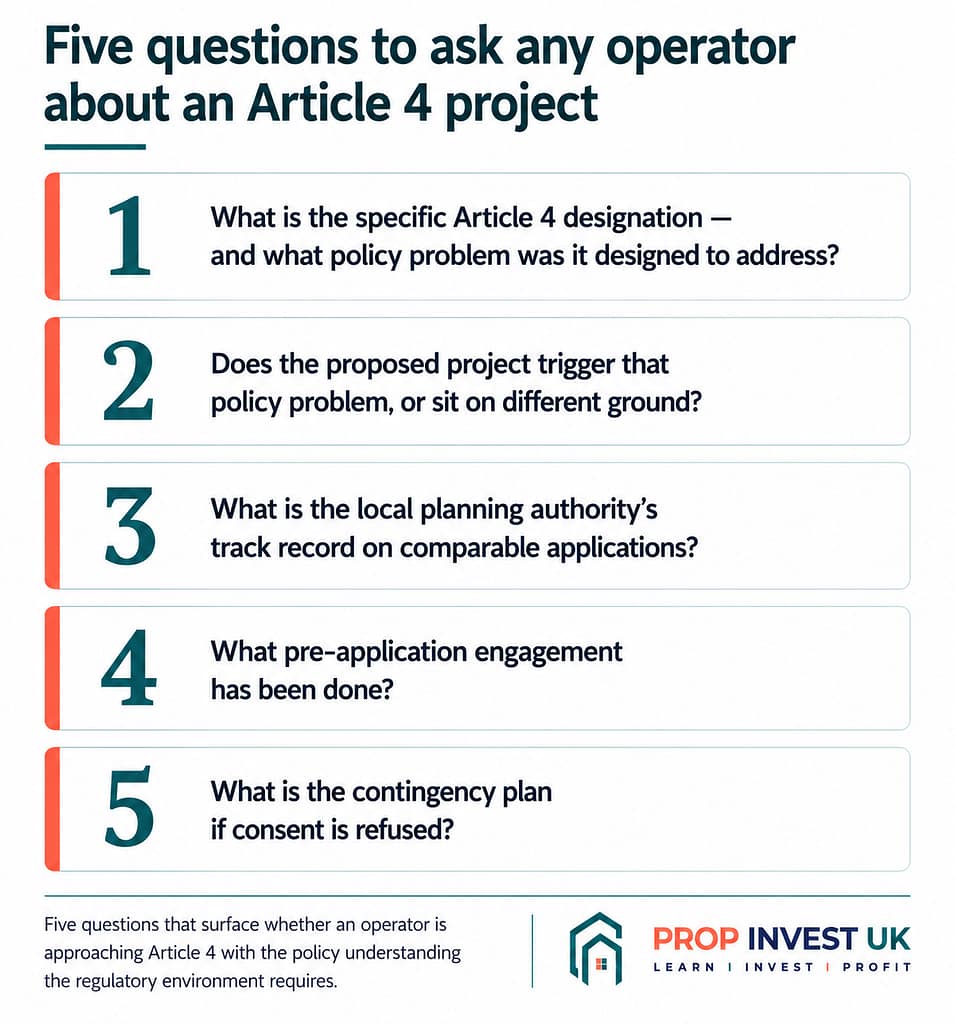
If you’re being asked to participate as a capital partner in a UK property project that sits in an Article 4 area, five specific questions to ask:
1. What is the specific Article 4 designation, and what policy problem was it designed to address?
A capable operator can answer this directly. Family housing protection, town centre HMO saturation, conservation character preservation — the specific policy goal of the Article 4 determines what kind of project can succeed within it. An operator who doesn’t know the policy intent isn’t operating from understanding.
2. Does the proposed project trigger the policy problem the Article 4 was designed to address?
A commercial-to-residential conversion in an Article 4 designed to protect family housing is structurally different from a family-home-to-HMO conversion in the same area. The operator should be able to articulate exactly why their project doesn’t undermine the policy intent.
3. What is the local planning authority’s track record on similar applications?
Planning is partly art, partly precedent. A local authority that has granted comparable applications in the area is signalling its policy interpretation. An authority that has refused comparable applications is signalling the opposite. The operator should know this precedent and be able to discuss it.
4. What pre-application engagement has been done?
For complex applications in Article 4 areas, pre-application meetings with the local authority are standard practice. They surface objections early, allow the application to be shaped to address concerns, and signal the operator’s seriousness. Applications submitted without pre-app are higher-risk by default.
5. What is the contingency plan if consent is refused?
Even strong applications can fail. Capable operators have a contingency — appeal route, alternative use, resale to another developer, hold strategy. Operators without a contingency are exposing investor capital to a single point of failure.
The connection to the broader development thesis
Article 4 directions sit at the intersection of the strategic frameworks we’ve covered across our investor content.
They’re a forced appreciation lever — the planning gain mechanism is most valuable in environments where consent is hard to obtain, which is exactly what Article 4 designations produce.
They’re a competitive moat — by suppressing generalist developer competition, Article 4 areas produce acquisition pricing that supports stronger development margins.
They’re a structural feature of how UK commercial-to-residential conversion produces value — the policy environment that makes the conversion possible is the same policy environment that suppresses competition for the sites where the conversion can be delivered.
They’re an operator capability indicator — the ability to navigate Article 4 environments separates serious operators from generalists, and is one of the strongest single signals of operator quality for investors evaluating UK property opportunities.
For investors evaluating projects in our portfolio specifically, the Mozarts conversion is one example of this capability in action. We apply the same approach across multiple regional markets where Article 4 designations create the structural conditions that allow forced appreciation at scale.
In summary
Article 4 directions are not blanket prohibitions on development in the affected area. They’re targeted policy tools designed to address specific local problems — usually the conversion of family housing into HMOs. Properties in Article 4 areas remain developable; they just require full planning application rather than Permitted Development.
Most UK developers screen out Article 4 areas at the sourcing stage because the regulatory complexity exceeds their planning capability. The result: Article 4 areas have suppressed competition, lower acquisition pricing, and substantial forced appreciation potential for operators capable of navigating the policy environment.
The strategic principle that runs through most UK Article 4 designations: the policy is designed to stop family housing being lost to HMO conversion. Conversions that don’t involve family housing — particularly commercial-to-residential conversions — sit on structurally different policy ground, even when they produce HMO end states.
The Mozarts conversion at 76 Walter Road, Swansea illustrates this principle in practice. Two underused commercial buildings in the Swansea Uplands Article 4 area, converted under full planning consent into a 26-bed en-suite HMO, with the policy argument that the conversion doesn’t remove family housing being central to the application’s success.
For investors evaluating UK property operators:
- Operators who avoid Article 4 areas entirely are passing on systematic forced appreciation opportunities
- Operators who claim Article 4 expertise without evidence of delivered projects are marketing, not delivering
- Operators who can consistently deliver Article 4 projects are operating with a competitive moat that generalist developers don’t have
Five questions to ask any operator about an Article 4 project:
- What is the specific Article 4 designation and policy intent?
- Does the proposed project trigger the policy problem the Article 4 was designed to address?
- What is the local planning authority’s track record on similar applications?
- What pre-application engagement has been done?
- What is the contingency plan if consent is refused?
An operator who can answer all five with detail and evidence is operating at a level that turns Article 4 complexity into capital partner opportunity. One who can’t, isn’t.
If you want to participate as a capital partner in projects structured around forced appreciation in Article 4 and other regulated planning environments — you can join the Prop Invest UK investor list. We share specific opportunities with capital partners and welcome the structural due diligence approach we’ve described across our content.
This article is general information only and is not financial or planning advice. UK planning law is complex and depends on the specific facts of each application. Investors should take independent legal and planning advice on any specific opportunity. Development carries risk; capital is at risk. Past project outcomes are not indicative of future performance.