
Property Investment Structures in the UK: An Overview for 2026
The structure an investor uses to hold UK property — personal name, limited company, SPV, partnership, LLP, trust, or joint venture — affects almost every economic outcome that follows: tax treatment, lender access, profit extraction, succession, and liability. There is no single best structure for every investor, and the right answer depends on circumstances that only a qualified tax adviser and property solicitor can properly assess.
This article is an overview of the main structures UK property investors typically use, the structural features of each, and the 2026 tax and regulatory environment in which the decision is being made. It is not advice on which structure to use. That decision should always be taken with a chartered accountant, a tax specialist, and a property solicitor who has reviewed your specific position. Where this article highlights trade-offs, it does so to help readers ask the right questions of those professionals — not to substitute for them.
Why structure matters more in 2026 than five years ago
The UK property tax environment has shifted significantly. The structural decisions that were broadly neutral in 2018 are now financially material in 2026.
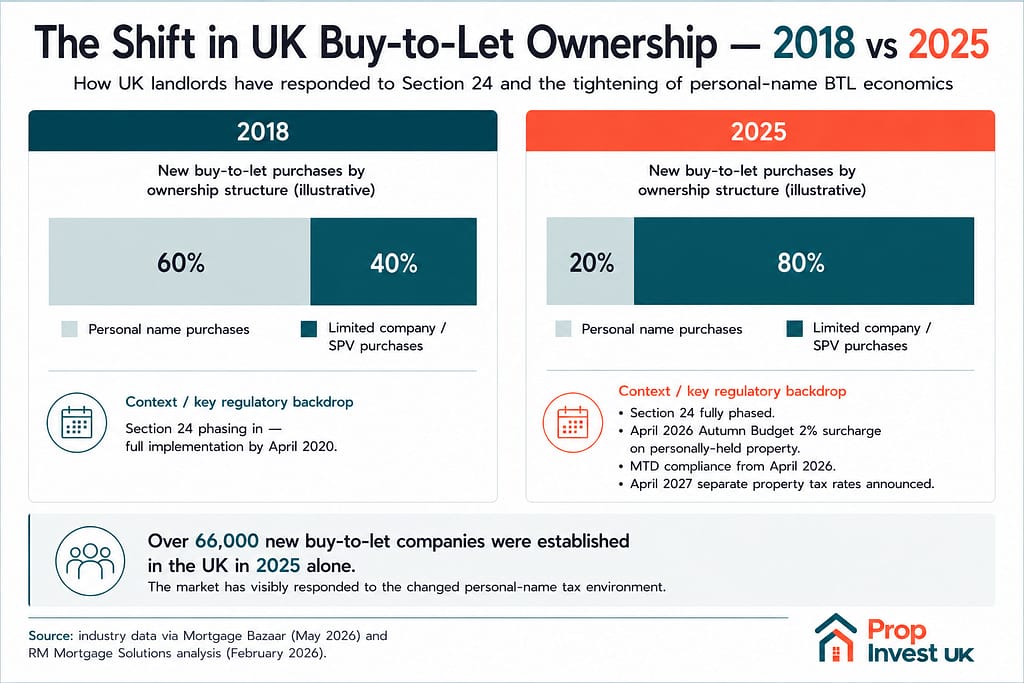
The headline catalyst was Section 24 of the Finance Act 2015, fully phased in by April 2020, which restricted mortgage interest relief for individual landlords to a 20% basic-rate tax credit rather than full deduction (📊 source: HMRC, Finance Act 2015 commencement schedule). For higher-rate and additional-rate taxpayers, this materially compressed the post-tax return on personally-held leveraged property.
The Autumn Budget 2025 introduced a further 2% rental profit tax surcharge on personally-held residential property, applying from the 2026-27 tax year (📊 source: HM Treasury, Autumn Budget 2025). From April 2026, Making Tax Digital for Income Tax has applied to landlords with property income above the threshold, increasing the compliance burden on individual ownership. From April 2027, property income is scheduled to be taxed at separate rates from general income (22% basic / 42% higher per the most recent HMRC guidance), further changing the calculation (📊 source: Property Tax Partners, April 2026 commentary).
The market has responded clearly. Approximately 80% of new UK buy-to-let purchases in 2025 were made through limited company structures rather than personal name (📊 source: RM Mortgage Solutions analysis, February 2026). Mortgage Bazaar reported over 66,000 new buy-to-let companies established in the UK in 2025 alone (📊 source: Mortgage Bazaar, May 2026).
That market shift is the structural backdrop to this article. The dominant ownership model is moving — and the structures that were typical five years ago are not necessarily the structures that fit the current tax environment. Whether the shift makes sense for any specific investor depends on their individual position.
Personal name ownership
Holding property in your own name remains the simplest UK ownership structure. The property is in the investor’s personal title; rental income is taxed as personal income; mortgage interest is restricted under Section 24; profits flow directly to the individual.
Where personal ownership typically suits. Basic-rate taxpayers with modest portfolios and low gearing. Cash purchases (where Section 24 doesn’t apply because there is no mortgage interest). Investors holding very small numbers of properties where the administrative simplicity outweighs the tax inefficiency. Long-held properties already in personal name where the cost of restructuring (SDLT on transfer to a company, CGT on disposal) would exceed the future tax savings.
Where personal ownership typically becomes inefficient. Higher-rate and additional-rate taxpayers with leveraged property. Portfolios of more than a small number of properties. Investors with significant other income where the marginal rate on rental profit reaches 40% or 45%. Situations where Section 24’s restriction of mortgage interest relief produces a meaningfully higher tax bill than corporation tax would on the same gross profit.
The transfer trap. Investors who already hold property personally and consider moving it into a limited company face two upfront costs: Stamp Duty Land Tax on the market-value transfer (treated as a sale to the company) and Capital Gains Tax on any uplift since acquisition. For many established landlords, these upfront costs make incorporation of existing portfolios uneconomic, even where future ownership in a company would be more tax-efficient on a forward basis. This is exactly the kind of decision that needs qualified tax advice before any action.
Limited companies and SPVs
A limited company — often set up as a Special Purpose Vehicle (SPV) for property investment — is now the dominant structure for new UK buy-to-let purchases. An SPV is a limited company incorporated for the specific purpose of holding or transacting in property, typically using a narrow set of Companies House SIC codes (68100, 68209, 68320) that lenders recognise.
The structural features. Corporation tax on profits (19% on profits below £50,000, 25% on profits above £250,000, with marginal relief between). Full deduction of mortgage interest as a business expense — Section 24 does not apply. Profits can be retained inside the company for reinvestment without triggering personal income tax. Limited liability separates the investor’s personal assets from company liabilities. Shareholder arrangements create flexibility for bringing in family members, partners, or external capital.
The trade-offs. Profit extraction triggers additional tax — dividends are taxed at 10.75% (basic), 37.5% (higher), and 39.35% (additional) from April 2026 (📊 source: HMRC dividend tax schedule, 2026-27). SPV mortgages have historically carried a roughly 1% rate premium over personal BTL mortgages, though the gap has narrowed in 2026 as the company-BTL lending market has deepened. Annual Tax on Enveloped Dwellings (ATED) applies to companies holding residential property worth over £500,000, though most BTL companies claim property rental business relief which reduces ATED to nil if the property is commercially let at full market rent.
Where limited companies typically suit. Higher-rate and additional-rate taxpayers with leveraged property. Investors building portfolios where retained profits will be reinvested rather than drawn personally. Long-term holds where the upfront SDLT cost of company purchase is recovered over time through annual tax savings. Investors who want clearer governance, separation of personal affairs, or a vehicle that can take external capital partners.
Where limited companies typically don’t suit. Investors who need all rental profit drawn personally each year (the combined corporation tax plus dividend tax can exceed personal income tax for basic-rate taxpayers). Existing personally-held portfolios where the cost of transferring in would outweigh the future tax saving.
Important note on lender requirements. Lenders typically require SPVs rather than trading companies for BTL mortgage applications, and require specific SIC codes to be registered. Setting up a property limited company without specialist mortgage advice can result in a structure that’s not lendable for the intended purpose.
Partnerships and LLPs
Partnerships are structures where two or more individuals or entities hold and manage property jointly. UK property partnerships come in two main forms.
General partnerships. Profits flow through to the individual partners and are taxed personally according to each partner’s share. Each partner is jointly and severally liable for partnership obligations. No formal incorporation; flexibility on profit allocation; can be structured between spouses, family members, or business associates.
Limited Liability Partnerships (LLPs). A formal incorporated structure registered at Companies House, providing limited liability protection while retaining partnership-style tax treatment (profits flow through to partners individually). More formal documentation requirements than a general partnership; specific lender treatment that varies by lender.
Where partnerships typically suit. Spousal arrangements where one partner is a basic-rate taxpayer and the other is higher-rate — allocation of profits between partners can produce efficient outcomes. Family arrangements involving multiple generations. Some development joint ventures where parties bring different contributions (capital, expertise, sourcing).
The structural weakness. Partnerships depend heavily on the partnership agreement. Without a properly drafted agreement covering profit shares, decision-making, exit, dispute resolution, and liability, partnerships can become problematic precisely when projects encounter friction. LLP lending appetite varies by lender and transaction type, and some lenders prefer SPVs to LLPs for BTL specifically.
For partnership structures, a property solicitor’s input on the partnership or LLP agreement is not optional — it’s the document that determines how the structure behaves under pressure.
Trusts and inheritance planning structures
Trusts sit in a different category from the operating structures above. They are typically used for asset protection, succession planning, and managing how property-backed wealth passes between generations, rather than for day-to-day rental income optimisation.
The main categories used in UK property. Bare trusts (where the trustee holds property for a beneficiary with no discretion). Interest in possession trusts (where a beneficiary has a right to income from the property). Discretionary trusts (where trustees have discretion over distributions to a class of beneficiaries). Each has different tax treatment for income, capital gains, and inheritance tax purposes.
Where trust structures are typically considered. Inheritance tax planning for substantial property estates. Multi-generational wealth transfer where control of the asset needs to remain separate from beneficial ownership. Protection of property assets from specific risks. Structures involving minor beneficiaries.
Important position. Trusts are not a casual tax-saving device. They involve specific legal frameworks, ongoing administration, and tax treatments that depend heavily on the trust type and the trustee/beneficiary structure. They are also under continued HMRC scrutiny on inheritance and capital gains tax treatment. Trust structures should only be set up after specialist legal and tax advice — typically from a chartered tax adviser and a private client solicitor.
For the majority of mainstream property investors, a trust is not the starting point. It is a specialist tool used for a specific reason and only after qualified professional advice.
Joint ventures, syndicates, and nominee arrangements
Joint ventures in UK property typically involve two or more parties contributing different elements to a single project — most commonly, one party brings capital and another brings sourcing and operational delivery. JV structures can be set up as limited companies (with shareholders), LLPs, or as contractual arrangements between separate vehicles.
Where JV structures typically work. Development projects where a capital partner participates alongside an operating developer. Family arrangements where one party has capital and another has time. Acquisitions where one party has sourcing access and another has funding capacity.
Where JV structures typically fail. Vaguely documented arrangements without proper shareholders’ agreements, defined decision rights, reporting standards, or exit mechanics. JVs that rely on informal understanding rather than legal documentation tend to surface problems exactly when external pressure (cost movement, planning delay, market shift) is highest.
A separate category is nominee arrangements, where legal ownership of property is held by one party (the nominee) on behalf of the beneficial owner. These have legitimate uses in property transactions but require careful documentation, including declarations of trust. Nominee structures should never be set up without legal advice from a property solicitor.
For investors considering a JV or partnership-style arrangement with an experienced operator, the relevant questions are structural rather than financial: what’s the legal vehicle, what’s the shareholders’ or partnership agreement, what are the decision rights, how is reporting handled, and what’s the exit mechanism. Those are the same questions any well-structured operator-led arrangement should be able to answer in documents, not in conversation.
The questions to take to your professional advisers
This article is overview, not advice. The right structural questions to take to a qualified accountant, tax adviser, or property solicitor — informed by reading articles like this one — typically include:
- What’s my current marginal tax rate, and how does that change the personal-vs-company calculation for my situation?
- What’s my expected portfolio size and growth trajectory, and how does that affect which structure makes sense?
- Will I need to extract rental profits personally each year, or can profits be retained for reinvestment?
- What’s my existing position — am I structuring a fresh acquisition, or considering moving existing properties into a different vehicle?
- What are the upfront costs of any restructuring (SDLT, CGT, professional fees), and over what period would the future tax saving recover them?
- How does inheritance tax planning interact with the choice of structure?
- What’s my lender’s position on the structure I’m considering — particularly if SPV, LLP, or trust?
- If I’m considering a joint venture or capital partnership, what documentation governs my position and what protections does it provide?
These are the questions a qualified professional will work through with you against your specific circumstances. The answers will produce a structural recommendation that fits your position — which is, by definition, something this article can’t provide because it doesn’t know your circumstances.

How Prop Invest UK fits
Prop Invest UK works with investors who participate as capital partners in UK property development projects sourced and delivered by an experienced developer. The structures we use for those partnerships are project-specific and documented to a standard appropriate for sophisticated capital — but the investor’s own holding structure (whether they participate personally, through a limited company, through a SSAS pension, or through another vehicle) is a decision for them and their advisers, not for us.
What we can do is provide the project-side documentation that a qualified adviser needs to assess how a specific opportunity would interact with the investor’s existing position. What we don’t do is advise investors on which structure to use — that’s a regulated activity, and the right place for that conversation is with a chartered tax adviser or property solicitor who has reviewed the investor’s full position.
If you’re considering UK property as part of a wider capital strategy, the most useful sequence is usually: get your structural advice from qualified professionals first; then assess specific opportunities against the structure you’ve decided on. Doing it the other way round tends to produce structural decisions made under deal pressure, which is rarely the best context for them.
—
About Prop Invest UK
Prop Invest UK is a property development business working with investors who want exposure to UK property development without taking on operational delivery themselves. Each opportunity is sourced, structured, and delivered by an experienced developer, with investors participating as capital partners on a deal-by-deal basis.
Join the investor list to receive details of future opportunities as they become available, subject to investor qualification and project documentation.
—
This article is for general information purposes only and does not constitute financial, tax, or legal advice. It is an overview of UK property investment structures and the 2026 tax environment, not a recommendation as to which structure any specific investor should use. The choice of ownership structure for property investment has significant tax, legal, and financial consequences and should only be made after taking advice from a qualified chartered accountant or tax adviser, and where appropriate a property solicitor, who has reviewed your full personal and financial circumstances. Tax rates, allowances, and regulations referenced in this article are accurate as of the dates cited but are subject to change. UK property investment involves risk, including the risk of capital loss, and returns are not guaranteed. Past performance is not a reliable indicator of future results. Any specific investment opportunity is offered only to investors who qualify under the relevant exemptions and have received the full project documentation. If you are uncertain whether an investment is suitable for your circumstances, you should consult an FCA-authorised financial adviser.
—