
Introduction
To anyone outside property development, bridging finance sounds like a niche corner of UK lending. To anyone inside it, bridging finance is one of the engines that makes development work.
The UK bridging market reached a loan book of £13.4 billion in 2026 (Bridging Finance UK Guide, 2026). It funds auction purchases, site acquisitions, refurbishments, conversions, and the gaps between phases of a development project. Without bridging finance, much of the activity that creates value in UK property — buying awkward commercial buildings, converting them, refinancing onto longer-term debt — simply doesn’t happen.
For investors looking at development opportunities, understanding bridging finance matters for three reasons. It explains how developers actually fund the acquisition stage of a project. It tells you something about how a project’s cash flow works. And it lets you read a development appraisal critically, because bridging cost is a real line item that eats into the margin between purchase price and Gross Development Value.
This guide explains what bridging finance is, how it’s used in UK property development, what it costs in 2026, and how to evaluate its role in any development opportunity presented to you, especially in the context of bridging finance UK property. It’s written for investors evaluating UK property development opportunities — particularly those moving from buy-to-let or completed-asset investing into participating in development projects as capital partners.
What bridging finance actually is
A bridging loan is a short-term, property-secured loan used to bridge a temporary gap in funding. It’s secured against a property — either the one being acquired or another property the borrower owns — and is designed to be repaid within 1 to 24 months through a clearly defined exit strategy.
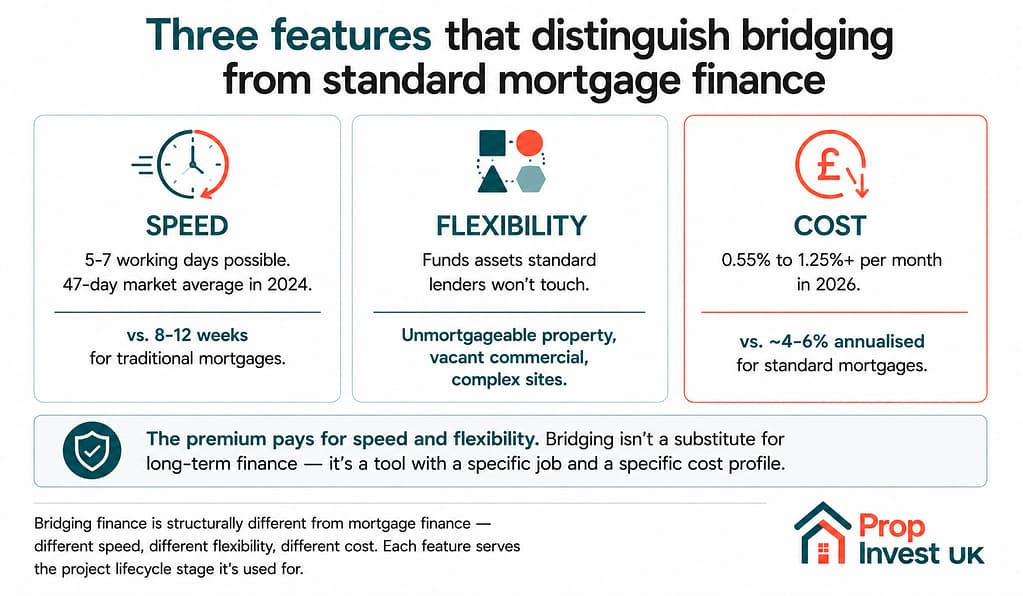
Three features distinguish bridging from a standard mortgage:
Speed. Bridging loans complete in days, not months. The fastest cases close in 5–7 working days. The market average in 2024 was 47 days, a 23% improvement on the 58-day average recorded in 2023 (FD Commercial, 2026). Traditional mortgages routinely take 8–12 weeks.
Flexibility. Bridging lenders will consider security types most high-street lenders won’t touch: unmortgageable properties, commercial buildings without leases in place, land with planning, mixed-use assets, properties needing significant refurbishment. The deal and the exit strategy carry more weight than the borrower’s profile.
Cost. Bridging is significantly more expensive than long-term finance. Rates are quoted monthly rather than annually, reflecting the short term. In 2026, market rates range from 0.55% per month for prime residential first-charge cases to 1.25%+ for complex commercial or second-charge transactions (Bridging Finance UK Guide, 2026).
A monthly rate of 0.75% equates to roughly 9% annualised — considerably higher than a standard mortgage. The premium pays for speed and flexibility. You wouldn’t use bridging for a 25-year hold; you use it for a 12-month project where time-to-complete is worth more than annual rate.
Why bridging exists in property development
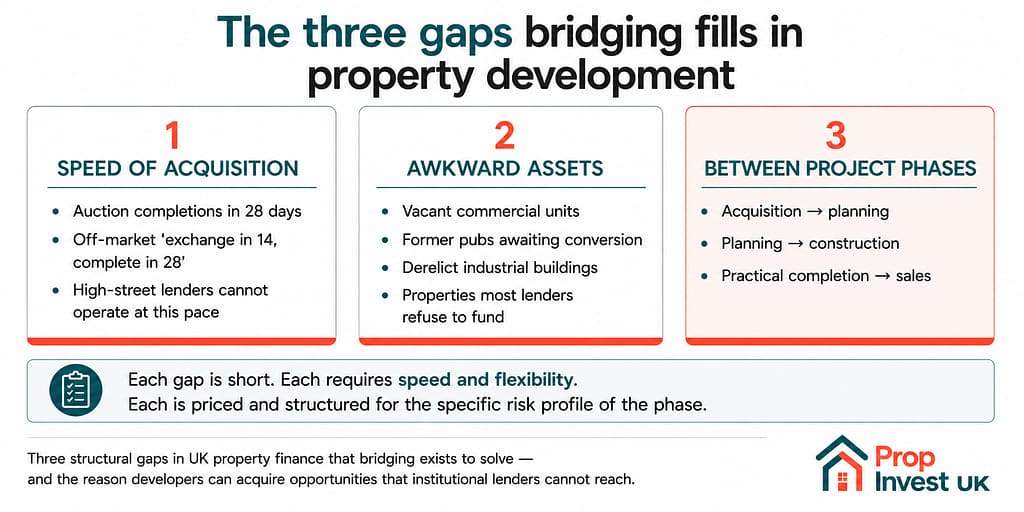
The property development cycle creates funding requirements that traditional lenders cannot or will not meet. Three of those gaps are why bridging exists in this market.
Gap 1: Speed of acquisition
A development site is often acquired through an auction or off-market transaction. Auction purchases require completion within 28 days. Off-market deals frequently come with a “exchange in 14, complete in 28” demand, because the seller has alternatives and won’t wait.
No high-street mortgage lender works at that pace. Bridging finance does. The developer secures the asset before another buyer can, using bridging to fund the purchase, then arranges longer-term finance or proceeds directly to development.
Gap 2: Properties that don’t fit standard lending criteria
A high-street commercial mortgage lender will fund a tenanted office block with a stable income stream. They will not fund a vacant commercial unit awaiting conversion, a former pub being repurposed, or a derelict industrial building needing significant capital works.
But those are exactly the kinds of assets where development value can be created. The “awkward” buildings most lenders won’t touch are often the most profitable to convert — precisely because demand from other developers is suppressed by the financing difficulty. Bridging lenders specialise in this segment, pricing for the risk and the short hold period.
Gap 3: Bridging between project phases
A typical development project moves through distinct phases — acquisition, planning, construction, sales — and each phase has different funding requirements. Bridging covers transitions:
- Acquisition bridge: Funds the site purchase, exits when planning is granted and development finance is drawn
- Refurbishment bridge: Funds light or heavy refurbishment, exits when the property refinances onto a buy-to-let mortgage or is sold
- Development exit bridge: Funds the gap between practical completion and final unit sales, allowing the developer to hold for the right price rather than discounting to clear
Each gap is short. Each requires speed and flexibility. Each is priced and structured for the specific risk profile of the phase.
How bridging is priced in 2026
Bridging loan rates are quoted as a monthly percentage of the loan balance. Pricing varies based on five factors:
1. Loan-to-value (LTV)
The single biggest driver of price. Most lenders operate tiered rate structures with defined bands at 60%, 65%, 70% and 75% LTV (FD Commercial, 2026).
A loan at 50% LTV attracts a substantially lower rate than the same loan at 70%. Most UK bridging lenders cap gross LTV at 75%, with lower limits for land (typically 55–60%) and commercial property.
2. Asset type
Residential security carries the lowest risk and the sharpest rates. Mixed-use property attracts a modest premium. Commercial and semi-commercial property carries higher rates because it has a smaller buyer pool and longer exit timelines. Land without planning permission commands the highest rates, typically 0.3% to 0.5% per month more than residential (FD Commercial, 2026).
3. Exit strategy quality
The exit — how the loan will be repaid — is the most important factor in any bridging application. Lenders assess this above everything else.
A strong property with a weak exit will not get funded. A 2026 underwriting shift: lenders now require evidence-based exit planning rather than narrative. They want comparable sales data, rental income projections, or confirmation of a mortgage in principle — not just a stated intention (Bridging Finance UK Guide, 2026).
4. Regulated vs unregulated
Regulated bridging loans, governed by the FCA under the Mortgage Credit Directive, apply when the loan is secured against a property the borrower lives in or intends to live in. Unregulated loans cover investment property, commercial assets, development land, and buy-to-let — and are not subject to FCA consumer credit rules.
Most bridging in property development is unregulated, because it’s secured against investment or commercial assets, not the developer’s home. Regulated loans tend to price slightly higher than unregulated for equivalent scenarios, reflecting the additional compliance burden.
5. Charge position
A first charge loan is secured directly against the property with no other lender having a prior claim. A second charge sits behind another lender. Second charge bridging rates typically run 0.1% to 0.3% per month higher than equivalent first charge, reflecting the additional risk (UK Broker, 2026).
What this means in numbers
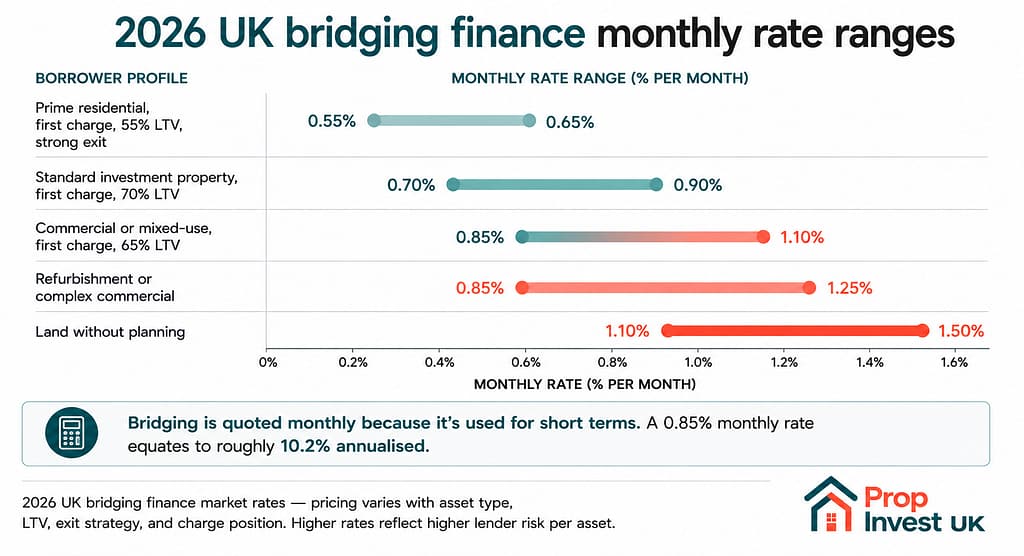
For a typical UK property development scenario in 2026:
| Profile | Monthly Rate |
|---|---|
| Prime residential, first charge, 55% LTV, strong exit | 0.55% – 0.65% |
| Standard investment property, first charge, 70% LTV | 0.70% – 0.90% |
| Commercial or mixed-use, first charge, 65% LTV | 0.85% – 1.10% |
| Refurbishment or complex commercial | 0.85% – 1.25% |
| Land without planning | 1.10% – 1.50% |
On a £500,000 bridging loan at 0.85% per month over 12 months on a rolled-up basis (interest compounds), the interest alone is approximately £53,400. Add an arrangement fee of 1.5–2% (£7,500–£10,000), valuation costs (£500–£1,500), and legal fees (typically £2,000+), and the total finance cost of a 12-month bridge can run to 12–15% of the loan amount.
This is why bridging is not a substitute for long-term finance. It’s a tool with a specific job and a specific cost profile.
How interest is structured
Bridging interest can be structured in three ways, and the choice has a meaningful effect on the project’s cash flow:
1. Serviced (monthly) Interest is paid each month from the borrower’s own cash flow, like an interest-only mortgage. Most affordable structure, but requires the borrower to have monthly income or capital to service it.
2. Retained The lender deducts the full term’s interest from the loan advance at drawdown. Borrower receives the loan net of interest. No monthly payments to make, but the net advance is lower than the headline loan amount.
3. Rolled-up Interest accrues against the loan balance each month and is repaid in full when the loan is redeemed. The balance grows over the term. Most common structure for development bridging because the project typically doesn’t generate income during the bridge period.
The effective cost of rolled-up interest is higher than the headline rate suggests, because each month’s interest accrues on a larger base than the previous month. A 12-month loan at 0.85% per month with rolled-up interest produces an effective annual rate above 10.2%, not exactly 10.2%, because of compounding (FD Commercial, 2026).
For investors reading a development appraisal, the interest structure tells you something about the project’s cash flow assumptions. Rolled-up interest is normal in development. Serviced interest implies the project has income during the bridge term — which is rare on a conversion or ground-up project, but common on a refurbishment with continuing rental income.
How bridging is used at each stage of a development project

Bridging plays a different role at different points in a project’s lifecycle. Understanding which type of bridge is being used tells you which phase the project is in and which risks are being financed.
Stage 1 — Acquisition bridging
The most common use of bridging in UK property development. Funds the site purchase before any value-creation work has begun.
The typical scenario: a developer identifies an opportunity — a vacant commercial building, an unmortgageable property, an off-market site — that requires fast completion. Bridging funds the acquisition at 65–75% LTV. The exit is either (a) refinancing onto development finance once planning is granted, (b) selling the site with planning consent for an uplift, or (c) refurbishing and refinancing onto a long-term mortgage.
For an investor evaluating an opportunity, acquisition bridging on the appraisal means the developer hasn’t yet drawn longer-term finance. Planning risk, valuation risk, and exit risk all remain live.
Stage 2 — Refurbishment bridging
Used for light to heavy refurbishment of an existing property. Light refurbishment covers cosmetic upgrades — kitchens, bathrooms, redecoration. Heavy refurbishment includes structural work, layout changes, and significant capital expenditure.
A significant portion of bridging loan volume in 2026 is being driven by the urgent need for EPC (Energy Performance Certificate) compliance upgrades across buy-to-let portfolios. Bridging finance is being used to fund light and heavy refurbishments, with the exit either via a buy-to-let remortgage or sale once works are complete (Bridging Finance UK Guide, 2026).
Stage 3 — Conversion bridging
A specific case for commercial-to-residential conversions, often using Permitted Development rights (Class E to Class MA). Bridging funds the acquisition and the conversion works, exiting on sale of the completed units or refinance onto a long-term facility.
This is where many of the highest-margin opportunities in UK development sit. The UK planning system’s Permitted Development rights allow conversion of certain commercial properties to residential use without full planning application, compressing the planning timeline and reducing one of the largest project risks (Bridging Finance UK Guide, 2026).
Stage 4 — Development exit bridging
Used at the end of a development project. Practical completion has been achieved, units are ready to sell, but sales velocity is slower than expected. Development finance facilities typically have a hard end date — extending them is expensive and sometimes impossible.
A development exit bridge refinances out of the development facility onto a 12–18 month bridging loan, allowing the developer to hold completed stock for the right price rather than discounting to clear. Development exit finance has become a strategic lifeline in 2026, allowing developers to avoid distressed sales and hold for the right price while recycling equity into new acquisitions (LendInvest, 2026).
For an investor, the presence of a development exit bridge on an appraisal is a sign of a developer managing risk actively — not a sign of distress. Distressed positions are forced sales, not deliberately structured exit finance.
How to read bridging finance on a development appraisal
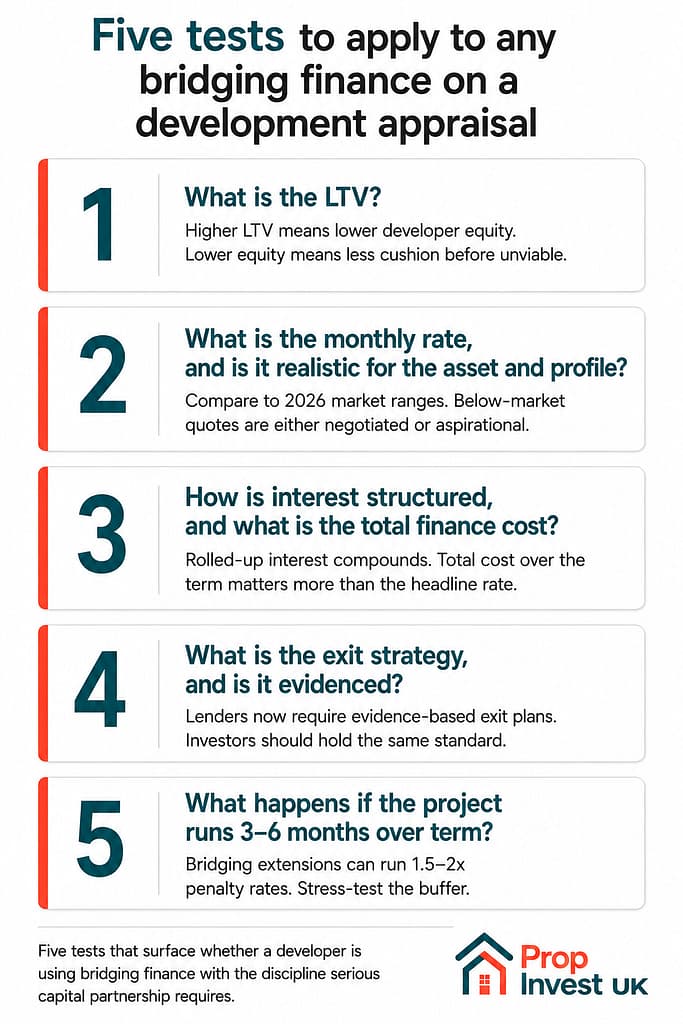
When evaluating a development opportunity, the bridging finance line is one of the most important sections of the appraisal. Five tests to apply:
Test 1: What is the LTV?
The bridging LTV tells you how much equity the developer (and capital partners) have committed to the deal. A 75% LTV bridge means 25% of the property value is funded by equity. A 60% LTV bridge means 40% is equity.
Higher equity contributions generally signal lower risk — the developer has more skin in the game and more cushion before the project becomes unviable. Lower equity contributions can be appropriate where the development margin is strong, but they leave less room for error.
Test 2: What is the monthly rate, and is it realistic?
Compare the quoted rate to the 2026 ranges above. A rate well below market for the asset type and LTV is either (a) a brokered relationship advantage worth understanding, or (b) wishful pricing that won’t survive the actual lender’s offer. Ask which lender, ask whether terms are sheeted.
Test 3: How is interest structured?
For a development project with no rental income, rolled-up interest is normal and expected. Check the total finance cost over the full term — that’s the number that matters to project economics, not the headline monthly rate.
Test 4: What is the exit strategy?
The exit is what the lender cares about, and it’s what an investor should care about too. Acceptable exits in 2026 include:
- Sale of the secured property
- Refinance onto a buy-to-let or residential mortgage
- Development exit finance
- Bridge-to-Let products
- Commercial refinance
A weak or undocumented exit is the single biggest risk in any bridging-funded project. Lenders now require evidence-based exit planning, not narrative — and investors should hold the same standard.
Test 5: What happens if the project runs over term?
Bridging loans are short by design — 12 to 24 months. If the project doesn’t exit within the term, extensions are possible but expensive. Penalty rates can be 1.5–2x the standard monthly rate. Some lenders will refuse to extend at all.
A robust project appraisal should include a stress test showing what happens to investor returns if the bridge runs 3–6 months over plan. Projects without that buffer are betting on perfect execution.
The structural shifts in UK bridging in 2026
Three changes in the 2026 bridging market matter for how development projects are being structured.
1. Exit viability is now the primary underwriting consideration
With interest rates stabilising at higher levels and the buy-to-let mortgage market more constrained, exit viability has become the primary underwriting consideration (LendInvest, 2026).
Lenders are pricing for the certainty of repayment, not just the security of the asset. This rewards developers with clear, evidenced exit plans and pricing realistic to the current sales market — and penalises those still working from 2021-vintage assumptions.
2. Bridge-to-Let products are mainstreaming
A Bridge-to-Let approach secures an exit at the same moment the bridge is initiated, eliminating “exit anxiety” and locking in the post-development financing structure from day one (LendInvest, 2026).
For projects where the end position is a held rental asset rather than a sale, this is now standard practice and a sign of a developer thinking about the full lifecycle of the project, not just the bridge phase.
3. Commercial-to-residential conversions remain a high-yield frontier
Permitted Development rights continue to make commercial-to-residential conversion one of the most active segments of the development market. Underused secondary commercial assets are being revitalised into modern residential units through compressed planning timelines.
This is the segment where bridging finance, value creation through planning and conversion, and investor returns intersect most directly. It’s also the segment most aligned with how we structure projects at Prop Invest UK.
How we use bridging at Prop Invest UK
At Prop Invest UK, bridging finance is part of how we acquire and develop projects — but it’s a tool, not the strategy.
Every project we structure for capital partners has a clearly modelled finance plan that includes:
- The bridging facility (lender, amount, LTV, rate, term)
- The total interest cost over the planned term
- The exit strategy with supporting evidence (comparables for sales exits, mortgage in principle for refinance exits)
- Stress tests showing the impact on investor returns if the bridge runs 3–6 months over plan
- The transition to long-term finance where the project holds completed units
The bridging line on any project we present to capital partners is fully transparent — what it is, what it costs, what risk it carries, and how the project survives if it doesn’t exit on schedule.
Bridging finance done well shortens timelines and unlocks opportunities. Bridging finance done badly amplifies every other risk in the project. Knowing the difference is part of how a developer earns the right to manage other people’s capital.
In summary
Bridging finance is a short-term, asset-secured loan used to bridge funding gaps in property transactions. In UK property development, it funds site acquisitions, refurbishments, conversions, and the transitions between project phases.
It costs more than long-term finance because it offers speed and flexibility that long-term finance cannot. Rates in 2026 range from 0.55% per month for prime cases to 1.25%+ for complex commercial or land-without-planning scenarios. LTVs typically run to 70–75% on residential, lower on commercial and land.
For investors evaluating development opportunities, the bridging finance section of an appraisal is one of the most informative. It tells you which phase of the project is being financed, what the developer is paying for speed and flexibility, how the project plans to exit the bridge, and what happens if that exit takes longer than planned.
The five questions to ask of any bridging finance on a development appraisal:
- What is the LTV?
- What is the monthly rate, and is it realistic for the asset and profile?
- How is interest structured, and what is the total finance cost?
- What is the exit strategy, and is it evidenced?
- What happens if the project runs 3–6 months over term?
A developer who can answer those five with detail is operating with the discipline the current market requires. One who can’t, isn’t.
If you want to receive analysis of current UK development opportunities — including the finance structure, exit strategy, and stress-tested return profile of specific projects — you can join the Prop Invest UK investor list. We share specific opportunities with capital partners on the list as they come to market.
This article is general information only and is not financial advice. Bridging finance and UK property development carry risk; capital is at risk. Rates and terms referenced reflect general market conditions at time of writing and vary by lender, asset type, LTV, and exit strategy. Specific project finance structures should always be evaluated with appropriate professional advice.