
For thirty years, buy-to-let was the default route into UK property investment. Buy a residential property, mortgage it at 75%, let it to a tenant, collect rent, wait for the market to deliver capital appreciation. Simple, scalable, profitable, and accessible to anyone with a deposit and a borrowing capacity.
That model is structurally broken in 2026. Section 24 has dismantled the tax efficiency of leveraged BTL. EPC C by October 2030 has imposed compliance costs that erode net yield. The Renters’ Rights Act has removed Section 21 and made tenancy management materially harder. Making Tax Digital has added administrative burden. The 5% SDLT surcharge has made acquisition substantially more expensive. The combined effect: many UK landlords are quietly exiting the model, and the question for serious property capital is what to do instead.
This guide explains why traditional buy-to-let no longer works the way it did a decade ago, why commercial-to-residential conversion (delivered through capable operators) sits on structurally different ground, and what the two routes look like compared side-by-side in 2026 conditions.
The buy-to-let model that built UK property wealth — and why it’s broken now
For most of the 1990s, 2000s, and into the 2010s, the leveraged BTL model worked through a specific combination of features that no longer exist together in 2026.
1. Full mortgage interest deduction. Landlords could deduct 100% of mortgage interest from rental income before calculating taxable profit. A higher-rate taxpayer with £18,000 of rent and £9,000 of mortgage interest paid tax on £9,000 of profit — straightforward business expense treatment.
2. Section 21 “no-fault” possession. Landlords could regain possession of their property with two months’ notice for any reason. Tenancy management was relatively predictable.
3. Lower stamp duty. No 5% surcharge on additional properties. The acquisition cost of building a portfolio was materially lower.
4. Stable EPC requirements. Properties needed an EPC rating of E or above to be legally let. Most rental stock met the standard without significant capital investment.
5. Rising property values. Most years between 1995 and 2007, and again between 2013 and 2022, delivered natural appreciation that compounded leveraged equity returns.
Each of these features has now been removed, weakened, or reversed. Combined, they fundamentally change the economics of leveraged BTL ownership.
What’s actually changed for BTL investors in 2026
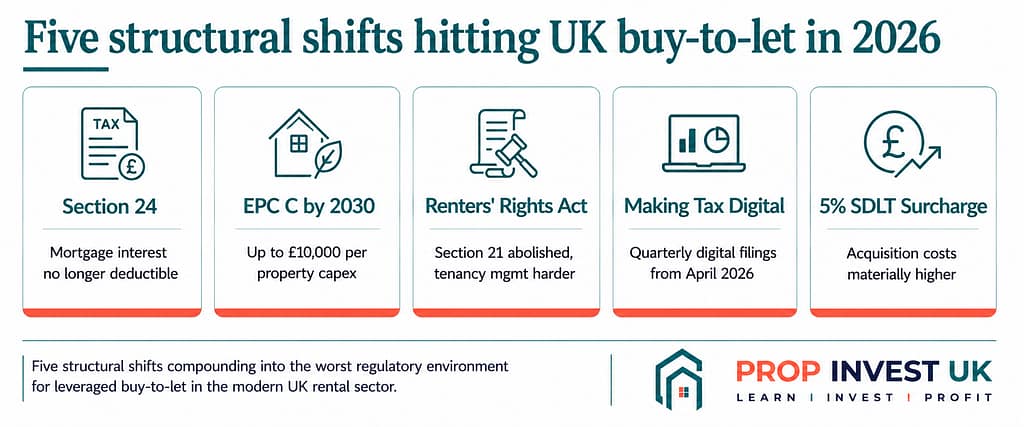
Five structural shifts have hit the BTL model in the last decade, and most of them have hit hardest in the period since 2020. The combined effect is a sector that looks superficially similar to a decade ago but produces materially different economics for individual landlord ownership.
1. Section 24 — full mortgage interest restriction (since April 2020)
Section 24 of the Finance (No 2) Act 2015 removed the ability for individual residential landlords to deduct mortgage interest from rental income before calculating taxable profit. It was phased in from April 2017 and fully in force from April 2020 (Property Passport UK, 2026).
Mortgage interest is now replaced by a 20% basic rate tax credit. For higher-rate taxpayers, this is a substantial increase in real tax burden.
The worked example most often cited: a higher-rate (40%) taxpayer with £18,000 of annual rent and £9,000 of mortgage interest. Under the old system, they paid tax on £9,000 of profit — £3,600 of tax (40% × £9,000). Under Section 24, they pay tax on the full £18,000 of rental income (£7,200 at 40%) minus a 20% credit on the £9,000 of mortgage interest (£1,800 credit) — a net tax bill of £5,400. A 50% increase in tax burden on the same actual cash flow.
There’s a worse secondary effect. Because mortgage interest is no longer removed from income before calculating tax band, Section 24 pushes landlords into higher tax brackets even when their actual income hasn’t changed. A basic-rate taxpayer can become a higher-rate taxpayer for Section 24 purposes alone, paying additional tax on income they never received as profit.
The structural implication: leveraged BTL ownership in an individual name is now materially less tax-efficient than it was a decade ago — particularly for higher and additional-rate taxpayers.
2. EPC C by October 2030 — the £10,000 (or £30,000) bombshell
The Department for Energy Security and Net Zero confirmed in February 2026 that all privately rented properties in England and Wales must achieve an EPC rating of C by 1 October 2030. Non-compliance penalties have risen to £30,000 per property — up from £5,000 previously (EPC Advisor, 2026; LandlordZONE, 2026).
The cost cap per property is £10,000 (or 10% of property value for properties under £100,000). Government impact assessments estimate average per-property spend at £5,400-£6,800 (Home Owners Alliance, 2026).
For a portfolio landlord with 10 properties, that’s potentially £54,000-£68,000 of capital expenditure required by October 2030, none of which produces meaningful additional rental income. For properties that can’t achieve EPC C even after the cost cap is reached, the landlord can register an exemption — but the exemption needs renewing, and the property will remain a compliance vulnerability indefinitely.
The structural implication: portfolio landlords are looking at substantial capital expenditure required over the next four years just to maintain the legal right to let.
3. Renters’ Rights Act — Section 21 abolition
The Renters’ Rights Act fundamentally changes UK tenancy law. The most significant change: the abolition of Section 21 “no-fault” possession, which previously allowed landlords to regain possession with two months’ notice for any reason.
Post-abolition, landlords must use specific Section 8 grounds to recover possession — selling the property, moving in, anti-social tenant behaviour, persistent rent arrears, and a narrow set of other grounds. Each ground has specific evidentiary requirements and court procedures, and contested cases can take significantly longer than the old Section 21 process.
Industry estimates suggest landlords now face approximately £3,000 in court fees and legal costs to evict problem tenants under the new framework (LandlordZONE, 2026).
The structural implication: tenancy management is materially harder and more expensive than it was, with longer hold periods on problem tenancies and reduced flexibility for landlords managing portfolio repositioning.
4. Making Tax Digital — administrative burden increasing
From 6 April 2026, landlords with combined gross income from rental properties and self-employment over £50,000 must use Making Tax Digital software, submitting quarterly digital updates to HMRC rather than annual tax returns (Landlord Studio, 2025; Propertymark, 2026).
The threshold reduces to £30,000 from April 2027 and £20,000 from April 2028 — capturing most active UK landlords within the next three years.
MTD adds quarterly digital filings, MTD-compatible software costs, and significantly more administrative work throughout the year compared to the previous annual tax return system.
5. 5% SDLT surcharge — acquisition cost squeeze
Additional properties (second homes, BTL purchases) attract a 5% SDLT surcharge on top of standard rates. On a £300,000 BTL acquisition, the SDLT bill is approximately £20,000 — money that previously could have been deployed into the deposit or improvements.
The combined effect: every BTL acquisition is more expensive at the front end, every operating year is more tax-burdened, every property needs EPC investment over the next four years, every tenancy is harder to manage, and every accounting cycle requires more administrative work.
The structural maths — what BTL actually delivers in 2026
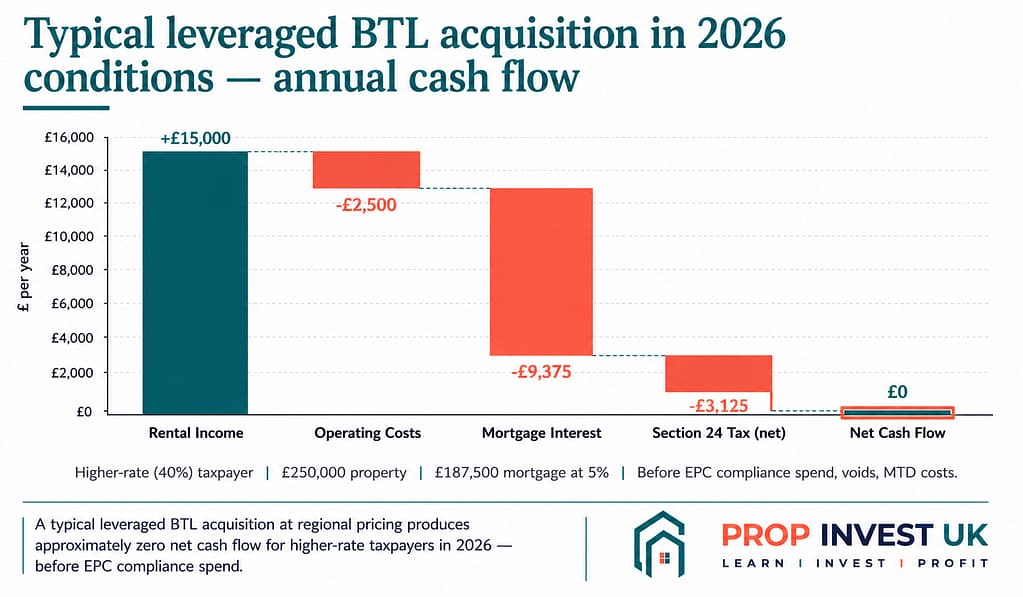
Run the numbers on a typical BTL acquisition in 2026 conditions.
The deal:
- Acquisition: £250,000 (typical regional residential property)
- SDLT (with 5% surcharge): £10,000
- Mortgage: £187,500 at 75% LTV
- Equity required (deposit + SDLT + fees): £75,000-£80,000
- Annual rent: £15,000 (£1,250/month — typical regional yield around 6% gross)
- Mortgage interest: £9,375 (at 5% rate)
The annual numbers (under Section 24):
- Rental income: £15,000
- Allowable costs (insurance, repairs, agents): £2,500
- “Profit” for tax purposes: £12,500 (mortgage interest not deductible)
- Tax at 40% (higher rate): £5,000
- 20% credit on mortgage interest: £1,875
- Net tax: £3,125
- Cash flow: £15,000 – £2,500 – £9,375 – £3,125 = £0
Before EPC compliance spend. Before voids. Before tenancy management costs under the new framework. Before MTD administrative costs. Before the £10,000 of likely EPC compliance spend required by 2030.
The honest assessment: a leveraged BTL acquisition in 2026 at typical regional pricing produces approximately zero net cash flow for a higher-rate taxpayer once Section 24 is fully applied. The model works only on capital appreciation — and capital appreciation depends on natural market movement, which is exactly the variable that became unreliable from 2022 onwards.
The investors who built portfolios in the 2000s and 2010s acquired their stock when the structural conditions were different. The investors looking at the same deals now in 2026 are buying into a fundamentally different economic model.
What commercial-to-residential conversion looks like as an alternative
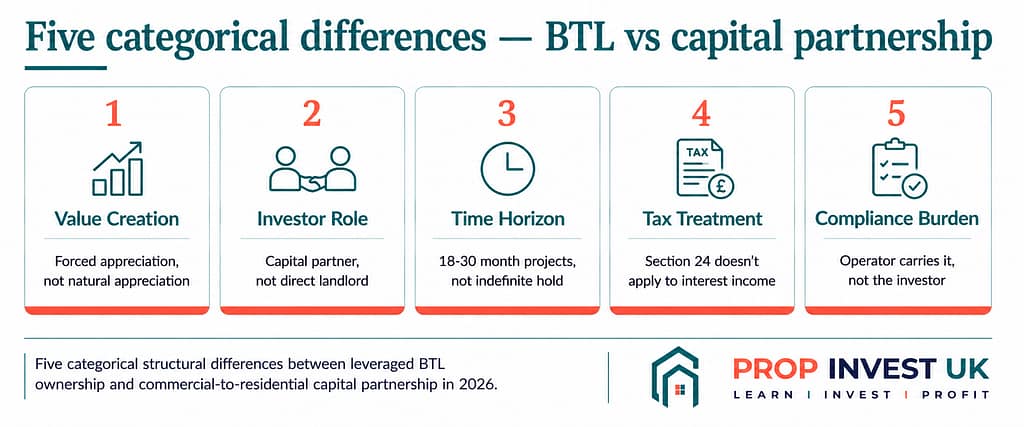
Commercial-to-residential development — delivered through capable operators with capital partner participation — sits on structurally different ground. The differences aren’t marginal. They’re categorical.
1. Forced appreciation, not natural appreciation
This is the central structural difference, and we covered it in detail in our forced appreciation article. BTL ownership depends on the market moving the property’s value upward over time. Development depends on the operator creating value through planning, conversion, density optimisation, specification, and repositioning.
A BTL property bought in 2026 and held for ten years might appreciate by 30-40% if the market cooperates, with that appreciation eroded by ongoing tax inefficiency, compliance costs, and tenancy friction. A commercial-to-residential conversion delivered in 18-30 months can produce 100-300% gross uplift before any natural market movement — as we documented at Gore Terrace (£411,000 acquisition to £1,225,000 valuation) and Mozarts (£625,000 acquisition tracking toward £2,480,000 GDV).
The investor isn’t dependent on the market for the return. The investor is dependent on the operator.
2. Capital partnership, not landlord ownership
In BTL, the investor is the landlord. They own the property, manage the tenancy (or pay agents to), handle the compliance, take the operational risk, and bear the regulatory exposure directly.
In commercial-to-residential capital partnership, the investor funds the operator who delivers the project. The operator handles the planning, the build, the contractors, the regulatory compliance, the tenancy or sale. The investor holds a contractually defined position — either a fixed-return loan or an equity stake — with structural protection (typically a second legal charge as we covered in our security article) and a defined exit horizon.
The investor isn’t dealing with broken boilers at 11pm. The investor is receiving structured returns from a position in the capital stack of a project they didn’t have to operate.
3. Fixed timeline, not indefinite hold
BTL is an indefinite-hold model. The capital sits in the property until the landlord chooses to sell — which, with CGT implications and a 5% SDLT cost to re-enter, creates significant friction around portfolio changes.
Commercial-to-residential capital partnership operates on defined timelines — typically 18-30 months from acquisition to capital return. Investors know when their capital is deployed, when it’s expected to return, and what the structural backstop is if the timeline extends. The capital is then redeployable into the next opportunity.
For investors who want active capital allocation across multiple projects rather than passive accumulation in a single asset, the defined-timeline structure is materially different.
4. Section 24 doesn’t apply to capital partnership returns
Section 24 applies to individual landlords letting residential property. It doesn’t apply to:
- Commercial property holders
- Properties held in limited companies (which pay corporation tax on net profit, with full finance cost deduction)
- Returns received from lending capital to property operators (which are interest income, not rental income)
- Returns held within pension structures like SSAS or SIPP (which are tax-exempt within the wrapper)
Capital partnership returns sit in different tax categories than BTL rental income. The Section 24 burden that erodes BTL cash flow doesn’t apply in the same way to investors providing capital to operators — and for SSAS-held capital like Jason’s structure (which we covered in our SSAS article), the returns accrue tax-free within the pension wrapper.
5. Compliance burden sits with the operator, not the investor
EPC C requirements, Renters’ Rights Act tenancy management, Making Tax Digital, property licensing, HMO regulation — all of these apply to the operator delivering and holding the property. The capital partner providing the funding doesn’t carry these compliance burdens directly.
This isn’t a marginal benefit. The operational reality of running a UK BTL portfolio in 2026 is materially more complex than it was a decade ago. Investors who want property exposure without operational complexity have a structurally clean route through capital partnership that BTL doesn’t offer.
The side-by-side comparison
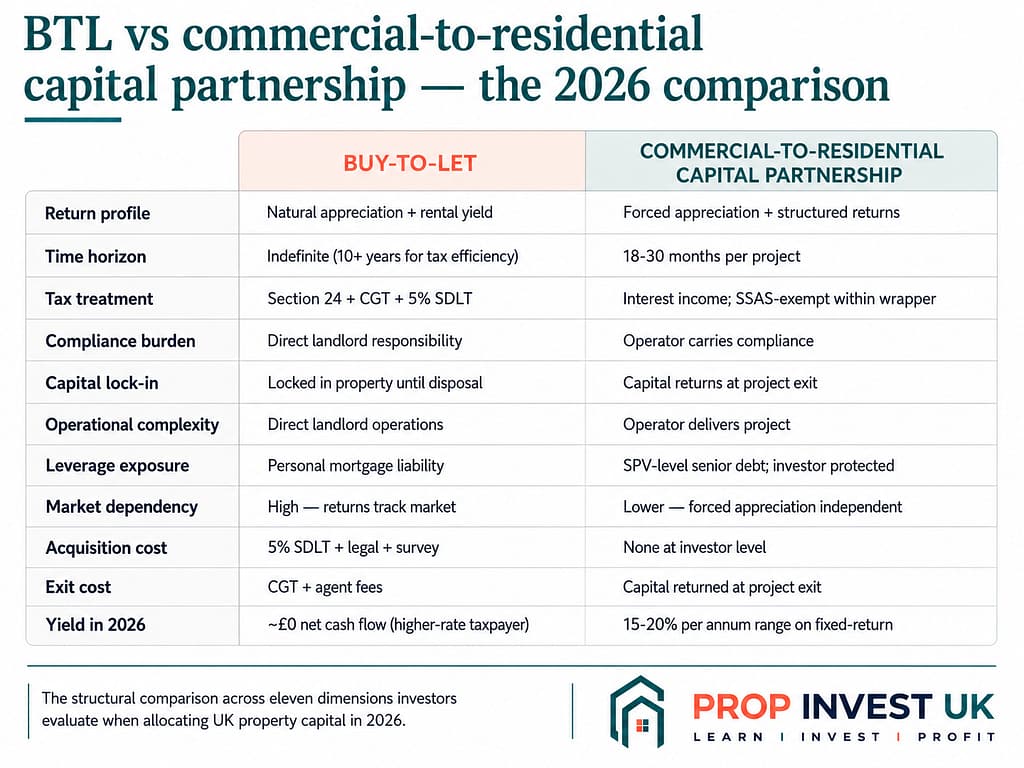
In 2026 conditions, here’s what the two routes actually look like across the dimensions investors care about.
| Dimension | Buy-to-Let | Commercial-to-Residential Capital Partnership |
|---|---|---|
| Return profile | Natural appreciation + rental yield | Forced appreciation + structured returns |
| Time horizon | Indefinite (effectively 10+ years for tax efficiency) | 18-30 months per project, then redeployable |
| Tax treatment | Section 24 + CGT on disposal + 5% SDLT on acquisition | Interest income / equity returns; SSAS-held capital exempt within wrapper |
| Compliance burden | Direct — EPC, MTD, Renters’ Rights, licensing, HMO regs | Operator carries the compliance |
| Capital lock-in | Locked in property until disposal | Defined timeline; capital returns at project exit |
| Operational complexity | Direct landlord responsibility | Operator delivers; investor receives structured returns |
| Leverage exposure | Personal — investor holds the mortgage | Senior debt held by operator’s SPV; investor’s position is structurally protected |
| Market dependency | High — returns depend on market direction | Lower — forced appreciation produces value regardless of market direction |
| Acquisition cost | 5% SDLT surcharge + legal + survey | None at investor level (operator handles SPV-level costs) |
| Exit cost | CGT on disposal + estate agent costs | Capital returned at project exit (interest accrued / equity share) |
| Yield comparison (current 2026) | ~£0 net cash flow on leveraged BTL for higher-rate taxpayer | Fixed-return ranges of 15-20% per annum on capital partnership structures |
The comparison isn’t ambiguous. For investors with capital to deploy and a preference for structured returns over operational complexity, the capital partnership route is categorically different from leveraged BTL ownership.
The exception: investors who want direct property ownership for non-financial reasons (legacy planning, family asset structure, personal involvement in property management) may still prefer BTL despite the structural headwinds. The model still works for some specific situations. It just doesn’t work as the default capital allocation route for serious property investors the way it did a decade ago.
Why landlords are quietly exiting BTL
The structural changes above explain why the UK private rental sector has seen sustained landlord exits since 2020 — particularly among individual portfolio landlords with leveraged positions.
Three patterns dominate.
Pattern 1 — Selling and stepping out entirely. Landlords who built portfolios in earlier conditions are taking the capital gains tax hit on disposal, paying down debt, and exiting property entirely. The capital goes to other asset classes, lifestyle spending, or family wealth distribution.
Pattern 2 — Incorporating into a limited company structure. Properties transfer (with SDLT and CGT consequences) into a limited company that pays corporation tax on net profit, restoring full finance cost deduction. This is operationally and administratively complex, and the entry cost is substantial — but for landlords with significant existing portfolios, the long-term economics often work.
Pattern 3 — Moving capital into property development capital partnership. The route that fits investors who want continued property exposure without the operational complexity and tax burden of direct BTL ownership. Capital is recycled out of BTL holdings and into participation in development projects where the operator handles the work and the investor receives structured returns.
The investors who participate in our projects — including Raf, Jason, and Glenn whom we’ve featured across the case study material — typically have a BTL background. They understand property economics; they just no longer want to be active landlords in the 2026 regulatory environment.
For the 2026 BTL investor reading this article and recognising the pattern, the question isn’t whether to leave BTL — it’s where to redeploy the capital.
What capital partnership in 2026 actually offers
Three structural features distinguish capital partnership in UK property development from leveraged BTL ownership in 2026 conditions.
1. Structured returns with defined exits
Capital partnership returns are contractually defined — typically as fixed-return loans at agreed rates with defined terms, or equity stakes with defined distribution waterfalls. The investor knows what they’re getting and when. BTL cash flow depends on tenants paying, voids being managed, and compliance not biting — none of which is contractually defined.
2. Operator-led delivery, investor-led capital
The operator handles the operational complexity. The investor provides the capital. Each party plays to their structural strengths — the operator has the planning expertise, the contractor relationships, the regulatory knowledge; the investor has the capital that funds the activity.
For investors whose comparative advantage is capital allocation rather than operational property management, this division of responsibilities produces materially better outcomes than trying to run BTL portfolios solo.
3. Tax efficiency through structure choice
Returns earned through capital partnership are interest income (for fixed-return positions) or equity returns (for equity positions). Neither is affected by Section 24 in the way BTL rental income is.
For investors with SSAS or SIPP-held capital, the returns accrue tax-free within the pension wrapper — a structural feature impossible to replicate with direct BTL ownership. Jason’s structure illustrates this in practice (see our SSAS article for the detail).
What this means for the BTL investor reading this article in 2026
If you’re a UK BTL investor in 2026 and the structural picture above resonates, the practical decision points are:
Should I exit BTL entirely? Depends on the position. A fully-owned, EPC-C-compliant, low-friction property in a strong location may still produce acceptable returns even under current conditions. A leveraged, EPC-D-rated property in a regulated planning area with tenancy management complications may be the kind of position worth disposing of.
If I redeploy capital, where? The structural alternatives include: paying down BTL debt, incorporating into a limited company structure, moving into a different asset class entirely (equities, gilts, alternative investments), or participating in property development as a capital partner.
The capital partnership route fits investors who want continued property exposure without continued landlord operations. The structural protections (second legal charges, professional documentation, conservative gearing), the return structures (fixed-return or equity), and the operator-delivered execution all sit on different ground from direct BTL ownership.
Who should I work with? The operator evaluation framework we set out in our vetting article applies. Track record, references, completed projects, documentation, communication patterns, and the consistent structural disciplines that produce repeated good outcomes.
The body of work across our investor content evidences how we approach the capital partnership structure — how we source projects, how we structure capital agreements, what completed projects look like (Gore Terrace, Windsor Lodge), and how investors who’ve worked with us across multiple projects have experienced the relationship.
In summary
The leveraged buy-to-let model that built UK property wealth between the 1990s and the 2010s has been structurally dismantled in the period since 2017. Section 24 removed mortgage interest deductibility. EPC C by 2030 has imposed material capital expenditure requirements. The Renters’ Rights Act has made tenancy management harder. Making Tax Digital has added administrative burden. The 5% SDLT surcharge has made acquisition more expensive.
The combined effect: many UK landlords are quietly exiting the model, and leveraged BTL acquisition at typical regional pricing now produces approximately zero net cash flow for higher-rate taxpayers in 2026 conditions. The model still works in specific situations, but it no longer functions as the default route for serious UK property capital allocation.
Commercial-to-residential capital partnership sits on structurally different ground. Forced appreciation rather than natural appreciation. Operator-led delivery rather than direct landlord responsibility. Defined timelines rather than indefinite holds. Section 24 doesn’t apply to interest income or equity returns. Compliance burdens sit with the operator. Returns are structured contractually rather than dependent on market conditions and tenant cooperation.
For BTL investors evaluating where to redeploy capital in 2026:
- The structural headwinds against leveraged BTL aren’t temporary — they’re the new baseline
- Capital partnership in development sits in fundamentally different tax, operational, and structural categories
- The operator vetting framework matters more in capital partnership than in BTL because the investor’s outcome depends on the operator’s quality
- Specific completed-project evidence (Gore Terrace, Mozarts, Windsor Lodge) is the strongest signal of what capital partnership outcomes look like in practice
The shift from active landlord to capital partner is the strategic reallocation many sophisticated UK property investors are now making. The structural conditions justify the move.
If you’re a UK BTL investor evaluating capital partnership as an alternative — and want to discuss specific opportunities — you can join the Prop Invest UK investor list. We share specific development opportunities with capital partners and welcome the due diligence approach described across our content.
This article is general information only and is not financial, tax, or legal advice. UK tax law, EPC regulations, and tenancy law are complex and change over time. Investors should take independent professional advice on tax position, regulatory obligations, and investment structure before making decisions. Development carries risk; capital is at risk. Past project outcomes are not indicative of future performance.