
Most UK property development projects don’t sell every completed unit the moment they hit practical completion. Sales take time. Refinance onto long-term debt takes time. And while the units sit on the market or work through the mortgage process, the original development finance facility is still accruing interest at typical 2026 rates of 6.5-9.5% per annum or 1.0-1.5% per month.
Development exit finance is the structural product that solves this problem. It replaces the original development loan with a cheaper short-term facility once construction is complete (or nearly complete), giving the developer 12-18 months of breathing room to sell units at full market value or arrange permanent refinance — at rates that are materially lower than the original development facility, because most of the construction risk has gone.
For UK property investors evaluating capital partnership opportunities, understanding development exit finance matters for two reasons. First, it’s the structural mechanism that protects investor capital from forced sale scenarios when a project completes into a softer market. Second, the existence and structure of exit finance is one of the signals that distinguishes well-prepared operators from speculative ones. This guide explains how it works, when it’s used, and what it means for the capital partnership structure.
The structural problem development exit finance solves
Every UK property development project carries a structural timing problem at completion.
The build finishes. The units are ready for sale or letting. But the senior development finance facility has a fixed expiry date — typically 12-24 months from drawdown — and the original lender wants to be repaid. The developer faces three scenarios:
Scenario 1: Sales happen quickly enough that the senior debt is cleared from sale proceeds before the facility expires. Clean exit, original plan works as modelled.
Scenario 2: Sales take longer than the facility allows. The developer needs more time to clear the debt at full market prices.
Scenario 3: The market has shifted or the development strategy has changed (units retained for rental rather than sale, for example). Permanent finance is required but the developer needs a window to arrange it.
In Scenarios 2 and 3, the developer needs a bridge between completion and final exit. Without that bridge, the original senior facility’s hard expiry creates pressure that can force discounted sales, defaulting, or restructuring on adverse terms.
Development exit finance is the product that fills this gap. It replaces the original (expensive, higher-risk-priced) development facility with a (cheaper, lower-risk-priced) bridging facility specifically designed for completed-or-nearly-completed schemes — giving the developer typically 12-18 months of runway to achieve the original exit strategy at full value.
Why exit finance is cheaper than development finance
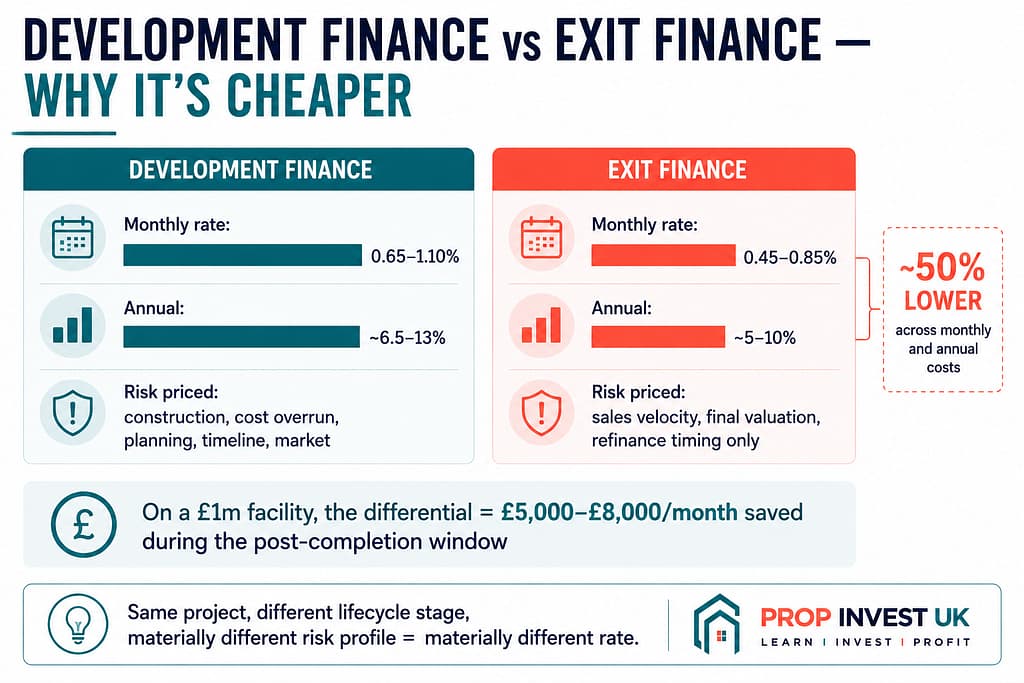
The pricing differential between development finance and development exit finance is the structural core of why exit finance exists.
Development finance is expensive by design. The lender is carrying:
- Construction risk — the project might not get built to specification
- Cost overrun risk — the build might cost more than modelled
- Planning risk — conditions might not be discharged as expected
- Timeline risk — the project might take longer than planned
- Market risk during construction — values might shift during the build window
At typical 2026 rates of 0.65-1.10% per month (6.5-13% per annum), development finance pricing reflects this stack of risks (Construction Capital, 2026).
Once the project reaches practical completion, much of that risk profile has gone. The building exists. The specification is delivered. Planning has been discharged. The value is broadly known.
The remaining risk is much smaller:
- Sales velocity — how quickly the completed units sell
- Final valuation — what the units are genuinely worth at completion
- Refinance timing — how long the permanent finance takes to arrange
A specialist exit-finance lender pricing against this reduced risk profile can offer materially better rates. 2026 development exit finance rates sit at 0.45-0.85% per month for most cases — approximately 30-50% cheaper than the development facility being replaced (Fox Davidson, 2026; FD Commercial, 2026).
For a £1m facility, the differential is meaningful: roughly £5,000-£8,000 per month of saved finance cost during the post-completion window. Over a 12-month exit period, that’s £60,000-£96,000 of savings on the same project — money that goes directly to the development margin and ultimately to investor returns.
How development exit finance is structured
The mechanics of development exit finance follow specific patterns that mirror standard bridging finance but with development-specific features.
Facility size
Development exit lenders typically advance up to 65-70% of the current open market value of the completed or near-completed scheme, with some specialist lenders stretching to 75% for strong borrowers (Fox Davidson, 2026; Fox Davidson Strategy, 2026).
The critical distinction from development finance: the loan is sized against the current value of the completed scheme, not the GDV used to underwrite the original development facility. Where development finance is priced against the projected value at completion, exit finance is priced against the actual value once completion is achieved.
For a scheme with completed units worth £2m, a 75% LTV exit facility provides £1.5m — typically more than enough to redeem the original development loan and potentially release some equity for the next project.
Term length
Most development exit facilities run 12-18 months, with some products extending to 24 months for larger or more complex schemes. The term is sized to match a realistic sales or refinance window for the specific scheme, not the developer’s preference for a longer hold.
For HMO conversions specifically — where the exit strategy is typically refinance onto a buy-to-let mortgage once tenancy income is established — the exit facility needs to be long enough to accommodate the 3-6 month tenancy seasoning that most BTL lenders require before completing a refinance.
Interest structure
Interest on development exit facilities is typically rolled up or retained, not serviced monthly. This is the same structure we covered in our bridging finance article — there are no monthly payments during the loan term, with the accumulated interest repaid alongside the principal at redemption.
For the developer, the rolled-up structure preserves cash flow during the sales window. For investor capital partners participating in projects using development exit finance, the structure means the project’s finance cost is predictable across the exit window — important for the underlying project economics.
Exit strategies (three primary routes)
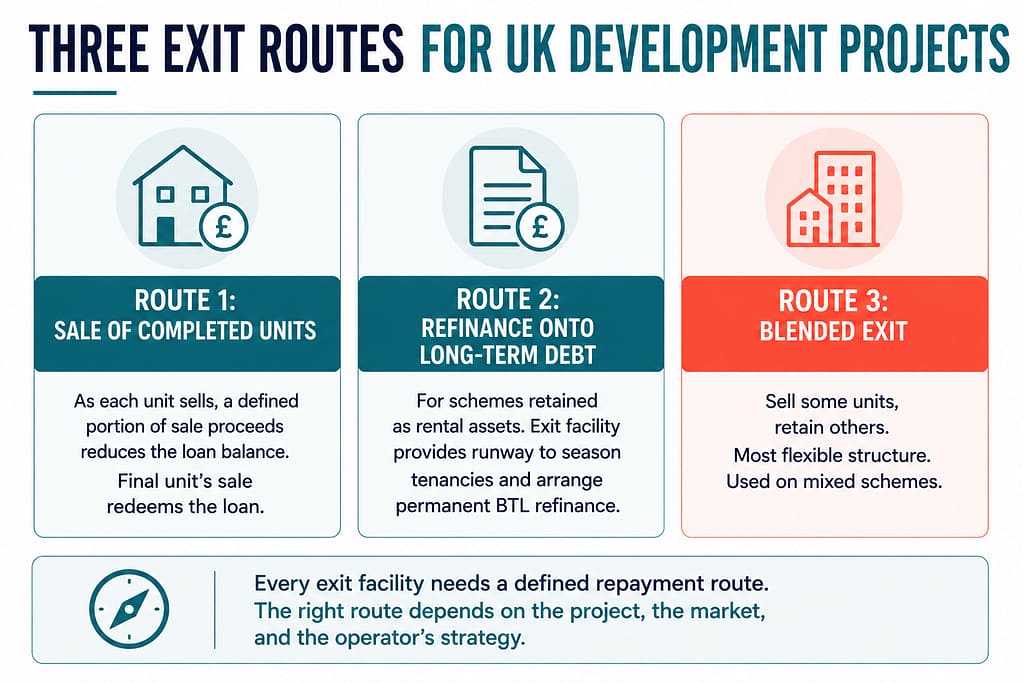
Every development exit facility needs a defined repayment route. Specialist lenders evaluate the credibility of the exit strategy as the single most important underwriting criterion (Fox Davidson Strategy, 2026). Three primary routes:
Route 1 — Sale of completed units: As each unit sells, sale proceeds reduce the loan balance. The facility is typically structured so a defined portion of each sale goes to the lender, with the remainder retained by the developer. The final unit’s sale redeems the loan.
Route 2 — Refinance onto long-term debt: For schemes retaining units as rental assets, the exit is a buy-to-let mortgage or portfolio refinance once tenancy income is established. The development exit facility provides the runway to season the tenancies and arrange the permanent finance. This is the structural pattern that worked at Gore Terrace — completed HMO refinanced onto a Shawbrook BTL facility at 75.23% LTV, covering 100% of project cost.
Route 3 — Blended exit: Sell some units, retain others. As units sell, the loan balance reduces; for the retained units, refinance onto BTL once income seasoning is complete. Most flexible structure, and the one most commonly arranged for mixed schemes (Fox Davidson Strategy, 2026).
When development exit finance is used in practice
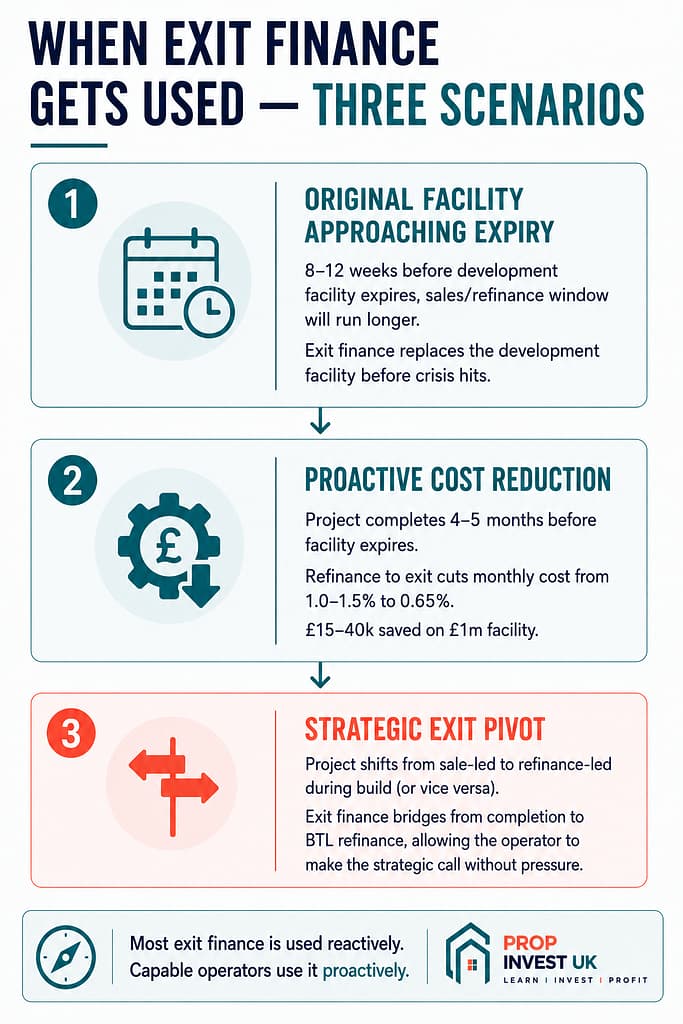
Three scenarios drive most UK development exit finance use in 2026.
Scenario 1: Original facility approaching expiry
The most common trigger. A developer has 8-12 weeks remaining on their development finance facility but the project’s sales or refinance window will run longer than the original facility allows. Without exit finance, the choices are:
- Negotiate an extension with the original development lender (often at penalty rates — 1.5-2x standard during extension periods)
- Rush sales at discounted prices to clear the debt
- Default on the facility (with serious consequences for the SPV and the developer’s track record)
Development exit finance provides a structured route out of this pressure by replacing the development facility with a cheaper bridging facility at a critical point in the project lifecycle.
Scenario 2: Proactive cost reduction
Some developers refinance onto exit finance before the original facility expires — specifically to reduce monthly finance cost during the sales window.
If a project completes 4-5 months before the development facility expires, refinancing onto exit finance immediately drops the monthly finance cost from ~1.0-1.5% per month to ~0.65% per month. Across 4-5 months, on a £1m facility, that’s £15,000-£40,000 of saved finance cost — money that goes directly to the project margin.
The trade-off: arranging exit finance carries its own costs (arrangement fees of 1-2%, valuation fees, legal fees). The cost reduction needs to materially exceed the refinancing cost to make the move worthwhile. For developers running multiple projects across years, exit refinancing is often a standard play; for single-project developers, the calculus is more case-by-case.
Scenario 3: Strategic exit pivot
A project that was originally modelled for sale at completion may shift toward retention for rental — perhaps because the rental market has strengthened, or because the operator wants to build a long-term portfolio. Development exit finance bridges the gap between completion and the BTL refinance that eventually replaces it.
This is particularly relevant for HMO schemes, where the operator may decide to retain units for the strong rental yield rather than crystallise capital through sale. The exit finance gives the operator the runway to make and execute this strategic decision without the original development facility forcing the hand.
What exit finance means for investor capital partners
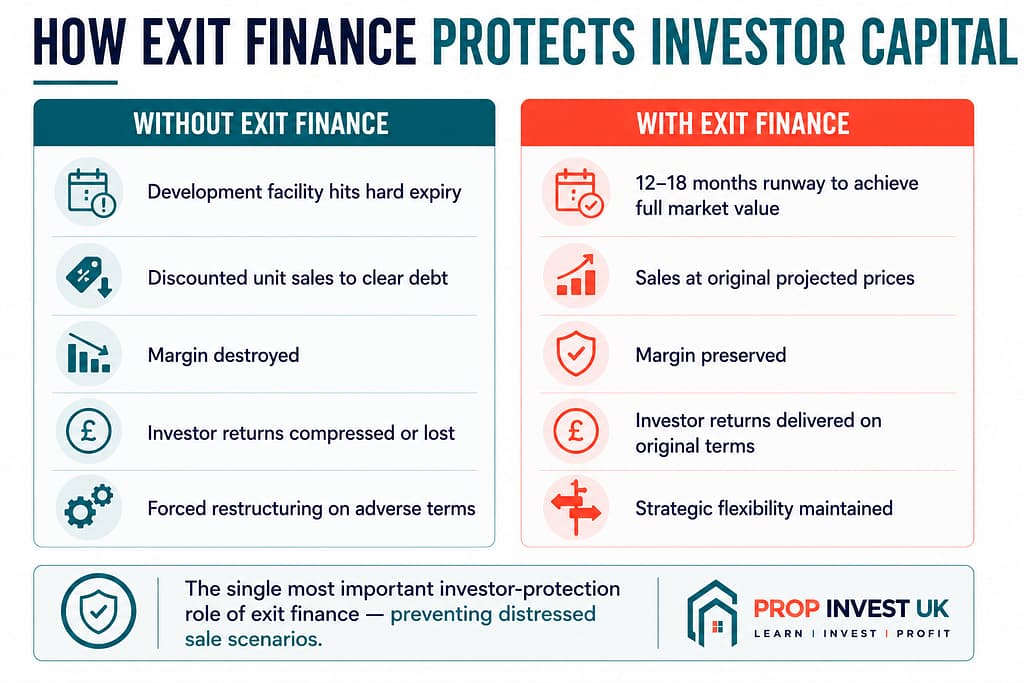
For investors participating in UK property development projects as capital partners, development exit finance has direct structural implications.
It protects against forced sale scenarios
The single most important investor-protection role of development exit finance: it prevents distressed sale scenarios at original facility expiry.
A project that completes into a softer market may not produce the sales velocity originally modelled. Without exit finance, the developer faces pressure to discount units to clear the debt — destroying margin and potentially investor returns. With exit finance in place, the developer has 12-18 months to achieve full market value, protecting the project’s economic outcome.
For fixed-return capital partners, this matters because the project’s ability to repay depends on the exit value achieved. For equity partners, it matters even more — equity returns are the residual after senior debt repayment, and forced sales destroy that residual most directly.
It signals operator quality
Operators who plan for exit finance in their original project structure are operating with foresight. Operators who only encounter exit finance as an emergency option when their original facility is about to expire are operating reactively.
This distinction shows up in how operators discuss the exit strategy during investor diligence. Capable operators can articulate:
- The original exit strategy (sale, refinance, blended)
- The backup if the original strategy needs extending
- The specific exit finance products they would access if needed
- The cost implications for the project economics
- How the investor’s position is protected through any exit refinancing
Operators who can’t engage with this conversation are signalling that their thinking stops at completion. Investor capital deserves operators whose thinking extends through to the final capital return event.
It’s part of why conservative LTGDV matters
Throughout the Prop Invest UK content body, we’ve emphasised conservative LTGDV ratios on senior development finance — typically 60-65% LTGDV vs the 65-75% upper range. Mozarts at 61.1% LTGDV is illustrative.
One of the structural reasons this conservatism matters: a project with conservative original LTGDV has more headroom for exit refinancing if the original facility expires before the original exit is achieved. The exit lender will lend up to 70-75% of current value; if the original senior debt was 60-65% of GDV and current value has held at or near GDV, the exit facility comfortably covers the original debt and may release some equity.
A project with stretched original LTGDV (75%+) has less headroom. The exit lender’s 70-75% LTV may not cover the outstanding original debt, requiring additional capital injection or asset sales to bridge the gap.
This is one of the structural reasons our development finance article and overrun article put so much weight on conservative LTGDV. The benefits compound through to the exit window.
The 2026 development exit finance market
Three structural features define the current UK development exit finance market.
Rates have moved lower
The Bank of England base rate fell from 5.25% in August 2023 to 3.75% by early 2026. Development exit rates have moved with it. Senior lenders are pricing completed residential schemes at 0.65-0.85% per month in early 2026, compared to peaks of 1.1-1.3% during the rate cycle peak (FD Commercial, 2026).
For developers and projects with capital partners participating, the improved pricing reduces the cost of the exit window — directly benefiting project economics and investor returns.
LTV remains conservative
Despite the better rates, exit lenders haven’t materially stretched leverage. The 65-70% LTV ceiling on current value remains standard for most cases, with 75% available only for strong borrowers and prime assets. This reflects exit lenders’ lessons from the 2022-2024 rate cycle — they want repayment certainty, not maximum advance.
Lender appetite is differentiated
The exit finance lender market includes specialist bridging lenders, challenger banks, and private credit funds. Each has different appetites:
- Specialist bridging lenders offer the fastest execution but typically tightest LTV
- Challenger banks offer competitive pricing but more conservative criteria
- Private credit funds offer the most flexibility but often at higher rates
- Specialist development lenders’ own exit products (where the original development lender offers an in-house exit facility) — usually competitively priced but with continuity benefits
For developers planning exit finance, the lender selection matters as much as the headline rate. The right lender for a specific project depends on the asset type, the location, the developer’s track record, and the specific exit strategy.
The five questions to ask any operator about exit finance
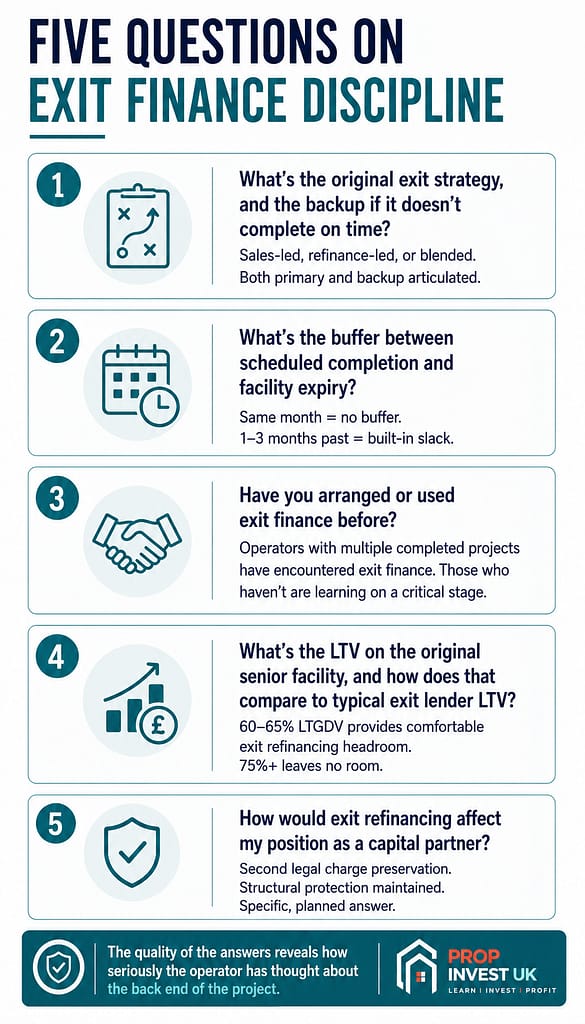
For investors evaluating UK property development opportunities, five specific questions about exit finance surface how seriously the operator has thought about the back end of the project.
1. What’s the original exit strategy, and what’s the backup if it doesn’t complete on time?
Sales-led exit (units selling off-plan or post-completion). Refinance-led exit (units retained for rental, refinanced onto BTL). Blended exit (mix of both). The operator should be able to articulate the primary and the backup with specific routes.
2. What’s the buffer between scheduled completion and the original facility expiry?
A facility that expires the same month as scheduled completion has no buffer. A facility termed 1-3 months past scheduled completion has built-in slack. We covered this in the overrun article — Mozarts has a one-month buffer between target completion and facility expiry.
3. Have you arranged or used development exit finance before?
Operators with multiple completed projects have typically encountered exit finance in some form. Those who have arranged it before are familiar with the process, the lenders, and the cost implications. Those who haven’t are facing a learning curve on a critical part of the project lifecycle.
4. What’s the LTV on the original senior facility, and how does that compare to typical exit lender LTV?
A project funded at 60-65% LTGDV provides comfortable headroom for exit refinancing at 70-75% of current value. A project funded at 75% LTGDV may need the current value to hold strongly to access exit finance without additional capital injection.
5. How would exit refinancing affect my position as a capital partner?
If the project moves to exit finance, what happens to the investor’s second legal charge? Is the position preserved against the new senior debt? Are there any structural changes to the investor’s protection? Capable operators have planned this; the answer should be specific.
How our Group approaches exit finance
Three things are worth knowing about how we engage with development exit finance across the portfolio.
We structure projects to allow for exit finance from the start. Conservative LTGDV on the original senior facility (Mozarts at 61.1% is illustrative). Realistic timeline assumptions with built-in slack. Multiple potential exit routes evidenced at acquisition. The structural choices that enable exit finance later are made at the front end, not improvised when problems emerge.
We treat exit finance as one tool in the broader exit toolkit. For Gore Terrace, the exit was a Shawbrook BTL refinance directly from development finance — no exit bridge needed because the refinance lined up with practical completion and tenancy seasoning. For projects where the sale or refinance window will run longer than the original facility, exit finance provides the bridge. The right tool depends on the specific project.
We discuss exit strategies with capital partners as part of the project structure, not as an afterthought. Investors deserve to understand the back end of the project as well as the front end. Exit finance is part of how investor capital is structurally protected through to repayment — and it should be visible in the project model from the start.
In summary
Development exit finance is a short-term bridging product designed specifically to replace expensive development finance once construction is complete or nearly complete. It replaces development finance rates of 0.65-1.10% per month with exit finance rates of 0.45-0.85% per month — typically 30-50% cheaper — giving developers 12-18 months of runway to achieve sales at full value or arrange permanent refinance.
The product works because the risk profile of a completed scheme is materially lower than the risk profile of an active construction project. Exit lenders pricing against the reduced risk can offer rates that reflect it.
For UK property investors participating as capital partners, development exit finance matters for three structural reasons:
- It protects against forced sale scenarios when projects complete into softer markets
- It signals operator quality — capable operators plan for exit finance, weak operators encounter it as emergency
- It rewards conservative original LTGDV — projects funded conservatively have more headroom for exit refinancing
The five questions worth asking any operator about exit finance:
- What’s the original exit strategy, and what’s the backup?
- What’s the buffer between completion and original facility expiry?
- Have you arranged or used exit finance before?
- What’s the original LTGDV vs typical exit lender LTV?
- How would exit refinancing affect my position as a capital partner?
A capable operator engages substantively with all five. A weaker operator deflects to “we’ll sell them” or “we don’t think that will be needed.” The difference tells you a lot about how the operator thinks about the back end of the project — which is the half of the lifecycle that determines whether capital partners actually receive their returns.
If you want to evaluate specific Prop Invest UK opportunities — including the exit finance and structural protection frameworks behind each project — you can join the investor list. We share specific opportunities with capital partners and provide full finance and exit detail on a per-deal basis.
This article is general information only and is not financial advice. UK property development carries risk, including the risk of total loss of capital invested. Development finance and exit finance terms, market conditions, and project outcomes vary by deal and by the prevailing market environment. Past project outcomes are not indicative of future performance.