
Development finance is the single largest source of capital in UK property development. The market reached approximately £12.5 billion in annual volume by late 2025, with non-bank lenders now holding around 45% of market share. For any private investor evaluating UK property development opportunities, understanding how development finance works — and how investor capital sits alongside it — is fundamental.
This guide explains what development finance actually is, how it differs from bridging and mortgages, the capital stack structure that defines every UK development project, the metrics lenders use to underwrite facilities, and how Mozarts at 76 Walter Road, Swansea illustrates the full development finance structure in action.
What development finance actually is
Development finance is short-to-medium-term funding specifically structured for the construction phase of a property development project. It’s the lending product that bridges the gap between acquiring a development site and either selling the completed units or refinancing onto long-term debt.
Three features distinguish development finance from other property lending products:
1. It’s priced against future value, not current value. A standard mortgage is sized to the current market value of a property. A development finance facility is sized to the projected Gross Development Value of the completed scheme — what the project will be worth when finished. This is the structural feature that makes development finance work: it lets developers borrow against value that doesn’t yet exist.
2. It’s drawn down in stages. Where a mortgage advances the full loan at completion, development finance releases capital in tranches as construction progresses. An initial advance funds the land acquisition. Subsequent drawdowns are released against certified build progress, inspected by a monitoring surveyor appointed by the lender. The developer only pays interest on capital actually drawn.
3. It’s time-limited and exit-dependent. Development facilities run typically 12-24 months, with some larger projects extending to 36 months. The lender expects repayment through one of two routes: sale of the completed units, or refinance onto long-term debt (often a buy-to-let mortgage for retained rental assets). The strength of the exit strategy is one of the largest single factors in whether a facility is approved.
We covered the broader concept of GDV in detail in our GDV article — development finance is the lending product that operationalises that concept. Without development finance, the gap between purchase price and GDV would have to be funded entirely from equity, which would limit the scale of UK property development activity dramatically.
How development finance differs from bridging and mortgages

These three lending products are often confused, but they serve completely different purposes in a property project lifecycle.
Bridging finance
Bridging is short-term, typically 1-24 months, used to bridge a temporary funding gap. The most common use in property development is acquisition bridging — funding a site purchase before planning consent is granted, with the bridge later refinanced onto development finance once the project is ready to start construction.
We covered bridging in detail in our bridging finance article. The structural point worth noting here: bridging is acquisition-stage; development finance is construction-stage. Many UK property development projects use both — bridging to acquire, then development finance to build.
Standard mortgages
A mortgage is long-term (typically 25-30 years), assessed on the current property value and the borrower’s income. It’s the lending product for completed, occupied properties — not for development sites.
The most common mortgage role in development is as the exit product. Once a development project completes and units are converted from development asset to rental asset, a buy-to-let mortgage refinances the development facility and the property continues as a long-term rental investment.
Development finance
Development finance sits between the two. Short-to-medium-term (12-24 months), priced against future GDV, drawn down in stages, secured against the development property. It’s the lending product specifically designed for the construction phase.
A typical UK property development project lifecycle uses all three:
- Bridging funds the acquisition before planning consent
- Development finance funds the construction phase after planning is granted
- Mortgage refinance is the exit for retained rental units
For investors evaluating development opportunities, understanding which product is being used at which stage tells you what risk profile the project is currently carrying and what the exit dependencies are.
The 2026 UK development finance market
The UK development finance market has shifted materially in the last three years.
According to Bank of England data, annual development finance volumes reached approximately £12.5 billion in late 2025, up 18% year-on-year (Fox Davidson, 2026). Non-bank lenders — challenger banks, specialist private credit funds, and family offices — now hold around 45% of UK development finance market share, often offering faster approvals than traditional bank lenders.
This shift in the lender landscape matters for two reasons:
1. More capital is available than at any point in the last decade. The competitive dynamics between bank-backed and non-bank lenders are keeping pricing competitive across the market.
2. Different lender types serve different developer profiles. Bank-backed development lenders typically offer lower headline rates but stricter criteria — minimum scheme size, pre-sales requirements, stronger track record demands. Non-bank lenders and private credit funds typically price slightly higher but offer higher leverage (65-75% LTGDV vs 60-65%) and faster execution (Construction Capital, 2026).
The Bank of England base rate stood at 3.75% in April 2026, having come down from its 5.25% peak in August 2023. Development finance lenders typically price at base rate plus 3 to 5 percentage points on a monthly rolled basis. For mainstream residential schemes with experienced developers, this puts current development finance rates at approximately 6.5% to 9.5% per annum, or 0.65% to 0.90% per month rolled up (Construction Capital, 2026; FD Commercial, 2026).
Higher-risk schemes — first-time developers, speculative commercial, complex conversions — can attract rates up to 1.10% per month or 13% per annum.
For investors, the implication is that 2026 is a structurally healthy moment in the UK development finance market. Capital is available, competition is keeping pricing reasonable, and experienced operators with strong track records can access finance at the lower end of the range.
The capital stack — how development projects are actually funded
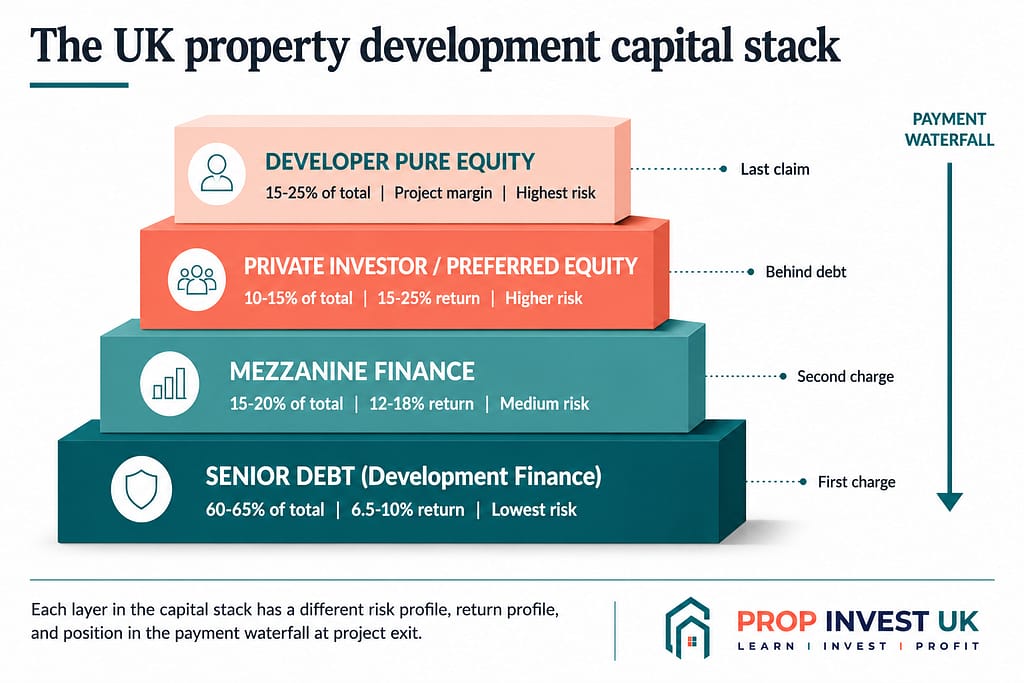
Every UK property development project is funded through a stack of capital layers, each with a different risk profile, return profile, and position in the payment waterfall. Understanding the stack is fundamental to understanding where private investor capital fits.
A typical UK residential development capital stack looks like this:
| Layer | Typical % of total | Annual return | Position | Risk |
|---|---|---|---|---|
| Senior debt (development finance) | 60-65% | 6.5-10% | First charge | Lowest |
| Mezzanine finance | 15-20% | 12-18% | Second charge | Medium |
| Preferred equity / private investor | 10-15% | 15-25% | Behind debt | Higher |
| Pure equity (developer) | 15-25% | Project margin | Last | Highest |
Source: Construction Capital, 2026
Each layer plays a different role.
Senior debt — the foundation
Senior development finance is the largest single layer and the lowest-risk position. The senior lender takes the first legal charge against the property, advances the largest portion of the project capital, and has the strongest claim on proceeds at exit.
Senior debt typically covers 60-70% of GDV and 80-90% of total project costs. Within that, the senior lender funds:
- Day 1 land advance: 60-70% of site value at acquisition
- Build advances: Up to 100% of construction costs, drawn in stages
- Professional fees and contingency: 10% contingency on build costs is standard; some lenders include professional fees within the facility
The senior lender is the gatekeeper for the project. If senior finance can’t be secured, the project doesn’t happen. If senior terms are tight, the rest of the capital stack has to absorb the squeeze.
Mezzanine finance — the gap filler
Mezzanine sits behind senior debt with a second legal charge. It’s used to increase total leverage when the developer’s equity contribution is constrained — typically stretching total leverage from 65% LTGDV to 80-85% of total costs.
Mezzanine attracts higher rates than senior debt (typically 12-18% per annum) because the risk position is materially higher — mezzanine is repaid only after senior debt is fully satisfied at exit.
Not every development project uses mezzanine. Many UK schemes are structured with senior debt + developer equity + investor capital, without a separate mezzanine layer. Where mezzanine appears, it usually reflects either a capital-constrained developer or a project with strong economics that justifies the extra leverage.
Preferred equity / private investor capital — where most capital partnerships sit
This is where most private investor participation in UK property development happens. Sitting between mezzanine (or directly behind senior debt if no mezzanine is used) and the developer’s pure equity position, private investor capital takes structured returns — either as fixed-return loans, equity participations, or hybrid structures.
We covered the structural difference between fixed return and equity in our fixed return vs equity article, and the security arrangements that protect this layer in our investor security article.
The key point: most private investor capital in UK development sits in this layer of the stack. It’s the layer where the structural protections matter most (second legal charge, professional documentation, conservative gearing) because it’s the layer that absorbs project friction before pure equity loses capital.
Pure equity — the developer’s position
The developer’s own capital sits at the bottom of the stack — last to be repaid, first to absorb losses. This is the position that captures the project’s residual margin if everything goes well, and the position that takes the first hit if things go wrong.
Pure equity typically represents 15-25% of total project capital in a well-structured UK development. Lower equity contributions push the project’s risk profile up across all layers above; higher equity contributions create resilience that benefits every other layer in the stack.
How development finance is underwritten
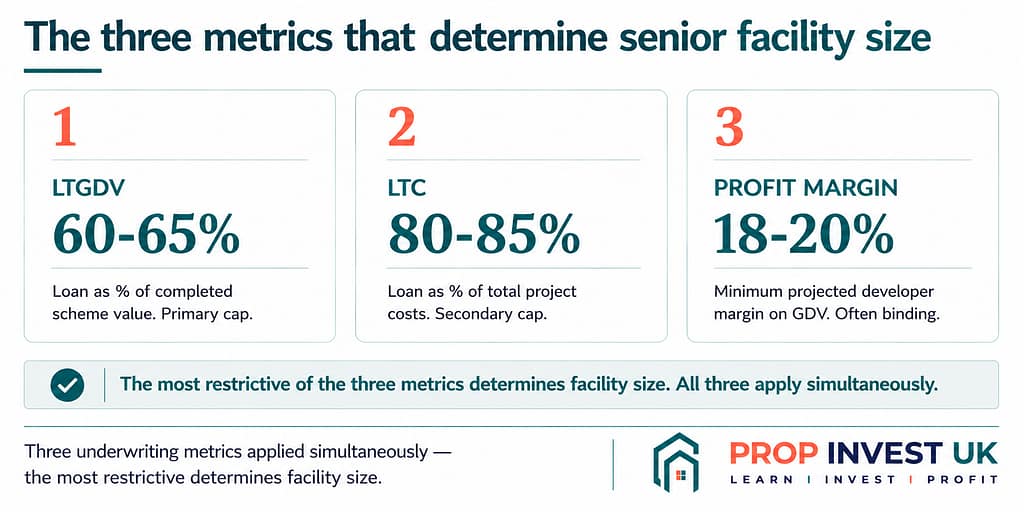
Senior development lenders assess applications against three key metrics, and the most restrictive of the three determines the facility size.
1. Loan-to-Gross-Development-Value (LTGDV)
The primary cap. LTGDV expresses the total loan amount as a percentage of the completed scheme value.
Most senior lenders cap LTGDV at 60-65%, with some specialist lenders stretching to 70% for strong borrowers (Construction Capital, 2026). For first-time developers, the cap is typically lower — 55-65%.
The LTGDV cap is the structural buffer that protects both the lender and the broader capital stack. A 65% LTGDV means there’s 35% of GDV between the senior debt and the realisable property value — substantial headroom to absorb cost overruns, sale price slippage, or refinance friction.
2. Loan-to-Cost (LTC)
LTC measures the loan against total project costs rather than end value. Most senior lenders fund up to 80-85% of total costs, with the developer contributing the remaining 15-20% as equity (FD Commercial, 2026).
LTC and LTGDV apply simultaneously. The facility is sized to the lower of the two caps. On a project with a £1.8m GDV and £1.2m total cost: 65% LTGDV gives a maximum facility of £1.17m. 85% LTC gives a maximum facility of £1.02m. The lower figure (£1.02m, the LTC cap) is what gets advanced.
3. Developer profit margin
Often the binding constraint. Lenders want to see at least 18-20% projected profit on GDV for residential schemes. If the appraisal shows less than that, the lender may reduce the facility — even when LTGDV and LTC ratios are comfortable — to create a larger equity buffer (Construction Capital, 2026).
This third metric matters more than most developers realise. A project with strong LTGDV and LTC but thin margin will struggle for senior finance even if the leverage looks acceptable on paper. Lenders are explicitly pricing for the margin buffer that protects them through project friction.
The five factors that determine your rate
For developers seeking senior finance, the rate offered reflects a combination of factors specific to the project and the operator.
1. Developer track record
The single biggest factor. Developers with multiple completed schemes access the widest lender panel and most competitive pricing. First-time developers face higher rates (typically 1-2% premium), lower leverage caps, and more intensive monitoring.
2. LTGDV requested
Conservative LTGDV (sub-60%) attracts the sharpest pricing. Stretched LTGDV (70%+) pushes the rate up because the lender is taking more risk.
3. Scheme type and location
Residential schemes attract sharper pricing than commercial or mixed-use. Prime and major regional locations (London, South East, major regional cities) compete for capital more aggressively than secondary markets. Speculative commercial schemes — pure offices or retail without pre-lets — attract the highest pricing because the exit market is uncertain.
4. Exit strategy quality
Sales-led exits (units selling off-plan or with strong comparable evidence) attract better rates than refinance exits. Lenders price for the certainty of repayment, and pre-sales materially reduce that uncertainty.
5. Planning status
Full planning consent in hand is a different proposition from outline planning or pre-planning. Lenders heavily prefer projects where consent is secured before drawdown begins. Pre-planning finance exists but is more expensive and harder to access.
How Mozarts illustrates the full development finance structure
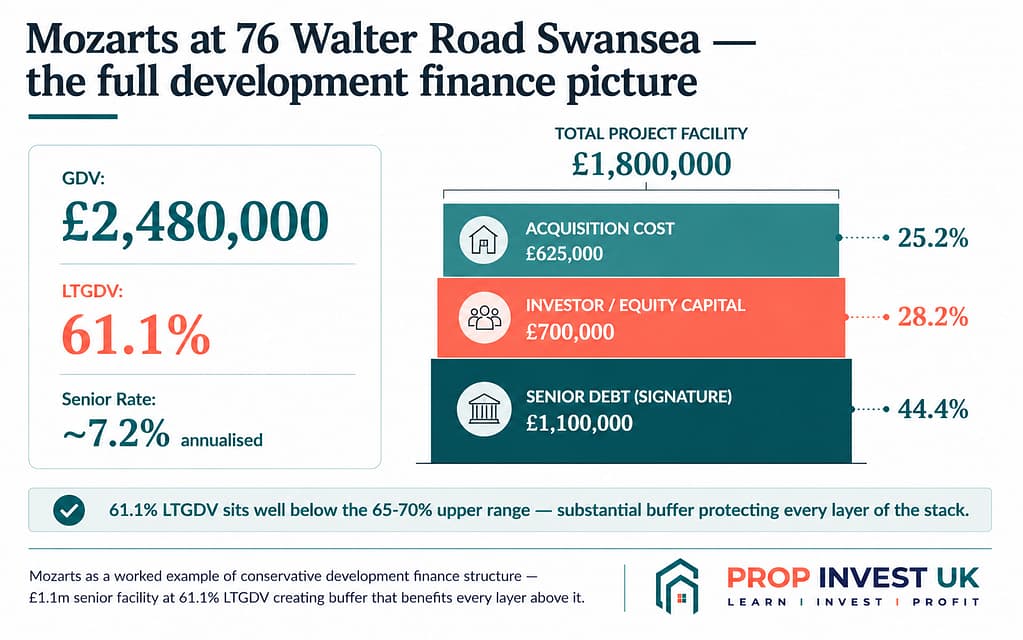
The Mozarts conversion at 76 Walter Road, Swansea — which we’ve covered from multiple angles across our conversion, overrun, and forced appreciation articles — is a clear illustration of how development finance fits into the broader project structure.
The facility
Mozarts is funded with a £1,100,000 senior development finance facility from Signature, secured against 76 Walter Road. Monthly finance cost is approximately £6,578.58, equating to roughly 7.2% annualised — competitive pricing reflecting both the conservative LTGDV and the strength of the planning consent.
The facility expires on 13 July 2026, with target completion at mid-June 2026 — a one-month buffer between scheduled completion and facility expiry, which we covered in the overrun article as one of the structural features that allows the project to absorb overruns.
The capital stack
The Mozarts capital stack is structured as follows:
| Layer | Amount | % of total |
|---|---|---|
| Acquisition cost | £625,000 | 25.2% |
| Total build cost | £801,900 | 32.3% |
| Total project facility | £1,800,000 | 72.6% |
| Senior debt (Signature) | £1,100,000 | 44.4% |
| Investor / equity capital | £700,000 | 28.2% |
| Projected GDV | £2,480,000 | — |
| LTGDV | 61.1% | — |
The £1.1m senior facility at 61.1% LTGDV sits well below the 65-70% upper range typical for residential development. This conservative gearing is the structural feature that creates substantial buffer between the senior debt and the realisable property value — protecting both the senior lender and the £700,000 of investor/equity capital sitting behind it.
How investor capital fits
The £700,000 of investor and equity capital represents the developer and capital partner participation behind the senior debt. Our capital partners — including Raf at Gore Terrace, Jason at the Windsor Lodge, and Glenn at Mozarts — typically participate through fixed-return loan structures, secured by second legal charges registered at HM Land Registry behind the senior facility.
We covered the specifics of how these capital partner positions are structured and protected in our investor security article. The development finance facility is the foundation; the investor capital sits behind it; the developer’s pure equity sits behind both.
What this illustrates
Three things worth taking from Mozarts as a development finance worked example:
1. The £1.1m senior facility makes the £625k acquisition and £800k build possible. Without development finance, the project would require £1.8m of equity capital to deliver — which would put it out of reach for most operators and most capital partnerships.
2. The conservative LTGDV creates the structural protection that benefits every layer above it. The senior lender has substantial buffer. The investor capital has substantial buffer behind the senior. The developer’s equity has substantial buffer behind the investor capital. Conservative senior gearing creates resilience throughout the stack.
3. The exit strategy is what makes the facility approvable. Mozarts has a clear exit path (sale of completed units or refinance onto long-term debt), supported by genuine comparable evidence in the Swansea HMO market. That exit strength is why Signature priced the facility at 7.2% annualised — competitive even by 2026 standards — and accepted the 61.1% LTGDV rather than demanding 65-70%.
What investors should ask about any development finance facility
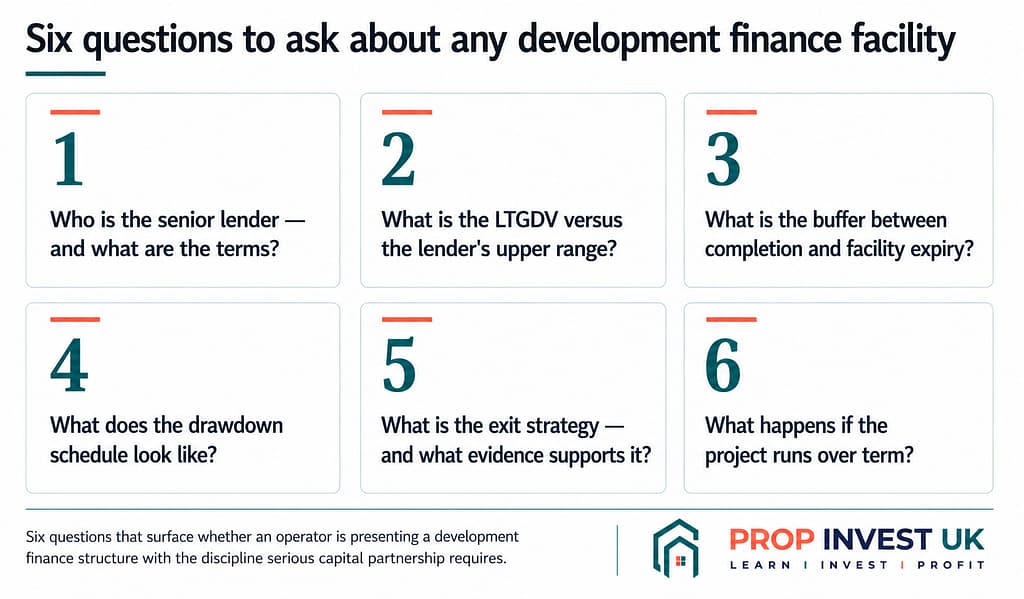
For a private investor evaluating participation in a UK property development project, the development finance facility is one of the most informative parts of the deal. Six specific questions to ask:
1. Who is the senior lender, and what are the terms?
The lender’s identity tells you something. Established specialist development lenders, challenger banks, and reputable non-bank funds each have known underwriting standards. Unknown or unverifiable lenders are a warning sign.
Terms to understand: the facility size, the rate, the term, the LTGDV, the LTC, and any extension provisions.
2. What is the LTGDV, and how does it compare to the lender’s upper range?
Below 65% on residential is conservative. Above 70% leaves limited equity buffer. The position the senior debt takes tells you what the lender thinks of the project’s risk profile — and how much buffer exists to protect the capital stack behind it.
3. What is the buffer between scheduled completion and facility expiry?
A facility that expires the same month as scheduled completion has no built-in slack. A facility termed 1-3 months past scheduled completion has buffer for typical overruns — as we covered in detail in the overrun article.
4. What does the drawdown schedule look like?
Development finance is drawn in tranches against certified build progress. The drawdown schedule tells you the project’s funding rhythm — when capital enters the project, when interest accrues, when the project is fully drawn. Understanding the drawdown profile tells you what the actual finance cost will be at each stage.
5. What is the exit strategy, and what evidence supports it?
For sales-led exits: comparable sales evidence in the local market. For refinance exits: mortgage in principle or strong refinance product availability. Multiple potential exit routes is better than one. Vague answers are warning signs.
6. What happens if the project runs over term?
Most development facilities have extension provisions, but the cost and availability of extensions matter. Extension fees (1-2% of balance), penalty rates (1.5-2x standard during extension), and the lender’s willingness to extend all need to be understood before capital is committed.
How Prop Invest UK structures development finance into the broader project
At Prop Invest UK, every project we present to capital partners includes the development finance position as part of the structural picture. Specifically:
- Senior facility details disclosed — lender, facility size, rate, term, LTGDV
- Conservative LTGDV targeted — Mozarts at 61.1% is illustrative of the level of conservatism we apply across the portfolio
- Capital stack fully mapped — investors see exactly where their capital sits relative to senior debt, mezzanine (where used), and developer equity
- Exit strategy evidenced — sales comparables, refinance product availability, or both
- Extension provisions explained — what happens if the project runs over term, and how it affects the investor position
This transparency exists because development finance is the foundation of every UK development project, and capital partners deserve full visibility of the foundation supporting their capital position.
The investor capital partnership only makes structural sense when the development finance underneath it is conservatively structured. A second legal charge behind a 75% LTGDV senior facility is materially less protective than the same second charge behind a 60% LTGDV senior facility — even though both look like “second charges” on paper.
In summary
Development finance is the lending product that funds the construction phase of UK property development. The UK market reached approximately £12.5 billion in annual volume by late 2025, with non-bank lenders now holding around 45% of market share. Current rates for mainstream residential schemes range from 6.5% to 9.5% per annum, with LTGDV typically capped at 65-70%.
Every UK development project is funded through a capital stack that typically includes senior debt (60-65% of total), mezzanine finance (15-20% where used), private investor or preferred equity capital (10-15%), and developer pure equity (15-25%). Each layer has a different risk profile, return profile, and position in the payment waterfall — and understanding the stack is fundamental to understanding where private investor capital fits.
Senior development lenders assess applications against three metrics: LTGDV (typically 60-70%), LTC (typically 80-90%), and developer profit margin (typically 18-20% minimum). The most restrictive metric determines facility size. Rate is determined by developer track record, LTGDV requested, scheme type and location, exit strategy quality, and planning status.
Mozarts at 76 Walter Road, Swansea illustrates the full structure: £1.1m senior facility from Signature at 61.1% LTGDV, sitting underneath £700,000 of investor and equity capital, with the conservative gearing creating structural buffer that protects every layer in the stack.
The six questions worth asking about any development finance facility:
- Who is the senior lender and what are the terms?
- What is the LTGDV vs the lender’s upper range?
- What is the buffer between completion and facility expiry?
- What does the drawdown schedule look like?
- What is the exit strategy and supporting evidence?
- What happens if the project runs over term?
An operator who can answer these with detail, evidence, and specifics about the project’s place in the broader market is operating with the discipline serious capital partnership requires. One who can’t, isn’t.
If you want to participate as a capital partner in projects structured with the conservative development finance disciplines described in this article — you can join the Prop Invest UK investor list. We share specific opportunities with capital partners and provide full development finance and capital stack detail for every project.
This article is general information only and is not financial advice. UK property development carries risk; capital is at risk. Development finance terms, market conditions, and project outcomes vary by deal and by the prevailing market environment. Past project outcomes are not indicative of future performance.