
Development Partnerships vs Buy to Let: An Allocation Comparison for 2026
For UK investors weighing how to deploy capital into property, the central allocation question in 2026 is increasingly direct: stay with the buy-to-let model that’s been the default for two decades, or move toward development capital partnerships? Both are legitimate routes. They are also structurally different investments — different returns, different risks, different capital exposure, different time costs, different tax positions.
This article is a direct head-to-head comparison of the two, grounded in current 2026 UK economics. It is written for investors with meaningful capital who want to make the allocation decision on structural grounds rather than habit, and who recognise that the BTL model that worked for their first property doesn’t necessarily fit the rest of their capital position. Both routes still work in 2026. They work for different investors, for different reasons, at different points in a wider strategy.
The two routes, defined cleanly
Buy to let means buying a property in your own name (or through your own company) and holding it for rental income and capital appreciation. You are the legal owner. You arrange the financing, choose the tenant or appoint an agent, manage compliance, fund maintenance and capital expenditure, handle voids and arrears, and exit through sale when you choose to. The asset is yours; the operational responsibility is yours.
Development capital partnership means deploying capital alongside an experienced developer into a specific property development project, with the operator handling sourcing, planning, construction, finance management, and exit. Your role is to select the operator, assess the structure, commit capital under documented terms, and maintain oversight through reporting. You don’t own the asset directly; you participate in defined project economics through a structured arrangement.
The first useful clarification: these aren’t competing flavours of the same investment. One is direct asset ownership with operational responsibility. The other is structured exposure to development-led value creation without the operational layer. Comparing them on yield alone misses the structural difference; comparing them properly means looking across multiple dimensions.
The 2026 economics of buy to let, honestly
The first part of any genuine comparison is honest data on what BTL actually produces in 2026, after the regulatory and economic changes of the past decade have worked through.
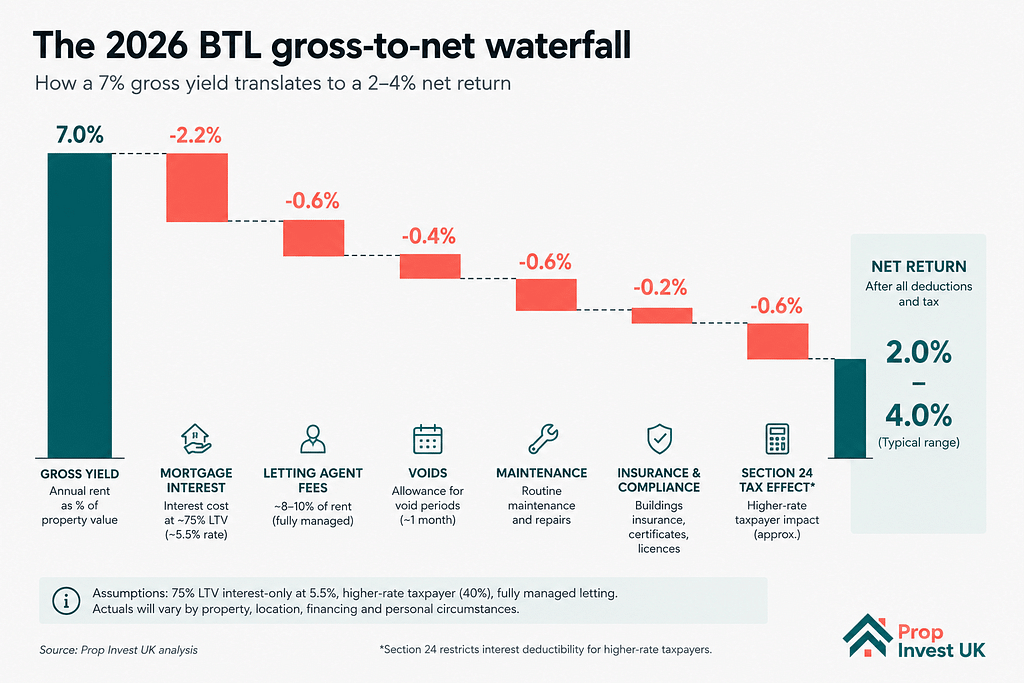
Gross-to-net yield gap. Average UK gross rental yields sit at 5–7%. After mortgage interest, letting agent fees (10–15% on full management), voids (4–8 weeks per year, equivalent to 8–15% rent loss), maintenance (1–2% of property value annually), insurance, compliance, and tax, the net yield typically lands in the 2–5% range ( source: Landlord Knowledge BTL Investment Guide 2026; Money Meister UK Rental Yields 2026). A “7% yield” investment is more realistically a 3–4% net cash-on-cash return for a higher-rate taxpayer running a leveraged BTL.
The Section 24 effect. Since April 2020, mortgage interest is no longer deductible from rental income before tax for personally-held BTL. Instead, landlords receive a 20% basic-rate tax credit. The mechanical effect for a higher-rate taxpayer: a property generating £12,000 annual rent with £8,000 in mortgage interest produces a tax bill of £3,200 — versus £1,600 under the pre-2017 rules. The same property; the tax bill literally doubled ( source: UK Property Calculator analysis, 2026).
Rental coverage ratios. Buy-to-let lenders stress-test mortgage applications against a rental coverage ratio of typically 125–145% — meaning rental income must cover 125–145% of mortgage interest at a stress-tested rate of 5.5–6.5%. Higher-rate taxpayers face 145% coverage. Portfolio landlords with four or more mortgages face 175%. In practical terms, an investor needs a 6.1–7.1% gross yield just to qualify for the mortgage on a 75% LTV property ( source: Money Meister rental yield analysis, February 2026).
Compounding regulatory load. Making Tax Digital for property income began applying from April 2026 to landlords with property income above £50,000, extending to those above £30,000 from April 2027 — adding quarterly digital reporting requirements. The Renters’ Rights Act 2025 came into force in May 2026, ending Section 21 no-fault evictions and adding tenant protection mechanisms. The Capital Gains Tax annual exemption fell from £12,300 in 2022/23 to £3,000 in 2025/26. From April 2027, property income will be taxed at separate rates from general income — 22% basic, 42% higher, 47% additional — meaningfully higher than the current 20/40/45 rates ( source: Cryers / Sterling & Wells UK landlord tax analysis, 2026).
This is the BTL reality in 2026, named honestly. It still works for some investors in some situations. It works less well than it did five years ago, and it works least well for higher-rate taxpayers running leveraged single-let portfolios.
What capital partnership exposure looks like
The capital partnership route produces a structurally different economic profile.
Return structure. Capital partnerships in UK development typically produce returns through a combination of development margin (created during the project phase) and, where the asset is retained, long-term hold income from the completed property. The investor’s specific return depends on the structure — secured lending, equity participation, profit share, or hybrid arrangements all produce different return profiles.
Operational responsibility. Sits with the operator. The investor doesn’t source the deal, doesn’t manage contractors, doesn’t deal with tenants, doesn’t handle compliance, doesn’t make day-to-day delivery decisions. The investor’s role is selection, structure assessment, capital commitment, and oversight through reporting.
Capital exposure. Defined by the structure. In secured lending arrangements, exposure is limited by the security position and ranking (covered in detail in the property secured investment guide). In equity participations, exposure is to project performance. The structural form determines the risk profile, and the operator’s track record on similar arrangements determines the practical risk.
Tax position. Capital partnership returns can be structured as interest income, partnership distributions, or capital returns depending on the legal form, with materially different tax treatment for each. This is exactly the territory where qualified tax advice is essential — there is no generic answer, only individual circumstances.
Time horizon. Project-bound rather than open-ended. Most UK development capital partnerships have defined terms of 12–24 months for project-only exposure, longer if the structure includes retention of the completed asset. The investor knows roughly when capital will be returned or rolled forward.
The structural difference from BTL is significant: BTL is open-ended, operationally demanding, and exposed to a single asset’s performance over time. Capital partnership is defined-term, operationally light for the investor, and exposed to a specific project’s performance plus the operator’s execution quality.
A direct comparison across the criteria that matter
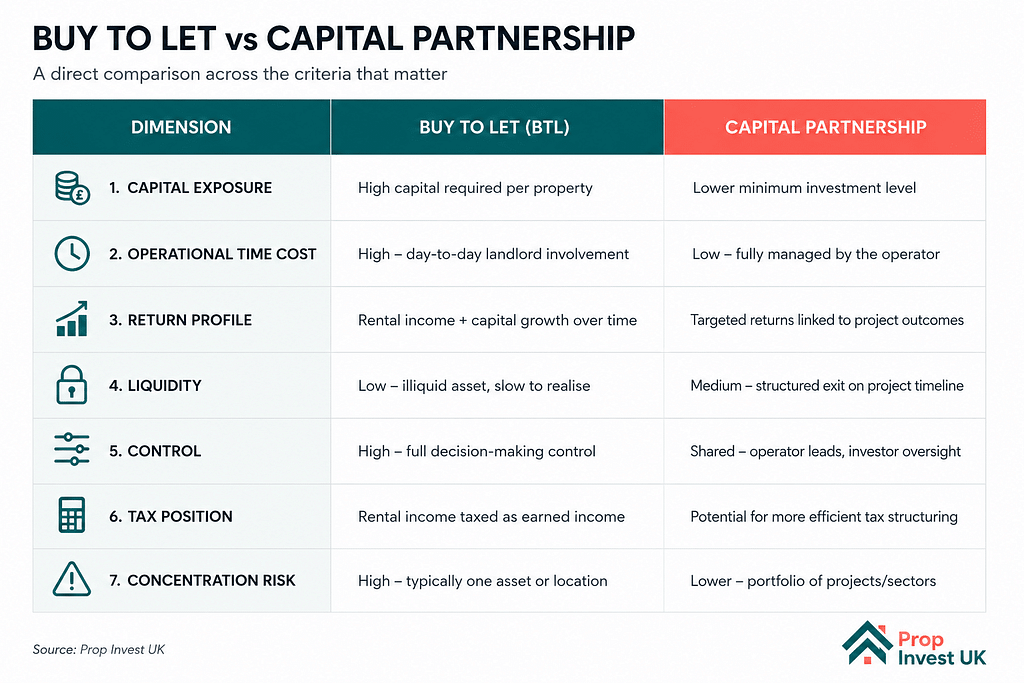
The decision usually comes down to seven dimensions. Both routes can be the right answer; the difference depends on which dimensions matter most for the specific investor.
Capital exposure. BTL: capital is exposed to a single property’s market value and rental income, with leverage typically amplifying both upside and downside. Capital partnership: capital is exposed to the operator’s execution and project performance, often with structural protection mechanisms (security, ranking, documented exit) that don’t exist in direct ownership.
Operational time cost. BTL: meaningful and ongoing. Self-managing landlords spend 8–15 hours per month on a small portfolio; even fully-managed BTL requires oversight of the agent and decision-making on issues. Capital partnership: minimal during the investment period beyond reading reports and maintaining oversight.
Return profile. BTL: rental yield (2–5% net for higher-rate taxpayers in 2026) plus capital appreciation. Capital partnership: development margin and/or income from retained assets, with the specific return defined by the structure. The two return profiles are not directly comparable on a single metric — they’re different shapes.
Liquidity. BTL: relatively illiquid (typically 3–6 months to sell), but the investor controls the timing. Capital partnership: defined-term illiquidity — capital is committed for the project term and cannot typically be withdrawn early.
Control. BTL: full control over the asset, financing decisions, tenant selection, refurbishment, and exit. Capital partnership: no operational control — the investor is reliant on the operator’s competence and the documented governance structure.
Tax position. BTL: rental income taxed at personal rates (or corporation tax if held through a company), with Section 24 mortgage interest restriction for personally-held leveraged property, Section 24 mortgage interest restriction, and from April 2027 separate property tax rates. Capital partnership: variable depending on the specific structure — interest income, partnership distribution, or capital return — each with different treatment.
Concentration risk. BTL: high concentration on a single property, single tenant base, single micro-location. Capital partnership: project-specific concentration but typically diversifiable across multiple partnerships over time.
No single dimension determines the answer. The investor who prioritises hands-on control of a tangible asset, has time to operate it well, and is in a basic-rate tax position may genuinely be better off with BTL. The investor who prioritises capital efficiency, has limited operational time, is in a higher-rate tax bracket, and wants exposure to development-level returns without the operational layer is more likely to find capital partnership better-fitted.
Where each route genuinely suits
BTL tends to suit:
- Basic-rate taxpayers where Section 24 has less impact
- Cash purchasers where mortgage interest restriction doesn’t apply
- Investors with strong local knowledge of a specific market and the time to source/manage actively
- Investors who genuinely value direct asset ownership and the control that comes with it
- Long-term holders prepared to absorb regulatory load in exchange for capital appreciation potential
Capital partnerships tend to suit:
- Higher-rate and additional-rate taxpayers where the BTL tax position has compressed materially
- Investors with meaningful capital but limited operational time
- Investors who want exposure to development-level returns without becoming developers themselves
- Pension-led investors (SSAS, SIPP) where the structure suits qualifying investments
- Investors building portfolio exposure who want diversification across multiple projects and operators rather than concentration in one asset
These aren’t mutually exclusive. Many serious UK investors hold both at different points in their capital position — older BTL holdings for stable long-term income and capital growth (often where the cost of restructuring would outweigh the benefit), with new allocations directed toward capital partnerships for the more capital-efficient exposure 2026 conditions reward.
The honest comparison framing
Neither route is universally better in 2026. The structural shift in the market — Section 24, the Renters’ Rights Act, MTD, CGT changes, mortgage rate environment — has compressed BTL economics meaningfully, particularly for leveraged higher-rate taxpayers. That hasn’t killed BTL. It has changed which investors and which circumstances make BTL the right answer.
The same period has structurally favoured capital partnership arrangements with disciplined operators, because the conditions that compressed individual landlord economics (tighter regulation, more complex operations, harder finance environment) have raised the bar for what specialist operators can deliver compared to individual investors operating on their own. Where capable operators exist, the capital partnership route accesses returns and protections that direct ownership of a single property typically can’t replicate.
For investors making the allocation decision today, the question isn’t “is BTL dead?” — it isn’t. The question is whether your specific tax position, capital scale, time availability, and objectives point toward direct ownership or structured partnership for the next allocation of capital. That answer is rarely the same as the answer was for the first BTL purchased 10 years ago.
How Prop Invest UK fits
Prop Invest UK works with investors who want exposure to UK property development as capital partners on specific projects. Our model is one of several legitimate property-backed routes — not the only one, and not the right answer for every investor in every situation. The article above sets out the framework for assessing which route fits which investor; the assessment of any specific opportunity should be made with that framework applied honestly and with qualified tax advice on the personal circumstances.
For investors actively comparing BTL with capital partnership for their next allocation, the most useful sequence is usually: assess your own position (tax, time, objectives, alternatives) first; understand the structural differences between routes (this article); apply the property due diligence framework to any specific operator or opportunity being considered; and confirm tax treatment with a qualified adviser before committing capital. Doing it that way produces structural decisions that match the investor’s actual position — not decisions made under deal pressure or driven by the most recent marketing material received.
—
About Prop Invest UK
Prop Invest UK is a property development business working with investors who want exposure to UK property development without taking on operational delivery themselves. Each opportunity is sourced, structured, and delivered by an experienced developer, with investors participating as capital partners on a deal-by-deal basis.
Join the investor list to receive details of future opportunities as they become available, subject to investor qualification and project documentation.
—
This article is for general information purposes only and does not constitute financial, tax, or legal advice. UK property investment involves risk, including the risk of capital loss, and returns are not guaranteed. Past performance is not a reliable indicator of future results. Tax rates, allowances, and regulations referenced in this article are accurate as of the dates cited but are subject to change. The choice between direct property ownership and capital partnership arrangements depends on individual circumstances and should be made only after taking advice from a qualified chartered accountant or tax adviser who has reviewed your full personal and financial circumstances. Any specific investment opportunity is offered only to investors who qualify under the relevant exemptions and have received the full project documentation. If you are uncertain whether an investment is suitable for your circumstances, you should consult an FCA-authorised financial adviser.