
When a private investor commits capital to a UK property development project, the structure of the participation is as important as the project itself. The same £100,000 invested in the same development can produce very different outcomes — and very different risk profiles — depending on whether the structure is a fixed-return loan, an equity stake, or some combination of the two.
Why the structure matters as much as the project
Most early conversations between a property developer and a private investor focus on the project itself. The site, the planning, the GDV, the timeline, the margin. All of those matter — and we’ve covered them in detail in our GDV and commercial-to-residential conversion articles.
But the question of how an investor participates in the project — through what legal and economic structure — is often left as an afterthought. It shouldn’t be.
The structure determines:
- What position the investor’s capital occupies in the project’s capital stack
- What return the investor receives, and on what timing
- What happens if the project underperforms, completes late, or exceeds budget
- What happens if the project outperforms expectations
- What rights the investor has during the project
- What documentation and security protects the position
Two investors can commit identical sums to the same project on the same day and end up with materially different outcomes — because they chose different structures.
For private investors moving from buy-to-let or completed-asset investing into property development, this is the conceptual shift that matters most. Buy-to-let has one structure: you own the property, you collect the rent, you bear the costs. Development has options. Understanding the options is the difference between picking a structure that fits and picking one that creates friction later.
The two primary structures

UK private property development capital is typically structured as either a fixed-return loan or an equity participation. Each has variants, and many real-world structures combine elements of both — but those are the two parent categories.
Fixed-return loan
The investor lends money to the developer’s project entity (typically a Special Purpose Vehicle — an SPV — set up for the specific project). The loan is documented as a debt facility, with a defined interest rate, defined term, and defined repayment schedule. The investor’s position is one of a creditor, not an owner.
At the end of the term, the investor receives back their original capital plus the agreed interest. The return is fixed in the sense that it is contractually defined — it does not vary with the project’s outcome, provided the project can repay.
Position in the capital stack: Debt — typically junior to any senior development finance, senior to any pure equity. Where multiple investor loans sit alongside each other, position is determined by the security and any inter-creditor arrangements.
Documentation: A loan agreement, security documentation (debenture, legal charge, or personal guarantee depending on the structure), and any inter-creditor agreements with other lenders.
Return shape: Predictable. Defined interest rate over a defined term, repaid on a defined date.
Equity participation
The investor takes a stake — usually shares in the project SPV, or a proportional beneficial interest — in the project itself. The investor is an owner, not a creditor. Returns come from the investor’s share of the project’s profits on completion, not from contractual interest payments.
If the project outperforms expectations, the equity investor’s return is higher than originally projected. If it underperforms, the return is lower. If the project loses money, the equity investor bears their share of the loss before any of the developer’s profit is paid.
Position in the capital stack: Equity — the most subordinate position. All debt (senior development finance, junior debt, investor loans) is repaid before equity receives anything.
Documentation: A shareholders’ agreement, articles of association for the SPV, and any associated documents defining how decisions are made and how proceeds are distributed.
Return shape: Variable. Driven by project outcome, paid at the end when the project is wound up and proceeds are distributed.
A worked example — same project, two structures

The simplest way to see how these differ is to run the same project through both structures.
Take a hypothetical UK conversion project with the following characteristics:
- Total project cost: £2,000,000
- Projected GDV: £2,800,000
- Senior development finance: £1,400,000
- Equity and investor capital required: £600,000
- Projected project margin (profit): £800,000
- Projected timeline to completion and exit: 24 months
An investor commits £100,000 to this project. Here’s what happens in each structure.
Scenario A — Fixed-return loan at 12% per annum
The investor lends £100,000 to the project SPV on a 24-month term at 12% per annum, with interest rolled up to maturity.
- After 24 months, the investor receives: £100,000 capital + £24,000 interest = £124,000
- Total return: 24% over 24 months (approximately 12% annualised)
- Project outcome variance: irrelevant to the investor’s return, provided the project can repay
Scenario B — Equity participation, 16.7% of project equity
The investor takes 16.7% of the £600,000 equity (i.e. £100,000 / £600,000) in the project SPV.
On the projected outcome of £800,000 of profit:
- Total profit available for distribution: £800,000
- Investor’s 16.7% share: approximately £133,600
- Total return: £233,600 (capital £100,000 + profit £133,600), or 33.6% over 24 months
But equity returns vary with outcome:
| Project outcome | Total project profit | Investor’s 16.7% share | Total return on £100k |
|---|---|---|---|
| Project loses 10% on cost | -£200,000 | -£33,400 (loss) | £66,600 (loss of capital) |
| Project breaks even | £0 | £0 | £100,000 (no profit) |
| Project hits 50% of plan | £400,000 | £66,800 | £166,800 (66.8% return) |
| Project hits projection | £800,000 | £133,600 | £233,600 (133.6%) |
| Project outperforms by 20% | £960,000 | £160,320 | £260,320 (160.3%) |
What this comparison shows
On the projected outcome, equity participation produces a substantially higher return than the fixed-return loan (£233k vs £124k on the same £100k commitment). That’s the upside of equity — owning a slice of the profit means participating in the full extent of value creation.
The downside is symmetric. If the project loses 10% on cost, the fixed-return investor still receives £124k (provided the project can repay). The equity investor receives £66,600 — a loss of capital.
The fixed-return investor accepts a lower expected return in exchange for predictability and earlier position in the capital stack. The equity investor accepts variability and later position in the capital stack in exchange for a higher expected return.
Neither structure is universally better. Each fits different investor circumstances and different points in an investor–developer relationship.
Who fixed-return suits, and when

Fixed-return loans tend to suit:
Investors new to a specific developer. When the relationship is unproven, fixed-return positions allow capital to participate in the project without taking the full equity risk. The investor sees how the developer executes, how communication works during the project, how the exit plays out — all without an equity-level exposure to project outcome. The first project with a new operator is rarely the moment to take maximum exposure.
Investors who need predictability. A defined interest rate over a defined term, paid on a defined date, fits a financial plan that requires forecastable cash flow. SSAS holders structuring against future pension events, investors with defined liabilities to meet, family offices managing intergenerational cash flows — all generally prefer predictability over upside variance.
Investors who don’t want decision-making involvement. Equity participation usually comes with some level of shareholder voting rights, project decision involvement, and ongoing engagement. Fixed-return loans are largely passive — the developer manages the project, the investor receives interest, the loan is repaid at the end.
Investors deploying pension or trust capital. As we covered in our SSAS pensions and property article, arm’s-length commercial loans from a SSAS to an unconnected developer can be a structurally appropriate way for pension capital to participate in UK property development. Equity stakes from a SSAS are possible but require more careful structuring and administrator approval.
Investors testing a new operator. First project with us, or with any developer, is rarely the right moment to commit to a full equity position. Fixed-return loans let an investor participate at a meaningful level while preserving the option to take a different structure on later projects, once the relationship has track record behind it.
Who equity participation suits, and when
Equity stakes tend to suit:
Investors with established trust in the developer. Equity is the appropriate structure when an investor has worked with a developer across multiple completed projects and has direct evidence of how the operator performs. The development margin captured by equity is exactly the value the operator creates — committing equity means betting on the operator as much as on the project.
Investors seeking higher returns and willing to accept variance. The expected return on equity in a strong UK development project is typically higher than the fixed return available on the same project. The trade-off is that the actual return is unknown until the project completes.
Investors who want exposure to project outperformance. A fixed-return loan caps the investor’s upside at the interest rate, regardless of how well the project performs. An equity investor in a project that outperforms its plan receives a proportional share of the extra value created. For investors who believe in the operator’s ability to outperform — and who want exposure to that outperformance — equity is the only structure that delivers it.
Investors building a long-term capital partnership. Where the relationship between developer and investor is moving toward an ongoing partnership across multiple projects, equity structures often reflect the depth of the relationship more accurately than serial fixed-return loans. The investor becomes a genuine partner in the project’s outcome rather than a creditor.
Investors with capital they can afford to expose to variance. The fundamental rule of equity: the capital exposed should be capital the investor can afford to lose. Equity returns are real — but so are equity losses. Investors with fully-utilised emergency funds, tight cash flow, or capital that has to perform within a fixed window typically belong in fixed-return structures rather than equity ones.
How experienced investors actually use both
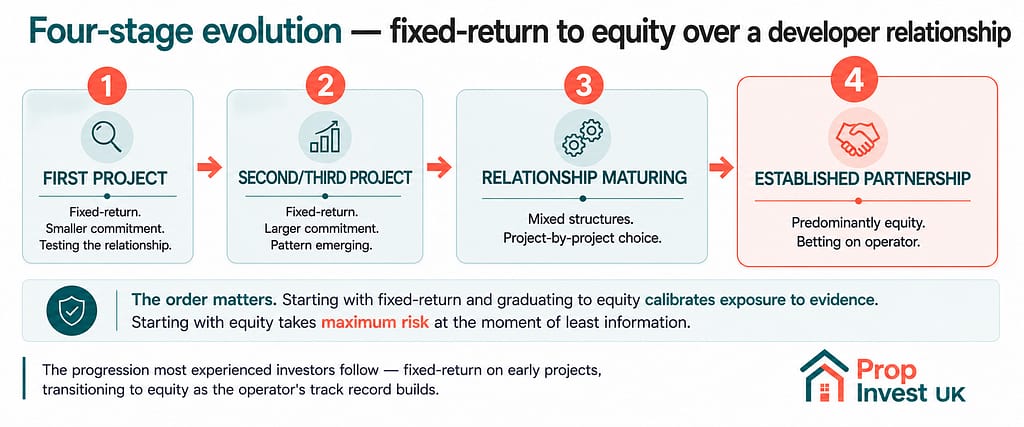
The framing above isn’t a binary choice. Experienced UK private property development investors typically use both structures across their portfolio — and across their relationship with a single developer — depending on what fits at each moment.
A common evolution looks like this:
Stage 1 — First project, fixed return. Investor commits to a single project on a fixed-return structure, sized appropriately for an unproven relationship. The investor sees how the developer communicates, how the project tracks against plan, how the exit is managed.
Stage 2 — Second and third project, fixed return. Same structure, perhaps larger commitment as comfort builds. The investor is testing whether the first project was an anomaly or a pattern.
Stage 3 — Mixed structures. As the relationship matures, the investor begins to take equity positions in some projects alongside fixed-return positions in others. Different projects suit different structures — a lower-risk PD conversion might warrant fixed-return; a complex Article 4 HMO with higher projected margin might warrant equity participation.
Stage 4 — Predominantly equity. Where the relationship has matured into a genuine capital partnership, equity becomes the default structure. The investor is betting on the operator, not just on individual projects.
This is the progression we described in Jason’s story in the SSAS article: starting with fixed-return lending across multiple projects, then transitioning to share-based equity participation as the relationship matured and the operator’s track record was directly evidenced.
It’s worth noting that the order matters. Investors who start with equity participation in their first project with a new operator are taking maximum exposure at the moment they have least information. Investors who start with fixed-return and graduate to equity are calibrating exposure to evidence — which is generally the more disciplined approach.
The hybrid structures
Pure fixed-return and pure equity are the two endpoints. Many UK private development capital structures combine elements of both. Worth understanding the common variants:
Preferred equity
A structure that sits between debt and equity. The investor takes an equity stake but with priority rights — typically a defined preferred return that gets paid before the developer’s profit share, plus participation in any residual upside.
Preferred equity captures some of the predictability of fixed-return (the preferred return) and some of the upside of equity (the participation in residual profit). It’s also more junior than pure debt, so it carries higher risk than a fixed-return loan.
Profit share with floor
A fixed-return loan with an additional profit-share component if the project outperforms a defined threshold. The investor receives a minimum guaranteed return regardless of project outcome (subject to the project being able to pay), plus a share of any upside above projection.
This structure is useful where an investor wants a defined floor but doesn’t want to cap their upside entirely. It tends to be less common than pure fixed-return or pure equity because it requires more complex documentation.
Convertible debt
A loan that can convert into equity at defined trigger points. Allows the investor to take a debt position initially and convert to equity if certain conditions are met — for example, if a project requires extension, or if the investor wants to participate in a follow-on project.
Loan plus warrants
A fixed-return loan accompanied by warrants — rights to take an equity position in the developer’s wider business at a defined price. Used in some private property development structures, though more common in venture finance.
For most private investors in their first few projects with a new developer, the choice is genuinely between pure fixed-return and pure equity. The hybrid structures tend to appear in more mature relationships where capital partner sophistication and project complexity both warrant them.
The five questions to ask before choosing a structure

Whether you’re looking at an opportunity from us or anyone else, these are the five threshold questions on structure:
1. What is the developer’s track record with this specific type of project?
The structure should match the evidence. New operator + new project type = fixed-return position with appropriate sizing. Established operator + repeated project type = equity participation may be appropriate.
2. What is the projected return at fixed-return vs equity, and what’s the gap?
If the fixed-return option is 10–12% annualised and the equity option projects to 25–30% annualised, the gap is the premium for variance. Whether that premium is worth paying depends on the investor’s circumstances and the project’s risk profile.
3. What are the documented downside scenarios?
A serious developer should be able to show stress-tested project models — what happens to returns if costs run 10% over, if sales come in 5% below comparables, if the project runs 3 months long. Those scenarios affect equity and fixed-return positions differently, and the differences should be explicit.
4. What is the position in the capital stack?
For fixed-return: is the loan secured, what security position, what’s the recourse if the project can’t repay. For equity: what’s the priority order in distributions, what protections exist before equity loses capital.
5. What documentation is in place?
Loan agreements with proper security documentation, shareholders’ agreements with clear distribution waterfalls, articles of association that reflect the agreed structure. Verbal arrangements or under-documented structures are a sign to slow down, not speed up.
A developer who can answer all five with detail and supporting documentation is operating at the right level of professionalism. One who can’t, isn’t.
How we structure investor participation at Prop Invest UK
At Prop Invest UK, we structure investor participation across both fixed-return and equity formats, with the structure for any specific project agreed deal-by-deal based on:
- The investor’s stage of relationship with us
- The investor’s capital structure (SSAS, personal capital, corporate capital)
- The project’s specific risk profile
- The investor’s stated preferences on return shape, variance, and involvement
Our default with investors new to us is fixed-return participation on first projects, sized appropriately for an unproven relationship. As track record builds across completed projects, we typically offer the option to participate in subsequent projects through equity structures — at the investor’s choice, not at our insistence.
For every project we structure for capital partners — fixed-return or equity — the documentation includes:
- Clear position in the capital stack
- Stress-tested project models showing downside scenarios
- Defined distribution waterfall (for equity) or repayment schedule (for fixed-return)
- Independent legal documentation of the structure
- Direct contact with us throughout the project
The structure is a decision the investor makes, not one we impose. Our job is to make sure the options are clear and the documentation supports whichever structure is chosen.
In summary
Fixed-return loans and equity participation are the two primary structures available to UK private property development investors. They are not interchangeable. Each is the right answer in different circumstances.
Fixed-return suits investors new to a developer, investors who need predictability, and investors deploying pension or trust capital where defined-return structures fit better. The return is capped at the interest rate but the position is more protected.
Equity suits investors with established trust in a developer, investors comfortable with variance in exchange for higher expected returns, and investors seeking exposure to project outperformance. The return is higher in strong outcomes and lower (or negative) in weak ones.
Most experienced investors use both structures across their portfolio, often evolving from fixed-return to equity as the relationship with a specific developer matures. The order matters: starting with fixed-return and graduating to equity calibrates exposure to evidence. Starting with equity on an unproven relationship takes maximum risk at the moment of least information.
The five questions to ask of any structure on offer:
- What is the developer’s track record with this specific project type?
- What is the projected return at each structure, and what’s the gap?
- What are the documented downside scenarios?
- What is the position in the capital stack?
- What documentation is in place?
A developer offering both structures, explaining the trade-offs honestly, and letting the investor choose, is operating at the right end of the discipline. A developer pushing one structure regardless of context, isn’t.
If you want to discuss which structure might fit your specific circumstances and current opportunities, you can join the Prop Invest UK investor list. We share specific development opportunities with capital partners and discuss structural options deal-by-deal.
This article is general information only and is not financial advice. Development carries risk; capital is at risk. Returns and outcomes on any specific project depend on planning, construction, market conditions, and execution factors that vary by deal.