
Most property owners experience natural appreciation — the market goes up over time, and the value of their property goes up with it. They didn’t do anything to cause it; they owned the asset at the right time.
Property developers do something different. They create value through deliberate action — through planning expertise, physical conversion, density optimisation, specification upgrade, and asset repositioning. The technical term for this is forced appreciation, and it’s the single mechanism that separates property developers from property investors.
This guide explains what forced appreciation actually is, the five mechanisms that create it, why it works regardless of what the wider market does, and how the Mozarts conversion in Swansea illustrates all five mechanisms applied to a single project — where the same building has carried three completely different values during the project lifecycle.
The fundamental distinction
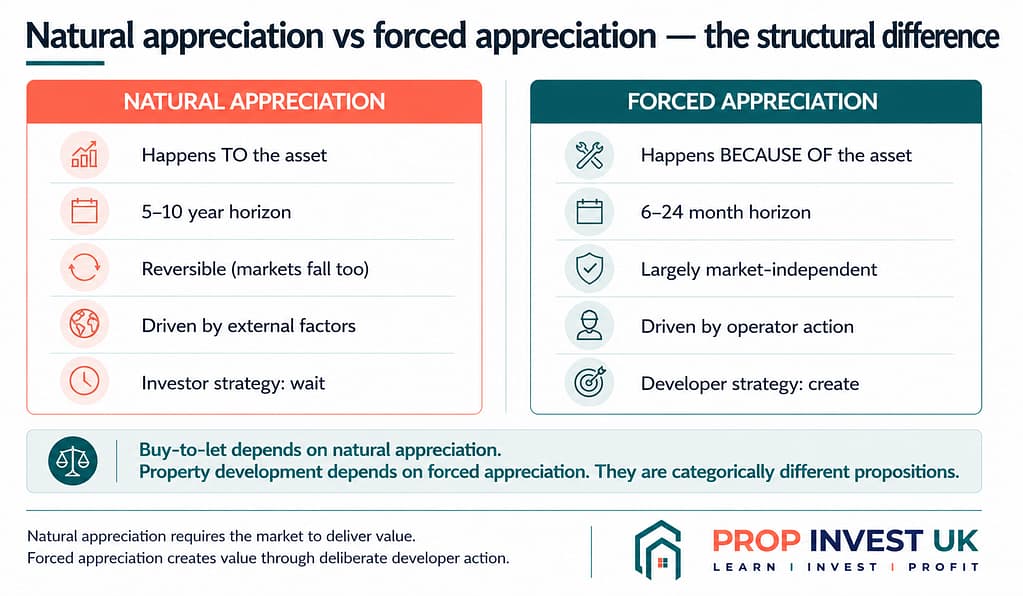
Property as an asset class produces two kinds of value gain. Understanding the distinction is the difference between thinking like a buy-to-let investor and thinking like a property developer.
Natural appreciation
This is what most people mean when they talk about property “going up in value.” The wider market moves, and individual properties move with it. Inflation, demographic shifts, interest rate cycles, regional economic trends, infrastructure investment — all push property values upward over long time horizons.
Natural appreciation has three characteristics:
- It happens to the asset, not because of the asset. The owner doesn’t cause it.
- It’s slow. Meaningful natural appreciation typically requires 5-10 years.
- It’s reversible. Markets fall as well as rise.
Buy-to-let investing is largely a natural appreciation strategy. The investor buys a finished property at market value, collects rent, and waits for the market to do the work. The return is the combination of rental yield and long-term capital appreciation, both of which depend heavily on factors outside the investor’s control.
Forced appreciation
Forced appreciation is the opposite. It’s value created through deliberate action — specific things the owner does to the property that increase its value, regardless of what the wider market does.
Forced appreciation has three opposite characteristics:
- It happens because of what the owner does. The owner causes it.
- It’s fast. Meaningful forced appreciation typically takes 6-24 months.
- It’s largely market-independent. A planning consent that doubles a property’s value is worth what it’s worth even if the wider market is flat.
Property development is fundamentally a forced appreciation strategy. The developer’s value-add isn’t waiting for the market to move — it’s making the property move through specific, repeatable actions that experienced developers know how to execute.
For investors evaluating UK property opportunities, the distinction matters because the two strategies produce different return profiles, different time horizons, and require different operator capabilities. A buy-to-let landlord doesn’t need to know how to create forced appreciation. A property developer’s entire business is built on knowing how to create it consistently.
The five mechanisms that create forced appreciation
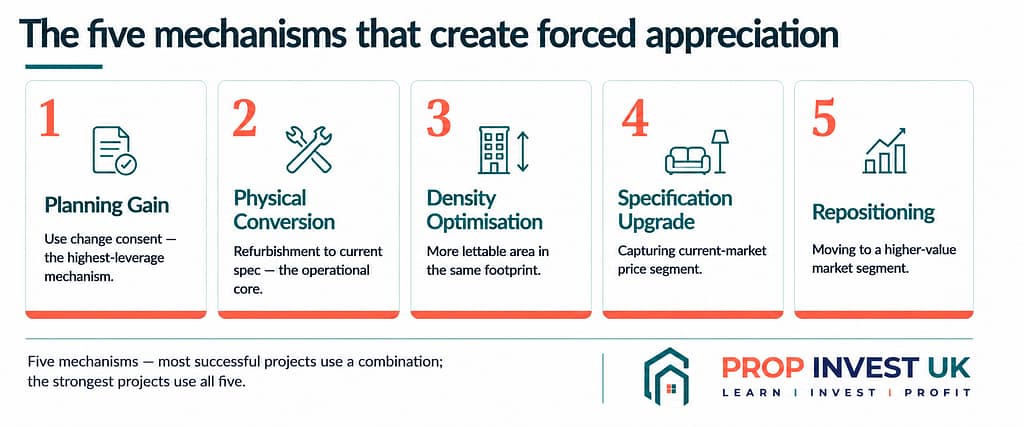
There are five primary mechanisms a developer uses to create forced appreciation in UK property. Most successful projects use a combination; the strongest projects use all five.
Mechanism 1: Planning gain
The single largest lever in UK property development. Planning gain is the increase in property value that occurs when a property’s permitted use is changed to something more valuable — usually before any physical work has been done.
In UK planning law, what you’re allowed to do with a property is at least as important as the property itself. A commercial unit consented for conversion to residential. A field consented for housing development. A retail premises consented for conversion to flats. Each of these changes can produce substantial uplift the moment consent is granted.
The uplift exists because planning consent removes the largest single source of project risk: whether the use change is permitted at all. Before consent, the property is worth what it’s worth in its current use plus a speculative premium for the possibility of consent. After consent, the property is worth what it’s worth in its new use, less the cost of getting it there.
We covered the technical detail of planning routes — Permitted Development, full planning, Article 4 conservation areas — in our commercial-to-residential conversion article. The structural point worth absorbing here is that planning gain is the highest-leverage form of forced appreciation in UK property because it can produce significant value uplift before a single brick has been laid.
Mechanism 2: Physical conversion and refurbishment
The most visible form of forced appreciation. Physically changing the property — converting commercial to residential, refurbishing tired space to modern standards, restructuring layouts to optimise usable area, upgrading systems and services.
The value-add comes from three sources: the property is now genuinely worth more than it was before because it’s a better property; the property is now in a market segment with more buyers (which itself supports higher per-unit prices); and the property has compliance and specification features that the previous configuration lacked (EPC ratings, fire safety, current building regulations).
Physical conversion is the operational core of property development. It’s also the activity that separates operators who can deliver from operators who can’t. The mechanism is conceptually simple; the execution requires deep operational capability — contractor relationships, project management, supplier networks, quality control, regulatory compliance, and the experience to handle the unforeseen conditions that always emerge once work begins.
Mechanism 3: Density optimisation
A specific case of physical work focused on getting more lettable or saleable area into the same building footprint.
Common applications include: converting a 4-bedroom house into a 6-bedroom HMO; converting one large commercial unit into multiple smaller residential units; subdividing an oversized flat into two separately-leased units; adding floors or extensions to increase total floor area; converting attic, basement, or outbuilding space into habitable area.
The mathematical leverage of density optimisation is substantial. If a single 4-bed property rents at £1,800/month and the same building configured as a 6-bed HMO rents at £3,600/month (£600/room × 6), the asset is worth materially more on a yield basis even before the wider market moves.
The constraint on density optimisation is regulatory. Article 4 areas restrict HMO conversions in many UK locations. Local planning policies cap the number of units allowed on a site. Building regulations impose minimum room sizes, light requirements, and access standards. Operators who understand the regulatory framework can navigate it to find density opportunities; operators who don’t tend to over-promise on units and under-deliver on consents.
Mechanism 4: Specification upgrade
Bringing a property’s finish, services, and presentation to a current-market specification that supports current-market prices.
The mechanism is straightforward in concept but operationally significant. A 1970s commercial conversion finished with 1990s residential specification will sell or rent at prices the 1990s residential market supports — not the 2026 market. Specification upgrade — current kitchens, current bathrooms, current heating systems, current insulation standards, current finishes — captures the price differential between dated specification and current market.
The specification choice also affects valuer behaviour at refinance, which we covered in detail in our unicorn deals article. A property specified for the upper end of its market segment supports valuations that a property specified for the middle of the segment cannot.
Mechanism 5: Repositioning
Repositioning is the most strategic of the five mechanisms. It involves moving a property from one market segment to a higher-value one — typically by changing the type of buyer or tenant the property is targeting.
Examples: a tired commercial building in an area that’s gentrified around it, repositioned as residential targeting young professionals. A small student HMO in a market that’s shifting toward postgraduate and professional rentals, repositioned as a higher-spec professional HMO. A regional retail unit in a town centre losing footfall, repositioned as a mixed-use development with residential above.
The repositioning mechanism creates value by capturing the gap between what a property is worth in its current market segment and what it could be worth in a higher segment. The skill is identifying the gap before the market does — recognising where local dynamics are shifting and positioning the project to capture the new value before the wider market catches up.
Why forced appreciation works regardless of the market

The most important strategic feature of forced appreciation — and the one that distinguishes developer activity from buy-to-let investing — is that it largely works independently of market direction.
Consider three scenarios.
Scenario 1: Rising market
The wider UK property market rises 5% over the project lifecycle. The Mozarts conversion in Swansea is acquired at £625,000, planning consent secured, conversion delivered, and the completed scheme sells at £2.48 million.
In this scenario, the natural appreciation contribution (5% on £625,000 = £31,250) is a small fraction of the total value uplift. The bulk of the £1.85m gross uplift (before costs) comes from forced appreciation — planning gain, conversion, density optimisation, specification, repositioning.
Scenario 2: Flat market
The same project, but the wider market is flat over the project lifecycle. The acquisition is still £625,000, the consent is still granted, the conversion is still delivered, and the completed scheme is still worth substantially more than £625,000 — because the value was created, not inherited.
In a flat market, forced appreciation isn’t reduced because the market didn’t help. It’s the entire value uplift. The £1.85m+ of gross uplift in Mozarts comes from what was done to the building, not what happened to the market around it.
Scenario 3: Falling market
The same project, but the wider market falls 5%. Most assets lose 5% of value. The Mozarts conversion still completes and still sells.
In this scenario, the wider market subtracts roughly £31,000 of value (5% on £625k natural component). But the forced appreciation — the £1.8m+ created through planning consent, conversion, density, specification, and repositioning — is largely intact. The project still produces a substantial uplift, just slightly less than it would have in a rising market.
The strategic implication
This is the structural reason serious property capital partners prefer development to buy-to-let in 2026. Buy-to-let depends on natural appreciation, which is depending on the market. Development depends on forced appreciation, which is depending on the operator.
Markets are unpredictable. Operators with track records of consistently delivering forced appreciation are not. For an investor evaluating where to deploy capital, depending on operator skill is more controllable than depending on market direction.
Mozarts as a forced appreciation case study

The 76 Walter Road conversion in Swansea — which we’ve explored from different angles across our conversion article, our overrun article, and our security article — is a clear illustration of forced appreciation in practice.
The same building has carried three different values during the project lifecycle:
Stage 1: Acquisition — £625,000
In April 2024, we acquired the two adjoining commercial buildings — the former Mozarts bar/nightclub with its underused upper floor on one side, and the commercial office building on the other — for £625,000.
This was the property’s commercial market value as-is. Two underused commercial buildings in an Article 4 conservation area with no obvious path to value creation for a generalist buyer. The pricing reflected the difficulty of the planning environment and the lack of competition from other developers who couldn’t see (or couldn’t deliver) what the buildings could become.
Stage 2: Planning Consent — substantial uplift
Full planning consent was secured for conversion of both buildings into a single 26-bedroom, fully en-suite HMO. The planning argument — that the proposed use case was structurally different from what the Article 4 restriction was set up to address, and that the design respected and enhanced the conservation area character — was accepted by the local authority.
This is the planning gain mechanism in action. The day the consent was granted, the property’s value moved substantially. The site went from “two awkward commercial buildings in a restricted planning environment” to “a consented 26-unit HMO development site” — a categorically different proposition with a categorically different buyer pool and a categorically different value.
The exact value at this stage isn’t public, but the principle is clear: a substantial portion of the project’s total value uplift was created at the moment of consent, before any physical conversion work began.
Stage 3: Completion — £2.48m GDV
The conversion work currently in build is the physical conversion mechanism — turning the consented site into the 26 finished en-suite rooms that the GDV calculation is built on. Density optimisation is in the mix too: getting 26 rooms into the two-building footprint is materially higher density than the original commercial use supported. Specification upgrade is built into the design: en-suite to every room, communal spec targeting the upper end of the Swansea HMO market. And repositioning is the through-line: the buildings are moving from underused commercial to high-spec professional HMO, capturing the value differential between two completely different market segments.
The projected GDV of £2.48 million reflects all five mechanisms layered onto the original £625,000 acquisition.
What this illustrates
A single property. £625,000 → substantial planning uplift → £2.48m completed value. All five forced appreciation mechanisms applied to one building in a 26-month period. The gross uplift in value is roughly four times the acquisition price.
Some of that uplift becomes development margin (the gap between GDV and total project cost). Some of it pays for the cost of executing the conversion. None of it depends on the wider market rising, falling, or staying flat over the project lifecycle.
This is what forced appreciation looks like applied at industrial scale by an operator with the capability to deliver across all five mechanisms simultaneously.
What separates operators who deliver forced appreciation from those who don’t
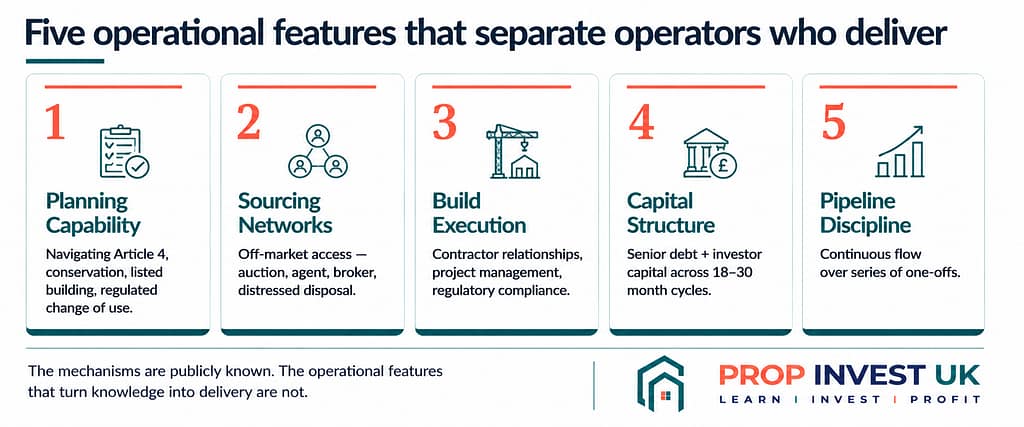
The five mechanisms are well-known. Every property investor educational programme covers them. But knowing the mechanisms and consistently delivering them across a pipeline of projects are categorically different skills.
Five operational features distinguish operators who consistently produce forced appreciation from those who talk about it without delivering:
1. Planning capability
Operators who can navigate complex UK planning environments — Article 4 areas, conservation areas, listed buildings, regulated use changes — can pursue forced appreciation opportunities that simpler operators can’t touch. The Mozarts consent in an Article 4 conservation area is exactly this kind of capability in evidence: most operators would have walked away from the site; the value creation is precisely because of the planning complexity.
2. Sourcing networks
Forced appreciation requires acquisition prices that leave room for the value to be created. Operators sourcing from Rightmove are paying retail. Operators with off-market sourcing relationships — auction professionals, estate agent introductions, broker networks, distressed disposal contacts — get access to acquisition opportunities that competitive market dynamics don’t produce.
The Mozarts acquisition at £625,000 wasn’t the result of getting lucky on a market listing. It was the result of being the operator the introduction came to because the relationship history was there.
3. Build execution capability
Planning gain creates paper value. Physical conversion turns paper value into realisable value. The gap between the two is execution — contractor relationships, project management, supplier networks, regulatory compliance, quality control. Operators with execution capability deliver the consented projects; operators without it accumulate consented sites they can’t convert.
4. Capital structure that supports the activity
Forced appreciation typically requires capital for acquisition, build, and finance costs across an 18-30 month project cycle. Operators with reliable capital access — senior development finance relationships, private investor capital partnerships, structural understanding of how to layer capital across the project lifecycle — can pursue projects that capital-constrained operators can’t.
The combination of Signature senior finance and investor capital partners at Mozarts is exactly this kind of capital structuring in action — and it’s why the project could be acquired, consented, and converted on a timeline that produces forced appreciation at scale.
5. Pipeline discipline
The single most underappreciated skill. Operators who pursue individual deals on individual merits tend to over-pay on the most exciting opportunities and miss the systematic pipeline thinking that produces consistent forced appreciation across years.
Pipeline discipline means evaluating every opportunity against the full portfolio of activity, walking away from deals that don’t show forced appreciation potential regardless of how interesting they look in isolation, and treating the operation as a continuous flow rather than a series of one-off transactions. This is the discipline that produces consistent unicorn deal outcomes at BRR scale and consistent forced appreciation at conversion scale.
What this means for investors
For a private investor evaluating UK property opportunities, the forced appreciation framework has practical implications.
When evaluating an operator’s track record
The relevant question isn’t did the projects make money. The relevant question is where did the money come from. An operator whose track record consists of buying properties, holding them through rising markets, and selling them at uplifts attributable to natural appreciation hasn’t demonstrated forced appreciation capability. The same returns produced by operators who delivered planning gain, executed conversions, optimised density, or repositioned assets are categorically different evidence.
When evaluating an opportunity
Ask specifically: what forced appreciation mechanisms are creating value in this project, and how much of the projected uplift comes from each one. Capable operators can disaggregate the answer. Planning gain contributes X. Physical conversion adds Y. Density optimisation creates Z. The total uplift is the sum of identifiable, mechanism-specific value creation — not a vague hope that the property will be worth more when finished.
Vague answers — “we’re confident the value will be higher when complete” — are signals that the operator either doesn’t understand their own value-creation thesis or doesn’t want to expose it to scrutiny.
When evaluating the operator’s relationship to the market
This is the deeper question. An operator whose business model depends primarily on natural appreciation is a buy-to-let landlord scaled up. An operator whose business model is built around forced appreciation is a developer. The two are completely different propositions for investors, and the right choice depends on the investor’s preferences.
For investors who prefer market-dependent returns with longer time horizons and lower operational complexity, scaled buy-to-let or property funds may fit better. For investors who prefer market-independent returns with shorter time horizons and higher demand for operator quality, development with forced appreciation as the core mechanism is the structural fit.
Our operation is firmly in the second category. The Mozarts project is forced appreciation across all five mechanisms in a single project. We apply the same disciplines across a continuous pipeline of regional projects.
How forced appreciation connects to the other pieces in the puzzle
Forced appreciation isn’t a standalone concept. It connects to the other strategic frameworks we’ve covered in our investor content:
- It’s the mechanism that creates the GDV uplift we covered in our GDV article. GDV is the measurement; forced appreciation is what produces the measurement.
- It’s the structural reason no-money-left-in unicorn deals are possible. The property is worth more after the work than before because forced appreciation was applied successfully — and the 75% LTV refinance only works if the post-work value supports it.
- It’s the operating principle behind every project in our portfolio. Whether the project is a BRR refurbishment leaving zero capital in the deal, or a £2.48m conversion like Mozarts, the underlying mechanism is the same — deliberate value creation through planning, conversion, density, specification, and repositioning.
- It’s the structural feature that makes the investor security and overrun resilience approaches we cover in those articles actually meaningful. A second legal charge on a project with substantial forced appreciation is materially different from a second legal charge on a project that depended on the market rising — because the protective buffer exists regardless of market direction.
Understanding forced appreciation is understanding how UK property development actually works. The rest of the strategic content sits on top of it.
In summary
Forced appreciation is value created through deliberate developer action, in contrast to natural appreciation which depends on the market. It’s the single mechanism that distinguishes property developers from property investors, and it’s the structural reason development can produce meaningful returns regardless of which direction the wider market moves.
The five mechanisms are: planning gain (the highest-leverage), physical conversion and refurbishment (the operational core), density optimisation (the mathematical leverage), specification upgrade (the price segment lever), and repositioning (the strategic mechanism).
Mozarts at 76 Walter Road, Swansea illustrates all five applied to one project: £625,000 acquisition, substantial planning uplift on consent, £2.48m completed GDV. Roughly four times the acquisition value created over a 26-month project lifecycle, almost entirely independent of what the wider market did over the same period.
Operators capable of consistently delivering forced appreciation have five distinguishing features: planning capability, sourcing networks, build execution, capital structuring, and pipeline discipline. Operators who lack these features can talk about the mechanisms without delivering them.
For investors:
- Evaluate operator track records by where the returns came from, not just whether they were made
- Ask any opportunity for a mechanism-by-mechanism breakdown of where projected uplift comes from
- Recognise that operators dependent on natural appreciation are running a fundamentally different business from operators built around forced appreciation
- Match your investor preferences to the operator type that fits
An operator who can deliver forced appreciation across multiple mechanisms in difficult planning environments, sourced through off-market networks, executed through disciplined build relationships, structured with appropriate capital, and managed as a pipeline rather than a series of deals — is operating at the level UK property development actually requires.
One who can’t, isn’t.
If you want to participate as a capital partner in projects where forced appreciation across all five mechanisms is the operating principle — you can join the Prop Invest UK investor list. We share specific opportunities with capital partners and welcome the structural due diligence approach we’ve described across our content.
This article is general information only and is not financial advice. UK property development carries risk; capital is at risk. Outcomes on individual projects depend on planning, construction, market conditions, valuation, and execution factors that vary by deal. Past project outcomes are not indicative of future performance.