
“Property-backed investing” is one of the most-used phrases in UK private capital, and one of the most loosely defined. It describes a category — investments connected to physical property assets — rather than a single product or structure. Underneath the category sit several very different arrangements with very different risk profiles, return characteristics, and structural protections.
This article exists to define the category clearly, distinguish the main structural forms it takes, and point readers toward the deeper analysis on each form. It is designed as the entry point for investors orienting themselves to the property-backed space — not as a substitute for the more detailed pieces that follow on specific structures.
What “property-backed” actually means
A property-backed investment is one where the investor’s capital is connected to physical property assets — land, buildings, development projects, or income-producing residential or commercial stock. The “backing” is what creates the link between the investment and something tangible and valuable, rather than a purely financial claim against a company’s cashflows.
That backing matters because it produces a clearer line of sight between the investment and an underlying asset that has measurable value, can be independently valued, and (in most structures) can be sold or used as security if the arrangement needs to be unwound. Property doesn’t behave like an equity or a bond. It produces income from rent rather than dividend or coupon. Its value is influenced by physical condition, location, planning status, and tenant demand rather than primarily by financial market conditions. And it is, in the most direct sense, something the investor can stand in.
The phrase sits inside a broader institutional category called asset-backed finance — a global market valued at over $5.2 trillion (📊 source: TwentyFour Asset Management, 2026) that includes lending and investment secured by financial or hard assets, of which property is the largest single asset class. Property-backed investing for individual UK investors is the retail and HNW expression of that broader institutional model.
The structural forms property-backed investing takes
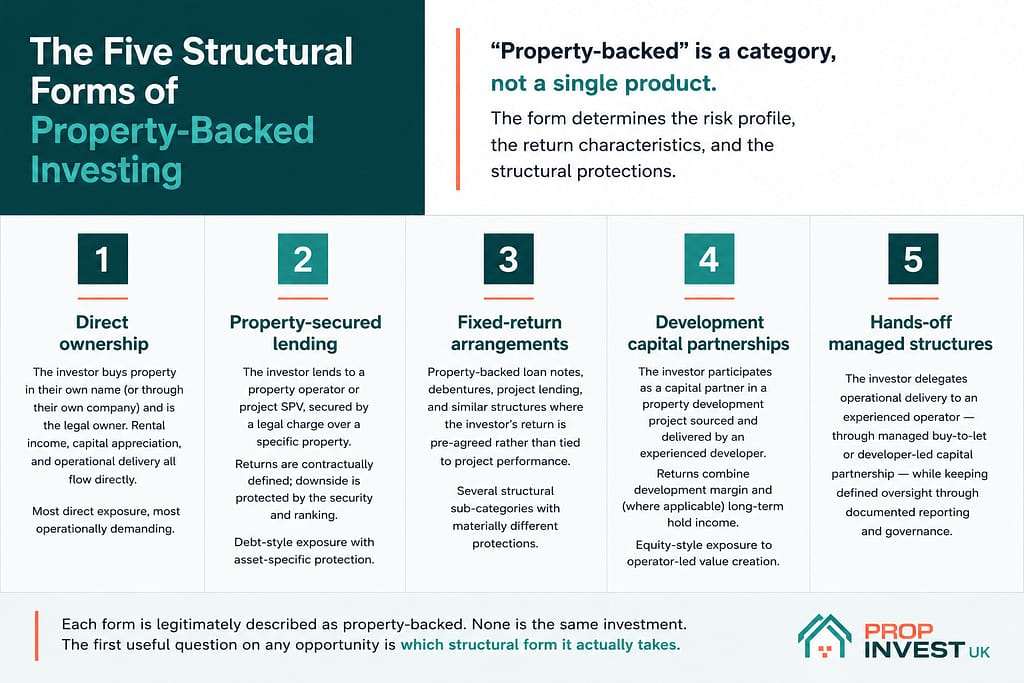
The phrase “property-backed” hides at least five materially different structures. They are not interchangeable, and the right one depends on whether the investor wants debt-style or equity-style exposure, defined-term or open-ended commitment, and direct ownership or capital partnership.
Direct ownership. The investor buys property in their own name (or through a company they own) and is the legal owner of the asset. Rental income flows directly; capital appreciation accrues directly; operational delivery is the investor’s responsibility. This is the most direct form of property exposure and the most demanding operationally.
Property-secured lending. The investor lends to a property operator or project SPV, secured by a legal charge over a specific property. Returns are fixed or variable based on the loan terms; downside is protected by the security and ranking. For deeper analysis of how legal charges, ranking, and LTV work in this structure, see the property secured investment guide.
Fixed-return arrangements. Property-backed loan notes, debentures, project lending, and similar structures where the investor’s return is contractually defined rather than tied to project performance. Several distinct structural categories sit under this label, with materially different protections. The fixed return property investment guide covers the four main structural forms in detail.
Development capital partnerships. The investor participates as a capital partner in a property development project sourced, structured, and delivered by an experienced developer. Returns are typically a combination of development margin and (where applicable) long-term hold income. The how to invest in real estate development guide covers the capital partner route and its mechanics.
Hands-off arrangements via managed structures. The investor delegates operational delivery to an experienced operator — either through a managed buy-to-let arrangement or a developer-led capital partnership — while keeping defined oversight through reporting and governance. The hands-off property investment guide distinguishes the two structurally distinct models inside this category.
Each of these forms is legitimately described as property-backed. None of them is the same investment. The first useful question on any opportunity is which structural form it actually takes.
The 2026 UK context
Property-backed investing has gained meaningful share of UK private capital in 2026, driven by structural shifts the cluster’s other articles cover in depth.
Personally-held buy-to-let has come under sustained pressure from Section 24 mortgage interest restriction, multiple stamp duty increases, the Renters’ Rights Act 2025 commencement in May 2026, and rising compliance costs — with around 93,000 landlord exits recorded in 2025. The capital released by those exits is increasingly redirecting into operator-led structures rather than leaving the asset class entirely. At the same time, mainstream bank lending against UK property has tightened under Basel IV regulatory capital requirements, leaving experienced developers more dependent on private capital partnerships to fund schemes that would once have sat with clearing banks.
The combination produces the current market dynamic: capable operators looking for capital, sophisticated investors looking for property exposure without operational ownership, and structural arrangements increasingly designed to connect the two cleanly. For deeper market commentary on these trends, see the UK property investment trends article.
What separates strong property-backed arrangements from weak ones
Regardless of the structural form, well-constructed property-backed investments share consistent features.
The underlying asset is real, valued, and verifiable. Independent professional valuation from a RICS-registered surveyor, dated within reasonable proximity to the investment. Title registered at HM Land Registry. Physical property the investor can — in principle — visit and assess.
The legal structure is documented and specific. Loan agreement, security trustee deed, partnership agreement, subscription agreement — whichever applies. The relationship is governed by the documents, not by conversation or marketing material.
The investor’s position is clearly defined. Where capital sits in the structure, what security supports it, what ranking applies, what reporting obligation exists, what governs decisions when conditions change.
The operator is credible and accountable. Specific track record on comparable arrangements. Reporting standards that survive period-over-period scrutiny. Demonstrated discipline under pressure on previous projects. The cluster covers operator assessment in depth in the top property due diligence checks article and the investor reporting standards article.
The exit is realistic and optional where possible. Schemes designed with single-route exits carry more risk than schemes designed with refinance, sale, or hold optionality. The operators who survive across cycles are typically the ones who build exit optionality at the structural level rather than improvising at completion.
When these features are present, the arrangement is genuinely property-backed in the substantive sense. When any of them is vague or missing, the “property-backed” label is doing marketing work rather than describing structural reality.
Where to go from here
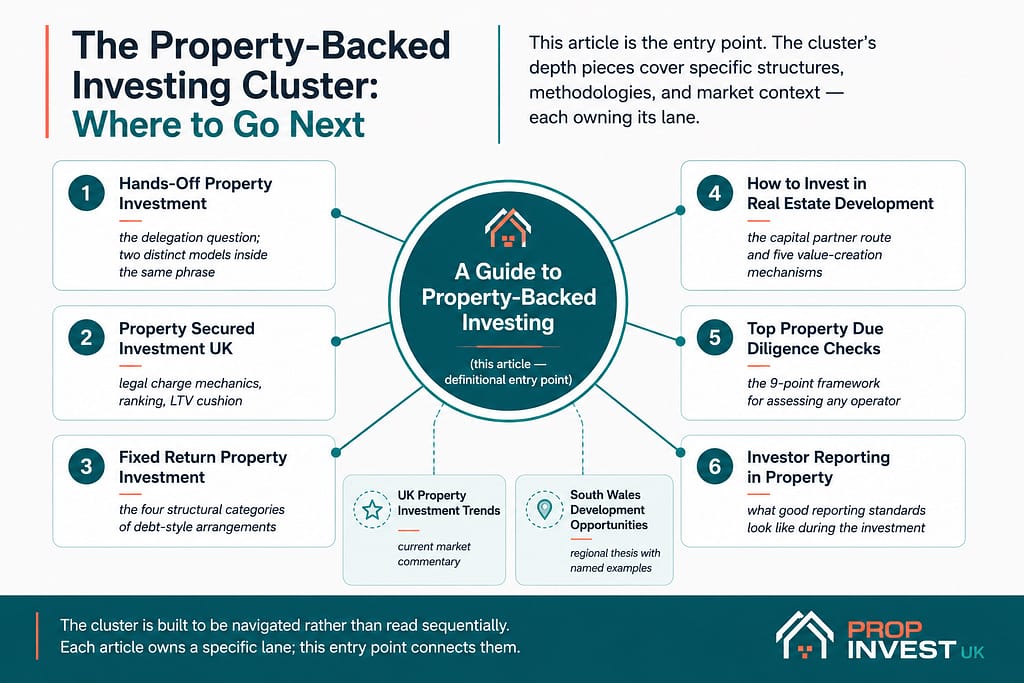
This article is the entry point to a broader cluster covering property-backed investing in depth. The natural next reads depend on what an investor is trying to assess:
- If the question is what each structural form actually involves → start with the hands-off property investment guide for the two main models, then either the fixed return property investment guide or the property secured investment guide for the specific structural form.
- If the question is how to assess any operator or opportunity → the top property due diligence checks article gives the 9-point framework, and the investor reporting standards article covers the assessment-during-investment side.
- If the question is how property-backed investing fits in a wider investment strategy → the UK property investment trends article gives the current market context, and the how to invest in real estate development guide covers the capital partner route and the value-creation mechanics behind it.
- If the question is specifically about UK regional development opportunities → the South Wales development opportunities article covers the regional thesis with named operational examples.
This cluster is built to be navigated rather than read sequentially. Each article owns a specific lane; this one connects them.
How Prop Invest UK fits
Prop Invest UK is a property development business working with investors who want exposure to UK property development as capital partners on specific projects. The operational delivery — sourcing, planning, construction, refinance or sale — sits with an experienced developer (Vernon Property Group), with the investor participating through a defined structure on a deal-by-deal basis.
This is one of several legitimate property-backed routes — not the only one. Whether it fits any specific investor depends on their objectives, capital position, time horizon, and the alternatives available. The educational material across this cluster is designed to help investors assess any property-backed opportunity from any operator, including assessing whether the PIUK route is the right fit for their position.
For investors orientating themselves to the property-backed space for the first time, the most useful sequence is usually: understand the category broadly (this article), then read the depth piece relevant to the structural form being considered, then apply the diligence framework to the specific operator. Doing it the other way round — committing to a specific opportunity before understanding the structural alternatives — tends to produce decisions made under conversion pressure rather than from a position of structural clarity.
—
About Prop Invest UK
Prop Invest UK is a property development business working with investors who want exposure to UK property development without taking on operational delivery themselves. Each opportunity is sourced, structured, and delivered by an experienced developer, with investors participating as capital partners on a deal-by-deal basis.
Join the investor list to receive details of future opportunities as they become available, subject to investor qualification and project documentation.
—
This article is for general information purposes only and does not constitute financial advice or an offer to invest. UK property-backed investments involve risk, including the risk of capital loss, and returns are not guaranteed. Past performance is not a reliable indicator of future results. Any specific opportunity is offered only to investors who qualify under the relevant exemptions and have received the full project documentation. If you are uncertain whether an investment is suitable for your circumstances, you should consult an FCA-authorised financial adviser.
—