
There is a meaningful difference between hands-off and hands-blind. Most of the content on UK hands off property investment treats the two as the same thing, and the conflation is where serious investors lose money.
A properly structured hands-off arrangement removes the operational burden of property ownership while keeping the investor close to the commercial substance of what their capital is doing. A poorly structured one removes the operational burden and the visibility, leaving the investor reliant on trust and tone of voice rather than on documents, reporting, and structural protections.
This article is a framework for telling the difference. It defines what hands off property investment should mean when used properly, sets out what good delegation actually looks like, and provides the questions a serious investor uses to test the gap between the marketing language and the underlying structure.
What “hands off” should mean in this context
A hands-off property investment is an arrangement where the investor’s capital is exposed to UK property without the investor taking on the operational delivery — no sourcing, no contractor management, no tenant relationships, no compliance obligations. The execution sits with an experienced operator. The investor’s role shifts from running property to selecting operators, selecting structures, and maintaining oversight through reporting.
That definition has two halves, and the second half is the one most operators leave out.
Delegation is operational. The investor isn’t running the project day-to-day. That part is uncontroversial and is what every operator in this market emphasises.
Oversight is governance. The investor stays close to the commercial reality of the arrangement — documentation, reporting, milestone progression, material variations, exit timing. The investor doesn’t run the asset; they monitor it. That part is what genuinely well-structured arrangements build in deliberately, and what weaker arrangements quietly remove.
Hands-off describes your role in delivery. It should not describe your level of scrutiny.
Why the distinction matters more in 2026
The category is growing. From 1 May 2026, the first phase of the Renters’ Rights Act 2025 came into force in England, ending Section 21 no-fault evictions and introducing new obligations on landlords and agents (📊 source: gov.uk, May 2026 commencement). Combined with sustained changes to Section 24 tax treatment, multiple stamp duty increases, and EPC regulation, the operational burden of running property directly has materially increased.
Investor demand has shifted accordingly. Around 93,000 landlords exited the UK rental market in 2025 (📊 source: Homenicom analysis via Mortgage Soup, March 2026), and a meaningful proportion of that capital is now looking for delegated property exposure rather than leaving the asset class entirely. The hands-off category has grown to meet that demand.
What’s grown alongside it is the volume of operators describing arrangements as “fully managed” or “hands-off” where the underlying delegation is weak, the reporting is sparse, or the investor’s structural protections are thin. Demand has commoditised the language. Investor discipline in reading the structure underneath the language has to rise in proportion.
The two distinct models hiding inside the same phrase
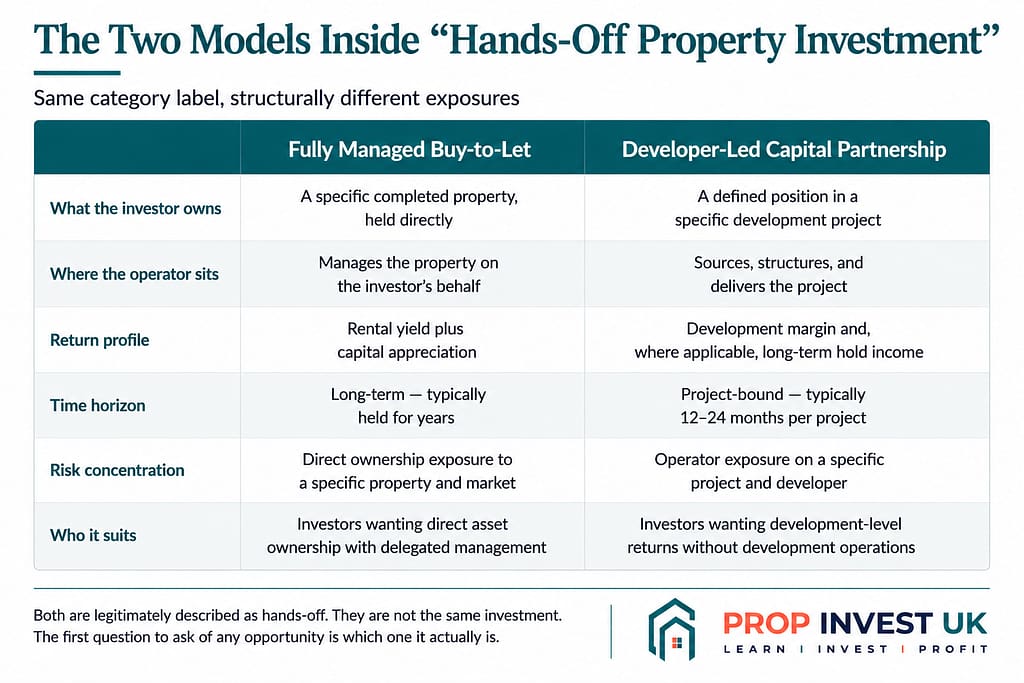
When operators describe arrangements as hands-off property investment, they typically mean one of two structurally different things.
Fully managed buy-to-let. The investor buys a property — usually a completed unit, often off-plan or in a regeneration area — and a management partner handles tenanting, compliance, maintenance, and reporting. The investor owns the asset directly; the operator manages it on the investor’s behalf. The return profile is rental yield plus capital appreciation. The investor carries direct ownership exposure to the specific property.
Developer-led capital partnership. The investor participates as a capital partner in a UK property development project sourced, structured, and delivered by an experienced developer. The execution — sourcing, planning, build, refinance or sale — sits with the operator. The investor’s economic position is defined by the specific structure of the participation, which can be a development capital partnership, a secured arrangement, or a profit-share. The return profile is development margin and, where applicable, long-term hold income on completed assets. The investor carries operator exposure on the specific project.
These are different exposures. Fully managed BTL is asset ownership with management delegation. Developer-led capital partnership is project participation with the development executed by the operator. Different return profiles, different risk structures, different time horizons, different appropriate investor profiles.
Both can legitimately be described as hands-off property investment. They are not the same investment. The first question to ask of any opportunity presented under this language is which one it actually is.
What good delegation actually looks like
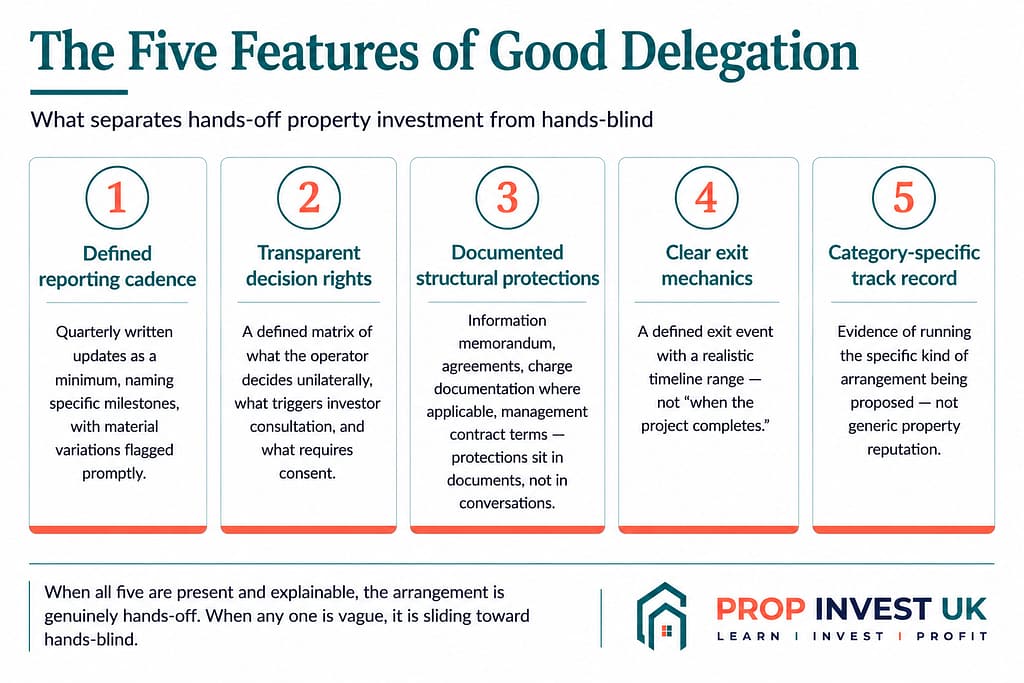
Across both models, well-structured hands-off arrangements share a small number of consistent features. The operators worth backing build these in deliberately because they understand that oversight isn’t a burden on the investor relationship — it’s what makes the relationship durable.
Defined reporting cadence. Quarterly written updates as a minimum, naming specific project or asset milestones, with material variations flagged promptly rather than discovered at year-end. Vague monthly emails or ad-hoc updates are not reporting — they’re communication theatre.
Transparent decision rights. The investor and operator should both know which decisions the operator can make unilaterally, which trigger investor consultation, and which require investor consent. “We’ll keep you informed” is not a governance structure. A defined decision matrix is.
Documented structural protections. Whatever the model — direct ownership with management contract, capital partnership with legal charge, development partnership with profit share — the protections sit in documents, not in conversations. Information memorandum, partnership or shareholder agreement, charge documentation where applicable, management contract terms. Sparse paperwork is itself a structural weakness.
Clear exit mechanics. When and how does the arrangement end? For managed BTL, what’s the disposal route and the management contract notice period? For development capital partnership, what’s the exit event and the typical timeline range? “When the project completes” is a description. A defined event with a realistic timeline range is an exit mechanic.
Track record on the specific category of arrangement. Generic property reputation is not the same as evidence of having run the specific kind of arrangement being proposed. Operators running managed BTL should show previous units, previous management performance, previous investor outcomes. Operators running capital partnerships should show previous projects, previous investor returns at the end of previous terms, previous handling of variations or delays.
When these five features are present and explainable, the arrangement is genuinely hands-off in the meaningful sense. When any of them is vague, the arrangement is sliding toward hands-blind.
The questions to interrogate before delegating capital
Before committing capital to a hands-off property investment, the questions that distinguish a real arrangement from a marketed one:
- Is this fully managed BTL (you own the asset, operator manages it) or capital partnership (you participate in a project the operator delivers)? They are different exposures.
- What documents will define your position, and can you see drafts before committing?
- What’s the reporting cadence and format? Can you see an example of a previous report from a comparable arrangement?
- What decisions can the operator make unilaterally? Which require investor consent?
- What’s the exit event and timeline? What happens if it slips?
- What’s the operator’s track record on this specific category of arrangement — not general property reputation, but evidence of running comparable arrangements through completion?
- Who do you contact if you have a concern between reporting cycles, and what response standard exists?
- What’s the operator’s communication discipline when things don’t go to plan? Ask for an example from a previous arrangement where something slipped.
If an operator can’t answer all eight of these clearly, the arrangement isn’t ready for capital — regardless of how attractive the headline opportunity sounds.
Risk doesn’t disappear when you delegate — it concentrates
A hands-off structure does not remove risk. It changes the shape of risk and concentrates it in a small number of places.
The primary risks in a properly delegated arrangement:
Operator competence risk. When the investor is not running execution, operator quality is the dominant variable. A capable operator delivering a moderate opportunity will outperform a weak operator delivering a strong one. This is the risk that compounds across the life of the arrangement and the one investors most often underweight.
Project or asset-specific risk. Planning delays, build cost movement, refinance friction, lettings market shifts, valuation movement on exit. These are real and present in every UK property arrangement regardless of structure. Well-run operators build conservative assumptions, contingency, and exit flexibility to manage them. Weak operators discover them.
Structural risk in the arrangement itself. Documentation gaps, weak security ranking, sparse governance provisions, no clear escalation path. These usually only become visible at the point they matter — when the underlying project or asset hits friction. Well-structured arrangements address them at the outset. Weak ones surface them at distress.
The honest framing is that the operator manages risk during the life of the arrangement, but the investor’s job is to assess risk before capital is committed. The diligence work the investor does at the outset is what protects against the risks that arise later.
Who hands off property investment suits — and who it doesn’t
A properly structured hands-off arrangement suits investors who:
- Have meaningful capital and limited operational appetite
- Value time more than they value direct control of every decision
- Are comfortable delegating execution to operators they have diligenced properly
- Want UK property exposure as part of a broader portfolio rather than as a primary occupation
- Understand that oversight is part of being a hands-off investor, not absence of it
It is less suited to investors who want to direct every operational decision, who are uncomfortable with the trust required even in well-structured arrangements, or who prefer the visibility of asset ownership over the indirection of structured participation.
The point of hands-off property investment isn’t to remove your judgement. It’s to redirect it from operations to allocation — from managing properties to selecting operators, structures, and arrangements that justify the capital you commit.
What good operator behaviour looks like
The operators worth backing in this category share consistent behaviours. They describe their structure in plain language. They lead with delegation mechanics and reporting cadence, not with headline returns. They use documented governance and clear decision rights rather than informal communication. They have track record on the specific category of arrangement they’re offering. And they treat oversight as part of how the relationship works, not as a friction to minimise.
This isn’t about finding the lowest-effort opportunity. It’s about finding operators who treat investor oversight as part of how the business is built — operators who would rather have a smaller number of well-informed investors than a larger number of under-informed ones. In UK property, the operators who maintain investor relationships across multiple projects and multiple market cycles are usually the ones who got the oversight architecture right from the outset.
At Prop Invest UK, we work with investors who want exposure to UK property development as capital partners — meaning the developer-led model rather than the managed-BTL model. The execution sits with an experienced developer; the investor participates in specific projects on a deal-by-deal basis through defined arrangements with documented reporting and governance.
If you’re considering hands off property investment as a route into UK property, the most valuable work you can do before committing capital is exactly what this article describes: distinguish the two models, interrogate the delegation mechanics, verify the operator’s track record on the specific category, and confirm the structural features that turn delegation into a relationship rather than a transaction.
—
About Prop Invest UK
Prop Invest UK is a property development business working with investors who want exposure to UK property development without taking on operational delivery themselves. Each opportunity is sourced, structured, and delivered by an experienced developer, with investors participating as capital partners on a deal-by-deal basis.
Join the investor list to receive details of future opportunities as they become available, subject to investor qualification and project documentation.
—
This article is for general information purposes only and does not constitute financial advice or an offer to invest. UK property investment involves risk, including the risk of capital loss, and returns are not guaranteed. Past performance is not a reliable indicator of future results. Any specific opportunity is offered only to investors who qualify under the relevant exemptions and who have received the full project documentation. If you are uncertain whether an investment is suitable for your circumstances, you should consult an FCA-authorised financial adviser.
—