
The question of how property developers raise capital gets asked from two sides of the same conversation. Developers ask it because they want a playbook for raising capital. Investors ask a quieter version of it because they want to know which operators are worth backing. The answer to both questions sits in the same place: the way a developer raises capital is itself the most reliable signal of what kind of operator they are.
This article walks through what credible capital raising actually looks like — what a properly structured offer contains, how track record is evaluated under pressure, what the capital raise process reveals about the operator behind it, and how we approach this side of the business at Prop Invest UK.
Developers reading get a checklist of what serious capital expects. Investors reading get a decoding lens for evaluating any operator presenting an opportunity. Both audiences leave with the same conclusion, viewed from different sides.
The same question from two sides
“How to get investors for property development” is one of the most-searched phrases in UK property circles, and it gets read in two ways depending on who’s reading.
A developer searches it looking for tactics — better pitch decks, warmer introductions, slicker positioning. They want capital that’s elusive to become accessible.
An investor never types it directly, but they’re asking a version of it constantly. Who do I trust with £100,000 of capital? How do I tell a credible operator from a confident one? What separates the developer who’ll deliver from the one who’ll burn my money chasing a flawed deal?
Both questions point at the same body of evidence. The difference is the direction of the conclusion.
Many investors describe the difficulty of identifying trustworthy developers as one of the biggest frictions in deploying capital into UK property. There’s no shortage of operators raising capital. There’s a meaningful shortage of operators who raise it in a way that holds up to serious scrutiny. The cost of getting that judgement wrong is significant — capital deployed into the wrong project structure can take years to recover, if it recovers at all.
For developers, this matters because the credibility bar set by serious investors is higher than most operators realise — and most failed capital raises fail not because the project was wrong, but because the way it was presented gave investors no structural reason to commit.
For investors, this matters because the way a developer raises capital is the earliest available evidence about how they’ll run the project once your capital is in it. The diligence done before commitment is more valuable than the diligence done after.
This article serves both readings. The structure of what credible capital raising contains is identical from both sides. The mechanisms that build investor trust are the same mechanisms that protect investor capital in delivery.
Why capital doesn’t move on enthusiasm
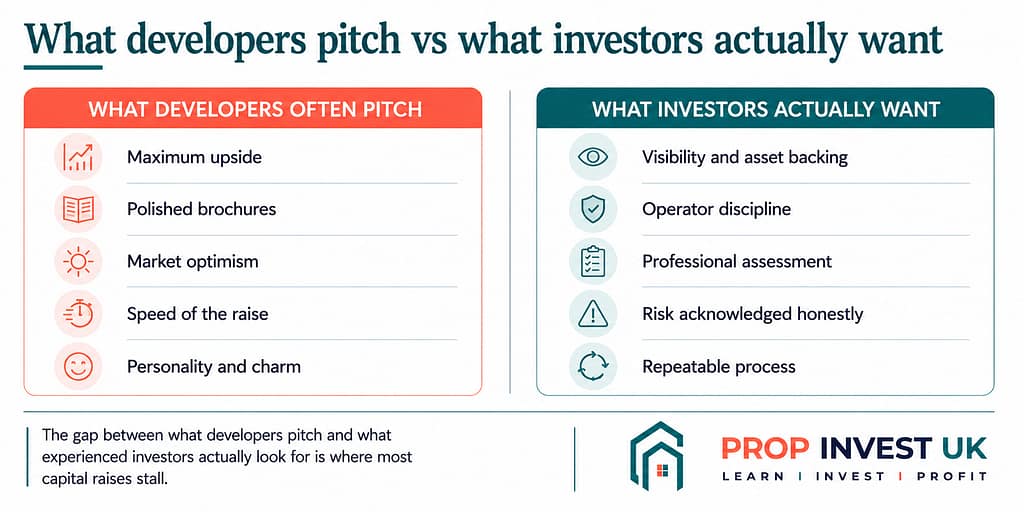
The most expensive mistake developers make when raising capital is assuming that energy and conviction are enough to move investors. They aren’t. Serious capital — the kind James Thornton would describe — moves on structure, evidence, and demonstrated competence under pressure.
Private investors evaluating a development opportunity work through three things, broadly in order:
1. Is this opportunity commercially real? The numbers have to make sense before anything else matters. The acquisition price has to be supported by recent comparable transactions. The build cost has to be properly scoped, not optimistically estimated. The exit value has to reflect realistic market conditions, not the highest comparable the developer could find. The development margin has to provide enough buffer for typical overruns and timing extensions.
If those mechanics don’t work on paper, no amount of pitch polish will save the conversation.
2. Is this operator actually capable of delivering it? Capability is evidenced by past work, not promised by future intent. Specifically: similar projects completed, problems handled under pressure, capital returned to previous investors, professional relationships with senior lenders and contractors that survive multiple project cycles.
A first-time developer can raise capital — but typically only by borrowing credibility through experienced partners, established advisers, or a particularly conservative first opportunity that gives investors visible structural protection.
3. Is my capital structured to protect me through the project lifecycle? This is where most retail-grade capital raises fall apart. Sophisticated investors understand that good intentions don’t survive contact with project delivery. They want structural protection: registered legal security, defined capital stack positioning, clear documentation of what happens in adverse scenarios, alignment of operator capital with investor capital so the developer carries downside exposure too.
The mechanism that protects investor capital isn’t the developer’s promise to act in good faith. It’s the legal structure that makes good faith enforceable.
When a capital raise addresses all three questions substantively, investors engage. When it addresses any of them with hand-waving — “the numbers will work out”, “trust me on this one”, “we’ll figure out the structure as we go” — the conversation typically ends, regardless of how good the underlying project might actually be.
What a credible offer actually contains
A serious investor evaluating a development opportunity expects specific components to be present and properly documented. Developers who deliver these components naturally raise capital more easily. Investors who learn to verify these components naturally make better allocation decisions.
The components, in the order they typically come up:
Commercial logic
The project has to make commercial sense before anything else is relevant. That means:
- Acquisition rationale: why this property, in this location, at this price, at this point in the market cycle
- Demand evidence: who buys or rents the finished product, at what price, and how that’s verified rather than assumed
- Build cost discipline: scoped costs from actual contractors, not internet estimates, with contingency built into the headline figure
- Exit strategy: a primary route to capital recovery and at least one backup, with the conditions under which each becomes the preferred exit
A developer who can walk through these four points with specific evidence is operating commercially. A developer who can’t — or who relies on optimism in any of them — is presenting an opportunity that hasn’t been properly stress-tested.
Legal structure
Investor capital has to sit somewhere defined and protected. The structural questions:
- What legal entity holds the asset? Typically an SPV (special purpose vehicle) created for the project, separate from the operator’s other activities.
- What is the investor’s legal position within that entity? Equity? Loan? Convertible? Each carries different risk-return characteristics.
- What security protects the position? Personal guarantees are weak; registered charges over the project property are strong. Second legal charges sit behind senior lender debt but ahead of operator equity.
- What documentation governs the relationship? Loan agreements, security deeds, intercreditor agreements where senior lenders are involved, shareholder agreements where equity is taken.
The investor’s position should be documented in a way that survives the operator’s continued involvement. If the operator disappeared tomorrow, the documentation alone should tell a new party exactly what the investor is owed, how it’s secured, and how it’s recovered.
Capital positioning
Within the project’s capital stack, the investor needs to know exactly where their capital sits. Senior debt typically sits at the bottom of the risk waterfall (paid first, lowest return). Operator equity typically sits at the top (paid last, highest return potential). Private investor capital can sit at various points between depending on how the deal is structured.
The mechanics matter because position determines what happens in adverse scenarios. If the project sells for less than the senior debt, equity gets nothing. If it sells for slightly more than the senior debt, mezzanine and second-charge positions get partial recovery. Understanding position before commitment is what allows investors to evaluate risk-adjusted return honestly.
Fund use clarity
Investors should know exactly how their capital is being deployed in the project. The acquisition price, the build cost, the professional fees, the holding costs, the contingency. A detailed sources-and-uses statement showing every pound of investor capital matched against every pound of project cost is standard practice in serious capital raises.
If a developer can’t produce a clear sources-and-uses on request, the project hasn’t been planned properly.
Reporting framework
Once capital is committed, investors should know what reporting they’ll receive and when. Monthly project updates, quarterly financial summaries, immediate notification of material events. The specific cadence matters less than the fact that it’s defined and adhered to.
Reporting is one of the cheapest things a developer can do to maintain investor trust, and one of the first things to get neglected when projects come under pressure. Operators who maintain reporting discipline through difficult periods build long-term capital relationships. Operators who go quiet when projects struggle don’t get backed twice.
Decision-control mechanisms
The final component is governance: what decisions can the operator make alone, and what decisions require investor consent? Most well-structured deals give the operator broad authority over day-to-day project management while reserving specific decisions — material variations to the budget, sale of the asset, refinancing — for investor approval.
For developers reading this as a checklist: every component above should be documented and presentable on request. If any of them aren’t ready when an investor asks, the project isn’t ready for capital.
For investors reading this as a decoding lens: every component above is a fair question to ask any operator presenting an opportunity. The way they respond — substantively or evasively — tells you almost everything you need to know before the conversation goes further.
Track record as evidence of judgement, not just delivery
There’s no shortcut around track record. Investors back operators, not opportunities — because the same opportunity in the hands of two different operators produces two different outcomes.
But the value of track record sits in what it reveals about judgement, not just completion. A list of completed projects tells you the operator finished what they started. A list of completed projects with what went wrong on each and how it was handled tells you something far more useful: how the operator behaves when projects don’t follow the plan.
The questions experienced investors actually ask about track record:
What have you bought, and why those specific deals? Acquisition discipline is the foundation of operator quality. An operator who chases every opportunity is undisciplined. An operator who can articulate clearly why they bought the deals they bought — and just as importantly, why they walked away from deals they didn’t — is applying a filter that protects investor capital before any capital is even at risk.
What have you delivered, and what came in over budget or behind schedule? Every developer has projects that ran over. The useful information is which projects, how much over, and how the overruns were handled. An operator who refuses to acknowledge any past overruns is either inexperienced or being dishonest. Neither is a position serious investors want to back.
How have you handled adverse scenarios? Planning refusals, contractor failures, finance market disruption, valuation reductions at refinance — these are normal events across enough project cycles. How an operator handled them last time is the best available predictor of how they’ll handle them next time.
The investor reading this should specifically ask any operator: “Walk me through a project that didn’t go to plan, what went wrong, what you did, what the outcome was for your investors.” The answer reveals more than any pitch deck.
How have your investors fared on previous projects? The bluntest question, and the most informative. Were they paid on schedule? Did they reinvest? Are they willing to speak to prospective investors? An operator with strong investor relationships will offer references readily. An operator who deflects this question is telling you something important.
For developers building track record: the lesson is that completed projects matter less than well-documented projects that demonstrate judgement, discipline, and integrity through adverse scenarios. Build the documentation as you go, not retrospectively.
For investors evaluating operators: track record is not “have they done deals before”. It’s “how did they handle the deals that went sideways, and would their past investors back them again”. Those questions get to the real signal.
What the capital raise process tells you about the operator
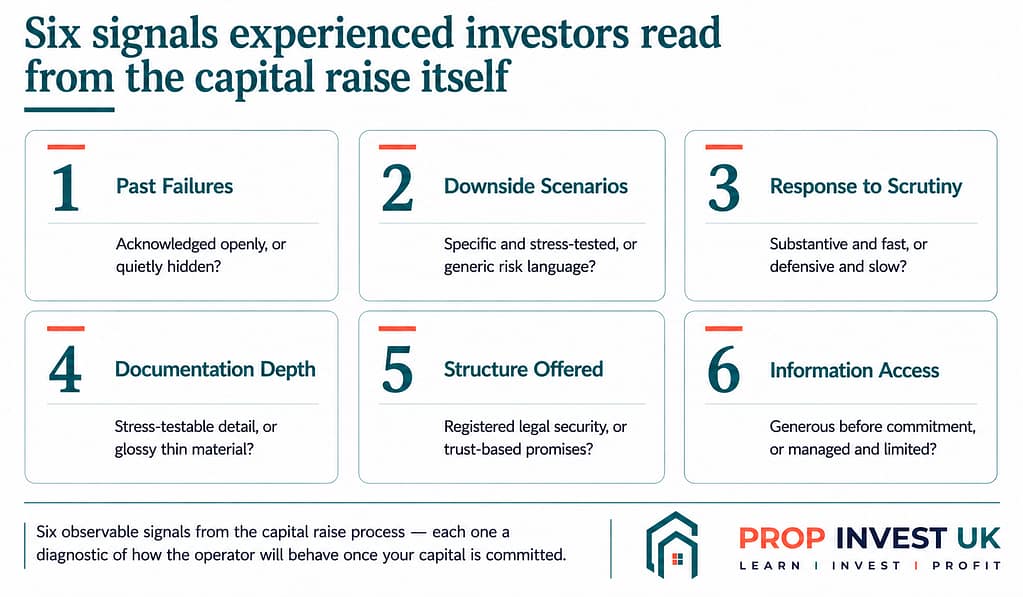
This is the section most developer-facing content skips, and the section most useful for investors. The way an operator raises capital is itself one of the strongest available signals about how they’ll run a project. Six specific signals experienced investors pick up on:
Signal 1 — How they talk about past failures
Operators who claim every previous project went perfectly are either inexperienced or being misleading. Property development at any scale involves regular adverse events: planning delays, build cost overruns, contractor problems, refinance complications, exit market shifts.
A credible operator will discuss these openly when asked, name specific projects where they occurred, explain what went wrong, and describe what was learned. The willingness to engage substantively with past difficulty is itself a credibility signal.
For investors: ask the question directly. “Tell me about a project that didn’t go to plan.” If the answer is vague, defensive, or claims it’s never happened, the conversation should slow down.
Signal 2 — How they handle the “what could go wrong” question
Every opportunity has downside scenarios. Mature operators have thought through them and can walk an investor through them on request. Less mature operators either haven’t done the work or are uncomfortable acknowledging risk to a prospective investor.
The mechanism: ask any operator presenting an opportunity to walk you through the three things most likely to go wrong on the specific project and how each would be handled. The depth and specificity of the answer is diagnostic. A substantive answer — naming particular risks specific to this project, with mitigations documented in the structure — indicates the project has been properly stress-tested. A generic answer about “property development involves risk” indicates it hasn’t.
Signal 3 — Speed and substance of response to investor scrutiny
When an investor asks a difficult question, how quickly and substantively does the operator respond? Strong operators welcome scrutiny because they’ve done the work and can demonstrate it. Weaker operators slow down, deflect, or attempt to redirect the conversation back to the opportunity’s upside.
The mechanism: ask questions that require the operator to share documentation rather than talk through assertions. Sources and uses statement. Build cost breakdown. Senior lender term sheet. Past project performance summary. The willingness and speed of providing these documents is itself the answer.
Signal 4 — Documentation depth
Capital raises supported by professional documentation tend to come from operators who think structurally. Capital raises supported by glossy decks but thin underlying detail tend to come from operators who think promotionally.
Substantive documentation includes: project information memorandum with all material facts disclosed, financial models that an investor’s adviser can stress-test, draft legal agreements available for review before commitment, evidence of professional due diligence (planning, structural, valuation) already conducted.
The mechanism: ask for the documentation pack. What’s provided — and how readily — reveals how the operator approaches the investor relationship.
Signal 5 — Structure offered for security and control
The legal structure proposed for the investment tells you what the operator thinks the relationship should look like. An operator offering registered legal security, defined consent rights, and clear reporting commitments is positioning themselves to be accountable. An operator asking for capital on the strength of personal commitment and informal agreements is asking for trust without offering the structures that make trust meaningful.
The mechanism: review the proposed structure carefully before commitment, not after. Ask specifically about security mechanism, capital stack position, governance rights, and what happens in adverse scenarios. The willingness to negotiate sensible structural protections is a strong signal; resistance to documenting basic protections is a strong signal in the opposite direction.
Signal 6 — Access given to underlying information
The final signal: what level of access does the operator provide to underlying project information? Site visits before commitment, introductions to senior lender or contractor, access to past project documentation for verification, references from previous investors.
Operators with nothing to hide tend to provide generous access. Operators with concerns about scrutiny tend to manage information carefully. The mechanism is observation: notice what’s offered, what’s resisted, and what’s only available after commitment. The pattern is informative.
For developers reading this section as a guide: every signal above is something you can send deliberately. Acknowledge past difficulty openly. Document downside scenarios specifically. Respond to scrutiny with substance. Build comprehensive documentation. Offer structural protections that make investor confidence rational rather than emotional. Provide generous access to underlying information.
For investors reading this section as a decoding lens: every signal above is observable in the early conversations with any operator. Make the observations deliberately. The capital you don’t deploy because of weak signals is more valuable than the capital you do deploy after ignoring them.
Where credible investor capital actually comes from
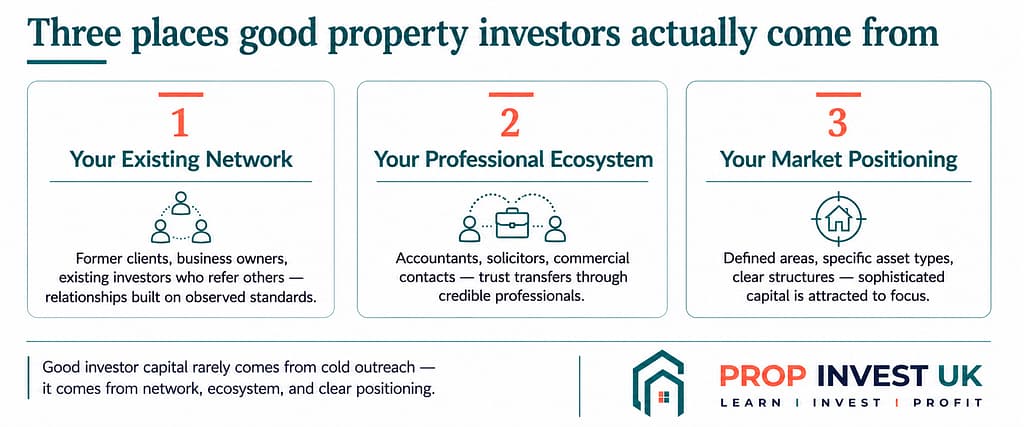
A common assumption in property development is that investor capital arrives through one well-timed introduction. Sometimes it does. Relying on that as a strategy is not viable.
In practice, credible investor capital comes from one of three sources, in order of typical contribution to a serious operator’s investor base:
Source 1 — Existing network
The strongest investor relationships usually begin with people who already understand the operator’s standards, reputation, and working style. Former business associates who’ve watched the operator handle pressure. Existing investors who refer peers. Professional contacts who’ve observed the operator’s competence in adjacent contexts.
This isn’t network in the lazy sense of social media followers or LinkedIn connections. It’s network in the substantial sense — people who would commit £100,000+ to the operator based on observed standards, not marketed claims.
For developers building this: it takes years and is built through visible competence rather than active networking. There are no shortcuts.
For investors evaluating operators: an operator whose investor base is primarily existing network is typically a stronger proposition than one whose investor base depends on continuous cold outreach. Network capital is “sticky”; outreach capital is transient.
Source 2 — Professional ecosystem
Accountants, solicitors, financial advisers, planning consultants, surveyors — the professional ecosystem around a credible operator becomes a referral network over time. Not because professionals are paid to refer (most reputable firms don’t operate that way), but because they observe the operator’s work directly and form views about competence.
Trust transfers through this layer. When a respected commercial solicitor mentions to a client that they’ve worked with a particular developer on multiple projects without issue, that statement carries more weight than any marketing claim. The transfer mechanism is the professional’s reputation: they wouldn’t reference an operator they didn’t respect, because doing so would damage their own standing.
For developers building this: the route is sustained professional work delivered to a high standard over multiple cycles. Operators who treat their professional advisers as service providers to be minimised tend not to develop this ecosystem. Operators who treat them as long-term professional relationships do.
For investors evaluating operators: it’s a reasonable question to ask any operator who their long-term professional advisers are, and whether those professionals would be willing to speak to a prospective investor. The depth and quality of the answer reveals how the operator has built relationships across their professional ecosystem.
Source 3 — Market positioning
Sophisticated investors are attracted to operators who can articulate clearly what they do, where they do it, and what they specifically don’t do. Operators who position themselves broadly — “we do all kinds of UK property development” — tend to look unfocused. Operators who position narrowly — “we focus on commercial-to-residential conversion in the M4 corridor and South West regional UK markets, typically through HMO development” — tend to look operationally credible.
The mechanism: focused positioning is observable through everything the operator does. It shows in the projects they bring forward, the deals they walk away from, the professional relationships they maintain, the content they publish. Investors who follow an operator across multiple project cycles develop a sense of whether the positioning is real (the operator actually operates within their stated focus) or marketed (the stated focus shifts depending on what’s currently available).
For developers building this: positioning is a long-term asset that compounds. Operators who shift their stated focus repeatedly to chase whatever deals are currently available never accumulate the credibility benefit. Operators who hold a defined position through cycles do.
For investors evaluating operators: positioning consistency over multiple years is a strong signal. Positioning that changes with each capital raise is a weaker one.
Why transparency raises more capital than promotion
There’s a persistent temptation in property to oversell — to inflate end values, minimise stated risk, present polished material that’s thin on detail underneath. That approach occasionally raises capital quickly. It almost never raises capital repeatedly.
The investors worth having as long-term capital partners respond better to measured confidence than inflated promises. The mechanism is simple: experienced investors have seen enough capital raises to recognise the difference between substance and presentation, and they’ve usually been burned at least once by mistaking the latter for the former.
Transparency strengthens an offer rather than weakening it. If planning isn’t yet secured, saying so and explaining the route to consent is more credible than pretending the planning risk doesn’t exist. If build costs are under active review, explaining the current assumptions and the contingency built in is more credible than presenting fixed numbers that the operator privately knows could move. If there are multiple exit scenarios, setting out the conditions under which each becomes preferred is more credible than presenting one route as certain.
Investors understand that development has moving parts. What they want from an operator is the discipline to stay in control when those parts move — which requires acknowledging the moving parts honestly in the first place.
This is also how repeat investor relationships are built. A one-off capital raise is useful. A retained investor base committing capital across multiple project cycles is fundamentally more valuable. The economics of operator growth shift substantially when investors who’ve been through one project successfully come back for the next one without needing to be re-acquired.
The compounding effect over five or ten years is significant. An operator who maintains transparency through difficult periods builds a capital base that funds future projects with substantially less friction. An operator who manages information defensively when projects struggle has to keep raising capital from scratch each time.
How we approach this at Prop Invest UK
Prop Invest UK is the investor-facing brand for development opportunities delivered by Vernon Property Group. We’ve been active in UK property development since 2017 and structure capital partnerships with private investors on a deal-by-deal basis. Below is the mechanism — not just the assertion — of how we approach each component above.
How we source projects
We focus on commercial-to-residential conversion and HMO development across South Wales, the M4 corridor, and the South West of England. The geographic focus is deliberate: we have contractor relationships, planning officer relationships, and market knowledge in these specific regions that don’t transfer to areas we don’t operate in. We don’t bring forward projects in locations where we lack operational depth, regardless of how attractive the headline economics might look.
We also walk away from deals we’d be perfectly capable of executing if the underlying numbers don’t support a development margin that protects investor capital. A recent example: we conducted full due diligence on a new build in Taunton, including foundations verification with building control, and ultimately walked away because the numbers were too tight. Discipline at acquisition is the foundation of investor returns later.
How we structure investor agreements
Most of our capital partnerships are structured as fixed-return loan positions secured by a second legal charge against the project SPV’s property. The mechanics: senior development finance sits in first position (typically around 60-65% loan-to-GDV), investor capital sits in second position, operator equity sits behind that. If the project exits within expected parameters, the investor receives their principal plus accrued interest at the agreed rate; the operator carries downside exposure first.
We also structure equity participation positions for investors who prefer profit-share on completion rather than fixed-rate interest. Each opportunity is presented with one or both structures available, depending on the project profile.
In all structures, the legal documentation is professionally drafted, the security is registered at the appropriate registries, and the structure is reviewable by the investor’s own legal adviser before commitment. We expect this scrutiny and welcome it.
How we report
Once capital is committed, investors receive structured project reporting at defined intervals — typically monthly project updates with milestone progress, photographic site evidence where relevant, and immediate notification of any material event affecting the project or the timeline. Quarterly summary reporting covers financial position and any material variations from the original project plan.
The cadence is set in the loan or partnership agreement at the start of the project, not negotiated as we go. Reporting discipline matters most during difficult periods, which is when it’s typically neglected by operators who treat investor communication as an optional courtesy rather than a structural commitment.
How alignment is built
Vernon Property Group capital sits in every project alongside investor capital. We carry the downside risk first, which means our incentive to make the project work is structural rather than contractual. The capital stack is designed so that if the project underperforms, our equity is reduced or eliminated before investor capital is impaired.
This alignment shows in how we behave under pressure. Examples include Gore Terrace in Swansea, where we absorbed a £50,000 build cost overrun ourselves rather than passing it to investors, and Mozarts in Swansea, currently mid-build and approximately three months over original schedule, where investor loans are being extended pro-rata with additional interest at the agreed rate rather than restructured to investor disadvantage. Project case studies covering both are available for review.
Why we approach it this way
The structures above aren’t unique to us — variations of them exist across the better operators in UK property development. What matters more is that they’re documented, applied consistently, and verifiable. We share this detail openly because the kind of investors we work with want to verify the mechanism before committing capital, not after.
For investors who want to see how this works on a specific opportunity, we present projects on a deal-by-deal basis to investors on our list. Each opportunity comes with the documentation, security structure, and reporting framework described above.
The real answer (both sides)

The real answer to “how to get investors for property development” is less glamorous than developers usually hope and less mysterious than investors usually fear.
For developers, it’s this: become investable. That means tighter structuring, stronger evidence, clearer communication, professional documentation, and a proposition built around investor confidence rather than developer excitement. There’s no shortcut around it, and the operators who’ve built sustainable capital relationships have all done it the same way.
For investors, it’s the mirror image: back operators who’ve made themselves investable. That means evaluating capital raise process as part of your operator due diligence — because how an operator raises capital is one of the most reliable available signals about how they’ll run the project once your capital is in it.
The shared insight, viewed from both sides: “investability” is a single phenomenon. It shows up the same way whether you’re presenting it or evaluating it. Tight commercial logic. Credible legal structure. Defined capital position. Substantive documentation. Honest acknowledgement of risk. Discipline under pressure. Consistency over multiple project cycles.
Developers who deliver these things raise capital naturally. Investors who require these things deploy capital wisely. The market becomes more efficient when both sides understand they’re looking at the same evidence.
If you’re an investor evaluating UK property development opportunities and want to see how we structure capital partnerships in practice, join our investor list to receive project briefings and structural documentation as opportunities are presented. We work with capital partners on a deal-by-deal basis and prioritise long-term investor relationships over volume.
If you’re a property developer reading from the other side of this conversation, the way you raise capital is part of how the market evaluates you. Build it accordingly.
This article is general information about property development capital raising and the structures involved. It does not constitute investment advice. UK property development carries risk, including the risk of capital loss. Anyone evaluating a specific opportunity should take independent professional advice on their own position. Past project outcomes are not indicative of future performance.