
Most investors arrive at real estate development after a disappointment. It might be an underperforming fund, a rental portfolio that became a second job, or cash sitting idle while inflation does the damage quietly. If you are looking at how to invest in real estate development, the real question is not whether development can create wealth. It can. The question is how to access it without taking on the wrong risk, the wrong operator, or the wrong structure.
That distinction matters. Development attracts attention because it can create value faster than standard buy-to-let. A site is acquired below its potential, planning is secured or improved, works are delivered, and the finished asset is either sold, refinanced, or held for income. That is where the upside sits. But development is not forgiving. The margin is made in the buying, protected in the structuring, and realised only through disciplined execution.
For private investors, that means the route in matters just as much as the project itself.
How to invest in real estate development without becoming the developer
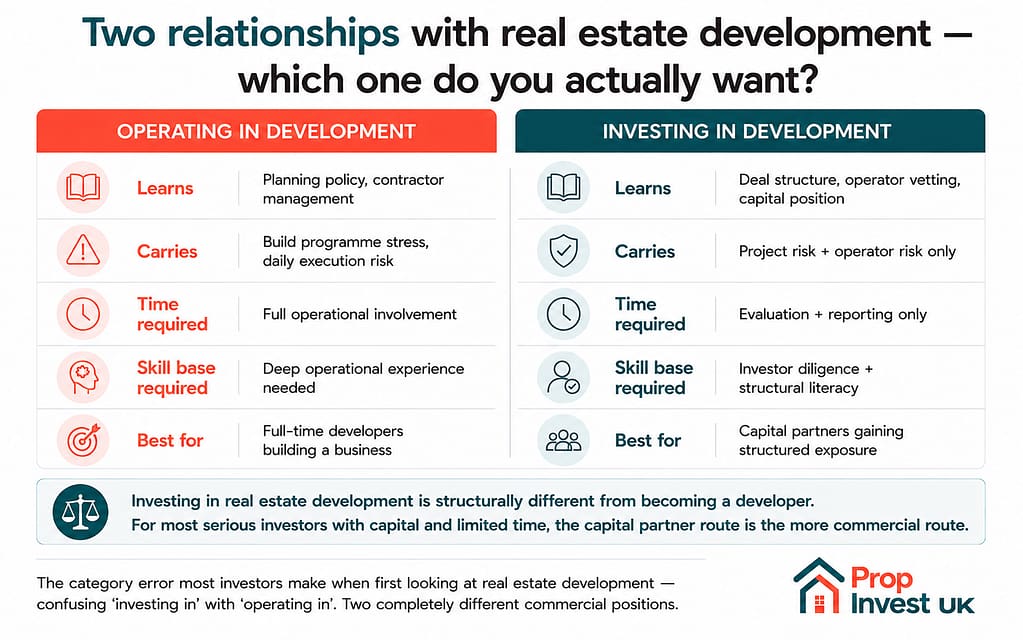
A lot of people assume investing in development means learning planning policy, managing contractors, and carrying the stress of a build programme. It does not. In practice, most serious investors should not try to become hands-on developers unless they already have deep operational experience, reliable deal flow, and time to absorb mistakes.
A more commercially sound route is to invest through a professionally structured, property-backed partnership where experienced operators handle sourcing, appraisal, planning, delivery, and reporting. That gives you exposure to development profit without taking on day-to-day execution risk personally.
This is where many investors either protect their capital properly or walk into avoidable trouble. If the structure is vague, the documentation is weak, or the operator communicates in hype rather than evidence, you are not investing. You are taking a punt.
The stronger model is straightforward. The project should be tied to a real asset, the capital stack should be clear, the operator should have a defined role, and your position in the deal should be easy to understand. If you cannot explain where your money sits, what security supports it, and what the operator is responsible for, you do not yet have enough clarity.
What makes development different from ordinary property investing
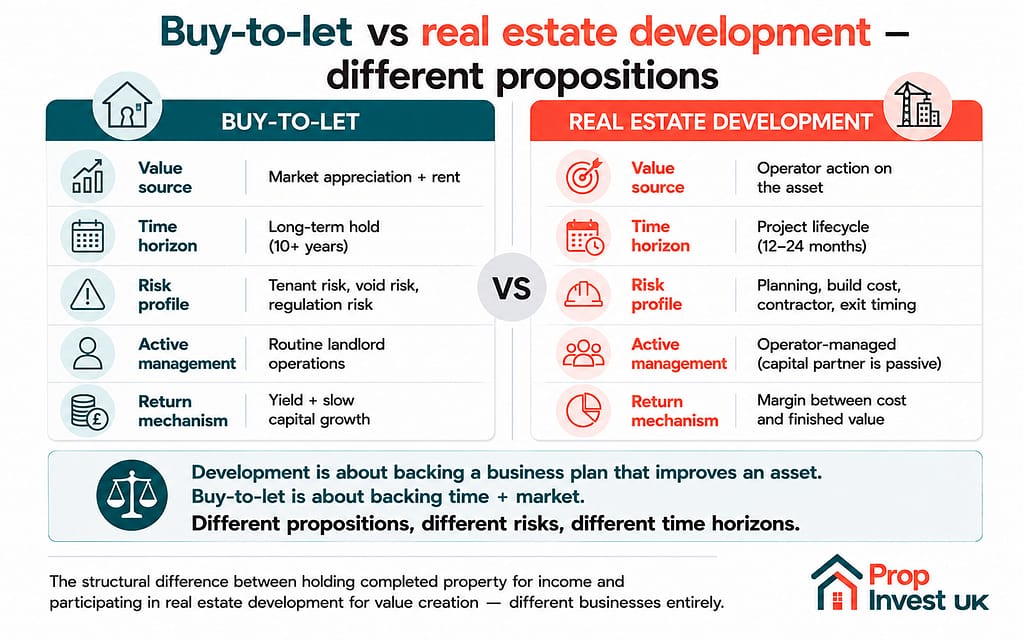
Traditional buy-to-let is mostly about income, financing, and holding power. Real estate development is about value creation. You are not relying solely on market appreciation or rent increases. You are backing a business plan that improves an asset.
That can mean converting underused commercial space, repositioning tired stock, securing planning uplift, or delivering new homes in supply-constrained areas. The opportunity is attractive because skilled operators can create equity through action rather than waiting on the market.
The trade-off is obvious. Development carries more moving parts. Planning risk, build cost pressure, contractor performance, time delays, and exit timing all matter. That is why operator quality is not a nice extra. It is central to the investment case.
Investors who do well in this space usually think less like hobby landlords and more like capital partners. They want to know whether the deal is sensible, the assumptions are grounded, and the people running it have done this before under real market conditions.
How to assess a development opportunity properly
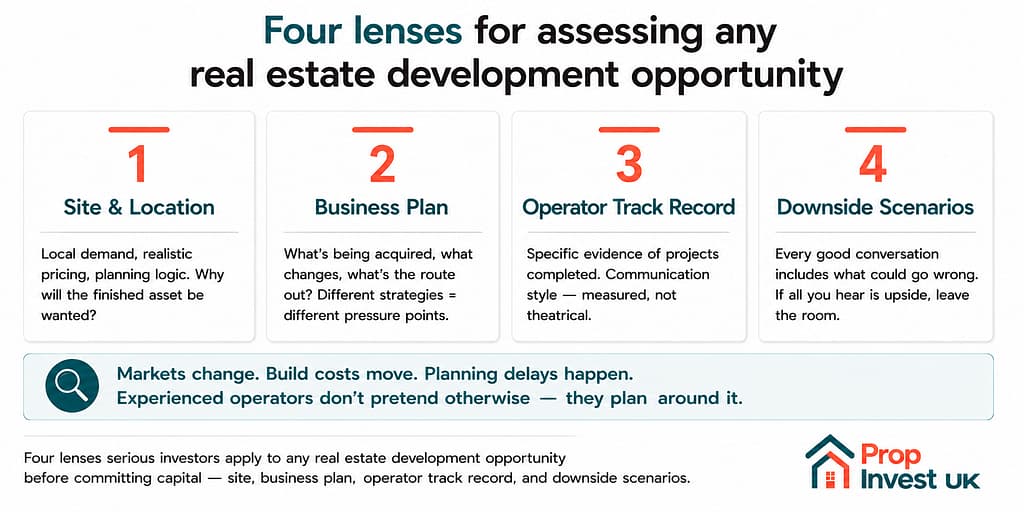
If you want to understand how to invest in real estate development intelligently, start with the basics that professionals care about.
First, look at the site and the location. Good development is not built on wishful thinking. It is built on local demand, realistic pricing, planning logic, and a clear reason the finished asset will be wanted by buyers, tenants, or lenders. A strong patch within the South West, South Wales, or the M4 corridor, for example, can offer resilient fundamentals if the scheme matches the local market.
Second, examine the business plan. What is being acquired, what changes are being made, and what is the likely route out? Some schemes work because planning uplift is the main driver. Others depend on efficient delivery and a refinance into long-term rental hold. These are very different strategies, and each has different pressure points.
Third, scrutinise the operator. Track record should be specific, not dressed up in vague claims. You want to see evidence of projects completed, experience across the development cycle, and a communication style that is measured rather than theatrical. Markets change. Build costs move. Planning delays happen. Experienced operators do not pretend otherwise. They plan around it.
Fourth, understand the downside. Every good investment conversation should include what could go wrong and how that risk is managed. If all you hear is upside, leave the room. Serious operators talk about contingencies, deal structuring, security, cost control, exit flexibility, and reporting discipline.
The structures investors usually consider
There is no single route into development, and the right option depends on your capital, experience, and appetite for involvement.
Some investors back individual projects through property-backed partnership structures. This suits people who want deal-by-deal visibility and a defined link between capital and asset. Others prefer a broader portfolio approach where capital is allocated across multiple schemes for diversification. Some use pension structures such as SSAS arrangements where appropriate, provided the investment has been assessed properly and the legal framework is clear.
The key is not choosing the most exciting format. It is choosing the one that matches your priorities. If your objective is hands-off exposure, wealth preservation, and professional oversight, then structure and governance matter more than novelty.
This is also where many investors make a useful shift in mindset. They stop asking, “How much could this make?” and start asking, “How is this controlled?” That is a better question. It tends to lead to better outcomes.
Red flags when learning how to invest in real estate development
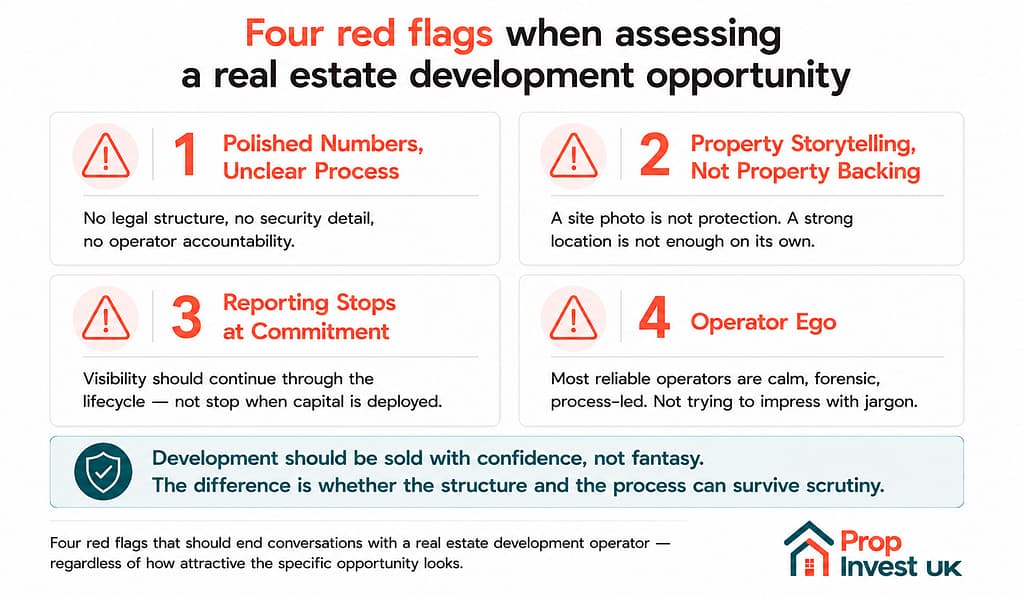
Development should be sold with confidence, not fantasy. There is a difference.
Be cautious of opportunities where the numbers are polished but the process is unclear. If there is no obvious legal structure, no detail on security, no explanation of planning status, or no clear operator accountability, you are looking at marketing, not an investment proposition.
You should also be wary of anyone blurring the line between property backing and property storytelling. A site photo is not protection. A strong location is not enough on its own. Capital needs to be positioned properly, documentation needs to reflect the commercial reality of the deal, and reporting should continue after the money is committed, not stop there.
Another warning sign is operator ego. Development is a team sport with plenty of room for error. The most reliable operators are usually calm, forensic, and process-led. They are not trying to impress you with jargon. They are trying to show you they have thought three steps ahead.
Why experienced investors often favour managed exposure
For busy professionals, business owners, and established investors, the issue is rarely whether they can raise the money. It is whether they want the administrative load, tenant issues, financing complexity, and operational drag that come with direct ownership.
Managed development exposure solves a different problem. It gives investors access to professionally run projects while keeping execution with people who live in that world every day. That can be a far more efficient use of capital than assembling a piecemeal portfolio alone.
It also creates a route into property wealth that is more deliberate. Development can generate capital growth opportunities, while the right projects can feed longer-term rental holdings once completed and stabilised. That combination matters. Quick profit without long-term asset thinking is short-sighted. Long-term holding without strong acquisition and development discipline can be equally underwhelming.
The strongest operators understand both sides – how to create value through development and how to preserve it through durable income-producing assets. That is the commercial sweet spot.
What good investor communication looks like
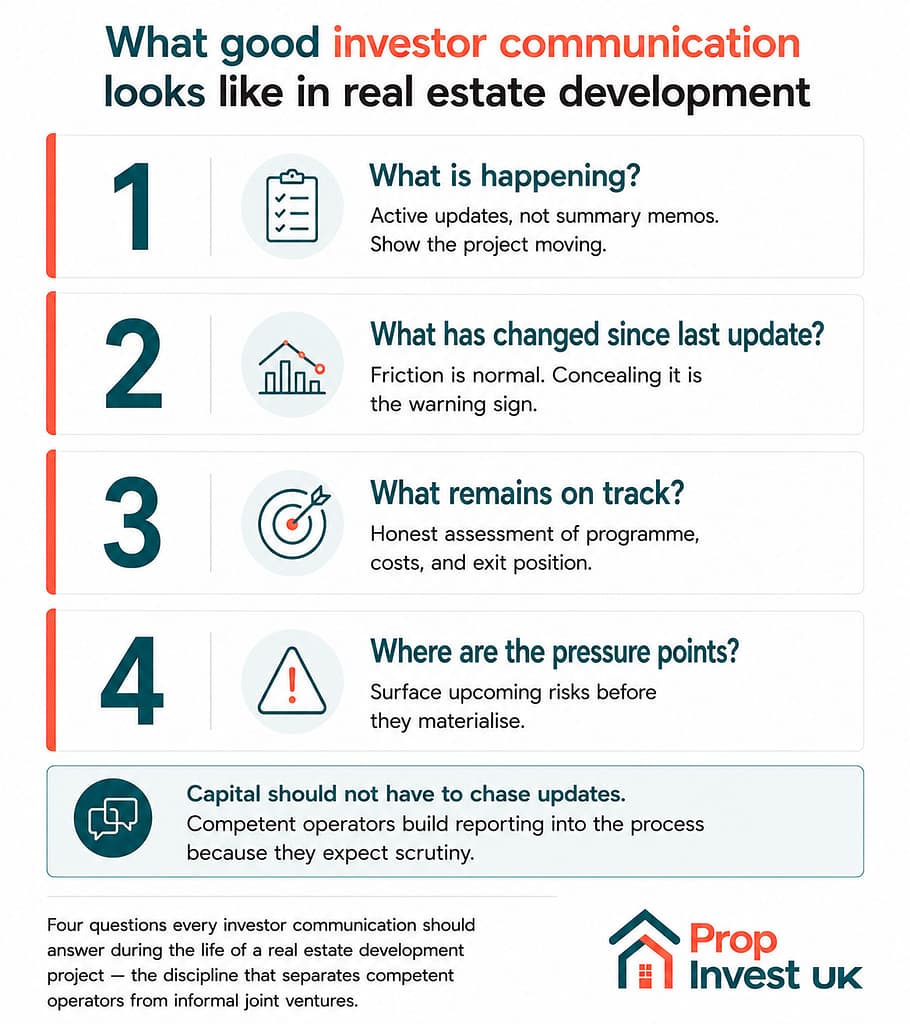
One of the most overlooked parts of development investing is communication. It is easy to focus on the deal and ignore the reporting. That is a mistake.
Professional communication should tell you what is happening, what has changed, what remains on track, and where pressure points sit. It should not read like sales copy after completion. Investors deserve visibility during the life of the project, especially when conditions shift.
This is one reason disciplined investors often prefer experienced operating partners over informal joint ventures with friends or first-time developers. Competent operators build reporting into the process because they expect scrutiny. That is healthy. Capital should not have to chase updates.
At Prop Invest UK, that investor-first discipline is part of how property investment should work – structured, transparent, and focused on repeatable performance rather than noise.
The smart starting point
If you are serious about how to invest in real estate development, start by narrowing your filter. You do not need more opportunities. You need better selection criteria.
Look for projects backed by real assets, run by proven operators, and structured in a way that makes your position clear from day one. Prioritise markets you understand, business plans you can follow, and partnerships where communication is treated as part of the investment, not an afterthought.
The best development investors are not chasing excitement. They are backing process, discipline, and the kind of operator who knows that preserving trust matters just as much as delivering a project. That is where confidence should come from.
Considering professionally managed UK property development?
Prop Invest UK works with serious investors who want exposure to UK property development without taking on the operational complexity directly. Each opportunity is sourced, structured, and delivered by an experienced developer, with investors participating as capital partners on a deal-by-deal basis.
Join the investor list to receive details of future opportunities as they become available.
Past performance is not a reliable indicator of future results. Property development involves risk, including the risk of capital loss, and returns are not guaranteed. The information on this page is for general information purposes and does not constitute financial advice or an offer to invest. Any specific opportunity is offered only to investors who qualify under the relevant exemptions and have received the appropriate project documentation.