
How to Make Money from Property Development: A UK Investor’s Guide for 2026
The honest answer to how to make money from property development is more mechanical than most content on the subject admits.
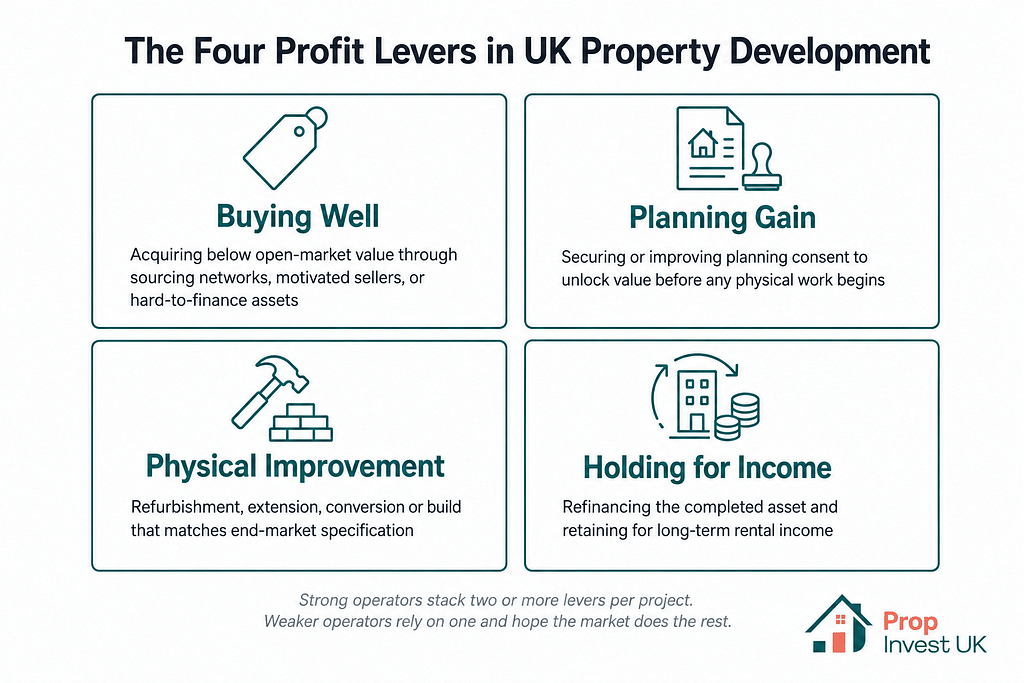
Profit is not created by ownership, market timing, or transformation in the abstract. It’s created by four specific levers, applied with discipline, on the right project at the right price. Strong operators stack two or three of those levers per project. Weaker operators rely on one and hope the market does the rest.
For investors approaching this space — particularly those weighing whether to back development directly or through a capital partnership — understanding those levers is the difference between assessing opportunities intelligently and being sold to. This article walks through them honestly, in the context of the current UK market, and finishes with the question most investors don’t ask early enough: what happens to the asset after the development is finished.
The 2026 UK development margin reality
Before the levers, the constraint they all operate inside.
In 2026, the realistic target margin on UK residential development is 15–20% profit on GDV, with most lenders requiring a minimum of 18–22% on GDV to fund a scheme at competitive leverage. Anything below 15% is generally treated as unviable. Lenders routinely stress-test projected GDV at 5–10% haircuts and add contingency on construction costs before approving facilities.
That tells you something important about how the market thinks. The headline margin on a development isn’t 20% because it sounds good in a brochure. It’s 20% because that’s the cushion required to absorb the things that will go wrong — cost movement, planning delay, sales market softening, refinance friction — without the deal becoming a loss.
When you see an appraisal showing 25–30% margin on GDV, two things are usually true. The deal is genuinely strong, and the operator has done unusually well on one or more of the four profit levers below. When you see an appraisal showing 10–12% margin, either the appraisal is honest and the deal is fragile, or the appraisal is optimistic and the deal is worse than it looks.
Either way, margin is the first filter. The four levers explain where that margin comes from.
Lever one: buying well
The cliché in property development is that profit is made at acquisition, not at exit. The cliché is true, and it’s mechanical, not philosophical.
Lenders and developers calculate maximum land bid through what’s called the residual method: take projected GDV, subtract build costs, professional fees, finance costs, and required profit margin — what’s left is the most you can pay for the site. If you pay more than that, the deal stops working before any work begins.
Buying well means one of three things. Either the seller is motivated (probate, divorce, financial pressure, portfolio rationalisation), the asset is hard to finance conventionally (commercial buildings without income, mixed-use with vacant sections, properties with structural complexity), or it’s been mismanaged in a way that the next buyer can fix. Operators with strong sourcing networks and local relationships find these situations consistently. Operators without those networks pay full market price and rely on the other three levers to make up the gap.
For investors assessing an opportunity, the buy-side discipline shows up in two questions: what did the operator pay, and how does that compare to comparable open-market evidence? If the gap is small or non-existent, lever one isn’t doing any work in the deal.
Lever two: planning gain
Planning consent — or improved consent — is often the single largest source of value uplift in a development. A site bought without consent and sold or refinanced with consent for a viable scheme can move materially in value, sometimes more than all the other levers combined.
The mechanics are simple. A property’s worth depends on what you can do with it. Improve the planning position, and the worth shifts upward — sometimes dramatically. A commercial building with consent to convert to residential is worth more than the same building without that consent. A site with detailed planning permission for a viable density is worth more than the same site with outline consent at lower density.
The catch is that planning is high-information and high-uncertainty. Local policy, design constraints, planning officer relationships, neighbour objections, statutory consultee responses, and committee politics all matter. Experienced operators know which authorities are workable, which schemes are likely to gain consent, and what pre-application engagement looks like in practice. Inexperienced operators frequently underestimate the time and cost involved, and overestimate the certainty of consent.
For investors, planning risk is one of the most important things to interrogate. A scheme that depends on consent that hasn’t yet been granted is structurally different from one with consent in place. Both can be backable, but the structure, security, and timeline need to reflect which one you’re looking at.
Lever three: physical improvement
The third lever is the visible one. Refurbishment, extension, reconfiguration, conversion, ground-up build. The work that changes the property’s physical condition and, with it, its valuation.
This is where capital efficiency matters most. Spending money on a property doesn’t automatically create value. Specification has to match the end buyer or tenant; over-specifying for the local market wastes capital, under-specifying leaves valuation on the table. Build costs in 2026 sit in a realistic range of £180–£250 per square foot for standard UK residential schemes, more for higher specification or complex conversions. Operators who routinely deliver at the lower end of that range without quality compromise have an edge that compounds across projects.
Physical improvement also includes the less glamorous work that protects valuation: addressing latent defects, upgrading services, meeting current building regulations, ensuring the property survives a robust valuation inspection at the refinance stage. The difference between a refurbishment that survives valuer scrutiny and one that doesn’t isn’t visible in the photographs. It’s in the specification choices.
For investors, the question on lever three is whether the operator’s build cost projections are credible against current benchmarks, and whether there’s enough contingency in the appraisal — typically 10% of build cost minimum, often 15% on more complex schemes.
Lever four: holding the completed asset for income
This is the lever most beginner-focused content misses, and it’s arguably the most important one for long-term wealth.
The default assumption in development discussions is that the project finishes with a sale. The site is acquired, developed, and sold to a buyer at the new valuation. That works, and many projects exit that way. But it’s not the only option, and for serious operators it’s often not the best one.
The alternative is to refinance the completed asset against its new valuation and retain it for income. The mechanics: the project is delivered, valued at completion, refinanced typically at 65–75% LTV on residential or 60% on commercial against the post-completion value, and the refinance proceeds repay the development finance — leaving the operator (or the operator and investor) owning a stabilised, income-producing asset for the long term.
What this does to the economics is significant. A development that produced 20% profit on GDV at completion can, if retained and refinanced, also produce ongoing rental income that compounds over time. The development creates the equity; retention creates the cashflow and long-term capital growth. Done repeatedly across a portfolio, this is how regional UK property businesses build durable wealth — not through serial flipping, but through serial developing and retaining.
For investors, this is the strategic question worth asking on any opportunity: what happens to the asset after completion? If the answer is “we sell it and exit,” that’s a one-off return on a one-off project. If the answer is “we refinance and hold for long-term rental, with the investor having optionality to remain participating in the income or exit at refinance,” the model becomes structurally different. Both can be legitimate. They are not the same investment.
Why the strongest operators stack levers
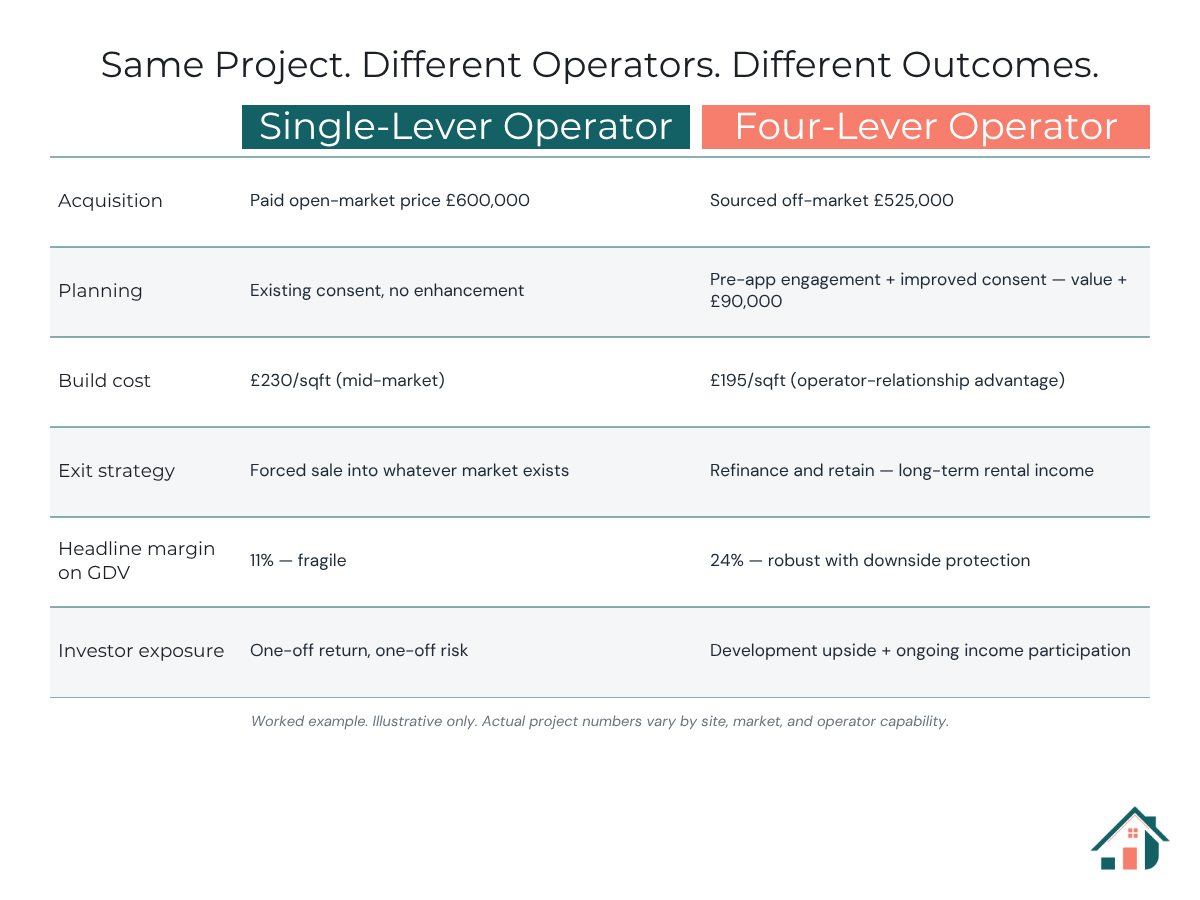
A weak development project relies on one lever. A site bought at market price, modest planning gain, a competent but unremarkable build, and a forced sale into whatever market exists at completion. Margin is thin, downside is real, and any one thing going wrong consumes the profit.
A strong development project stacks multiple levers. The site is bought below open market value because the operator’s sourcing network identified a motivated seller. Planning is improved through experienced pre-application engagement before consent is finalised. The build comes in at the lower end of current cost benchmarks because the operator has long-standing contractor relationships. And the completed asset is refinanced into long-term hold rather than force-sold into a market that may or may not be cooperative.
When all four levers do meaningful work, the headline margin grows, the downside protection improves, and the investor’s capital is exposed to something materially more resilient than a single-lever deal dressed up in marketing.
For investors, this is the difference between a credible operator’s appraisal and a speculative one. Credible appraisals identify which levers are doing the work and quantify each. Speculative appraisals present a single optimistic exit number and trust the reader not to ask where it came from.
The risk side, made specific
Anyone presenting development as easy is selling something. The genuine risks in 2026, in order of probability and impact for an investor backing a UK development project:
Build cost movement. Costs can move 5–10% during a 12–18 month project. Operators without strong contractor relationships absorb that movement themselves; operators with weak appraisals pass it through to the project’s contingency and beyond.
Planning delay. Local authority backlogs, consultation periods, committee deferral — six months of delay isn’t unusual on contested schemes. That’s six months of additional finance cost and six months of opportunity cost on capital.
Sales market timing. A scheme designed for sale exit can find the sales market less cooperative than expected at completion. Selling into a soft market at below-appraisal pricing erodes margin quickly. This is precisely why the refinance-and-hold option (lever four) matters as risk mitigation, not just as a strategic preference.
Refinance friction. Even when refinance is the chosen exit, the post-completion valuation has to support the refinance LTV. Valuers in 2026 are notably cautious; an appraisal that depends on a generous valuation at completion is structurally weaker than one that builds in a more conservative valuer position.
Operator execution. The hardest risk to price, and the one investors most often underweight. A capable team delivering a complex project on time is very different from an enthusiastic team learning on the job.
The right response to these risks is not to avoid them — there is no version of UK property development that doesn’t carry them — but to identify them clearly, structure for them, and back operators who have visibly handled them before.
How the model becomes a business, not a project
For investors, the most useful frame for thinking about development is to ask whether the operator is running it as a project or as a business.
A project-based operator does one development at a time. They make money on each one (or don’t), and then start over. Capital is at full risk on each scheme; investor relationships start fresh on each raise; lessons are learned individually rather than compounded across a portfolio.
A business-based operator does development as one stage of a longer cycle. They develop, refinance into long-term hold where the asset supports it, sell where the asset doesn’t, and use the refinance equity and rental cashflow to fund the next acquisition. Over time, the operator builds a regional portfolio of stabilised income-producing assets alongside an active development pipeline. The development creates value through execution; the retained portfolio compounds it through long-term ownership.
This is the model that survives across cycles, and it’s the model the most credible UK regional developers run. It’s also the model that gives investors a more interesting question to ask than “what’s the headline margin on this deal” — namely, “what happens to the equity created by this project, and is there a route for me to participate in the long-term asset position as well as the development upside?”
At Prop Invest UK, the model is exactly that — disciplined development, retention into long-term hold where the asset and market support it, and a regional portfolio that compounds rather than restarts each time. That’s what makes the difference between a one-off deal and a structured route to property wealth.
If you’re serious about how to make money from property development, the answer is to back operators stacking multiple levers on each project, who treat development as the front end of a business rather than the whole business. That’s where the durable returns are built — quietly, mechanically, and over time.
—
Considering professionally managed UK property development?
Prop Invest UK works with serious investors who want exposure to UK property development without taking on operational delivery themselves. Each opportunity is sourced, structured, and delivered by an experienced developer, with investors participating as capital partners on a deal-by-deal basis.
Join the investor list to receive details of future opportunities as they become available.
—
Past performance is not a reliable indicator of future results. Property development involves risk, including the risk of capital loss, and returns are subject to project performance and are not promised or assured. The information on this page is for general information purposes and does not constitute financial advice or an offer to invest. Any specific opportunity is offered only to investors who qualify under the relevant exemptions and have received the appropriate project documentation.