
Most people who want to get into development start in the wrong place. They look at glossy refurbishments, planning success stories and headline profits. What actually determines whether you last in this sector is far less exciting – deal discipline, funding structure, planning realism and the quality of the operator behind the project. If you are serious about learning how to start in property development, that is the level you need to think at from day one.
There is a reason many first-time entrants lose money, stall after one project or discover they have simply bought themselves an expensive job. Property development is not just buying low and selling high. It is a business model built on timing, control, expertise and margin for error. The people who do well in it are usually the ones who treat it as a commercial operation, not a side hobby dressed up as a wealth strategy.
How to start in property development with the right mindset
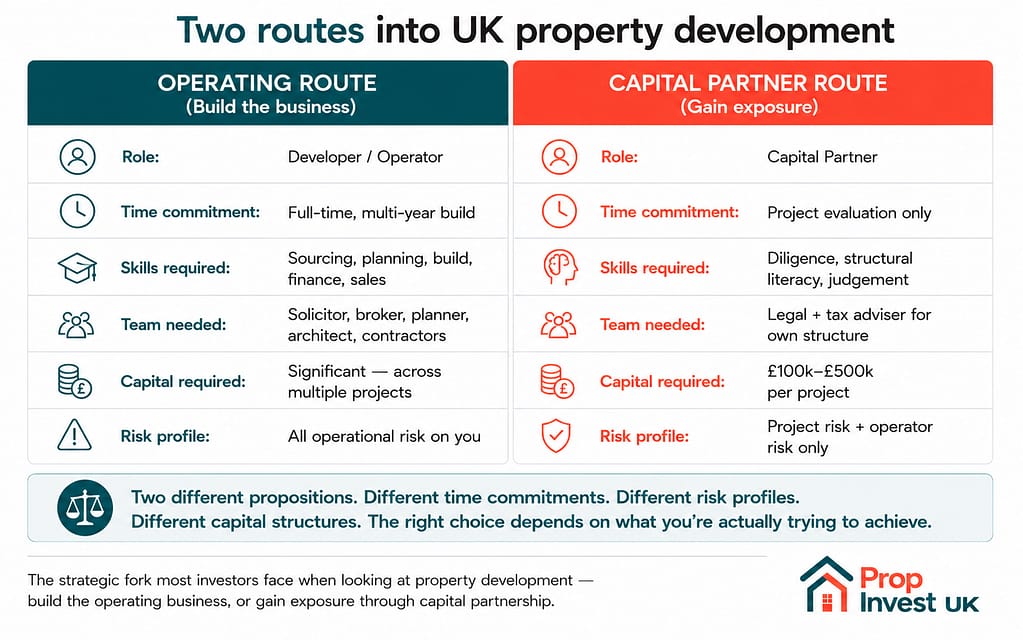
The first shift is understanding what development really is. You are not just purchasing a building. You are taking control of a process that includes acquisition, due diligence, planning, design, finance, legal work, contractor management, cost control, exit strategy and often long-term asset management. Every stage can add value. Every stage can also erode it.
That is why the right mindset is not optimism. It is controlled ambition. You need to look at opportunities with enough confidence to act, but enough scepticism to pressure-test every assumption. A site that looks cheap may be cheap for good reason. A planning angle that appears obvious may not survive scrutiny. A build budget that works on paper can fall apart once real quotes come in.
For serious investors, the better question is often not, “How do I become a developer from scratch?” but, “How do I gain exposure to development in a structured way without carrying every operational risk myself?” That distinction matters. There is a big difference between learning the market and trying to run an entire development business without the track record, team or systems to support it.

Start with strategy, not stock
One of the biggest mistakes beginners make is chasing whatever deal lands in front of them. A tired flat above a shop, a corner plot with planning potential, a heavy refurbishment project – each may sound attractive in isolation. Without a strategy, they are just random assets.
Start by deciding what role property development is meant to play in your wider wealth plan. Are you looking for short-term project exposure backed by real assets? Are you trying to build long-term income through completed stock held in a portfolio? Are you more interested in funding projects than operating them? Your answer changes everything from deal type to time horizon.
The strongest approach is usually one that combines development upside with a clear end use. In practical terms, that often means targeting schemes that can create refinanceable or lettable assets, not just speculative exits dependent on perfect market timing. Development margin matters, but so does what you are left holding if market conditions change.
Learn the numbers before you touch a site
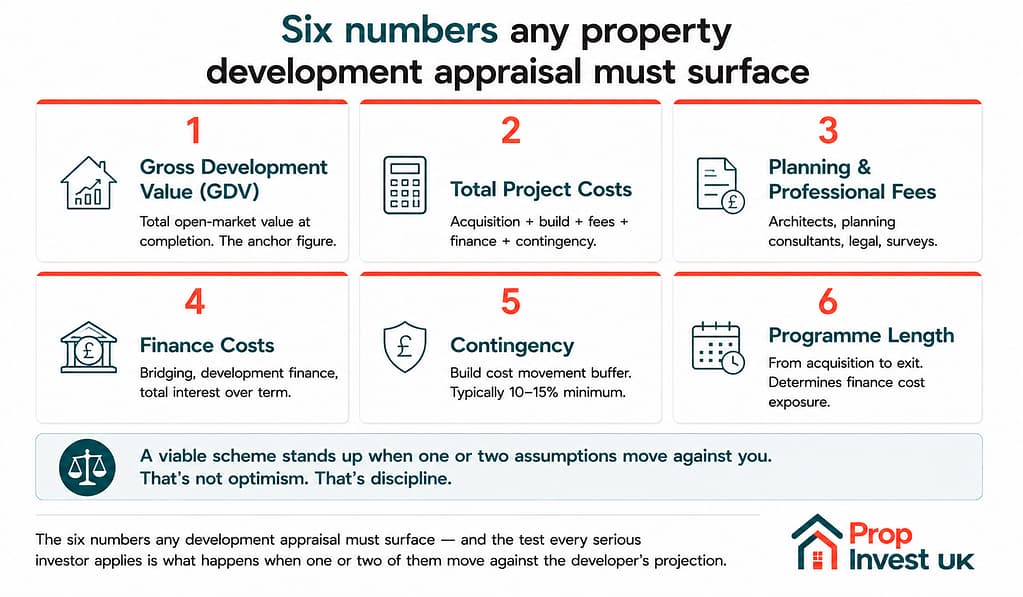
If you want to know how to start in property development properly, learn to underwrite risk before you ever view a project. Enthusiasm has no value if the numbers are weak.
At a minimum, you need to understand gross development value, total project costs, planning and professional fees, finance costs, contingency, programme length and exit costs. More importantly, you need to know what happens when one or two of those assumptions move against you. That is where weak deals are exposed.
A viable scheme is not one that only works if everything goes well. It is one that still stands up when build costs rise, the programme slips or the sales market softens. That is how experienced operators think. They are not trying to win the spreadsheet. They are trying to preserve control when conditions become less favourable.
This is also where many would-be developers realise they are better suited to partnering with experienced operators rather than trying to assemble the whole machine themselves. There is no weakness in that. In fact, for capital partners and time-poor professionals, it is often the more commercial route.
Your first project should match your experience
The market likes to glamorise scale. Bigger sites, bigger conversions, bigger headlines. In reality, your first exposure to development should match your actual capacity – financially, operationally and psychologically.
That does not always mean small. It means appropriate. If you have deep property knowledge, access to the right consultants and the ability to make fast commercial decisions, you may be able to participate in more complex projects earlier. If you do not, complexity is rarely your friend.
A sensible starting point is any project where the route to value creation is clear, the planning position is understandable and the execution risk is manageable. The more moving parts you introduce, the more your lack of experience gets punished. Ambition should come after repetition, not before it.
Build a serious team early
No credible developer succeeds alone. The quality of your solicitor, broker, planning consultant, architect, project manager and contractor can make or break a scheme. A weak team does not just slow you down. It creates blind spots, legal exposure and cost overruns.
The key point here is simple – you are not hiring services, you are building a risk-control framework. That means choosing professionals who understand development, not just generic property transactions. A high street conveyancer may be fine for a standard purchase, but development work demands a different level of commercial awareness.
The same applies to contractors. Cheap is not efficient if it leads to delays, disputes or remedial work. Price matters, but capability, reliability and communication matter more. In development, poor execution compounds quickly.
Funding is a strategy decision, not an afterthought
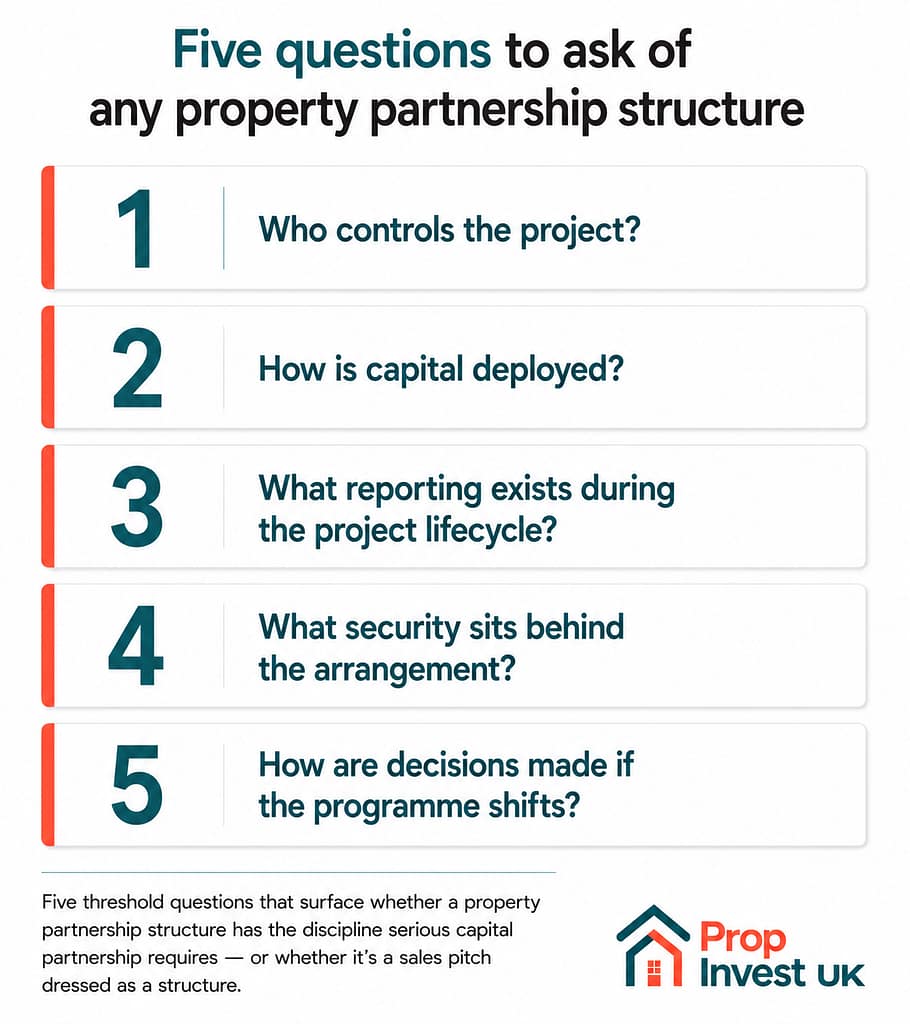
Too many people treat finance as something to arrange once they have found a site. That is backwards. Funding determines what you can buy, how quickly you can move, how much contingency you can carry and how resilient the project will be under pressure.
You need a clear view of your own capital position, borrowing capacity, cashflow tolerance and appetite for risk. You also need to be honest about whether your role is operator, investor or a blend of both. Those are very different positions.
For some, the right move is to control and deliver projects directly. For others, particularly investors who want exposure to development-led returns without becoming full-time operators, professionally structured property-backed partnerships are the smarter route. That model can offer access to experienced execution, transparent reporting and better use of your time, provided the operator has a credible track record and disciplined process.
That is the real test. Not the sales pitch, but the structure. Who controls the project? How is capital deployed? What reporting exists? What security sits behind the arrangement? How are decisions made if the programme shifts? Serious investors ask those questions early.
Planning, timing and exits all deserve respect
Development is often won or lost before works begin. Planning assumptions need to be grounded in local policy, professional advice and realistic timelines. Hoping a council will support your scheme is not a strategy.
Timing deserves the same discipline. A delayed start, slow discharge of conditions or contractor slippage can materially change the economics of a project. Time is not just inconvenience in development. It is cost.
Then there is the exit. If your project only works on one outcome, you are exposed. Better schemes usually have more than one route forward – sale, refinance, hold, phased disposal or long-term retention. Optionality is valuable because markets do not ask your permission before changing direction.
This is not for everyone
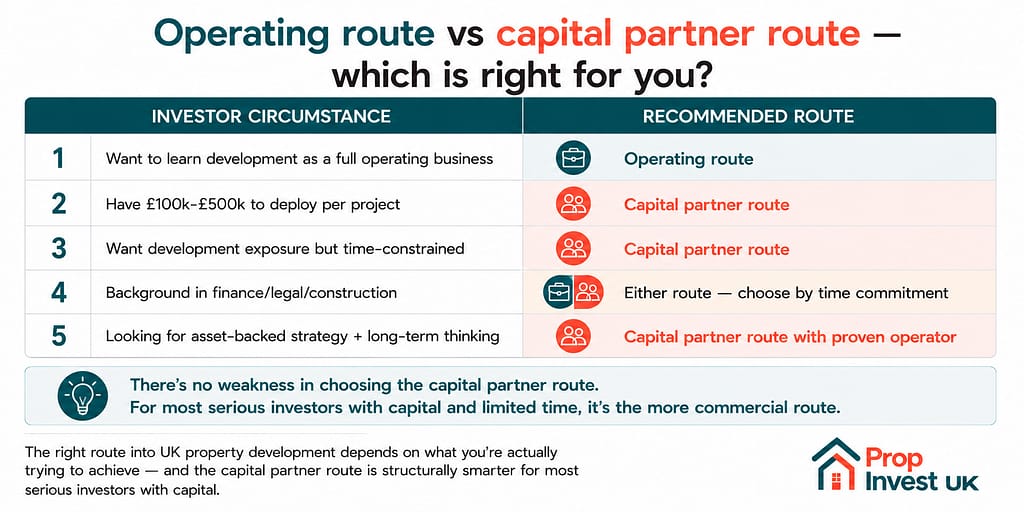
Property development attracts attention because the upside can be meaningful. It also demands judgement, patience and tolerance for complexity. If you want something passive with no need for scrutiny, it is the wrong arena. If you expect every scheme to run to plan, you will be disappointed.
But for investors who value asset-backed strategy, commercially structured opportunities and long-term thinking, development can play a powerful role inside a broader property wealth plan. The key is entering at the right level and with the right structure.
That is where experienced operators have an advantage. Businesses such as Prop Invest UK exist because many investors want access to development opportunities and long-term property exposure without having to build the sourcing, delivery and management infrastructure themselves. For the right investor, that is not a compromise. It is simply a more intelligent use of capital.
If you are looking at how to start in property development, start by deciding whether you want to build a development business or gain development exposure in a controlled, commercially credible way. Those are not the same thing. Once you understand that, your next move becomes far clearer.
The smartest first step is rarely the most exciting one. It is the one that leaves you with options, control and a structure you can trust.
If you’re seriously evaluating whether the capital partner route fits your situation — and want to receive analysis of current UK development opportunities including project structure, security, and projected outcomes — you can join the Prop Invest UK investor list. We share specific opportunities with capital partners on the list as they come to market.
This article is general information only and is not financial advice. UK property development carries risk; capital is at risk. Whether the capital partner route or operating role is appropriate for any specific investor depends on individual circumstances and should be evaluated with appropriate professional advice.