
Most investors evaluating a property development opportunity focus on the deal in front of them. The more useful question is whether the operator presenting it can consistently spot profitable deals in the first place — because the deal you're shown is only as good as the judgement that selected it. This article walks through the five things a capable operator does to identify a profitable deal before the wider market does, and how you, as an investor, can tell whether an operator genuinely has that discipline or is simply presenting the one deal that happened to land on their desk.
When you participate in a property development project as a capital partner, you are not really backing a building. You are backing the judgement that selected the building. A strong operator running a weak deal can usually protect your capital. A weak operator running a strong deal frequently can't. So the most important thing to understand before committing capital is not the specific opportunity — it's whether the person presenting it can reliably tell a profitable deal from an expensive lesson.
Below are the five disciplines that separate operators who consistently find profitable deals from those who get lucky occasionally — and the questions you can ask to tell which one you're dealing with.
1. They look for value they can create, not value they hope to find
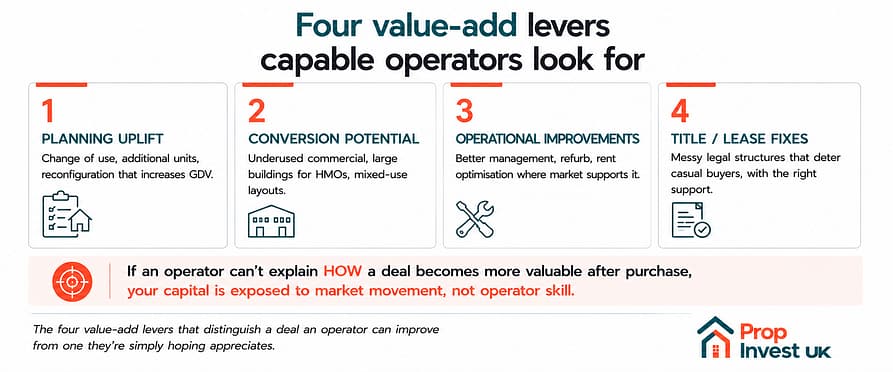
Most casual buyers search for "undervalued" property and hope the market proves them right. Capable operators do something different — they look for value-add levers: specific, identifiable actions that increase the end value, improve the rental position, or reduce risk.
Common value-add levers include:
- Planning uplift — change of use, additional units, or reconfiguration that increases GDV
- Conversion potential — underused commercial space, large buildings suitable for HMOs, or mixed-use layouts
- Operational improvements — better management, refurbishment to improve the tenant profile, or rent optimisation where the market genuinely supports it
- Title or lease fixes — messy legal structures that deter casual buyers, where the right professional support unlocks value
What to ask the operator: "How does this deal become more valuable after acquisition, and through which specific actions?" If they can't explain the mechanism clearly, they're presenting a hope-and-pray deal, not a value-add one — and your capital is exposed to market movement rather than operator skill.
2. They underwrite fast — and reject most deals quickly

Speed matters in deal sourcing, but speed without discipline is expensive. The strongest operators reject weak deals quickly so they can spend their time on the few that deserve deeper work. The discipline isn't in finding deals — it's in killing them efficiently.
A capable operator's early filter looks like this:
- Estimate realistic end value (GDV) using comparable sold prices, never asking prices
- Estimate total costs — purchase, stamp duty, legals, build or refurbishment, professional fees, finance, contingency
- Check the margin — does it still work under conservative assumptions, not perfect ones?
Many experienced developers aim for a development margin in the region of 25% of GDV, though the right target depends on risk, complexity, and exit strategy.
What to ask the operator: "How many deals did you review in the last quarter, and how many did you proceed with?" A credible operator rejects the overwhelming majority of what they see. If they seem to proceed with most deals they look at, their filter isn't tight enough to protect your capital.
3. They read motivated-seller signals without overpaying for the story
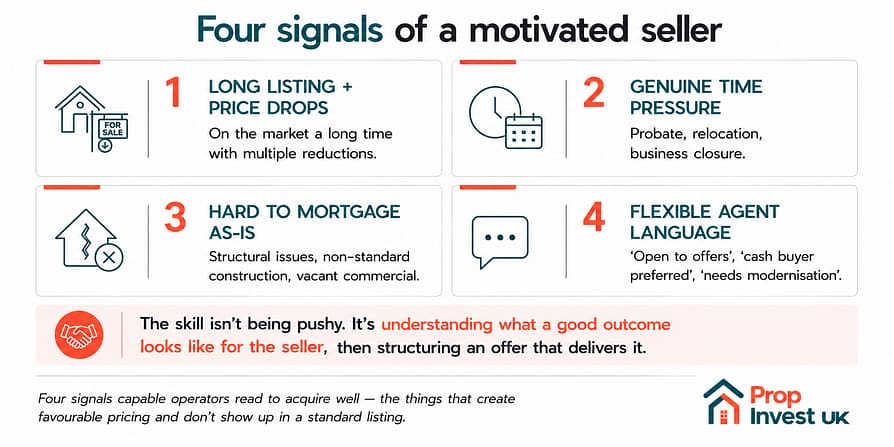
Profitable deals are often created at acquisition, before any work begins. Operators who consistently buy well can read the signals that create favourable pricing and terms — the things that don't show up in a Rightmove listing.
Signals a capable operator notices:
- A property listed for a long time with multiple price reductions
- A seller under genuine time pressure (probate, relocation, business closure)
- A property that's hard to mortgage in its current state — structural issues, non-standard construction, vacant commercial
- Agent language that hints at flexibility: "open to offers," "cash buyer preferred," "needs modernisation"
The skill isn't being pushy. It's understanding what a good outcome looks like for the seller, then structuring an offer that delivers it.
What to ask the operator: "How was this site acquired, and why was it available at this price?" A strong answer explains the specific circumstance that created the opportunity. A weak answer is vague about why a genuinely profitable deal was simply sitting on the open market.
4. They understand the planning angle before committing
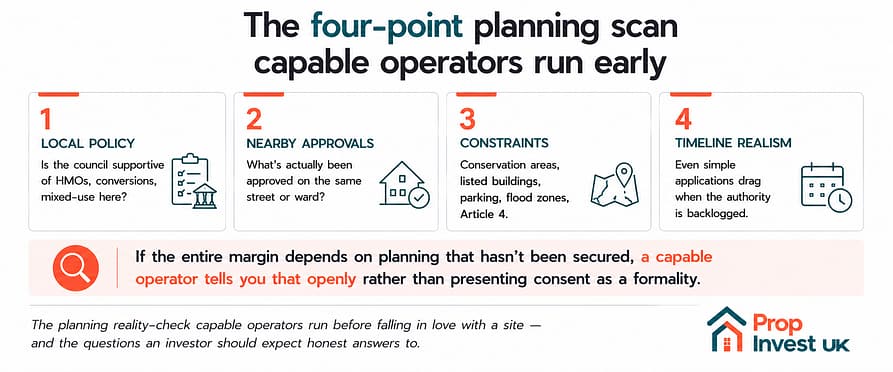
Planning is often where the largest upside lives — and the largest delays. Operators who consistently find profitable deals do a planning reality-check before falling in love with a site, not after.
A capable operator's quick planning scan covers:
- Local policy — is the council supportive of HMOs, conversions, or mixed-use in this area?
- Nearby approvals — what has actually been approved on the same street or in the same ward?
- Constraints — conservation areas, listed buildings, parking requirements, flood zones, Article 4 directions
- Timeline realism — even straightforward applications drag when the local authority is backlogged
What to ask the operator: "What's the planning status, and how much of the projected value depends on consent you don't yet have?" If the entire margin depends on planning that hasn't been secured, the deal carries significant risk — and a capable operator will tell you that openly rather than presenting consent as a formality.
5. They run a deal pipeline like a business, not a hobby
Operators who consistently find profitable deals don't get lucky once. They see more deals, reject faster, and follow up consistently — because deal flow is a system, not a stroke of fortune. This is the part of operator capability investors most often overlook, and it's one of the strongest predictors of whether good deals will keep coming.
A credible operator's pipeline has:
- Defined lead sources — agents, auctions, direct-to-vendor, professional referral networks built over years
- Clear deal stages — new lead → initial numbers → viewing → offer → due diligence → legals
- Regular review — what progressed, what was killed, what needs chasing
What to ask the operator: "Where does your deal flow come from, and how repeatable is it?" An operator with a genuine sourcing system can show you a pipeline. An operator relying on whatever turns up can't — which means the deal you're being shown might be the only one they have, rather than the best one they've selected.
The five-point lens, applied to an operator
Article 4 directions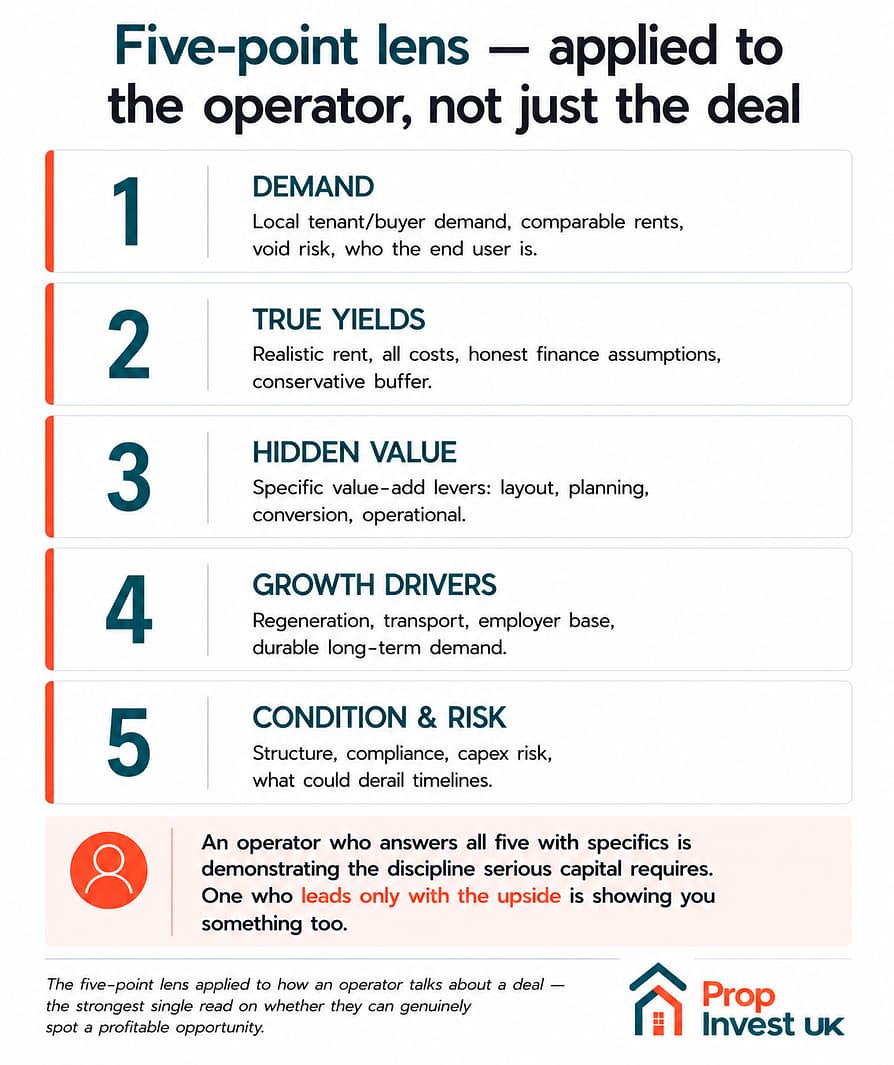
If you want a simple way to sanity-check whether an operator can genuinely spot a profitable deal, apply this five-point lens to the way they talk about the opportunity in front of you:
- Demand — can they explain local tenant and buyer demand, comparable rents, void risk, and who the genuine end user is?
- True yields — do their figures use realistic rent, all operating costs, honest finance assumptions, and a conservative buffer?
- Hidden value — can they articulate the specific value-add levers (layout, planning, conversion, operational)?
- Growth drivers — do they reference regeneration, transport links, employer base, and durable long-term demand?
- Condition and risk — have they assessed structure, compliance, capex risk, and what could derail timelines?
An operator who can answer all five with specifics is demonstrating the discipline serious capital requires. One who deflects, generalises, or leads only with the upside is showing you something important too.
A note on risk
Property development can produce strong outcomes, but it is not risk-free. Prices can fall, costs can rise, projects can be delayed, and rental demand can change. The questions above don't eliminate risk — they help you judge whether the operator managing your capital understands it. Any investment decision should be based on your own circumstances and independent professional advice.
How we approach deal selection at Prop Invest UK
The five disciplines above are the lens we apply to every opportunity before it reaches an investor. By the time we present a deal to capital partners, it has already passed our internal selection framework — and the overwhelming majority of what we look at never gets that far. The full version of how we evaluate and structure deals, including the projects we walk away from, is set out separately in our deal evaluation framework.
If you want to receive analysis of current UK development opportunities — including the value-add mechanism, the structure, the security, and the projected outcome — you can join the Prop Invest UK investor list. We share specific opportunities with capital partners on the list as they come to market.
This article is general information only and is not financial advice. UK property development carries risk; capital is at risk. Property development opportunities are typically not regulated by the Financial Conduct Authority, and investors do not have access to the Financial Ombudsman Service (FOS) or the Financial Services Compensation Scheme (FSCS). Past project outcomes are not indicative of future performance. Specific development opportunities should be evaluated with appropriate professional advice.