
Of all the questions a private investor faces when evaluating UK property development opportunities, the most important one isn’t about the project. It’s about the person — or the team — asking for the capital.
Property development is an operator-led business. The same site, the same planning consent, and the same finance structure will produce wildly different outcomes depending on who’s running the project. A competent operator builds value through dozens of small decisions made well. A weak operator destroys value through the same dozens of decisions made poorly.
This guide walks through how to vet a property operator before committing capital — the public records to check, the questions to ask, the patterns to look for, and the red flags that should end the conversation. It draws on the three real case studies (Raf at Gore Terrace, Jason at the Windsor Lodge, Glenn at Mozarts) we’ve covered in our overrun and investor security articles.
Why operator quality matters more than project quality
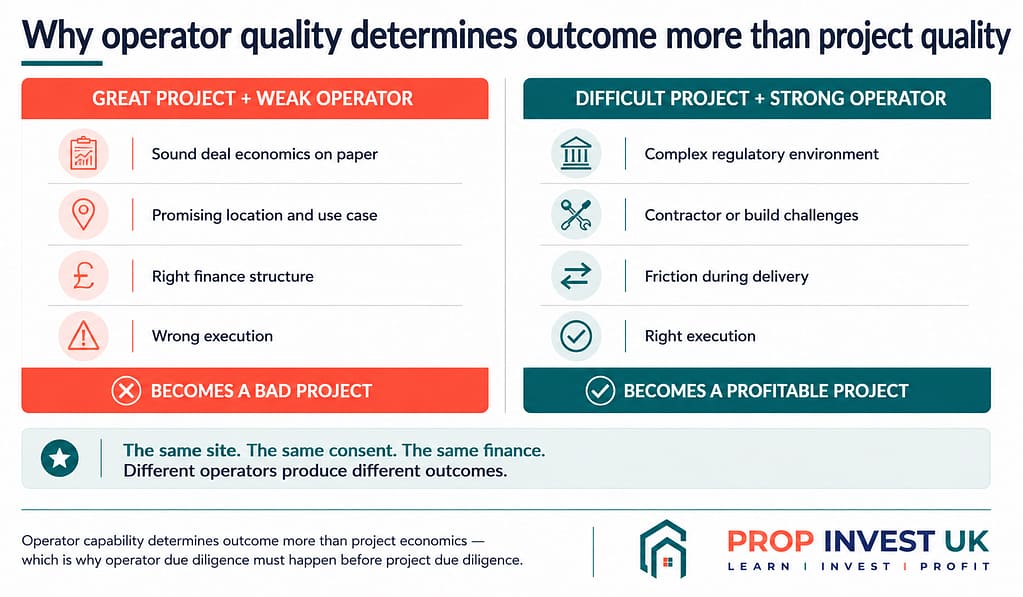
Most early conversations between investors and property developers focus heavily on the project. The GDV. The development margin. The exit strategy. The structural features that determine whether the deal economics make sense.
All of that matters. But experienced UK property investors have learned a different lesson over time:
A great project run by a weak operator becomes a bad project. A difficult project run by a strong operator becomes a profitable one.
The Windsor Lodge story we covered in the overrun article is a perfect illustration. The project itself was genuinely hard — Grade II listed, contractor execution problems, complicated regulatory environment. A weaker operator running the same project would have lost it. The same set of physical, regulatory, and contractor challenges produced an entirely different outcome because of who was running the project.
This is why operator vetting matters more than project vetting at the front end. You can fix or restructure aspects of a project. You cannot fix the operator. If the operator is wrong, the project is wrong — regardless of how attractive the deal economics look on paper.
Three principles flow from this:
- Operator due diligence must happen before project due diligence. The order matters. If the operator doesn’t pass, the project doesn’t need to be evaluated at all.
- Operator due diligence is mostly evidence-gathering, not opinion. Public records, completed projects, references from prior investors. The work is structured and verifiable.
- Most investors don’t do this work — which is why most fall for the wrong operators. The investor who actually completes the checks below is in a different category from the investor who relies on first impressions and marketing material.
The seven categories of operator vetting

A proper UK property operator due diligence covers seven distinct areas. Each has specific public records to check and specific questions to ask.
1. Identity and corporate structure
The first thing to verify is who you’re actually dealing with. Property development is run through limited companies, often multiple companies in a group structure — the trading operating company, individual project SPVs, holding companies, and sometimes a separate investor-facing brand.
What to check:
- The operator’s main company name and number — search Companies House to verify the company exists, was incorporated when claimed, and is in good standing (not dissolved, not in liquidation, no pending dissolution).
- The director(s) of the company — same Companies House search. Verify the names, dates of appointment, and any other directorships they hold.
- Group structure — if the operator describes multiple companies, ask how they relate to each other and verify on Companies House. A clean group structure is normal in property development. A confused or evasive answer about group structure is a warning sign.
- Filing history — Companies House shows when accounts were last filed, whether filings are up to date, and any compliance notices. Late filings or compliance notices warrant a question.
Companies House is a free, public, official UK government register. The data is verifiable, current, and searchable in 30 seconds. Any operator unwilling to give you the exact company name and number to verify themselves is signalling something significant — and the signal is rarely good.
2. Track record on completed projects
Marketing materials describe what an operator hopes to do. Completed projects describe what they’ve actually done. The gap between the two is sometimes large.
What to check:
- The number of projects actually completed. Not started. Not “in progress.” Completed — meaning the development was finished, the units were sold or refinanced, and capital was returned to investors.
- The specific addresses or project names of completed projects. Operators serious about their track record will name their completed projects publicly. Operators who describe completed projects only in vague terms (“our recent residential conversion”) are giving you information you can’t verify.
- The scale and complexity of completed projects. A track record of ten simple cosmetic refurbishments doesn’t qualify an operator to take on a 26-bed HMO conversion in an Article 4 conservation area. Match the operator’s actual track record to the project they’re asking you to back.
- Public proof points. Photos, planning records, Land Registry records of completed sales, articles in local press. The harder it is to find third-party evidence of the operator’s claimed track record, the more cautious you should be.
Our track record includes Gore Terrace (HMO conversion, completed, capital returned to investors including Raf with extended interest after planning delay), Windsor Lodge (Grade II listed conversion, completed despite significant contractor challenges, capital returned to investors including Jason), and Mozarts (76 Walter Road Swansea, currently in build, on the trajectory to complete in approximately three months past original schedule). Specific projects, specific names, specific outcomes.
3. Financial track record and current solvency
Property development operators run financial books like any other business. Those books are partly public information through Companies House filings, and partly information the operator should be willing to share with investors on request.
What to check from public records:
- Latest filed accounts at Companies House for the operating company. For smaller companies this is often abbreviated, but it still shows turnover, assets, liabilities, and going-concern status.
- Charges register — the list of registered charges against the company at Companies House. This shows which lenders the company has borrowed from, and the scale of secured borrowing. A company with multiple charges from multiple specialist development lenders has lender relationships. A company with no charges has either never borrowed (limiting track record) or hasn’t operated at meaningful scale.
- Director’s other directorships — same Companies House search shows what other companies the directors are involved in. Multiple successful property SPVs in the director’s history is reassuring. Multiple dissolved companies, or directorships across unrelated industries, warrants investigation.
What to ask the operator directly:
- Have you ever had a project that lost investor capital? If yes, what happened and what did you learn?
- Are you currently solvent across your operating companies, and can you show recent management accounts?
- What’s the current state of your senior lender relationships, and are you in good standing across them?
The questions matter less than the operator’s willingness to answer them. An operator who provides clear, verifiable answers is operating at the level investor capital requires. One who deflects or evades is signalling.
4. References from prior investors
The single most valuable due diligence step — and the one most investors skip because they feel awkward asking — is speaking to one or more investors who have been through completed projects with the operator.
A capable operator will have multiple investors who’ve been through full project cycles and will introduce you to one or more of them on request. This conversation tells you more about how the operator actually behaves than any written material can.
What to ask a reference investor:
- How long have you worked with this operator? How many projects across what timeline?
- What was your experience during the project — communication frequency, transparency, problem-solving?
- Did any of your projects encounter problems? If yes, how did the operator handle them?
- Did you receive full capital and full agreed returns? On schedule, or with adjustments?
- Would you invest with them again, and have you?
The single most powerful answer to that last question is “I’m currently in three more of their projects.” That tells you everything about whether the operator is worth backing. The investor isn’t telling you what they think of the operator — they’re showing you what they’ve decided with their capital.
If an operator refuses to provide references, or claims they “can’t share investor details for confidentiality reasons,” consider why. A genuinely good operator has investors who are happy to talk to prospective new investors — because the operator has earned that conversation through repeated good outcomes. Investors who’ve been through full cycles with strong operators tend to be glad to recommend them.
5. How they handle friction and overruns
We’ve covered this in depth in our project overruns article, but it’s worth repeating here as part of operator vetting because it’s where the operator’s true quality shows up most clearly.
Every UK property development operator has projects that ran over plan. The question isn’t whether they’ve had overruns — it’s how they handled them.
What to ask:
- Walk me through a project that ran over plan. What caused it, how did you handle it, what was the outcome for investors?
- How frequently do you communicate with investors during projects, and does that frequency change when issues arise?
- Have you ever extended investor loan terms because a project ran over? How did the structure work — did investors receive additional return for the extension period?
- Have you ever lost investor capital on a project? If yes, what happened?
The pattern that runs through our three case studies — Raf at Gore Terrace (planning delay, pro-rata interest extension, capital returned), Jason at the Windsor Lodge (build complexity with contractor changes, pro-rata interest extension, capital returned), Glenn at Mozarts (currently mid-overrun, pro-rata interest extension underway, capital expected to return) — is the pattern worth looking for. Consistent handling across different types of friction. Proactive communication during difficulties. Structural protection for investor capital regardless of which category of friction arises.
An operator with a single positive story to tell about overrun handling is weaker evidence than an operator with multiple consistent stories across different friction types.
6. The deal structure they propose
The structure of the deal an operator proposes tells you about the operator. Structures we covered in detail in our fixed return vs equity article and investor security article.
What to evaluate:
- Is the structure documented? Loan agreements, shareholders’ agreements, security documentation, legal charges. The documentation should exist, should be professional, and should be available for review before capital is committed.
- Is the security registered? A legal charge at HM Land Registry. A debenture at Companies House. A personal guarantee in a Deed of Guarantee. Registered security is verifiable security; unregistered “security” isn’t.
- Are independent solicitors involved on both sides? Operators who steer investors toward using only the operator’s solicitor are reducing investor protection. Two-sided legal review is standard for a reason.
- Are the terms stress-tested? What happens if the project runs over? What happens if costs exceed budget? What happens if the exit is delayed? The operator should have specific, modelled answers — not vague reassurance.
The structure of the first deal an operator proposes to a new investor is also a signal. Operators who push new investors directly into equity participation on their first deployment are taking advantage of the relationship trust gap. Operators who start new investors on fixed-return structures — at appropriate exposure for an unproven relationship — are recognising that trust is earned across projects, not assumed from the first conversation.
7. Personal credibility — beyond the public records
The first six categories are evidence-led and verifiable. The seventh is harder to formalise but at least as important.
What to look for:
- Specificity in answers. Capable operators answer questions about projects, finance, and structure with specific numbers, dates, addresses, and outcomes. Less capable operators answer the same questions with generalities, range, and qualifications.
- Willingness to admit weakness. An operator who tells you they’ve had a project that overran, or a deal they walked away from, or a contractor relationship that didn’t work out, is more credible than one who claims a perfect record. Perfect records in property development are usually short records.
- Comfort with the regulatory framing. Property capital partnerships sit close to FCA-regulated activity even when they don’t fall directly within it. Operators who understand the regulatory landscape, use appropriate framing, include disclaimers, and welcome independent legal advice are operating at a level that reduces investor risk. Operators who promise guaranteed returns, claim to be “regulated” without being able to specify by whom, or pressure investors to decide quickly are signalling — and the signal is bad.
- Time horizon. Capable property operators talk about projects in months and years. They explain why an HMO conversion takes 18-24 months from acquisition to completion, why planning timelines stretch, why exit windows take time. Operators who promise rapid returns on property development are usually promising things they can’t deliver.
Red flags that should end the conversation
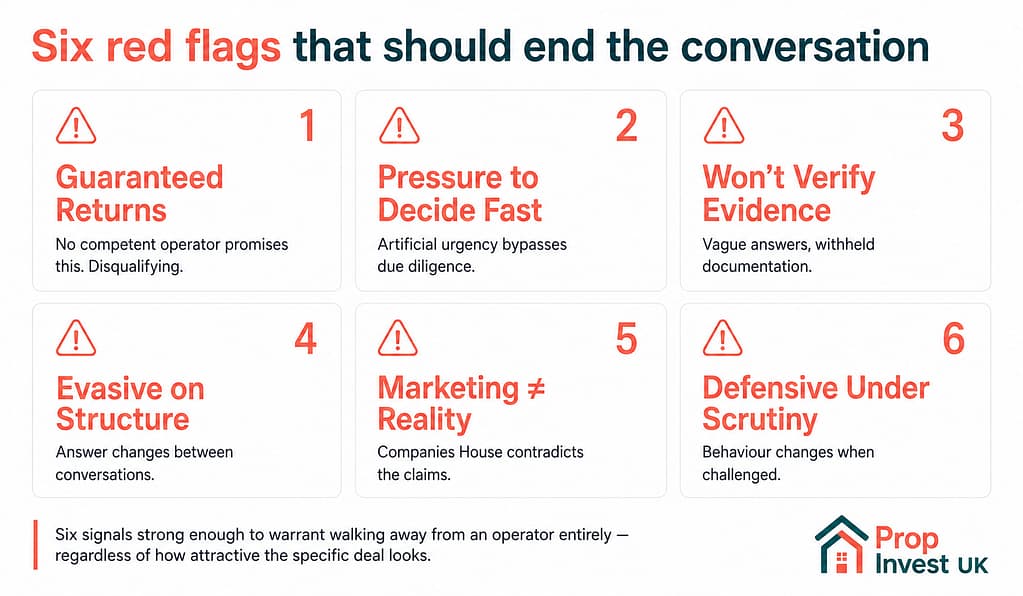
Some signals are strong enough that they warrant walking away from an operator entirely, regardless of how attractive a specific deal looks. Six in particular.
1. Guarantees of return
Property development carries risk. No competent operator promises a “guaranteed return” because no honest operator can. An operator who uses the word “guaranteed” about returns is either misunderstanding the structure they’re offering, or willing to mislead. Either is disqualifying.
The same applies to language like “risk-free”, “100% secure”, or anything implying capital cannot be lost. UK property development can produce strong risk-adjusted returns. It cannot offer guaranteed or risk-free returns. An operator who claims otherwise is selling a product that doesn’t exist.
2. Pressure to decide quickly
“This opportunity closes Friday.” “We have one space left at this rate.” “If you don’t commit by next week the terms change.”
Genuine UK property development opportunities have specific timelines tied to acquisition deadlines, planning windows, and finance facility expiry dates. But those timelines are usually weeks or months, not 48-72 hours. An operator who creates artificial urgency is using a sales technique designed to bypass due diligence. The investor’s protection against this is simple: any operator unwilling to give you proper time for due diligence isn’t worth investing with.
3. Refusal to provide verifiable evidence
Asked for completed project addresses, the operator gives “areas” or “regions” without specifics. Asked for the company number, they provide a brand name. Asked for references, they cite confidentiality. Asked for documentation, they promise to provide it “after commitment.”
A serious operator provides verifiable evidence on request because they have the evidence to provide. An operator who routes around verification is operating at a level investor capital should not accept.
4. Confused or evasive answers about structure
Asked about how investor capital is secured, the operator gives different answers in different conversations. Asked about the role of personal guarantees, the answer changes between the marketing material and the actual legal documents. Asked about charge priority, the operator implies “first charge” when the structure is actually second charge or unsecured.
Property development structures are legally defined and don’t move based on the conversation. An operator whose explanation of the structure varies depending on who’s asking is either confused about their own structure or actively misrepresenting it.
5. History that doesn’t match the marketing
The operator claims a 10-year track record. Companies House shows the company was incorporated three years ago. The marketing material describes “completed projects across the UK.” Companies House shows two SPVs, neither of which appears to have completed a development.
Marketing claims that don’t survive a 30-second Companies House search are the single clearest disqualifying signal in operator due diligence. If the basic claims are false, every subsequent claim is suspect.
6. Behaviour that changes when you push back
A capable operator welcomes hard questions because they have answers. A weaker operator becomes defensive, dismissive, or emotional when challenged. The conversational temperature of due diligence tells you something. An operator who shifts to charm or to discomfort when pressed on specifics is signalling — and what they’re signalling is that they don’t want you looking too closely.
What good operator behaviour looks like in practice
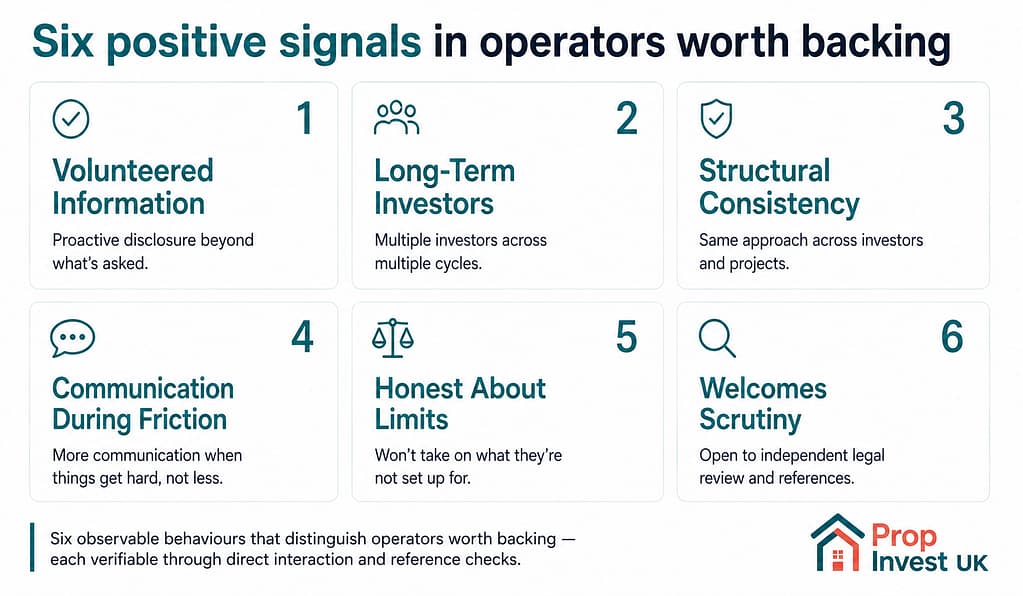
The flipside of red flags is what to recognise in operators worth backing. Six positive signals.
1. They volunteer information you didn’t ask for. Operators who proactively explain structural details, name completed projects, mention past difficulties, and walk you through what could go wrong are operating at a different level than those who answer only the specific questions you raise.
2. They have multiple investors who’ve been through multiple cycles. Long-term investor relationships across multiple completed projects are the strongest single signal of operator quality. Investors who’ve stayed for three, four, five projects across years are voting with their capital. Their continued involvement is evidence in a way nothing else is.
3. They have a consistent structural approach across investors and projects. The security structure, the legal documentation, the communication pattern, the way overruns are handled — all consistent across different investors and different projects. Consistency suggests process and discipline; variability suggests reactive decision-making.
4. They communicate more during friction than during smooth running. This is the single most distinguishing characteristic of strong UK property operators. When things are going well, communication is regular. When things are difficult, communication increases. The opposite pattern — going quiet during difficulties — is a near-universal signal of weak operator behaviour.
5. They give honest answers about limits. “We don’t take on projects above £X scale because we’re not set up for it.” “We don’t operate in Y region because we don’t have the contractor base there.” “We don’t offer guarantees because we can’t honestly offer them.” Honest acknowledgment of limits is a signal of operational maturity.
6. They welcome independent legal review and references. “Use your own solicitor, take your time, talk to our other investors, ask whatever questions you need.” This kind of openness is what genuine confidence in the operation looks like. It’s also rare — most operators want to move investors quickly through due diligence rather than welcome it.
A practical due diligence sequence
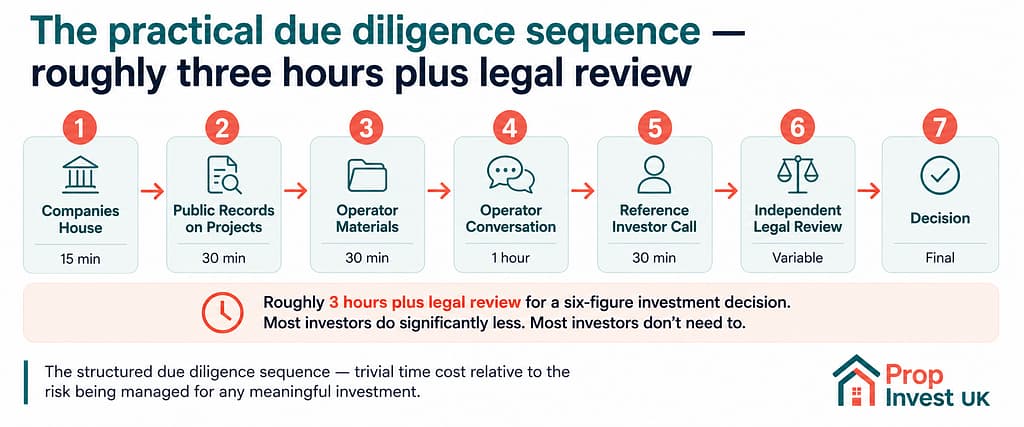
For an investor seriously evaluating a UK property operator, here’s a sensible sequence to work through:
Step 1 (15 minutes) — Companies House search. Verify the operator’s company exists, is in good standing, has appropriate filing history, and the directors are who they say they are.
Step 2 (30 minutes) — Public records on claimed projects. Verify named completed projects exist. Search planning portals for the local authorities mentioned. Search Land Registry for completed sales where addresses have been provided. Read local press coverage of the projects.
Step 3 (30 minutes — operator-supplied materials). Request and review the operator’s company structure, completed project list, and any documentation about the specific opportunity being discussed. Read what’s provided. Note what’s not provided.
Step 4 (1 hour — operator conversation). Have a structured conversation with the operator covering the seven vetting categories above. Take notes. Ask specifically about overruns, references, structure, and security.
Step 5 (30 minutes — reference investor conversation). Talk to at least one investor who’s been through a full cycle with the operator. Ask the questions from the references section above.
Step 6 (variable — legal review). If the previous steps are positive, instruct your own solicitor to review the loan agreement, security documentation, and any other legal materials before capital is committed.
Step 7 — Decision. Based on all of the above, decide whether to proceed.
This sequence takes roughly three hours of structured work, plus the legal review time. For a six-figure investment, three hours is a trivial cost relative to the risk being managed. Most investors do significantly less. Most investors don’t need to.
What this looks like at Prop Invest UK
The principles in this article apply to every UK property operator, including us. We’d encourage any investor evaluating Prop Invest UK or Vernon Property Group to work through the same checklist.
Specifically:
- Companies House — Vernon Property Group and the project SPVs are searchable, filed, and in good standing. The relevant company numbers and director information are publicly available.
- Track record — completed projects include Gore Terrace, the Windsor Lodge, Trowbridge, Gorseinon, Ilfracombe, and others. Addresses, scales, and outcomes can be discussed in detail.
- References — investors who have been through completed projects with us can be made available for direct conversation with prospective new investors, subject to their consent. Raf, Jason, and Glenn are three examples; there are others.
- Structure — second legal charges registered at HM Land Registry, solicitor handling on both sides, professional loan agreements, deal-specific personal guarantees where warranted. Consistent across investors and projects.
- Communication — proactive during all project phases, intensified during friction. The three case studies in our overrun article evidence this pattern across three different overrun causes.
- Honesty about limits — we deliver UK commercial-to-residential conversion and redevelopment projects, primarily in regional locations. We don’t claim expertise we don’t have, and we don’t take on project categories we’re not set up for.
We expect investor due diligence on us. We welcome it. The operators who fear scrutiny are not the operators worth investor capital — and we have no incentive to position ourselves alongside them.
In summary
Vetting a UK property operator before investing is the single highest-value due diligence step in private property investment. The operator determines the project’s actual outcome more than any other factor. Operator due diligence should happen before project due diligence — if the operator doesn’t pass, the project doesn’t need evaluation.
The seven categories of vetting: identity and corporate structure (Companies House), track record on completed projects, financial track record and current solvency, references from prior investors, how they handle friction and overruns, the deal structure they propose, and personal credibility beyond the public records.
The red flags that should end the conversation: guarantees of return, pressure to decide quickly, refusal to provide verifiable evidence, confused or evasive answers about structure, history that doesn’t match the marketing, and behaviour that changes when you push back.
The positive signals to recognise: volunteered information, long-term investor relationships across multiple cycles, structural consistency, increased communication during friction, honest acknowledgment of limits, and welcoming of independent legal review and references.
A practical sequence of work takes roughly three hours plus legal review time. For any meaningful investment, that’s a trivial cost relative to the risk being managed. The operators worth backing welcome the scrutiny. The operators not worth backing find ways to avoid it.
A developer who passes all seven vetting categories, displays consistent positive signals, and welcomes independent due diligence is operating at the level investor capital requires. One who doesn’t, isn’t.
If you want to evaluate Prop Invest UK as a potential property operator for your capital — including direct access to investor references, completed project details, and structural documentation — you can join the investor list. We share specific opportunities with capital partners and welcome the due diligence process described in this article on every prospective relationship.
This article is general information only and is not financial or legal advice. Investors should conduct their own due diligence on any operator they’re considering working with, and should take independent legal and financial advice before committing capital to any property development opportunity. Development carries risk; capital is at risk.