
Right. Most property developers will tell you they have “criteria” for evaluating deals.
Then you press them, and the criteria turn out to be “good location” and “decent margin.” Which isn’t criteria. It’s a vibe.
Real criteria are the things that kill a deal. Not the things that make you want to do one. Anyone can find a deal they want to do. The question is whether you can find the deal you shouldn’t do — and walk away.
So. This is how we actually evaluate development opportunities at Prop Invest UK. It’s not a marketing piece. It’s the framework I use when an estate agent emails me at 9 in the morning with a property they want me to take a look at, and I need to decide whether to drive across the country to view it or politely decline.
The honest number: we walk away from 99.9% of the deals we see. Three to five properties get looked at digitally each week. Tens of thousands get scrolled past on portals. A handful per year actually get bought. The framework below is how that filtering happens.
Five things matter. The order matters more than the list.
The five things that actually decide whether a deal happens

Location → Planning → Financials → Risk → Exit.
That order is deliberate. Each one filters out deals before the next gets considered. A deal that fails on location never reaches the planning question. A deal that passes location but fails planning never reaches the financials. The framework is designed to let you say no quickly, because saying no quickly is the most valuable skill in this business.
Most operators get this backwards. They start with financials — “what’s the margin?” — and only afterwards consider whether the location supports the assumptions and whether planning is achievable. By that point they’ve fallen in love with the numbers, and the next two questions become defensive rather than honest.
Right. Going through them in order.
1. Location (and what “good location” actually means)
“Good location” gets waved around as if it’s self-explanatory. It isn’t.
A good location for a 14-bed HMO is a terrible location for a Grade II listed hotel refurb. A good location for buy-to-let cashflow is a poor location for a commercial-to-residential conversion. The asset type determines what counts as good.
For our model — HMOs, commercial conversions, heritage refurbishments, buy-to-lets — three things have to be true:
Demand patterns specific to the asset type. For HMOs, that means a tenant pool that doesn’t disappear in a downturn — students, NHS workers, contractors, working professionals at the £600-£900pcm end of the market. For commercial conversions, it means a town centre or district centre with footfall that supports both the residential upper floors and the ground-floor retail. For heritage, it means a market that values the building’s character at completion, not just at purchase.
Transport links and growth indicators. Not just “near a train station” — which train station, going where, with what frequency. A property 10 minutes from Swansea station is a different proposition to a property 10 minutes from Cardiff Central, even if the postcode looks similar on paper. Same logic for employment hubs, planning trajectory, regeneration zones, university expansion.
Local market behaviour we actually understand. This is the unspoken one. We focus on the South West, South Wales, and the M4 corridor — Swansea, Frome, Trowbridge, Ilfracombe, Reading — because we’ve operated there for years. We know which streets work and which don’t. We know which planning officers are reasonable and which aren’t. We know the contractor base. We know how long a property has been sitting on the market and why.
Outside that geography, the numbers can look good on a spreadsheet and the actual deal can be a disaster. We turn down deals in Manchester and Birmingham and the South East all the time, not because they’re bad deals but because we don’t have the operational depth in those markets to execute them properly.
It works the other way too. Right now there’s a property called Gorseinon Working Men’s Club for sale. On paper, it’s interesting — the right size, the right type of asset, the right kind of conversion potential. Numbers look workable.
We won’t touch it.
Reason: it’s in the SA4 postcode area of Swansea. SA4 is run by a council so badly under-resourced that planning decisions take years rather than months. The planning officer for that area will not be fully honest in a pre-application meeting — they will, in my direct experience, outright tell you things at pre-app that turn out not to be true. Which means any deal in SA4 needs an extra £100k stripped off the purchase price up front to cover the planning carrying costs, legal challenges, and timeline risk.
The seller of Gorseinon won’t drop £100k. So we won’t buy it. That’s not visible from the listing. It’s not visible from Rightmove. It’s not in any data product Seomi could query. It only matters if you’ve actually tried to deliver projects in SA4 before.
That’s what “we know the geography” actually means. It’s not “the South West is a good market.” It’s “this specific postcode within this specific city has a specific planning department dynamic that costs £100k per project, so we don’t operate there even when individual deals look attractive.”
2. Planning (the deal-killer most operators underestimate)
This is where most property development projects die — and most operators don’t realise until it’s too late.
Council planning departments are not uniform. They have different cultures, different backlogs, different officers, different histories with developers. Two near-identical properties in two adjacent council areas can have wildly different outcomes depending on who’s handling the application.
I’ve seen a project that should have taken eight weeks for planning consent take two years, because the application landed on the desk of a part-time officer with a backlog they couldn’t clear. Same property type, same scheme, different council — would have gone through in three months.
So. When we look at a property, we engage with planning before we acquire. Not after. Pre-application meetings, conversations with planning consultants who know the local landscape, sometimes informal calls with officers we have prior relationships with. We also rely on hard-won experience of which planning departments are honest about what they’ll approve and which aren’t (see SA4, above).
What we ask before we even view:
- Has this site been refused planning recently, and if so for what?
- Is the property in a conservation area, listed, in flood zone, or in a designated regeneration zone?
- Are there active enforcement notices?
- What’s the council’s housing delivery position — are they under-delivering and therefore more inclined to approve, or over-delivering and more inclined to refuse?
- Who would the case officer likely be, and what’s their track record on similar schemes?
If the answers to those questions don’t give us a credible path to consent within a reasonable timeframe, we walk. Doesn’t matter how good the property looks.
The Frome Market Place example.
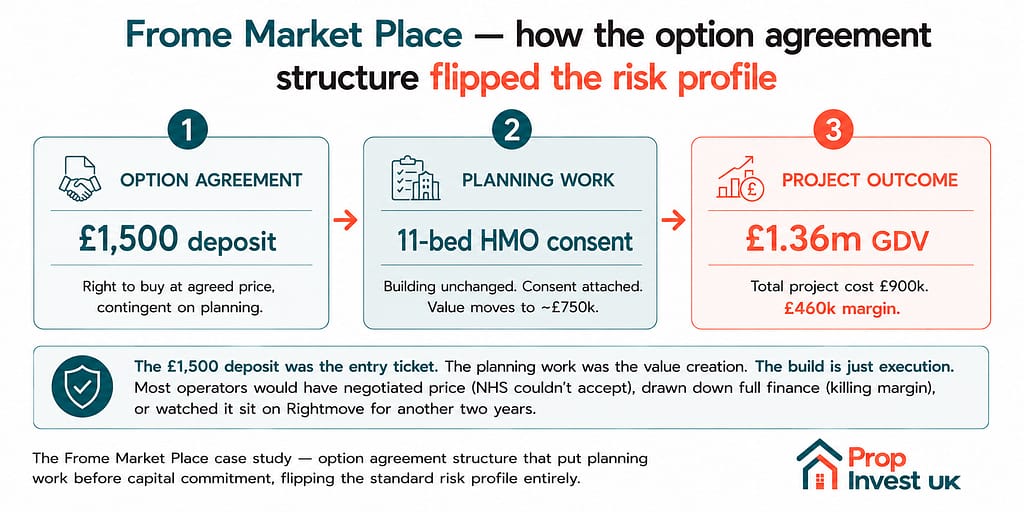
Frome Market Place was a former Shoe Zone unit in the town centre. I’d had my eye on it for years. The NHS owned it but I couldn’t find who within the NHS was responsible for it — these large institutional landlords have buildings sitting on their books that no individual has clear ownership of, which makes them simultaneously hard to acquire and occasionally easy to acquire at the right moment.
Eventually it came up for sale at a price above market value. The NHS had overspent on it historically and couldn’t sell below that price without having to explain a public-money loss to people higher up the chain.
We couldn’t buy it at that price either, not as a straight cash purchase. But the planning angle made it possible.
If we could secure planning consent for an 11-bed HMO conversion above the ground floor retail before completing the acquisition, the property’s value would shift entirely. Not because the building had changed, but because the consent would. £500k purchase on paper becomes £750k with consent in place. The NHS gets their book value. We get the uplift the planning work created.
So we structured it as an option agreement. £1,500 deposit secured the right to buy the property at the agreed price, contingent on planning. We then went and got the consent — an 11-bed HMO conversion above ground floor retail. With planning in place, the property’s value moved to roughly £750k pre-purchase. We then completed the acquisition with the consent already attached.
Total project cost: £900k. GDV: £1.36m.
The £1,500 deposit was the entry ticket. The planning work was the value creation. The build is just execution.
Most operators wouldn’t have approached the property that way. They’d have negotiated the purchase price down (which the NHS couldn’t accept), or drawn down finance to complete at the asking price (which would have killed the margin), or sat watching it on Rightmove for another two years. The option agreement structure flips the risk profile entirely — the planning work happens before the capital commitment, not after.
That’s not a trick. It’s pattern recognition built up over years of looking at properties that don’t fit standard acquisition routes.
3. Financials (the 25% rule and why we don’t bend it)
Right. Here’s where most operators get loose.
Our target margin is 25% on GDV. That’s not a stretch goal. That’s the threshold below which a deal doesn’t get done.
The maths matters. A property with a £1.36m GDV needs to cost no more than £1.02m to acquire and develop. That £340k margin isn’t profit you can rely on — it’s the buffer that absorbs cost overruns, timeline slippage, valuation surprises at completion, and refinance market shifts. Take a 25% margin and squeeze it through real-world execution, and you typically end up at 15-18% actual profit. Acceptable.
Take a 12% margin and squeeze it through the same execution, and you end up at 2-4%. Or negative. That’s the difference between a deal that pays investors and a deal that loses them money.
So. The 25% rule isn’t arbitrary. It’s the margin required for the deal to survive the friction of actually doing it.
Why discipline on margin matters more than ticket size.
A £100k profit on a £400k project at 25% beats a £500k profit on a £4m project at 12.5%. The first compounds reliably across multiple deals. The second is a binary bet — works brilliantly if everything goes right, loses heavily if anything goes wrong.
We’ve turned down deals with bigger headline numbers because the margin was thin. Each one felt painful in the moment. Each one looked obvious in hindsight.
How we underwrite.
GDV is based on conservative comparables, not aspirational ones. If recent similar HMOs in Swansea have sold or valued at £1.05m-£1.10m, we underwrite to £1.05m. The valuer might come in at £1.10m and that’s a pleasant surprise. We don’t plan on the surprise.
Costs include contingency — typically 10% on smaller refurbs, 15-20% on heritage and complex builds. Windsor Lodge ran £100k over budget because heritage projects always do, even when you build in contingency. We absorbed it. Wouldn’t have been able to if we’d underwritten without margin.
Exit is stress-tested. We assume the refinance market is tighter than today’s market, that valuations are slightly softer than today’s valuations, and that the lease income takes a month or two longer than planned to start flowing. If the deal still works under those assumptions, we proceed. If it only works if the wind is at our back, we don’t.
4. Risk (planning, structural, market, execution — and which scares us most)
Every deal has risks. The question is whether the risks are understood, priced, and managed — or buried, ignored, and hoped about.
The four categories:
Planning risk. Already covered. Mitigated by pre-application work and conversations with the local planning landscape before commitment.
Structural risk. What’s actually wrong with the building? Subsidence, knotweed, asbestos, damp, structural movement, title issues. Most of these are manageable if priced in. The Trebanos deal had four structural problems stacked on a single auction lot — and we still bought it.
Market risk. What we assume about interest rates, lending appetite, valuation behaviour, tenant demand. We can’t predict any of these, but we can stress-test against them.
Execution risk. The one most operators ignore. Can we, with the team we currently have, in the markets we currently operate — actually deliver this project in the timeframe we promise? Or are we hoping we can?
The last one scares me most. Planning, structural, and market risks all sit outside us. Execution risk sits inside us. If we can’t deliver, no spreadsheet rescues the deal.
The Trebanos deal — four problems on a single auction lot.
Trebanos didn’t come from a portal. It came directly from a friend in the property industry who knew what kind of properties I’m into.
This happens more than you’d expect. Once you’ve established a track record of taking on properties other developers can’t or won’t, you become the default buyer for those properties. Estate agents, fellow developers, lenders sitting on distressed assets, planning consultants who know operators in the market — they pass them to you because they know you can move quickly on the things that frighten everyone else off.
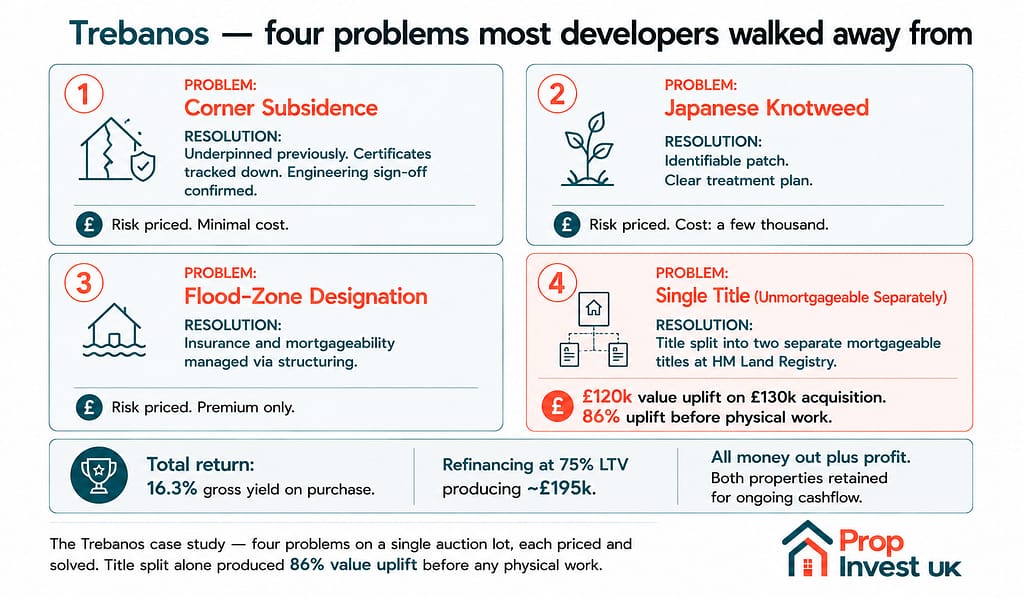
So Trebanos got walked to me. Two adjoining 3-bed houses, going to auction. £130k for the pair. Cheap on paper. The reason they were cheap:
- Corner subsidence on one of the properties — visible cracking, structural concern
- Japanese knotweed on the rear garden boundary
- Designated flood-zone location — meaningful insurance and mortgageability implications
- Single title — both properties registered together, which made them effectively unmortgageable as separate assets
Most developers at the auction saw four deal-killers and walked. We saw four problems that could be priced and solved.
The subsidence had been underpinned by a previous owner — we tracked down the insurance certificates and the structural engineering sign-off. Confirmed remediated. Risk priced.
The knotweed was on an identifiable patch with a clear treatment plan. Cost to remediate: a few thousand pounds. Risk priced.
The flood-zone designation affected insurance premium and mortgageability but didn’t prevent either if structured properly. Risk priced.
The single title was the biggest one — and the most valuable. Once acquired, we split the title into two separate mortgageable titles. Instant £120k uplift on a £130k acquisition. 86% value uplift before doing any physical work.
Title splits are handled through HM Land Registry and require legal work to complete, but the value uplift can be captured immediately at registration.
Total return: 16.3% gross yield on purchase price, with refinancing potential at 75% LTV producing approximately £195k — all money out plus profit, both properties retained for ongoing cashflow.
The Trebanos deal is the case study we point to when investors ask what “we see opportunity where others see obstacles” actually means. It’s not a slogan. It’s a specific framework: identify the problems, price each one, solve each one, capture the uplift the market missed because it couldn’t be bothered to do the work.
And it’s why these properties get brought to us off-market in the first place. Word gets around. Operators who buy clean assets in clean condition are everywhere. Operators who can take a four-problem auction lot and turn it into a 16% yield asset are rare. The flow of opportunity follows the rarity.
5. Exit (the question that should be asked first but usually gets asked last)
How do we get out, and what does the investor see at exit?
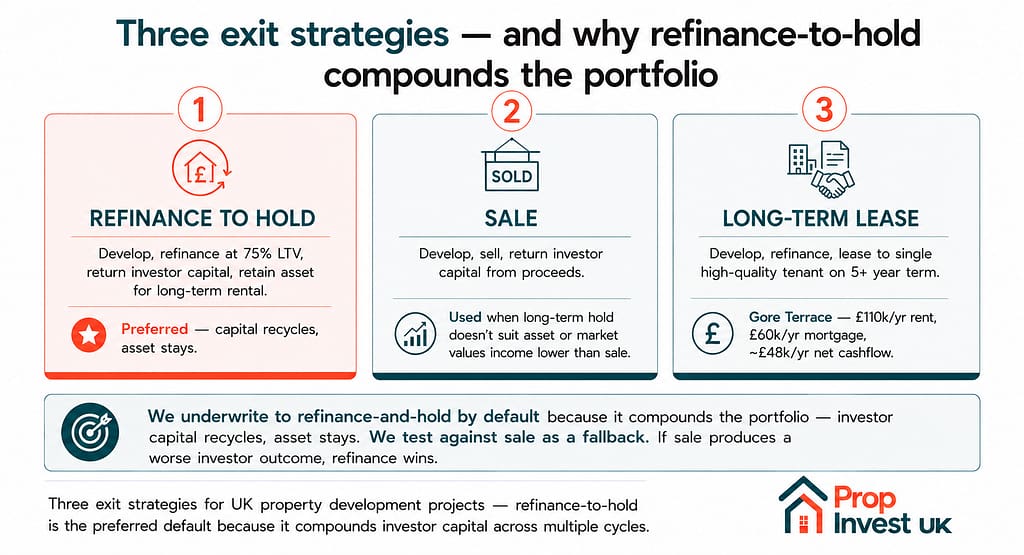
Three exit types:
Refinance to hold. Develop the property, increase the valuation, refinance at 75% LTV against the new valuation, and return investor capital from the refinance proceeds. Keep the asset on the books generating long-term rental income. This is our preferred exit because it compounds the portfolio — investor capital recycles, asset stays.
Sale. Develop the property and sell it. Returns investor capital from the sale proceeds. Used when the asset doesn’t fit long-term hold criteria, or when the local market values the asset at completion higher than it would value the ongoing income.
Long-term lease. Develop the property, refinance it, and lease to a single high-quality tenant on a 5+ year term. Used when the rental income from a single lease beats the cashflow available from multi-tenant operation. Gore Terrace is the proof point — 5-year lease to a single housing provider at £110k/year, with £60k/year mortgage cost, net cashflow ~£48k/year.
We underwrite to refinance-and-hold by default, because that’s the strategy that compounds the portfolio. We test the deal against sale as a fallback. If sale produces a worse investor outcome than refinance — which it usually does, because sale strips the long-term cashflow benefit — refinance wins.
What happens when the exit doesn’t land.
This is the question every investor should ask, and most don’t.
The refinance is dependent on three things: the valuation coming in at the level we underwrote to, the lending market being available at the LTV we assumed, and the timing aligning with our project completion. Any of those can move.
Our mitigation:
- Conservative valuation assumption (we underwrite to a valuation 5-10% lower than we expect)
- Buffer in the project for additional time if the refinance market is slow
- Established lending relationships across multiple lenders so we’re not dependent on a single one
- Project structure that allows us to operate the asset on an interim basis (short-let, hold, partial occupation) if the refinance is delayed
If all of those fail simultaneously — valuation lower than expected, lending market tight, time pressure on the project — the fallback is sale at the refurbished value. Investor capital comes from sale proceeds rather than refinance proceeds. Returns may be lower than originally targeted, but capital is returned.
We’ve never had to execute the sale fallback. But the deal is underwritten to survive it.
The deals we walk away from
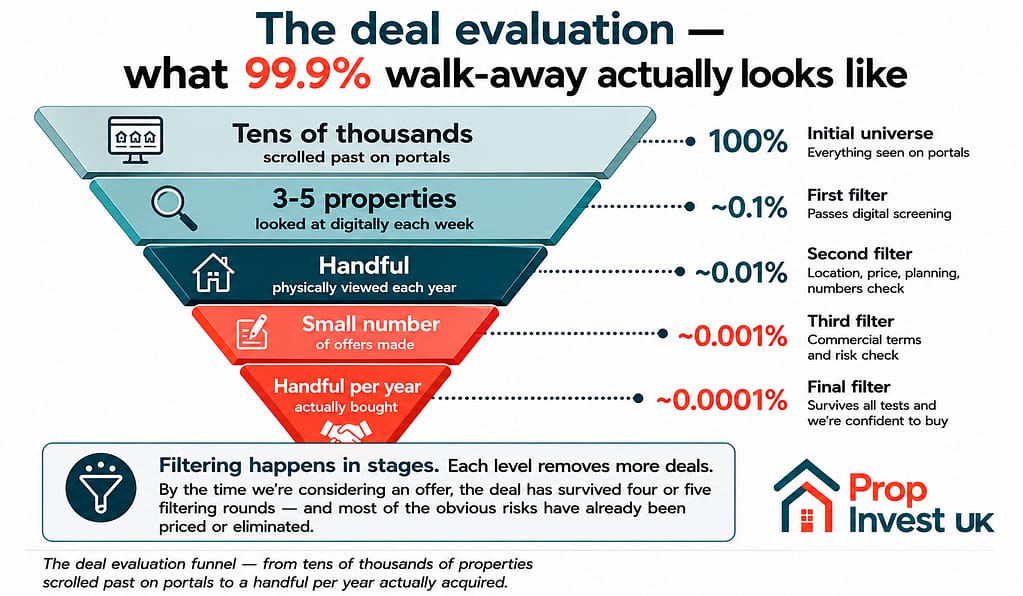
We walk away from 99.9% of deals we see.
That’s not an exaggeration. We look at three to five properties digitally every week — actual deep-looks, not portal scrolls. We scroll past tens of thousands. We physically view very few, because we already know enough from the digital evaluation to filter most out before we get in a car.
The pattern across the declines is rarely a single deal-breaker. It’s the framework above being applied honestly. The decision-making isn’t dramatic. It’s:
- Does it look like it will work at first pass? If no, move on.
- If yes, measure, draw, model. Does it still look like it will work? If no, move on.
- If yes, go deeper. Planning, structural, financial, exit. Each level removes more deals.
- By the time we’re considering an offer, the deal has survived four or five filtering rounds and most of the obvious risks have already been priced or eliminated.
Sometimes we make offers that don’t get accepted. We walk away. Sometimes we won’t engage at all because of postcode-specific risk like SA4. Sometimes a deal looks fine until the survey, and then it doesn’t.
The discipline of walking away is uncomfortable. There’s always a story you can tell yourself about why this one will be different. The 25% margin rule, the geographic focus, the planning pre-engagement, the execution capacity check — they exist to short-circuit that story.
How investors fit into this
By the time you see an opportunity from us, it’s already been through this framework.
Once a deal passes the framework and we open it to investor capital, the partnership structure itself follows the same paperwork-first approach we explain in How Property Investor Partnerships Actually Work.
We don’t bring deals to investors before they pass internal evaluation. The opportunity pack you receive contains:
- The deal logic: why this property, why this asset type, why this market
- The financials: GDV, costs, margin, sensitivity to the assumptions
- The risks: planning, structural, market, execution — and what we’ve done to price and mitigate each
- The exit: primary plan, fallback plan, what happens if neither lands cleanly
- The security: the legal charge, where it’s registered, what rank, against what asset
- The timeline: best case, expected case, worst case
If you can’t see all of that on paper, the deal hasn’t been evaluated properly. If we can’t show you all of that, we shouldn’t have offered the deal.
Investment opportunities are available only to certified High Net Worth or Sophisticated Investors. The qualification gate exists for FCA reasons but it serves another purpose too — it filters the conversation to investors who can actually engage with the evaluation framework on its own terms.
FAQ
Do you ever break the 25% rule?
Not deliberately. Occasionally a deal goes ahead at 23-24% because the asset is genuinely exceptional and the other risks are exceptionally low. Below 22%, we walk. The rule isn’t there to be flexed — it’s there to absorb the friction of actually doing the deal.
How do you know if a planning risk is manageable or fatal?
By doing the pre-application work before we commit. If the planning officer or planning consultant can’t articulate a credible path to consent within a reasonable timeframe, the risk is fatal. If they can articulate the path, it’s manageable. Some council areas are fatal almost regardless of the deal — see the SA4 comment earlier.
What’s the longest you’ve waited to acquire a property after first viewing it?
Gore Terrace took roughly six months to actually buy. We prefer to buy under auction conditions because when we bid, our money’s ready and our lawyers move at auction speed. When there’s no auction pressure, lawyers take forever. Some properties — like Frome Market Place — sat in our heads for years before they became acquirable.
How many properties do you look at to find one you’ll buy?
Tens of thousands scrolled past on portals. Three to five looked at properly each week. A handful physically viewed each year. A small number of offers made. Even fewer accepted. We walk away from 99.9% of everything we see.
How do you decide when to walk away?
When two or more risks are stacking and we can’t mitigate at least one of them down to a manageable level. Single risks are fine if priced. Stacked risks compound, and compound risk is what kills projects.
Do you take investor money before a deal is fully evaluated?
No. Investor capital is only deployed after the evaluation framework has been completed, the deal is contractually secured, and the opportunity pack has been delivered. We don’t raise speculative capital against deals that might happen.
What happens if the deal underperforms after you’ve raised investor capital?
Our investor agreements specify the security structure, the term, the return mechanism, and the operator’s responsibilities. If a deal underperforms, the security and the operational mitigations come into play. We’ve had deals run longer than planned — Gore Terrace ran 15 months instead of 12 — but we haven’t had deals that failed to return investor capital. The 25% margin rule and the conservative underwriting exist specifically to prevent that scenario.
Who else signs off on a deal before you commit?
Internally: Martin and Freddie both have to be aligned before a deal proceeds. Externally: planning consultant, structural engineer where relevant, solicitor on the legal title, valuer on the GDV. The deal doesn’t move until all four are comfortable.
How do you handle deals that come in under the 25% margin?
We walk. Or we restructure the deal to bring it above the threshold — negotiating the purchase price down, identifying additional value creation, repositioning the exit. If neither restructuring nor walking works, the deal doesn’t happen.
Want the deeper version?
Want to see how we structure investor partnerships?
If you want to see how we structure investor partnerships — the paperwork, the security, the documentation, and the questions to ask any operator before committing capital — you can join the Prop Invest UK investor list to receive analysis of current opportunities as they come to market.
Investment opportunities are available only to certified High Net Worth or Sophisticated Investors per FCA financial promotion rules.
Apply to join the investor list →
This article is a financial promotion. Investments are only available to certified High Net Worth or Sophisticated Investors. UK property development carries risk; capital deployed is at risk and target outcomes are not guaranteed. Past project performance referenced in case study material is not a reliable indicator of future results. Property investments are illiquid and not covered by the Financial Services Compensation Scheme (FSCS). Information about partnership opportunities is communicated directly to qualified investors who have applied to join our private investor list.