
The planning meeting is where a property development project either becomes a real project or stops. Most investor content treats planning consent as a binary — granted or refused — and skips over what actually happens in the room. This article goes behind the curtain. What planners scrutinise. How operators frame their case. Why the difference between operators who routinely get property development planning consent and operators who don’t usually has very little to do with the building’s design and everything to do with how the application engages with the planning system.
Compliance note: This article is general information about the UK planning process from the perspective of a development operator. It is not legal or planning advice. UK property development carries risk including the risk that planning consent is refused or granted on conditions that compromise project economics. Past planning outcomes are not indicative of future outcomes on any specific application.
What “planning” actually means
Before getting into the meeting itself, a brief framing for readers who aren’t deep in the planning process.
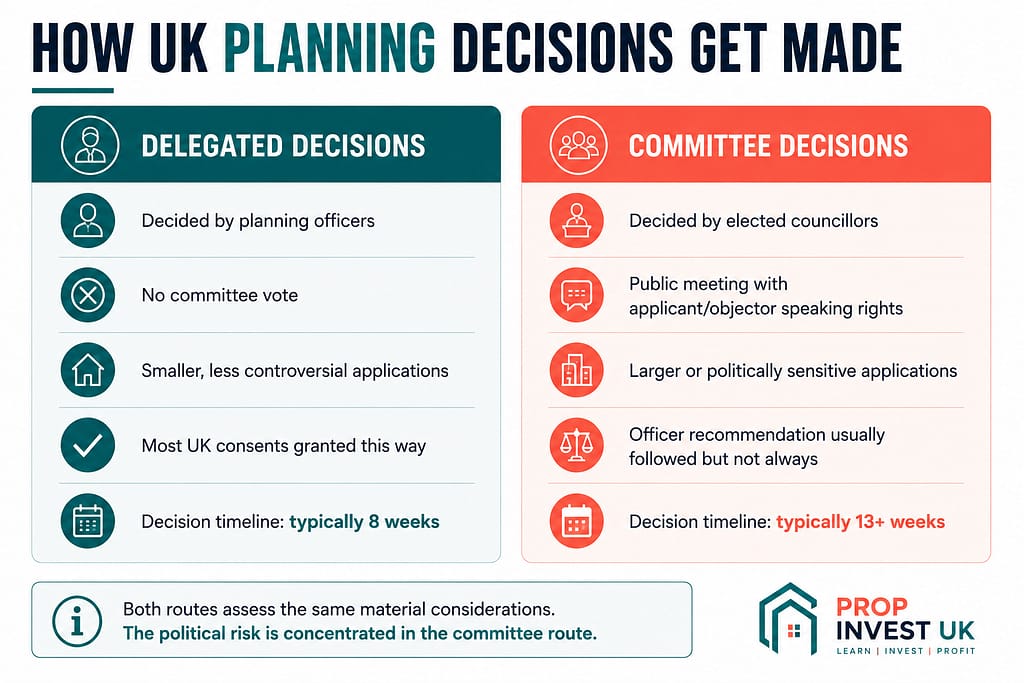
When a developer in the UK wants to change the use of a building (commercial to residential), increase its size (rear extension, roof raise), subdivide it (single house to HMO) or alter its appearance materially, they typically need formal planning consent from the relevant local planning authority. That consent comes through one of two routes:
- Delegated decisions: Smaller, less controversial applications are decided by planning officers without going to committee. Most planning consents in the UK are granted this way.
- Committee decisions: Larger, more controversial, or political applications go in front of a planning committee — elected councillors who review the planning officer’s recommendation and vote on whether to grant consent.
In both routes, the substantive work is done by planning officers — professional civil servants employed by the local authority — who assess the application against national policy (NPPF), local plan policies, design guidance, and the body of material considerations relevant to the specific site.
The “planning meeting” referred to in this article isn’t only the formal committee meeting. It’s the broader set of interactions between the developer’s planning team and the local planning officers that determine whether and how consent gets granted. Pre-application meetings. Site visits with officers. Discussions during the formal assessment period. Negotiation of conditions. And, where the application escalates to committee, the formal hearing and councillor vote.
The applications that go smoothly through this process and the ones that don’t usually differ less in the building design and more in how the developer engages with the planning system.
What planners actually scrutinise
Planning officers are working within a legal and policy framework. They aren’t approving applications on aesthetics or operator charisma. They’re assessing the application against specific material considerations that the planning system recognises.
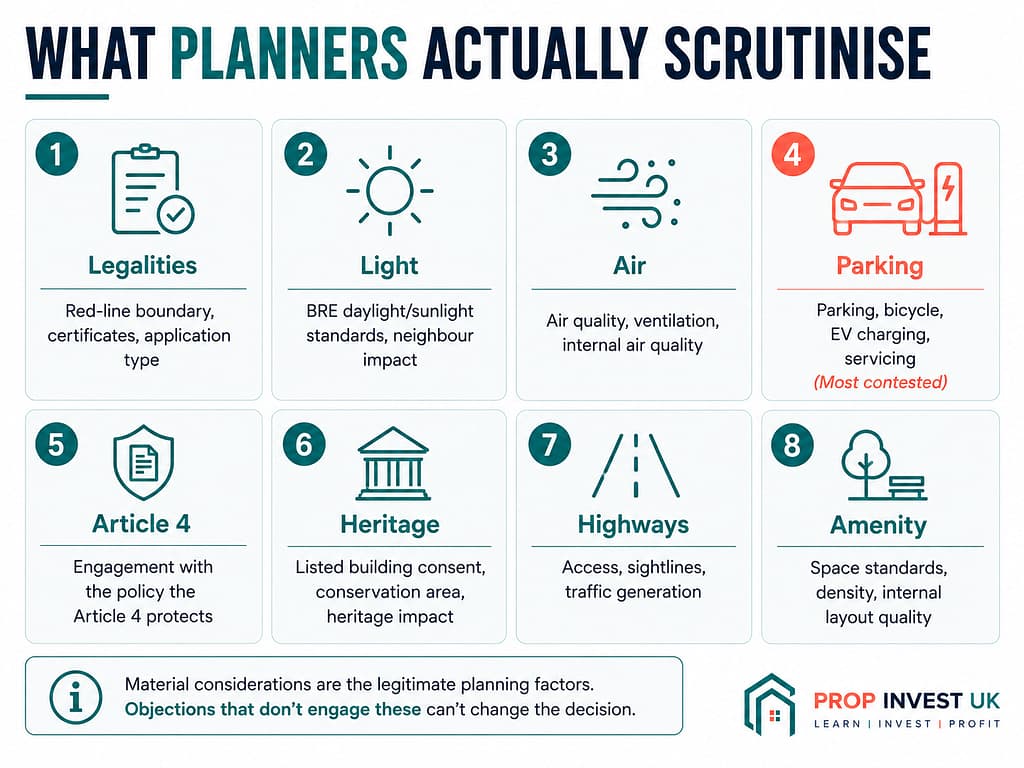
For a typical UK property development application — commercial-to-residential conversion or HMO development — the material considerations that planning officers actively scrutinise include:
Legalities
Is the application correctly constituted? Does it identify the right red-line boundary? Have the consultation requirements been met? Are the required certificates and notices in place? Has the right type of application been submitted (full planning, prior approval, change of use, listed building consent where relevant)?
This sounds administrative. It matters because a deficient application can be returned, refused, or held up indefinitely while the developer corrects basic process issues. Operators who routinely get consent get the legalities right at the first submission.
Light
Daylight and sunlight to the proposed dwellings (do they meet the relevant standards under BRE Site Layout Planning for Daylight and Sunlight?). Daylight and sunlight impact on neighbouring properties (does the proposal cause loss of light to existing residential or commercial uses?). Light pollution from external lighting schemes.
For conversions of commercial buildings, the daylight assessment for the new residential use is often the hardest single planning constraint. Commercial buildings weren’t designed around residential daylight standards. The conversion has to engineer the daylight provision — through window enlargement, additional openings, light wells, careful internal layout — to meet the residential standard.
Air
Air quality, particularly in urban locations close to busy roads. Ventilation provision in the new dwellings (consistent with Building Regulations Part F). Internal air quality where the building contains pre-existing contamination or where the surrounding use generates air pollution.
For a Swansea or Reading site close to a main road, air quality assessment can require specific noise and pollution mitigation in the design. This isn’t a refusal-inducing issue for most schemes but it’s an area that planners actively check.
Parking
Parking provision against the local authority’s standards for the relevant use class. Bicycle storage provision. Electric vehicle charging provision (increasingly mandated). Bin storage. Servicing arrangements.
Parking is often the single most contested aspect of urban conversion schemes. Local authorities have moved away from minimum parking standards in many central locations (in favour of maximum standards or transport-oriented frameworks), but the parking question still requires careful argument in the application. An HMO conversion in a Swansea Uplands location, for example, has to engage with the parking question even where the policy framework favours reduced car ownership.
Article 4 considerations
In locations covered by an Article 4 Direction (which removes the permitted development rights that would normally allow a use change without planning consent), the application has to engage with the specific planning policy that the Article 4 was designed to support. For HMO conversions in Article 4 areas like Swansea Uplands, that means demonstrating that the application is consistent with the housing balance policy that the Direction protects.
A separate article covers Article 4 Directions in detail.
Heritage and conservation
For listed buildings or buildings in conservation areas, the heritage impact assessment is its own planning workstream. The application has to engage with national and local heritage policy, demonstrate that the proposed work preserves or enhances the heritage asset, and where necessary obtain Listed Building Consent alongside planning consent.
Highways
Vehicular access, sightlines, traffic generation, impact on local highway network. For most conversion schemes this isn’t a major issue, but it can become one in specific locations.
Amenity and density
Are the proposed dwellings of adequate size and amenity? Do they meet the relevant space standards? Does the density of the proposal sit appropriately within the local context?
The difference between operators who get consent and operators who don’t
The list above looks like a technical checklist. It is. But meeting the checklist isn’t what differentiates operators who routinely get planning consent from operators who routinely don’t.
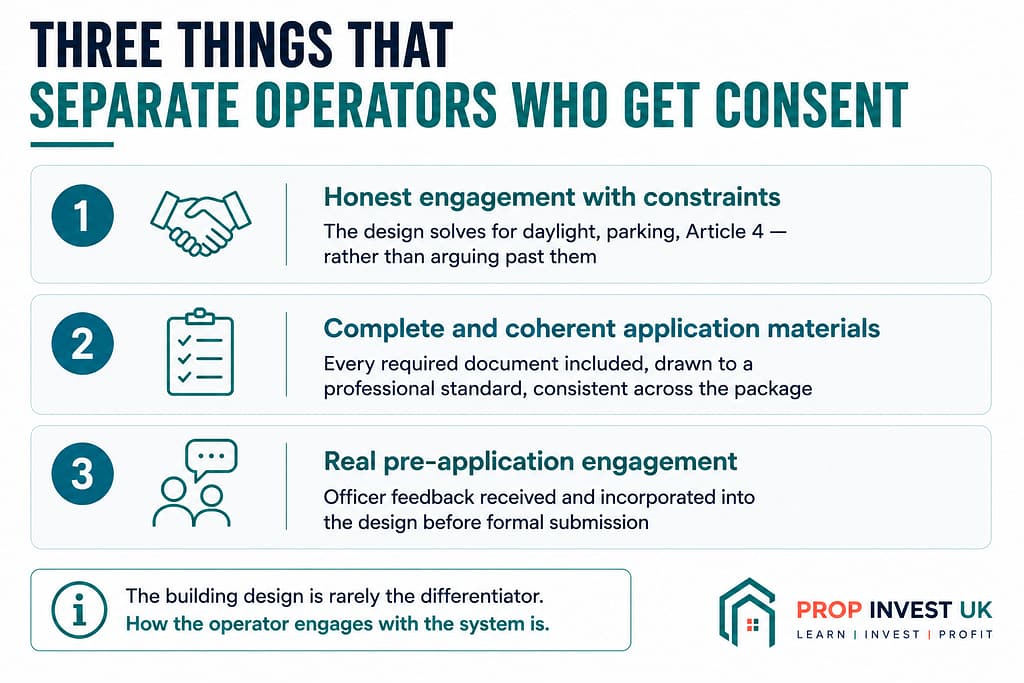
The difference is in how the application engages with the planning system. Three things matter most:
The application addresses the constraints honestly
Planning officers can tell when an application has been put together by someone who’s identified the binding constraints on the site and engineered the design around them — versus an application that’s been put together by someone who’s drawn the building they wanted and then tried to argue it past the constraints.
A daylight-constrained site needs a design that solves for daylight in the dwelling layout. Not a design that gestures at daylight while expecting the planner to accept compromised internal layouts.
A parking-constrained site needs a parking argument that engages with the local policy framework. Not a design that ignores the parking question and hopes it doesn’t come up.
An Article 4 site needs an application that demonstrates consistency with the policy the Article 4 was designed to support. Not an application that pretends the Article 4 isn’t there.
Honest engagement with constraints is the most consistently differentiating thing in planning outcomes. Officers respect applications that take the constraints seriously and respond accordingly.
The application materials are complete and coherent
Planning officers review hundreds of applications a year. They develop strong instincts for which applications are complete, coherent and ready for decision — and which applications will require multiple rounds of correspondence to fill in the gaps.
An application that includes a clear and properly drawn design and access statement, a full set of plans drawn to a professional standard, a daylight assessment where required, a heritage statement where required, a transport statement where required, a noise and air quality assessment where required, photographic context where useful, and a clear planning statement explaining the proposal and its policy compliance — is an application that the officer can assess efficiently and recommend for consent if the substantive case stacks up.
An application that’s missing materials, has inconsistencies between documents, or has been rushed to submission stage requires the officer to chase information, ask for clarifications, and either delay the decision or recommend refusal on the basis that the case isn’t made.
The completeness of the application is itself a signal to the officer about the developer’s seriousness and competence. That signal feeds into how the officer engages with the application’s substantive arguments.
The pre-application engagement is real
The pre-application stage is where most successful planning applications are won. The operator’s planning consultant meets with the local planning officer before the formal application is submitted, presents the scheme in outline, and listens to the officer’s feedback.
If the officer flags specific concerns at pre-app — daylight on the upper floor, parking provision, heritage detailing on a sensitive elevation — those concerns need to be addressed in the design before formal submission. The developer who responds to pre-app feedback by modifying the scheme typically gets a strong officer recommendation. The developer who ignores pre-app feedback typically gets refused.
Pre-app isn’t always available (some authorities charge for it, some have wait times that don’t fit the operator’s deal timeline, some specific application types don’t qualify) but where it is available, using it well is one of the strongest leading indicators of a successful planning outcome.
How the meeting actually feels in the room
The formal committee meeting, where applications go for councillor decision, has a specific atmosphere.
The committee is typically composed of councillors from across the political spectrum, supported by professional planning officers and legal officers. The committee meets in public. Applicants and objectors can speak (usually for limited time — often three minutes each). The planning officer presents their recommendation. Councillors ask questions. The committee votes.
The substantive work has been done before the meeting. The officer’s recommendation has been written based on the assessment of the application against policy. Most committees follow the officer’s recommendation in most cases.
Where committees overturn officer recommendations (granting consent against a recommendation of refusal, or refusing consent against a recommendation of approval), the reasons are usually political. Local objections from a vocal residents’ group. Pressure from local councillors. Concerns about precedent. These overturns are a real risk for any application that’s politically sensitive — large schemes, schemes in historic locations, schemes with strong local objection.
The operator’s discipline for a committee application includes:
- Making sure the application is technically robust enough to win on the officer’s recommendation
- Anticipating local objection and addressing it in the application
- Engaging respectfully with local stakeholders before the application is submitted
- Presenting at committee in a calm, evidence-led way that respects the process
Applications that go to committee with operator presentations that are emotional, defensive, or dismissive of objection tend to lose votes. Applications presented in a measured way, acknowledging the concerns that have been raised and explaining how the design responds to them, tend to win votes the operator might otherwise have lost.
What planners can and can’t grant
A useful distinction for investors is between what planning officers can decide on substantive grounds versus what they can’t.
Planners can grant or refuse consent based on material considerations. Light, parking, design, heritage, amenity, density, policy compliance. These are the legitimate planning factors.
Planners cannot grant or refuse consent based on:
- The applicant’s identity or character (a planning decision is on the application, not the applicant)
- The commercial viability of the development (unless viability is specifically being argued in relation to planning gain — different conversation)
- Property values in the surrounding area (loss of value to neighbours is not a material consideration in itself)
- Competition with existing local businesses
- Moral objections to a particular use class (an HMO that’s properly designed cannot be refused on the basis that the area “doesn’t want HMOs”)
This matters because objections to applications often run along these lines. Neighbours object on property value grounds. Local business owners object on competition grounds. Residents groups object on the basis that they “don’t want” the development. The planning officer has to disregard objections that aren’t framed against material considerations.
The implication for an operator is that an application well-grounded in material considerations is robust against most lines of objection. The objections that matter are the ones that engage the same material considerations the officer is assessing on — and a well-prepared application has anticipated those.
How Article 4 changes the conversation
For our Swansea projects, the Article 4 dynamic is part of every HMO planning conversation.
The Swansea Uplands Article 4 Direction removes the permitted development right that would normally allow a single dwelling house to be converted to a small HMO without planning consent. The Direction was put in place to manage the housing balance in the Uplands area — preventing further concentration of HMO accommodation in an area that was already heavily HMO-let.
An HMO application in Uplands therefore has to engage directly with the housing balance policy. The application has to demonstrate:
- That the proposal is consistent with the broader housing strategy for the area
- That the specific location isn’t subject to excessive existing HMO concentration
- That the conversion contributes to a balanced housing mix rather than reinforcing imbalance
- That the design produces accommodation of a quality consistent with the area’s character
Our HMO applications in Swansea engage with this framework directly. The operator’s track record of multiple completed projects in the same authority gives the planning team context for how our projects fit. The applications are drawn to address the Article 4 considerations head-on rather than treating them as a constraint to be navigated around.
This is consistent with the broader principle: honest engagement with constraints is the most consistently differentiating thing in planning outcomes.
What goes wrong, and why
Planning applications fail for predictable reasons. The most common categories:
The design didn’t engineer the constraints. The daylight isn’t solved. The parking isn’t argued. The Article 4 case isn’t made. The application asks the planner to accept compromises that the policy framework doesn’t allow.
The materials were incomplete. Missing assessments. Inconsistencies between drawings and the planning statement. Information that should have been included at submission and instead has to be requested through correspondence, slowing the process and often resulting in a refusal recommendation when the officer’s assessment period runs out.
Pre-app feedback was ignored. The officer flagged specific concerns. The application was submitted without addressing them. The officer is now writing a refusal recommendation on grounds they explicitly warned the developer about.
Local objection was unanticipated and unaddressed. The application is technically robust but politically vulnerable. The committee meeting takes a turn the application can’t survive.
The applicant misjudged the political context. A sensitive site in a sensitive ward at a sensitive moment. The application that would have been routine in different circumstances becomes contested in these ones.
Our discipline on planning applications is built around avoiding these failure modes. The pre-application engagement is real. The constraints are engineered into the design rather than argued past. The materials are complete and coherent. The political context is read carefully before a controversial application is submitted.
This discipline doesn’t guarantee planning consent. No application is a guaranteed grant. But it consistently produces applications that earn officer recommendations and survive committee scrutiny.
A lot of property investor content presents the planning system as an obstacle — a friction to be overcome by clever operators using technical workarounds. This framing misses what the planning system actually does.
The planning system is the mechanism that allocates land use, manages density, and balances private development with public interest. It’s the framework within which property development happens. Operators who treat it as an enemy spend their time fighting the system. Operators who treat it as the operating environment learn to work within it.
For us, the planning system is part of the operational environment. Planning officers in the local authorities we operate in (Swansea Council most prominently, but also the South West and M4 corridor authorities) are professional civil servants doing their job. Our planning team’s job is to bring applications that engage credibly with their professional judgement.
Where applications get refused or conditioned in ways that don’t fit our project economics, the operator’s response is to either modify the application and resubmit, accept the conditions and adjust the project, or walk away from the deal. The response is not to attack the planning process. Operators who run that play in regional UK markets damage their long-term ability to bring future applications in the same authority.
The professional reputation of the operator in the local planning system is itself an asset. Our reputation in Swansea — built over multiple completed projects — is part of why future applications get the engaged officer assessment they need to clear consent. That reputation is a real moat. It’s also fragile. One badly handled application can damage years of accumulated relationships.
The five questions to ask any operator about planning discipline
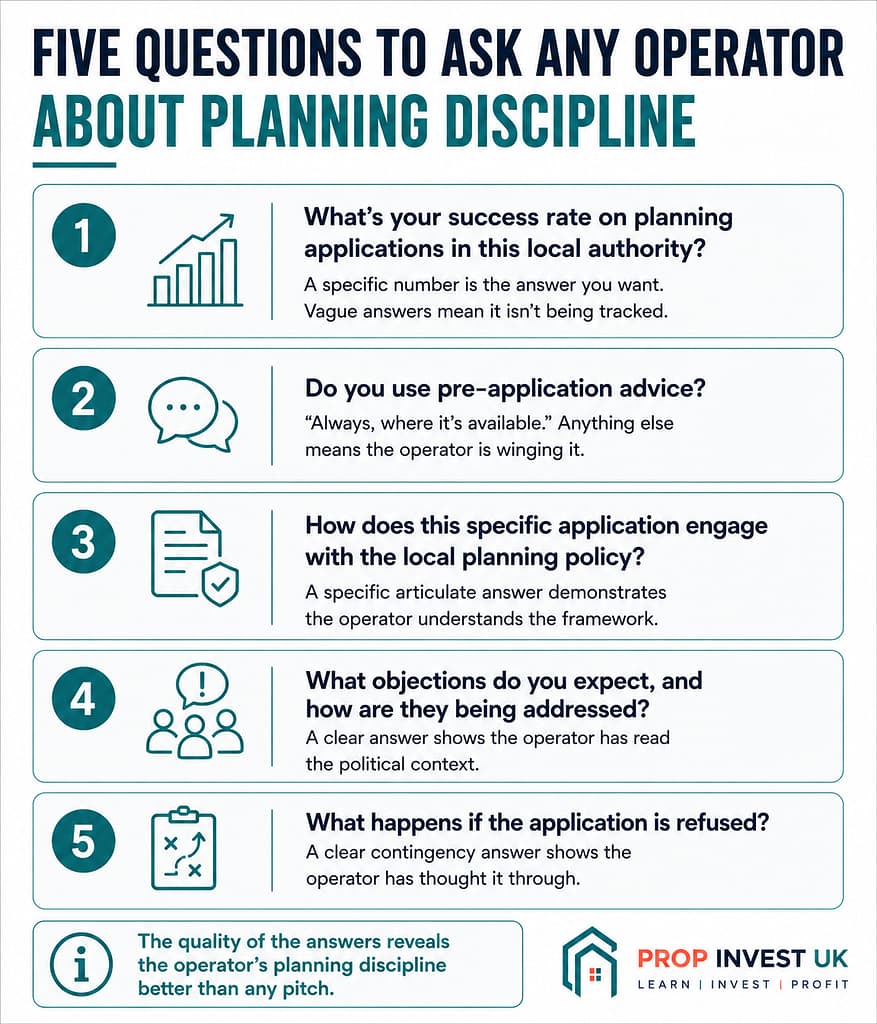
For investors evaluating a property development opportunity, the operator’s planning track record is one of the more diagnostic things to ask about. Five questions worth asking:
- What’s your success rate on planning applications in this local authority? A specific number (“our last seven Swansea applications all received consent at officer level”) is the answer you want. A vague answer means the operator isn’t tracking the metric.
- Do you use pre-application advice? “Always, where it’s available, before formal submission.” That should be the answer. Anything else suggests the operator is winging it.
- How does this specific application engage with the local planning policy? A specific, articulate answer demonstrates the operator understands the policy framework. A vague answer suggests they don’t.
- What objections do you expect on this application, and how are they being addressed? A clear answer shows the operator has read the political context and built the application to survive it. An “I don’t think there’ll be any objections” answer is naïve.
- What happens if the application is refused? A clear answer about resubmission strategy, appeal route, or walk-away criteria shows the operator has thought through the contingency. A vague answer suggests they’re hoping for the best.
How Our Property Group approaches planning
Our approach to planning is built around the principles described in this article.
Pre-application engagement is the default, not the exception. Every significant application starts with a conversation with the local planning officer before the design is locked.
Constraints are engineered into the design. Daylight, parking, density, heritage and Article 4 considerations are built into the scheme from the start, not argued past at submission.
Application materials are complete. When one of our applications lands on a planning officer’s desk, every required document is included, drawn to a professional standard, and consistent across the package.
The political context is read carefully. We doesn’t take applications to committee that aren’t technically robust enough to earn an officer recommendation. The team accepts that some sites need a longer pre-application engagement period or a different design approach before they’re ready for formal submission.
The local planning relationship is treated as a long-term asset. Our reputation in Swansea Council, in Wiltshire authorities, and in the South West local planning authorities is built over years of professional engagement on multiple applications. That reputation is part of why the operator’s pipeline keeps producing deliverable projects.
For investors, the implication is that planning risk on one of our projects is real but managed actively. No application is a guarantee. But the discipline at every stage — pre-app, design, submission, officer engagement, committee where required — is built around producing consent outcomes that support the project economics.
In summary
The planning meeting is where a development project either becomes real or stops. Most investor content treats consent as a binary. The reality is a sequence of professional engagements between the operator’s planning team and the local authority’s planning officers, governed by a defined framework of material considerations, with the application’s quality and the operator’s engagement determining the outcome.
Planners care about legalities, light, air, parking, Article 4 where relevant, heritage, highways, amenity and density. They assess applications against national and local policy. They give officer recommendations that go to delegated decision or to committee depending on the application.
The difference between operators who routinely get consent and operators who routinely don’t is not their building design — it’s how they engage with the planning system. Honest engagement with constraints. Complete and coherent application materials. Real pre-application engagement. Respectful engagement with the political context.
For us, planning is part of the operational environment. The planning relationships in each authority are long-term assets built over multiple completed projects. The discipline at every stage of every application is part of how the operator protects the project economics that capital partners are participating in.
The planning system isn’t the operator’s enemy. It’s the framework. Operators who work within it credibly get consent. Operators who fight it usually don’t.
Join the Prop Invest UK investor list for ongoing operational commentary, project updates, and details of capital partnership opportunities. Project-specific information is shared with introduced investors only — joining the list is the first step.
This article is general information about the UK planning process from an operator’s perspective. It is not legal or planning advice. UK property development carries planning risk, including the risk that consent is refused, delayed, or granted on conditions that affect project economics. The planning principles described reflect our operational practice — they are not guarantees about the outcome of any specific application. Past planning outcomes on our projects are not indicative of future outcomes on current or future applications. UK property development capital partnership opportunities are typically not regulated by the Financial Conduct Authority, and investors do not have access to the Financial Ombudsman Service (FOS) or the Financial Services Compensation Scheme (FSCS). Prospective investors should take independent professional advice before committing capital to any property development opportunity.