
Right. Before we get into structures, legal documents, and what people say they’re doing with your money, here’s the uncomfortable truth: you’re not really underwriting a property.
You’re underwriting an operator.
And the operator is the thing that breaks first.
Why this matters (and why most people get it backwards)
So. Most investors start with the asset:
- What’s the postcode?
- What’s the yield?
- What’s the “return”?
Like. That’s fine as far as it goes — but it misses the point.
The thing that decides whether you get your capital back isn’t the brochure. It’s what happens when the project hits friction: planning delays, contractors disappearing, cost overruns, refinancing taking longer than anyone wants.
(If you’ve never seen a project go sideways, you either haven’t done enough projects… or you’re being sold to.)
A quick note on why I’m qualified to teach this from the operator side
So. In 2020 I did a deal with a guy called James. Handshake stuff. “We’re both adults, we’ll do the right thing.” It ended with me losing £1m and learning — very quickly — that trust without paperwork is just optimism with a nice accent. That loss rewired how we operate: documentation first, clarity first, and no pretending risk doesn’t exist.
The two questions you should ask before anything else
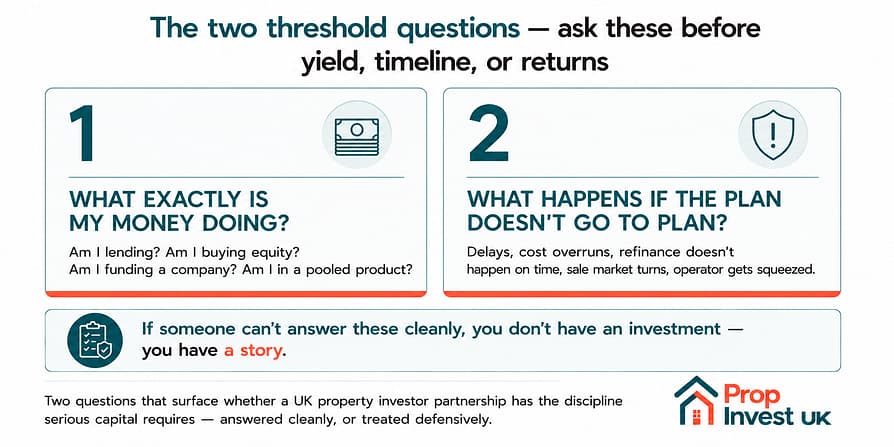
Right. Before you ask about yields, timelines, or whether the kitchen will be “high spec”, ask these two:
- What exactly is my money doing? (Am I lending? Am I buying equity? Am I funding a company? Am I in a pooled product?)
- What happens if the plan doesn’t go to plan? (Delays, cost overruns, refinance doesn’t happen on time, sale market turns, operator gets squeezed.)
So. If someone can’t answer those cleanly, you don’t have an investment — you have a story.
The three common partnership models (in plain English)
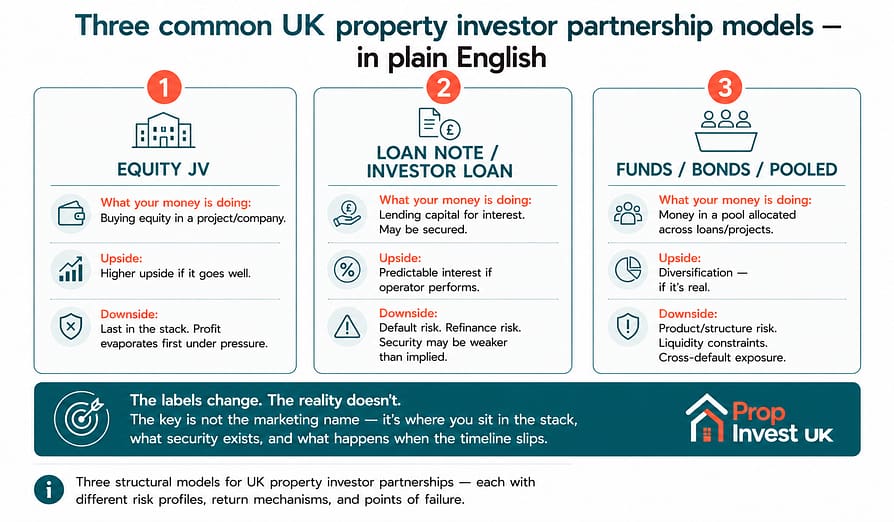
Like. When people say “property partnership”, they usually mean one of three things. The labels change, the reality doesn’t.
- Equity JV (joint venture) — you share profit, you share risk, you wait longer.
- Loan note / investor loan (debt) — you lend money to a project or company, you get paid interest (sometimes secured, sometimes not).
- Funds / bonds / pooled products — your money goes into a pot that’s allocated across multiple loans or projects.
Right. The key is not the marketing name. It’s where you sit in the stack, what security exists (if any), and what happens when the timeline slips.
1) Equity JV (joint venture)
So. This is where you’re sharing in the upside — and the downside.
Equity partnerships can be brilliant when the operator is strong and the project is right. They can also be a slow-motion car crash when the operator is undercapitalised and the timeline doubles.
Generic version: “You’ll share in the profits.”
Operator version: “You’re last in the stack. You get paid after everyone else. If costs blow out, your ‘profit’ is the first thing to evaporate.”
(Equity isn’t “better”. It’s just different. And it’s not for people who want certainty.)
2) Loan note / investor loan (debt)
Right. This is the one most people think they understand — and then they don’t read the documents.
In plain English: you’re lending capital. You’re expecting interest. The debt might be secured (legal charge) or unsecured (promise + paperwork). A “loan note” is usually just a wrapper that makes it easier to manage multiple investors.
So. Don’t get hung up on the label. Ask what matters:
- Is there security? If yes, what form? (Legal charge? Debenture? Personal guarantee?)
- Who holds it?
- Is it first charge or second charge?
- What’s the loan-to-value (LTV) at entry and at exit?
- What’s the exit plan and what happens if it’s delayed?
Generic version: “Your investment is secured.”
Operator version: “Here’s the charge, here’s where it’s registered, here’s the valuation it’s based on, and here’s what enforcement looks like if we default.”
(If they can’t explain enforcement without getting defensive, that’s a signal.)
3) Funds / bonds / pooled products
Like. This is the category people bump into when they Google “property-backed investments” and click the shiny stuff.
Your money goes into a pool. The operator allocates it across multiple loans or projects. You might have exposure to dozens of underlying assets — or you might have exposure to one operator with a spreadsheet.
Right. The risk isn’t just the property. It’s the product structure.
Ask:
- Is this regulated or unregulated?
- What exactly is the underlying asset exposure?
- What happens if other loans in the pool default?
- Can you exit early, and what does it cost?
(If the answer is “don’t worry, it’s diversified”, ask for the actual loan book.)
The due diligence checklist (operator-first)

So. If you want a practical way to assess whether a partnership is sensible, here’s the checklist I’d use if I were investing with another developer.
1) Track record: not just wins — complexity
Right. Ask for examples that weren’t easy.
- Listed buildings
- Commercial conversions
- HMOs
- Planning-heavy projects
- Problem acquisitions (subsidence, knotweed, flood zone, single title… pick your favourite)
Generic version: “We’re experienced developers.”
Specific version: “Here are three projects that went wrong, what it cost, what we did, and what we changed so it doesn’t happen again.”
2) Process: how they actually run a deal
So. You’re looking for a repeatable process, not improvisation.
- How do they source deals?
- How do they underwrite them?
- Who does what?
- What’s the decision-making cadence?
Our own answer to those questions is set out in detail in How We Evaluate and Structure a Property Development Deal — the five-filter framework and why we walk away from 99.9% of what we see.
Like. If everything is “we’ll figure it out”, you’re funding a learning curve.
3) Security: what it is, where it sits, and how it’s enforced
Right. “Asset-backed” is not a magic spell. It’s a legal position.
Ask:
- Is there a legal charge?
- First charge or second charge?
- Who holds the charge?
- What valuation is being used, and when was it done?
- What is the LTV?
So. The goal isn’t to be paranoid — it’s to be clear.
4) Timeline realism (and what happens when it slips)
Like. If the plan relies on “planning in 8 weeks” and “refinance immediately”, you’re not looking at a plan — you’re looking at a wish.
Ask:
- What’s the realistic timeline range?
- What are the top 3 risks specific to this project?
- What happens if the exit is delayed?
(Anyone can look competent when the schedule is green. The test is when it’s red.)
5) Communication: the thing nobody markets
Right. This is the biggest tell.
Ask:
- How often do investors get updates?
- What format?
- Do they share bad news quickly?
- Do they explain decisions, or just announce outcomes?
So. You’re not trying to be negative — you’re trying to find out if they’re honest.
Worked example: Gore Terrace (numbers first, then the real point)

Gore Terrace was a 14-bed HMO conversion in Swansea.
Purchase was £411k, refurb was £250k, total in was £721k. Post-refurb valuation came back at £1.07m. We refinanced at 75% LTV which was £802.5k — meaning all capital was returned at refinance. It then ran on a 5-year lease at £110k/year, with mortgage cost around £60k/year, leaving net cashflow of roughly £48k/year.
But that’s not why it matters.
It matters because it took 15 months, it dragged, and there was a period where — if you were the investor — you’d be perfectly justified thinking: “Is this going to be one of those deals?”
So. Here’s what actually happened.
We had an investor called Raf in that project. During the messy middle — when timelines were slipping and the job was just… heavy — we didn’t go quiet. We didn’t “wait until we had good news.” We did the opposite:
- Regular WhatsApp updates
- Clear explanations of what was happening on-site
- What decisions we were making and why
- What it meant for timeline, cost, and next steps
Like. Not “everything’s fine.” More “this is the problem, this is the plan, this is what we’re watching.”
And that’s the bit investors remember.
Raf reinvested into further projects afterwards not because we waved a return figure at him, but because he’d seen how we behave when it’s uncomfortable. That’s the real due diligence: how someone communicates under pressure.
(Anyone can look competent when the schedule is green. The test is when it’s red.)
Worth being clear: by the time we offer a deal like Gore Terrace to investors, it's already passed our internal evaluation framework. The full version of how we decide which deals proceed — and which 99.9% we walk away from — is set out separately in How We Evaluate and Structure a Property Development Deal.
FAQ (operator answers, not brochure answers)
What documents should I expect to see before I invest?
At minimum: the loan note / loan agreement, security documents (if any), a valuation, a budget, and a timeline. If there’s a legal charge, you should be able to see how and where it’s registered (Land Registry). If it’s a company-level lend, you want to understand debentures and Companies House filings.
What’s the difference between a loan note and a secured loan?
So. Often: not much. A loan note is usually just a wrapper. The real question is whether there’s security, what rank it is, and what happens if the operator defaults.
What does “first charge” actually mean?
Like. It means if things go wrong and the asset is sold, the first charge holder gets paid first. It does not mean you can’t lose money. It means you’re higher up the queue.
How do I check if a charge is real?
Right. Ask for the charge details and verify via Land Registry (property) and Companies House (company charges). If the operator can’t show you where it’s registered, assume it isn’t.
https://www.gov.uk/government/organisations/land-registry
https://www.gov.uk/government/organisations/companies-house
What’s a sensible LTV?
So. There isn’t one magic number. Lower LTV generally means more buffer, but it depends on asset type, build risk, and exit. The real question is: what happens if the valuation is wrong and the refinance market tightens?
What happens if the project runs late?
Like. It will. The question is whether the operator has contingency, whether the funding terms allow for extensions, and whether communication stays honest when everyone’s tired.
Can I get my money out early?
Right. Sometimes yes, often no — and if you can, it may come with fees or only be possible if someone else replaces you. If liquidity matters to you, you need to know that upfront.
Are property bonds safe?
So. “Safe” is not a category. Bonds can be secured or unsecured, pooled or single-asset, and the risk usually sits with the operator. For context on how regulated and unregulated investments differ in the UK, see the FCA's guidance on financial promotions. Read the docs, understand the security, and don’t let the word “bond” do the thinking for you.
What’s the biggest red flag?
Like. Defensive answers. If you ask a clean question about security, enforcement, or what happens in a downside scenario and they act like you’ve insulted them — walk.
The copy/paste questions to ask any operator
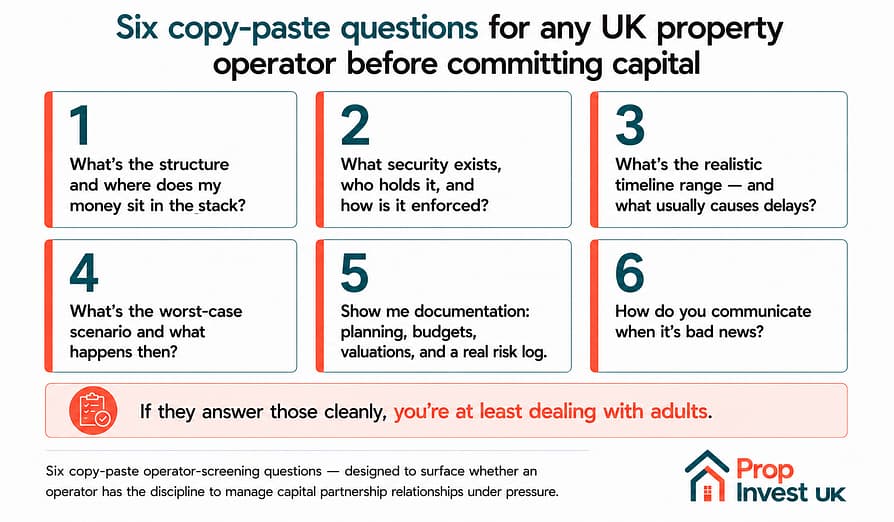
So. If you want a quick operator-screening set, here you go:
- What’s the structure and where does my money sit in the stack?
- What security exists, who holds it, and how is it enforced?
- What’s the realistic timeline range — and what usually causes delays?
- What’s the worst-case scenario and what happens then?
- Show me documentation: planning, budgets, valuations, and a real risk log.
- How do you communicate when it’s bad news?
Right. If they answer those cleanly, you’re at least dealing with adults.
Quick comparison table (scan this, then read the docs)
Structure | What your money is doing | Typical upside | Typical downside | What to check |
Equity JV | Buying equity in a project/company | Higher upside if it goes well | You’re last in the stack; timelines can stretch | Shareholders agreement, waterfall, decision rights, contingency |
Loan note / investor loan | Lending money for interest (may be secured) | Predictable interest if operator performs | Default risk; refinance risk; security may be weaker than implied | Loan note/loan agreement, security docs, charge registration, LTV, exit plan |
Funds / bonds / pooled products | Money goes into a pool allocated across loans/projects | Diversification (if real) | Product/structure risk; liquidity constraints; cross-default exposure | Underlying loan book, fees, liquidity terms, security position, governance |
Compliance note
This is a financial promotion. Investments are only available to certified High Net Worth or Sophisticated Investors. Capital at risk.
Past performance is not a reliable indicator of future results. Property investments are illiquid and values can fall as well as rise. Not covered by the FSCS.
Want the deeper version?
If you want how we structure investor partnerships — the paperwork, the security, the documentation, and the questions to ask any operator before committing capital — download the Property Development Investment Guide.Available to certified High Net Worth or Sophisticated Investors only.
Compliance note
This is a financial promotion. Investments are only available to certified High Net Worth or Sophisticated Investors. Capital at risk.Past performance is not a reliable indicator of future results. Property investments are illiquid and values can fall as well as rise. Not covered by the FSCS.