
Most UK property investors don’t lose confidence because a project hits friction. They lose it when communication goes quiet, numbers get vague, and the tone of updates changes depending on whether the news is favourable. Investor reporting is not a back-office task — it’s the single clearest signal of operator competence, capital discipline, and respect for the investor relationship.
This article sets out what investor reporting in property should look like when it’s done properly. It defines the structural features of a credible reporting standard, identifies the failure patterns that distinguish weak operators from strong ones, and points to the institutional benchmarks that have moved in 2026 to shape what serious capital now expects. It is written for investors who want to assess any operator’s reporting standard before committing capital — and who understand that reporting is one of the most reliable indicators of how the rest of the relationship will run.
Why reporting carries more weight than most investors initially assume
Property is operationally complex even when the investor’s exposure is hands-off. Behind every development project or income-producing asset sits a chain of moving parts — acquisition, planning, construction, finance, lettings, compliance, refinance, exit. Reporting is the mechanism by which that operational complexity becomes visible to the investor whose capital is funding it.
When reporting is strong, three things happen. The investor maintains genuine visibility over what their capital is doing. Issues get surfaced early enough to be managed rather than absorbed. And the relationship is structured to support repeat capital, because investors back operators who communicate with consistency under pressure as well as in good periods.
When reporting is weak, the opposite. Visibility collapses. Issues surface late, when options have narrowed. The investor’s confidence erodes whether or not the underlying asset is sound — because the absence of reporting is itself a signal about how the operation is being run.
This is why investor reporting standards have become a primary diligence focus for institutional capital in 2026, and increasingly for sophisticated individual investors. The pattern of an operator’s communication — the cadence, the consistency, the willingness to surface bad news as honestly as good news — predicts the relationship’s behaviour over time more reliably than almost any other observable signal.
What 2026 institutional standards look like — and why they matter for individual investors
Institutional property reporting has tightened materially in the past 18 months, and the standards are filtering into how serious individual investors evaluate operators they’re considering.
Three reference points worth knowing. The NCREIF-PREA Reporting Standards — the institutional benchmark for private real estate reporting in the US and increasingly referenced internationally — expanded in August 2025 to formalise asset-level reporting as a recommended standard, not just fund-level performance. The ILPA Reporting Template v2.0, released January 2025 with a Q1 2026 effective date, sets the institutional norm for private capital reporting templates and timelines. And institutional benchmarks now expect quarterly statements distributed within 45–60 days of quarter-end as standard practice — closer to ESG, AML, and KYC disclosure becoming baseline rather than optional add-ons.
These standards weren’t written with HNW individual investors and capital partnerships specifically in mind. But the direction they signal matters. Sophisticated UK investors deploying capital into operator-led property arrangements are increasingly applying institutional-style expectations to the operators they back — and operators offering anything materially weaker than that direction of travel are visibly behind the curve.
For individual investors, the practical takeaway: the reporting standard you should expect from an operator handling your capital is not the standard that was acceptable five years ago. It is closer to the standard institutional LPs apply to fund managers — adjusted for the smaller scale of individual partnerships, but governed by the same underlying principles of clarity, cadence, completeness, and honesty.
What good investor reporting actually contains
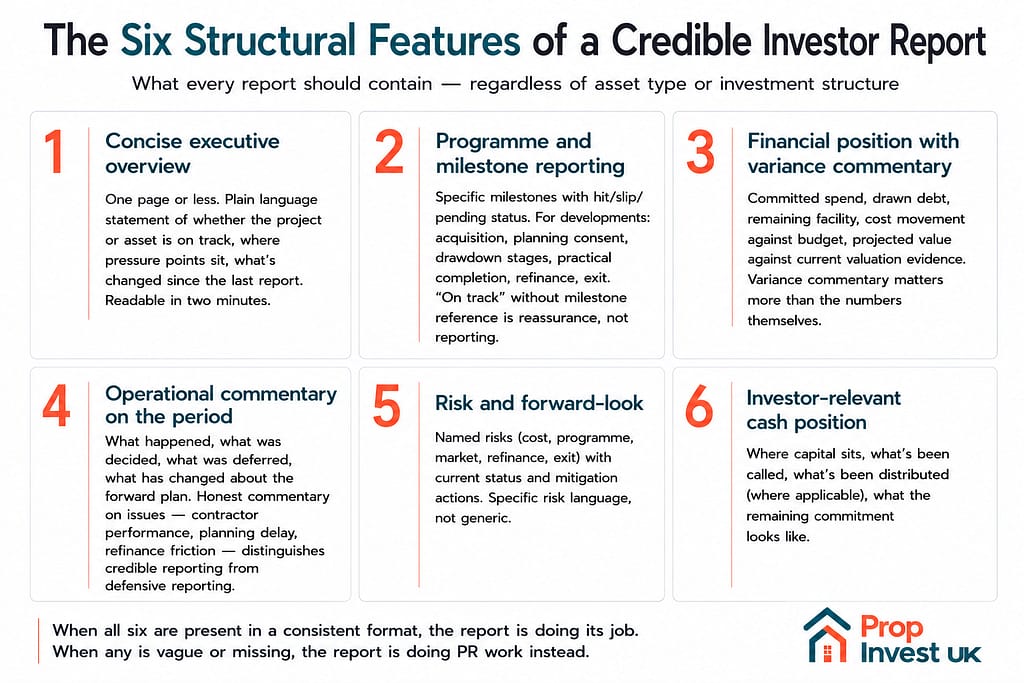
The structural features of a credible investor report, regardless of asset type.
A concise executive overview at the top. One page or less, telling the investor in plain language whether the project or asset is on track, where pressure points sit, what management is focused on for the next period, and what (if anything) has materially changed since the last report. If the executive overview can’t be read in two minutes, the report has been structured for the operator’s convenience, not the investor’s.
Programme and milestone reporting. For development projects, this means specific milestones (acquisition, planning consent, drawdown stages, practical completion, refinance, exit) and whether each has been hit, slipped, or remains pending. “On track” without milestone reference is not reporting — it’s reassurance. For income-led assets, the parallel is asset management milestones — lettings activity, rent review cycles, refinance windows, planned capex.
Financial position with variance commentary. Committed spend, drawn debt, remaining facility, build cost movement against budget, projected GDV or asset value against current valuation evidence. The numbers themselves matter, but the variance commentary matters more — what’s moved, why it’s moved, and what the management response is.
Operational commentary on the period. Specifically: what happened, what was decided, what was deferred, what has changed about the forward plan. Honest commentary on issues — contractor performance, planning delay, refinance friction, lettings velocity — is what distinguishes credible reporting from defensive reporting.
Risk and forward-look. Named risks (cost, programme, market, refinance, exit) with current status and mitigation actions. This is where operators most often retreat into generic language; credible operators are specific about which risks are currently live and what they’re doing about them.
Investor-relevant cash position. Where capital sits, what’s been called, what’s been distributed (where applicable), what the remaining commitment looks like.
When all six features are present in a consistent format the investor can compare period over period, the report is doing its job. When any of them is vague, generic, or missing, the report is doing PR work instead.
The failure patterns worth recognising
Several reporting failures are obvious. Others are subtle, and the subtle ones are usually the more dangerous because they can persist over multiple reporting cycles before the investor recognises them.
The optimism-asymmetry pattern. When good news is reported in detail and bad news is reported generically — or skipped — the report is filtering for tone. This is one of the strongest predictors of how the operator will handle genuine distress, because the pattern is already visible in periods of mild friction.
The “progressing well” pattern. Repeated narrative statements (“works are advancing,” “the project is progressing well,” “we remain on track”) without specific milestone references behind them. Phrases like these tell the investor nothing measurable. Either the milestone has been hit, or it hasn’t.
The vague-when-it-matters pattern. Financial detail is precise when figures are favourable and becomes general when figures aren’t. Costs are reported to the pound when they’re under budget; reported as “broadly in line” or “within expected variance” when they aren’t.
The inconsistent-format pattern. Every report is structured differently, making period-over-period comparison difficult. The investor can’t easily see what’s changed because the reporting framework itself keeps changing.
The over-reporting pattern. Lengthy updates documenting trivial activity — contractor visits, supplier conversations, minor approvals — while avoiding commercial substance. Volume substitutes for transparency.
The accountability-vacuum pattern. Issues are described in the passive voice (“delays have occurred,” “costs have moved”) without naming what management has done in response. Reporting that describes events without explaining management action is reporting at the investor, not to them.
Any one of these patterns in isolation can be explained. Multiple patterns in the same operator’s reporting, persisting across reporting cycles, are a structural signal — not an operational one.
Frequency, consistency, and proportionality
There is no single reporting cadence that fits every property structure. The right question isn’t “how often” — it’s “what cadence, defined how, and maintained how consistently.”
Active development projects typically warrant monthly written reporting during construction phases — change happens quickly, capital is exposed to delivery risk, and milestones are concentrated. Quarterly reporting on an active build is too infrequent to surface friction at a useful point.
Stabilised income-producing assets can be reported quarterly, with monthly summary commentary for investors who want it. Lettings, rent collection, maintenance, and refinance windows are the substantive content.
Funded acquisitions in legal progression warrant defined milestone-triggered communication — searches complete, offer accepted, exchange, completion — rather than calendar-based reporting.
What does not work across any of these is ad-hoc communication driven only by operator convenience. Investors should know when the next report is due before they need to ask. Silence creates suspicion even where none is warranted; irregular reporting signals internal disorganisation even when everything underneath it is fine.
Consistency over time matters more than frequency in isolation. An operator delivering quarterly reports of consistent quality across every cycle, including difficult ones, builds more durable investor confidence than an operator delivering elaborate monthly reports while things are going well and falling silent when they aren’t.
What good operator behaviour looks like under pressure
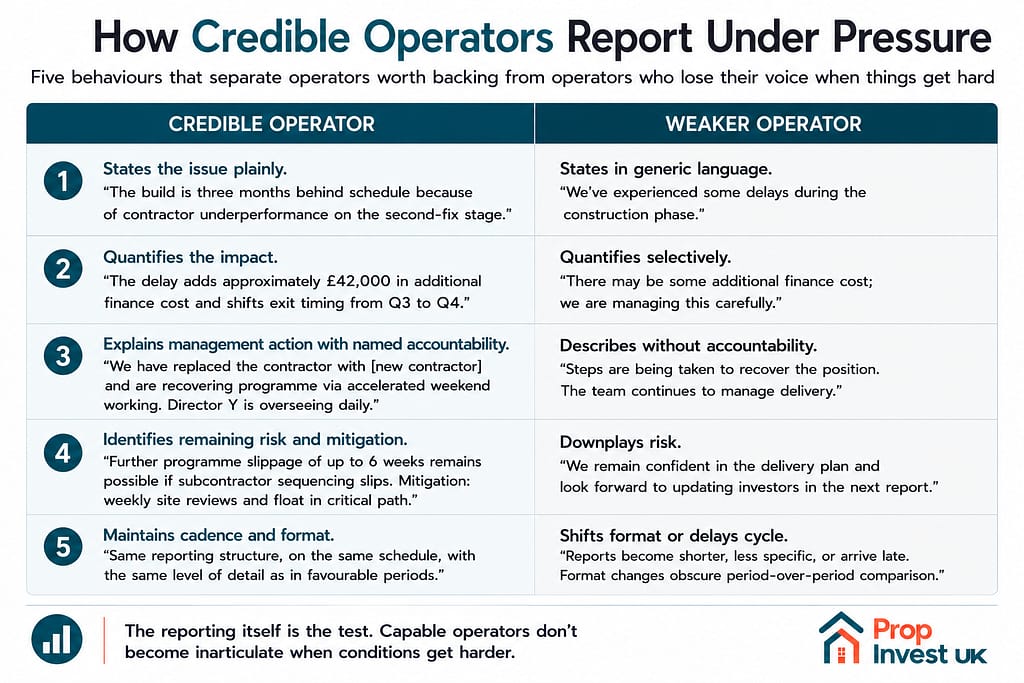
Every property project encounters friction at some point. The honest framing is that issues are not unusual — they are operational reality. What separates credible operators from weak ones is not the absence of issues but the reporting response when they occur.
A capable operator reporting on a difficult period typically does five things. They state the issue plainly. They quantify the impact — on programme, cost, or projected return. They explain what management has done in response and what is planned next. They identify the remaining risk and its mitigation. And they maintain the same reporting cadence and format they would have used in a favourable period.
A weaker operator does some of those things and skips others. They state the issue in generic language. They quantify selectively. They describe management actions without making clear who is accountable or what the timeline is. They downplay risk. And they sometimes shift the format or delay the cycle in a way that obscures the comparison with previous periods.
The reporting itself, in other words, is the test. Capable operators don’t become inarticulate when conditions get harder. The discipline that produced good reporting in favourable conditions produces consistent reporting under pressure. That discipline is what investors should be screening for at the diligence stage — because it predicts the operator’s behaviour through the rest of the relationship more reliably than almost any other indicator.
How investors should assess reporting standards before committing capital
For any opportunity an investor is evaluating, the reporting-related diligence questions:
- What is the operator’s defined reporting cadence and format for arrangements like this one? Can you see a redacted example from a previous arrangement?
- What specifically is included — programme milestones, financial position with variance commentary, named risks, management action, cash position?
- What’s the format of period-over-period comparison? Can the investor easily see what’s changed?
- What’s the operator’s track record on continuing reporting consistency when projects encountered friction? Ask for an example from a previous arrangement where something didn’t go to plan.
- What’s the response standard between reporting cycles — if the investor has a question or concern, what’s the expected response time?
- Is there a defined channel for escalation if the investor and operator’s views on a development diverge?
- Who is accountable for reporting? A defined named individual is materially stronger than a vague “the team will update you.”
The strongest signal in any of these answers is specificity. Operators with credible reporting standards can describe them concretely. Operators without credible standards describe reporting in general language because there isn’t a defined standard underneath the description.
Reporting is one of the cluster’s strongest predictors of operator quality
Across every dimension of operator diligence — track record, project selection, financial discipline, structural integrity — reporting is the one that operates during the investment, not just before it. The other diligence categories are largely about what the operator did historically and what they propose to do prospectively. Reporting is about what they actually do, every quarter, after capital is committed.
That makes reporting standards a uniquely useful diligence indicator. They are observable in real time. They are difficult to fake over multiple reporting cycles. And the operator’s discipline in reporting predicts the operator’s discipline in everything else — because the same organisational capability that produces consistent, specific, honest reporting produces consistent, specific, honest decision-making on the asset.
At Prop Invest UK, we work with investors who want exposure to UK property development as capital partners on specific projects. The reporting standard we apply is built around the principles this article describes — defined cadence, consistent format, specific milestone reporting, honest variance commentary, named accountability. We’re not setting it out as a benchmark to beat the competition; we’re describing the standard we think any operator handling investor capital should be working toward, regardless of who they are. Any specific opportunity we make available is offered only to investors who qualify under the relevant exemptions and have received the full project documentation, which includes the defined reporting standard for that arrangement.
If you’re evaluating an operator for a property capital partnership, the most useful question isn’t “what’s the return.” It’s “show me a recent report from a comparable arrangement, and tell me what was happening on the project when it was written.” The answer to that question tells you almost everything you need to know about how the rest of the relationship is likely to run.
—
About Prop Invest UK
Prop Invest UK is a property development business working with investors who want exposure to UK property development without taking on operational delivery themselves. Each opportunity is sourced, structured, and delivered by an experienced developer, with investors participating as capital partners on a deal-by-deal basis.
Join the investor list to receive details of future opportunities as they become available, subject to investor qualification and project documentation.
—
This article is for general information purposes only and does not constitute financial advice or an offer to invest. UK property investment involves risk, including the risk of capital loss, and returns are not guaranteed. Past performance is not a reliable indicator of future results. Any specific opportunity is offered only to investors who qualify under the relevant exemptions and who have received the full project documentation. If you are uncertain whether an investment is suitable for your circumstances, you should consult an FCA-authorised financial adviser.
—