
A tired commercial unit, bought well, repositioned properly and exited on schedule, can outperform years of passive saving. A poor scheme, even in a decent area, can absorb time, capital and confidence at speed.
That is the real answer to the question of whether property development is profitable: it can be, but only when the fundamentals are right and the operator knows exactly where value is created.
For serious investors, that distinction matters. Property development is not a lottery ticket, and it is not a hobby. It is a structured commercial activity where profit sits in the gap between acquisition cost, build strategy, finance structure, market demand and execution quality. Get that equation right and development can produce meaningful wealth creation. Get it wrong and the margin disappears long before the project completes.
This post is for investors weighing development as an asset class — not for would-be developers looking to do it themselves. The focus is on what makes the model work, how to evaluate operators offering access to it, and how it compares to the buy-to-let position many investors are now reconsidering.
—
What “profitable” actually means in UK development
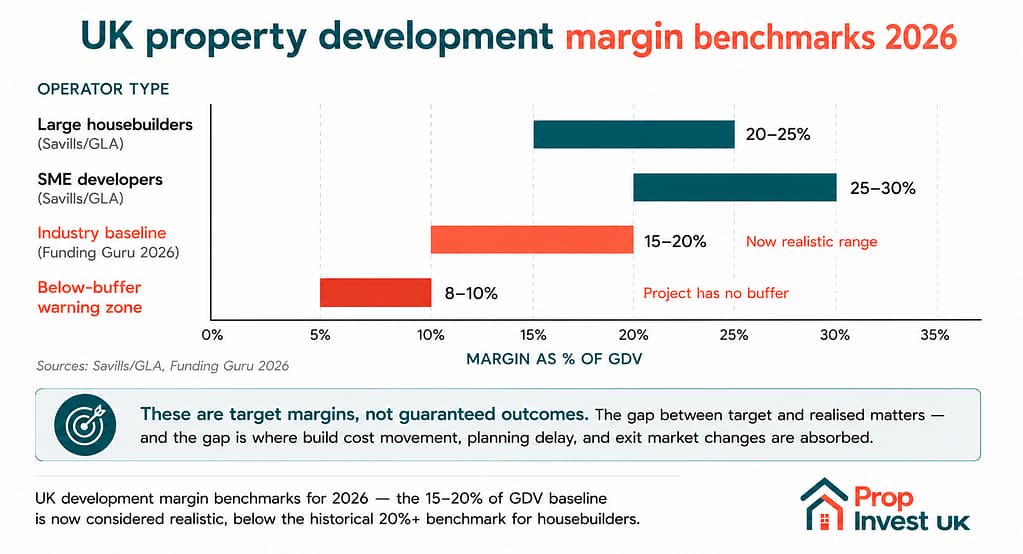
In the current UK market, residential development is typically underwritten to a profit margin of around 15–20% of Gross Development Value, with 20%+ historically considered a healthy hurdle rate for housebuilders. Savills research for the GLA put the site-level net margin target for larger housebuilders at 20–25% of GDV, with SMEs typically requiring 25–30% to account for higher project finance costs. (Savills / GLA — Residential Development Margin)
These are target margins, not guaranteed outcomes — and the gap between target and realised matters. Funding Guru’s 2026 market commentary notes that 15–20% of GDV is now more realistic for many schemes, with build cost inflation and tighter finance compressing the historical 20%+ benchmark. (Funding Guru, 2026)
What this means in practice: a project with an £800,000 GDV underwritten at a 20% margin targets £160,000 of profit before tax. That margin is not a forecast; it is a hurdle that has to survive build cost movement, planning delay, finance cost increases and sales market changes — any of which can erode it during the project lifecycle.
This is why experienced operators do not start with the headline margin. They start with the question of how much of that margin can be defended if things move.
—
Where the profit actually comes from
Most of the profit in property development is not made at the end. It is made at the point of purchase and in the planning of the scheme.
If a site is acquired at the wrong price, if planning uplift is overestimated, or if build costs are treated too casually, the project is under pressure before a contractor even arrives. By contrast, disciplined operators look for margin on the way in, not hope on the way out.
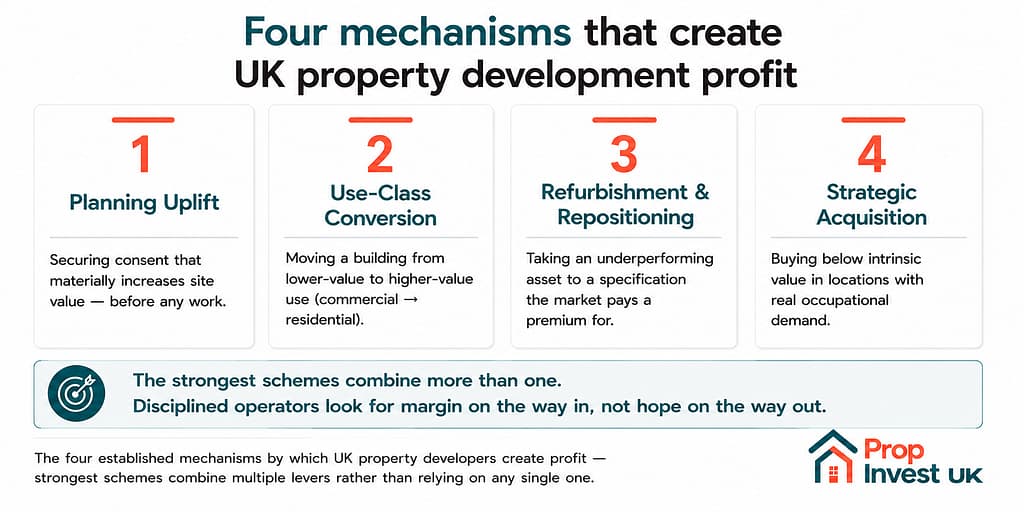
Development profit comes from creating value that did not exist before. The mechanisms are well established:
- Planning uplift — securing consent that materially increases the value of a site
- Use-class conversion — moving a building from a lower-value use (commercial, industrial) to a higher-value one (residential, hospitality)
- Refurbishment and repositioning — taking an underperforming asset and bringing it to a specification the market will pay a premium for
- Strategic acquisition — buying below intrinsic value in locations where there is genuine occupational demand
The strongest schemes usually combine more than one of these levers. Planning gain is powerful, but only if there is real demand for the completed product. Build-led uplift can transform a site, but only if costs are controlled and the end value is realistic. Buying below intrinsic value helps, but is rarely enough on its own.
This is where smaller investors often misread the sector. They assume profitability comes from rising markets. In reality, the strongest operators do not rely on market growth to rescue a weak scheme. They underwrite projects that make commercial sense on day one and treat any market tailwind as an advantage rather than a necessity.
—
The four factors that decide whether a scheme makes money
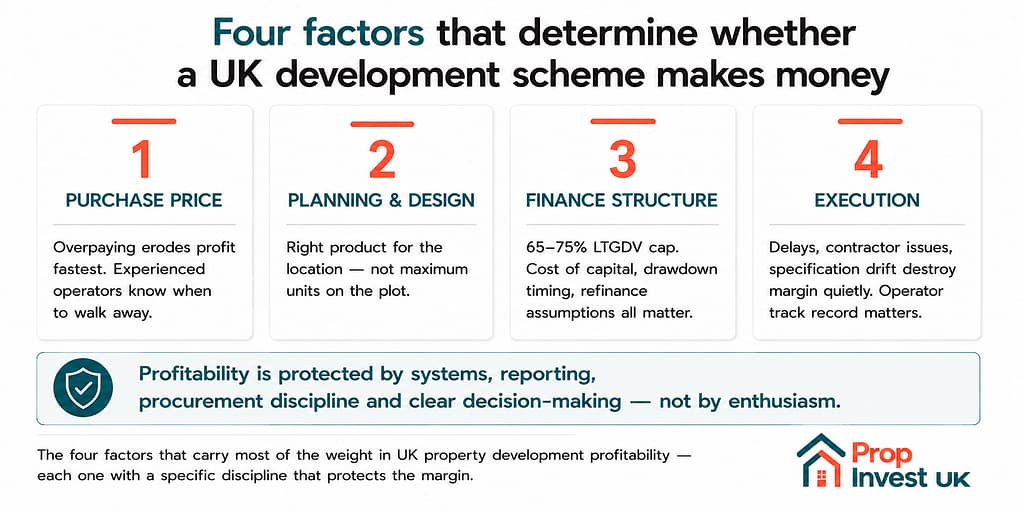
Several factors influence development outcomes, but four carry most of the weight.
Purchase price. Overpaying for land or buildings is the fastest way to erode profit. Competitive markets tempt buyers to stretch. Experienced operators know when to walk away. Discipline at acquisition protects everything that follows.
Planning and design. A site can look attractive on paper and still fail commercially if the proposed scheme does not suit local demand, local policy or build economics. Good development is not about squeezing the maximum number of units onto a plot. It is about delivering the right product for the location.
Finance structure. Development finance is useful, but it is not neutral. Cost of capital, timing of drawdowns, lender conditions and refinance assumptions all affect the final outcome. Lender Loan-to-GDV ratios typically cap residential development debt at around 65–75% of GDV, which means the equity component — and therefore the investor’s exposure — is structural, not optional. Strong operators structure finance around the realities of the project, not around best-case optimism.
Execution. Delays, contractor issues, specification drift and weak project management destroy margin quietly. This is why operator track record matters. On a serious development project, profitability is protected by systems, reporting, procurement discipline and clear decision-making — not by enthusiasm.
—
Why current market conditions matter
The wider environment for UK development has tightened over the last two years, and any honest answer to the profitability question has to engage with that.
Savills’ Q3 2025 development land research reported that UK brownfield land values had fallen 3.1% over the year, with urban land in particular under pressure from build cost inflation, building safety regulations and viability challenges. Greenfield values were flat, with the strongest growth in the North of England (up 0.6% for the quarter). (Savills — Market in Minutes: Residential Development Land Q3 2025)
The UK Construction PMI spent much of 2025 below 50, signalling sector contraction, with housebuilding consistently the weakest-performing segment. (Hickman Shearer — UK Housebuilding Market 2025 Valuation Outlook)
For developers who acquired land at the 2022 market peak, escalating construction costs have compressed margins to the point where some projects no longer justify continued investment. For developers acquiring now — at lower land values, with more disciplined cost assumptions — the entry point is materially more attractive than it was three years ago.
This is the key point for investors. A softer market does not eliminate development profit. It changes the acquisition price at which projects work, and it raises the bar for operator discipline. Both of those conditions favour selective, professionally managed development over speculative or volume-led activity.
—
How development compares to where buy-to-let now sits
A large share of the investor capital now exploring development is coming from people reassessing buy-to-let.
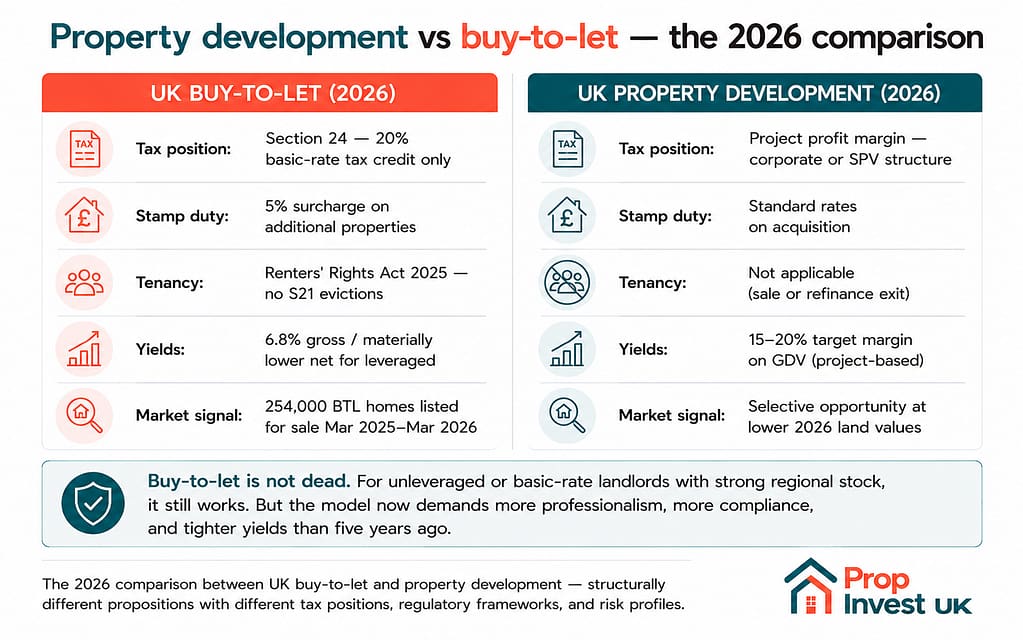
The reasons are well documented. Section 24 has restricted mortgage interest relief to a 20% basic-rate tax credit, increasing tax bills materially for higher-rate landlords. Stamp duty on additional properties has risen to a 5% surcharge. The Renters’ Rights Act 2025, which came into force on 1 May 2026, has ended Section 21 no-fault evictions and converted assured shorthold tenancies to assured periodic tenancies. (What Mortgage — Buy-to-Let in 2025)
The result has been a measurable structural exit. Savills estimated that around 254,000 previously let buy-to-let homes were listed for sale in Great Britain in the year to March 2026 — equivalent to roughly 697 properties per day, and 28% above the volume in the year to March 2024. In London, former rentals accounted for 30% of new sales instructions. (Savills, via Mortgage One Finance, May 2026)
The yield picture has shifted accordingly. National average gross BTL yields are reported around 6.8%, but net yields — after Section 24, finance costs, compliance and management — sit materially lower, particularly for higher-rate landlords with mortgaged portfolios. (Property Division, 2026)
Buy-to-let is not dead. For unleveraged or basic-rate landlords with strong regional stock, it still works. But the operating environment has fundamentally changed, and the model now demands more professionalism, more compliance overhead and tighter yields than it did five years ago.
For investors who valued buy-to-let for its passivity and tax efficiency — neither of which is what it once was — development partnerships are increasingly the comparison they are running.
—
Is development profitable for hands-off investors?
Yes, it can be, but the route matters.
Many investors like the commercial appeal of development but have no interest in managing planning consultants, overseeing contractors or dealing with lender requirements. That is sensible. Development is specialist work.
For hands-off investors, the real question is not whether they can become developers themselves. It is whether they can access development-led opportunities through a structure that is professionally managed, transparent and properly aligned.
This is where a lot of capital gets misplaced. Investors are often shown the upside of development without enough detail on operator capability. A strong opportunity is not defined only by the site. It is defined by who is running it, how risks are controlled, how reporting works during the project, and how clearly the business plan has been stress-tested before capital is committed.
For investors seeking property-backed exposure without the operational burden of direct ownership, managed development partnerships can make sense. The appeal is straightforward: access to value creation, clearer structure, alignment of interests, and none of the day-to-day landlord responsibility. But the same rule still applies. Profitability depends on discipline, not presentation.
—
What separates the schemes that work from the ones that fail
The market often blames failed schemes on timing. Timing matters, but it is rarely the whole story.
Projects usually fail because the margin was too thin from the outset, the assumptions were too aggressive, costs were not controlled, or the wrong product was delivered to the wrong market. A weak operator can still make money in a rising market for a while. That does not mean the model is sound.
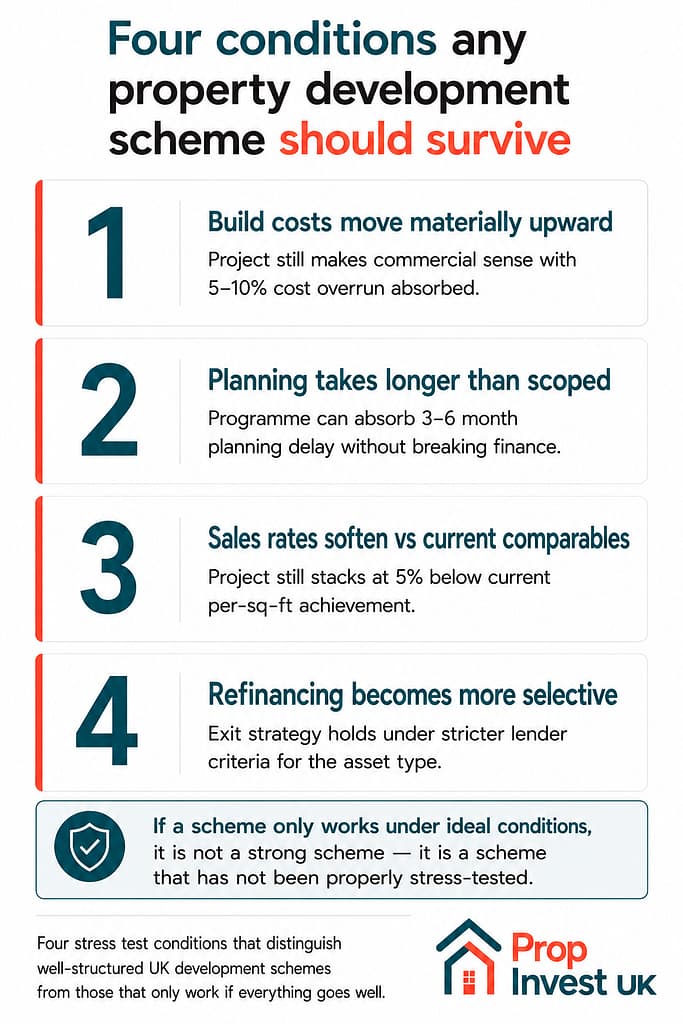
Profitable development requires room for error. Build costs can move. Planning can take longer than scoped. Sales rates can soften. Refinancing can become more selective.
If a scheme only works under ideal conditions, it is not a strong scheme — it is a scheme that has not been properly stress-tested.
That is why investor-grade development should be approached with a commercial mindset rather than an emotional one. The numbers need to work under conservative assumptions. The exit needs to be credible under multiple market scenarios. The local demand story needs to be grounded in real occupational evidence, not headline forecasts. And the operator needs to demonstrate that they can execute repeatedly — not simply market opportunities convincingly.
—
Where opportunity now sits in the UK market
UK development remains profitable in the right locations and with the right strategy, but broad generalisations are dangerous. Not every town supports the same product. Not every asset class offers the same resilience. Not every planning uplift is worth chasing.
The better opportunities tend to sit where there is genuine occupational demand, constrained supply and a clear route to either disposal or long-term hold. That may mean residential-led schemes in undersupplied commuter markets, mixed-use repositioning in improving centres, or heritage assets that can move from underperformance to stable rental income after completion.
Investor demand has been shifting accordingly. Savills’ data shows the strongest greenfield land value growth in 2025 was in the North and Scotland, supported by stronger sales rates and constrained land supply. NHBC data showed sales rates in the North East and North West running 40% higher than in the South East in the three months to August 2025. (Savills Q3 2025 land research)
Experienced operators in markets such as the South West, South Wales and the M4 corridor continue to find opportunity where less disciplined buyers see only noise. Local knowledge, planning familiarity and contractor relationships still matter. Property is not abstract — it is intensely regional, and the operators who do well in a tighter market are those who already know their patch and their counterparties.
Increasingly, development-led investors also care about the back end of the business plan. If the completed asset can transition into a durable income-producing hold rather than depend solely on a sale at exit, the project has more strategic depth and more flexibility if market conditions soften at the exit point.
—
So, is property development profitable for the right investor?
Yes — when it is treated as a business rather than a punt.
If the objective is easy money, development is the wrong vehicle. If the objective is to put capital to work in professionally structured property projects where value is created through planning, repositioning, build strategy and disciplined execution, development can be a meaningful part of a wider wealth strategy.
That is the real dividing line. Serious investors do not ask only whether a sector is profitable. They ask what conditions make it profitable, who is operating the scheme, and how risk is being managed before capital is committed.
At Prop Invest UK, that is how we view development: as a controlled route into property-backed value creation, supported by operator oversight and long-term thinking rather than speculation. Not every project deserves capital. The right ones do — and identifying which is which is the operator’s job.
—
For investors considering development as an asset class
Prop Invest UK operates a private investor list that receives information on operator-led development partnerships directly. The list is by application. Investors participate as capital partners — sourcing, planning, construction and operation are handled by the development team. The strategy is explained in advance. Reporting is regular. The investment timeline is defined and the exit strategy is structured before capital is deployed.
If that model fits how you are thinking about deploying capital, you can apply below.
Apply to join the investor list →
—
Past project performance is not a guide to future returns. Property development carries risk; capital deployed is at risk and target outcomes are not guaranteed. Prop Invest UK does not make public offers of investment. Information about partnership opportunities is communicated directly to qualified investors who have applied to join our private investor list.