
Property development carries real risk. Anyone telling you otherwise — operator, marketer, course teacher, or social media voice — is misleading you. The structural reality is that UK property development can produce strong risk-adjusted returns for capable investors working with capable operators, but the journey involves friction that doesn’t show up in the marketing materials.
For UK property investors evaluating whether to participate in development as capital partners — particularly those coming from buy-to-let backgrounds — the question of risk is the right one to ask. It’s also the question most operators duck or rebrand into something more comfortable.
This guide gives the honest answer. What kinds of risk actually exist in UK property development, how each type is structurally managed in well-run projects, the risks investors most often misunderstand, the risks they most often overlook entirely, and what “risk-adjusted return” actually means when applied to the activity. Drawn from the structural frameworks across the Prop Invest UK content body and grounded in the real case studies of Gore Terrace, the Windsor Lodge, and Mozarts.
The honest starting point
UK property development is not low-risk. It’s not risk-free. It’s not “asset-backed and therefore safe.” It’s not guaranteed.
Anyone framing it in those terms is either misunderstanding the activity or actively misrepresenting it. Both should be disqualifying as operator selection criteria, as we covered in our operator vetting article.
What property development can be is risk-adjusted favourably — meaning the structural return profile, when discounted appropriately for the actual risks involved, can compete with or exceed the risk-adjusted returns of other UK property investment routes (passive BTL ownership, REITs, property funds) and many non-property investments (equities, gilts, corporate bonds).
The “risk-adjusted favourably” claim only holds when three conditions are met:
- The operator is genuinely capable of delivering the project across planning, build, and exit
- The project is structurally conservative — appropriate margin against GDV, sensible LTGDV on senior debt, contingency budget in place, evidenced exit strategy
- The investor’s position is properly protected — registered security, professional documentation, fixed-return or equity structure that matches their risk tolerance
When all three hold, UK property development capital partnership produces returns that justify the risk being taken. When any one fails, the activity becomes a losing proposition for the investor — sometimes catastrophically so.
This article walks through the actual risk categories, the structural mechanisms that manage them, and the diligence framework that lets serious investors distinguish well-run opportunities from speculative ones.
The five categories of risk in UK property development

Property development risk isn’t a single thing. It’s a stack of five distinct categories, each with different mechanisms, different mitigations, and different implications for investor outcomes.
Risk 1: Planning risk
The risk that the project’s planning consent doesn’t come through as modelled — refused, delayed, or granted with conditions that materially affect the project economics.
How it manifests:
- Outright refusal of the application (the project doesn’t happen as designed)
- Appeal required (delays of 6-12 months, additional cost)
- Consent granted with conditions that change the development (smaller unit count, lower density, design changes that affect cost or value)
- Significant delays in decision (extending the project timeline by several months)
How well-structured projects manage it:
- Acquiring with consent already in hand, or with strong policy case for consent
- Pre-application engagement with local planning authority before committing capital
- Building planning delay tolerance into the project timeline (we covered this in our overrun article)
- For Article 4 areas specifically, applying the policy-intent framework we explored in our Article 4 article
Real-world example: Gore Terrace encountered a three-month planning delay. The conservative project structure absorbed it; Raf’s loan term extended pro-rata and he received additional interest at his agreed rate for the extension period. Same friction, very different outcomes for differently-structured projects.
Risk 2: Construction risk
The risk that the build phase produces outcomes worse than modelled — cost overruns, timeline overruns, quality issues, or unforeseen conditions that materially change the project.
How it manifests:
- Cost overruns from contractor pricing, supplier issues, or hidden conditions
- Timeline delays from trade availability, weather, or build complications
- Quality issues requiring remedial work
- Discoveries during the build (structural issues, compliance gaps) that weren’t visible during pre-acquisition surveys
How well-structured projects manage it:
- Explicit contingency budget (typically 5-10% of build cost)
- Established contractor relationships with track records
- Conservative timeline assumptions with built-in slack
- Quality monitoring through the senior lender’s appointed monitoring surveyor
Real-world example: Gore Terrace ran £50,000 over the original build budget — 20% above the modelled £250,000. The conservative project structure absorbed it (the refinance still produced a unicorn outcome, as we documented in the case study). Windsor Lodge encountered contractor execution problems on the Grade II listed conversion that required mid-project contractor changes. Same category of risk, different magnitude — held together by operational capability rather than structural luck.
Risk 3: Market risk
The risk that property market conditions move against the project during its development lifecycle, affecting either the exit value or the exit timeline.
How it manifests:
- Sale prices lower than modelled at completion
- Sales velocity slower than modelled (units take longer to sell)
- Refinance valuations coming in below the modelled level
- Rental yields softening, affecting refinance affordability
How well-structured projects manage it:
- Forced appreciation built into the project economics (as we covered in our forced appreciation article) — value created through the operator’s work isn’t dependent on market direction
- Conservative valuation assumptions at acquisition
- Multiple potential exit routes (sale to OO buyers, sale to investors, refinance onto BTL mortgage)
- LTGDV ratios sized below the upper end of lender ranges (creating buffer against valuation softness)
Real-world example: The Mozarts project (currently in build) was acquired in April 2024 with the conversion business case modelled against then-current Swansea HMO market conditions. The conservative 61.1% LTGDV on the £1.1m senior facility provides substantial buffer against any softening in the local market over the project lifecycle.
Risk 4: Financial / liquidity risk
The risk that finance facilities aren’t available, become more expensive, or have terms that change adversely during the project — affecting both project cost and exit options.
How it manifests:
- Senior development finance becoming more expensive (interest rate movement)
- Refinance products becoming harder to access (lender appetite shifts)
- Senior lender extension terms becoming more punitive
- Investor capital partners withdrawing or unable to fulfil commitments
How well-structured projects manage it:
- Locking in senior facility terms before committing capital
- Building finance cost variability into the project model (sensitivity analysis on interest rate movements)
- Maintaining multiple lender relationships rather than depending on one
- Conservative project structure that allows for facility extension at commercial terms (we covered this in the overrun article)
Real-world example: Mozarts’ Signature facility was locked at competitive 2024 terms — approximately 7.2% annualised — with the project structured to absorb facility extension if needed. The 2026 development finance market has moved (rates are now 6.5-9.5% range as we covered in our development finance article), making the locked-in early-2024 terms favourable in retrospect.
Risk 5: Operator risk
The risk that the operator running the project fails to deliver — through incompetence, mismanagement, financial difficulty, or in extreme cases, fraud.
How it manifests:
- Operator unable to deliver the project to specification (capability gap)
- Operator running into financial difficulty during the project (impacting the SPV)
- Operator communication breakdowns during difficulty
- In extreme cases: operator fraud or misuse of investor capital
How well-structured projects manage it:
- Investor due diligence on the operator before committing capital (the seven-category framework we set out in our operator vetting article)
- Registered security against the project property (second legal charge as we covered in our security article)
- Independent legal review of all documentation
- Professional loan agreements with clear default provisions
- Personal guarantees on a deal-specific basis where appropriate
Real-world example: This is the risk category where our track record matters most. The Windsor Lodge story — Grade II listed building, contractor execution problems, the project held together through operational capability — is exactly the scenario where weaker operators fail and stronger operators deliver. Investor outcomes in operator-risk scenarios depend almost entirely on operator quality, which is why operator selection is the single highest-leverage decision in capital partnership.
How investor capital is structurally protected
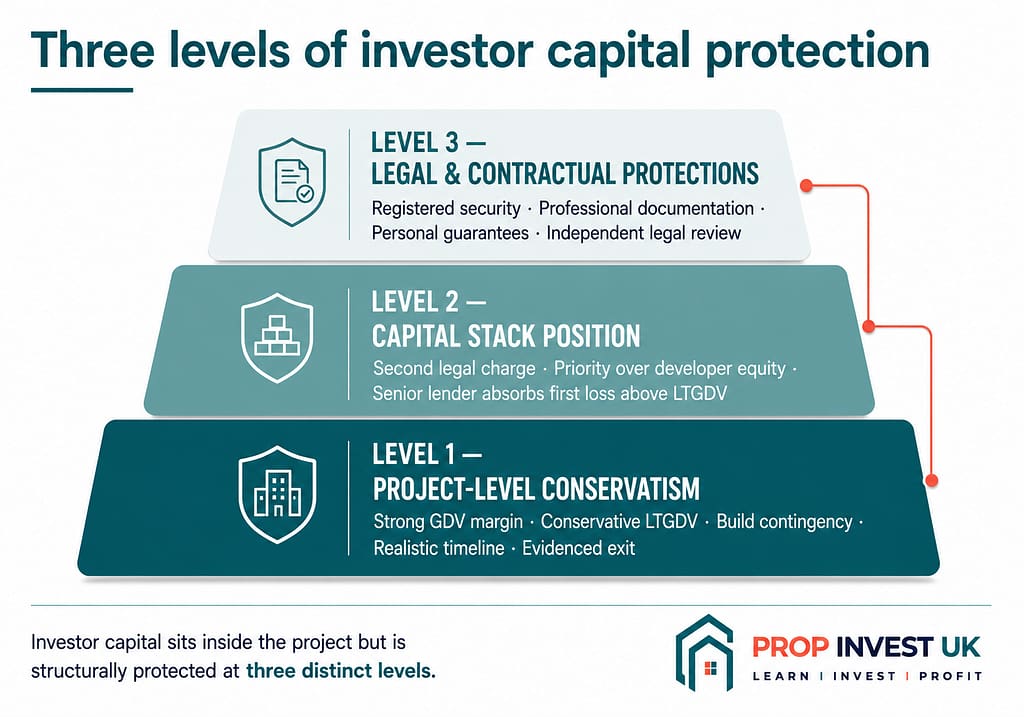
Each of the five risk categories above operates against the project as a whole. Investor capital is inside the project but doesn’t have to be exposed to every risk in the same way the project itself is exposed.
The structural protections for capital partners exist at three levels.
Level 1: Project-level structural conservatism
The first line of defence is the project itself being structured to absorb friction. Strong margin against GDV, conservative LTGDV on senior debt, contingency in the build budget, realistic timeline assumptions with slack, and an evidenced exit strategy.
A project with all five features absorbs typical-range friction without compromising investor outcomes. A project missing any of them is materially more exposed to the categories of risk above.
Level 2: Investor position within the capital stack
The second line of defence is where investor capital sits in the project’s payment waterfall. As we covered in our development finance article, a typical UK development project has senior debt (first charge), mezzanine where used (second charge), private investor capital (preferred equity or fixed-return loan with second charge), and developer equity (last).
For a fixed-return investor with a second legal charge against the property, the structural protection is:
- The senior lender takes the first loss above the LTGDV ratio
- The developer’s equity takes loss before the investor’s position
- The second charge gives priority over unsecured creditors
- The fixed-return structure means returns scale with time, not project outcome
For an equity investor, the structural protection is different: returns scale with project outcome (more upside in good scenarios, more downside in bad scenarios), but the structural seniority over the developer’s pure equity still applies.
Level 3: Legal and contractual protections
The third line of defence is the legal structure. Professional loan agreements with clear default provisions. Registered security (legal charge against the property at HM Land Registry, registered debentures where applicable). Personal guarantees from the operator on a deal-specific basis. Independent legal review on both sides.
These protections matter most in extreme scenarios — operator failure, severe overruns, or fraud. The legal infrastructure determines what an investor’s actual recourse is when things go wrong. In capable structures, that recourse is meaningful. In informal arrangements without registered security or professional documentation, it isn’t.
The risks investors most often misunderstand
Of the five risk categories above, two are commonly misunderstood by investors evaluating UK property development for the first time — typically those coming from BTL backgrounds where these distinctions don’t apply in the same way.
Misunderstanding 1: Timing risk vs capital loss risk
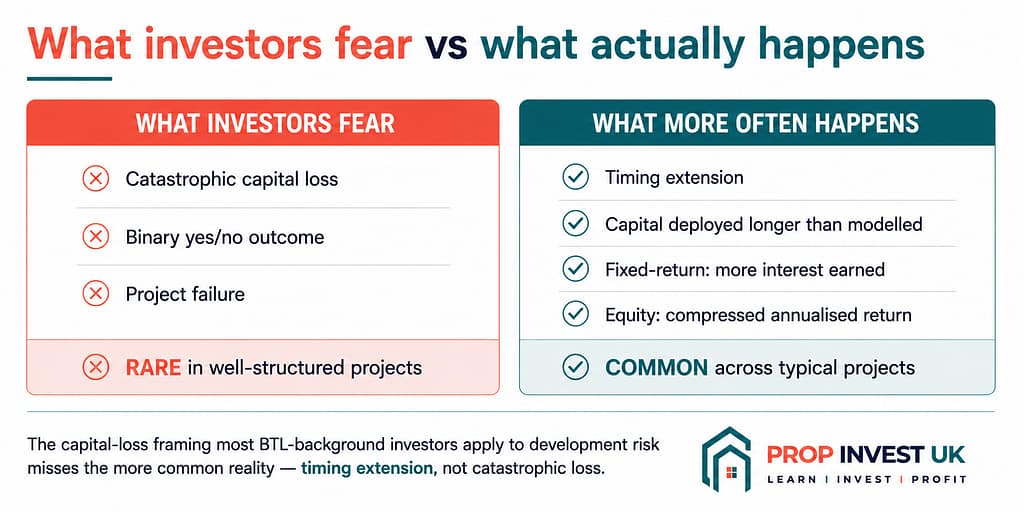
Many BTL-background investors evaluate development risk through the lens of “will I get my capital back?” — a binary question with a yes-or-no answer. This framing misses the more common reality.
In well-structured UK property development, the more common risk is timing, not capital loss. A project might run six months over the original timeline. The investor’s capital is deployed longer than modelled. For a fixed-return investor, this means more total interest earned (positive on return) but capital locked up longer (negative on opportunity cost). For an equity investor, this means compressed annualised return (negative on return) and capital locked up longer (negative on opportunity).
Catastrophic capital loss in well-structured UK development is rare. Timing extensions are common. The investor who understands this distinction makes better participation decisions than the investor who doesn’t.
Misunderstanding 2: Operator risk vs project risk
Many investors fixate on the project — the building, the location, the GDV, the margin. These matter. But they matter less than the operator delivering them.
The same project run by a capable operator and a weak operator produces categorically different outcomes. The Windsor Lodge story illustrates this directly: the building, the listed status, the contractor problems — the same set of conditions could have sunk the project under a weaker operator. The fact that it didn’t is operator capability, not project quality.
For investors, this means the diligence priority should run operator first, project second. We covered this directly in our operator vetting article. Investors who screen projects without first screening operators are evaluating the wrong question.
The risks investors most often overlook
Two further risk categories tend to be underweighted by investors evaluating UK property development for the first time.
Most project models assume the exit market at completion looks broadly like the market at acquisition. For most projects, that’s a reasonable assumption — UK property markets don’t typically move 20-30% over an 18-30 month project lifecycle.
But they can. The 2022 market reset, the 2008 GFC, and the 2020 COVID disruption are all examples of meaningful UK property market shifts inside typical project lifecycles. Projects that complete into adverse exit conditions face genuine market risk — either lower sale prices than modelled, slower sales velocity, or refinance valuations below the LTGDV expected.
For capital partners, this is the risk that most commonly gets understated in operator presentations. A project pitched with strong projected returns based on the current market may produce materially different outcomes if the market shifts at exit. Stress-testing the exit assumptions matters as much as evaluating the acquisition.
Overlooked risk 2: Operator pipeline concentration
A single project’s outcome depends partly on the operator’s broader pipeline health. An operator running 3-5 projects simultaneously, with capital tied up in each, is exposed to friction across the portfolio — not just the one project an individual investor is participating in.
If the operator’s broader pipeline runs into difficulty (multiple projects encountering friction simultaneously, capital constraints, key relationships breaking down), the project a specific investor is in can be affected even when its own underlying economics remain sound.
This is one of the reasons operator diligence should include questions about pipeline structure, financial position across the operating entity, and senior lender relationships across multiple facilities. Single-deal evaluation misses pipeline-level risk.
What “risk-adjusted return” actually means in this context

The concept of risk-adjusted return is widely used in investment but often vaguely defined. In UK property development capital partnership specifically, it means:
The return earned on capital, evaluated against the probability and magnitude of capital loss, time extension, or underperformance scenarios.
For a fixed-return loan position in the 15-20% per annum range, the risk-adjusted return depends on:
- The probability of full capital plus full interest return: needs to be high (typically 90%+ for well-structured projects with capable operators)
- The probability of partial capital recovery: needs to be acceptably low (typically 5-10%)
- The probability of total capital loss: needs to be very low (typically under 1% for projects with proper security and structural protection)
- The probability of meaningful time extension: needs to be acknowledged (20-40% is realistic for typical-range overruns)
- The probability of the project being a “unicorn” outcome that delivers original modelled return on the original timeline: typically modest in the realistic universe of UK development
Compared against alternative investments:
- UK gilts at 4.3%: Lower probability of capital loss, lower return, no operator risk
- Cash savings at 3-4%: Lower return, very low capital loss probability, inflation risk
- Equity ISA / SIPP-held equities: Higher long-term return potential, much higher short-term volatility, no time-defined exit
- Direct UK BTL: Comparable nominal yield (after Section 24 burden, lower), more operational complexity, less defined timeline, more direct compliance burden
- REITs and property funds: Lower nominal returns, higher liquidity, no operator concentration
The risk-adjusted return on capable UK property development capital partnership compares favourably to most of these alternatives — when the structural conditions hold. The “when” matters.
How to evaluate any opportunity for risk-adjusted return
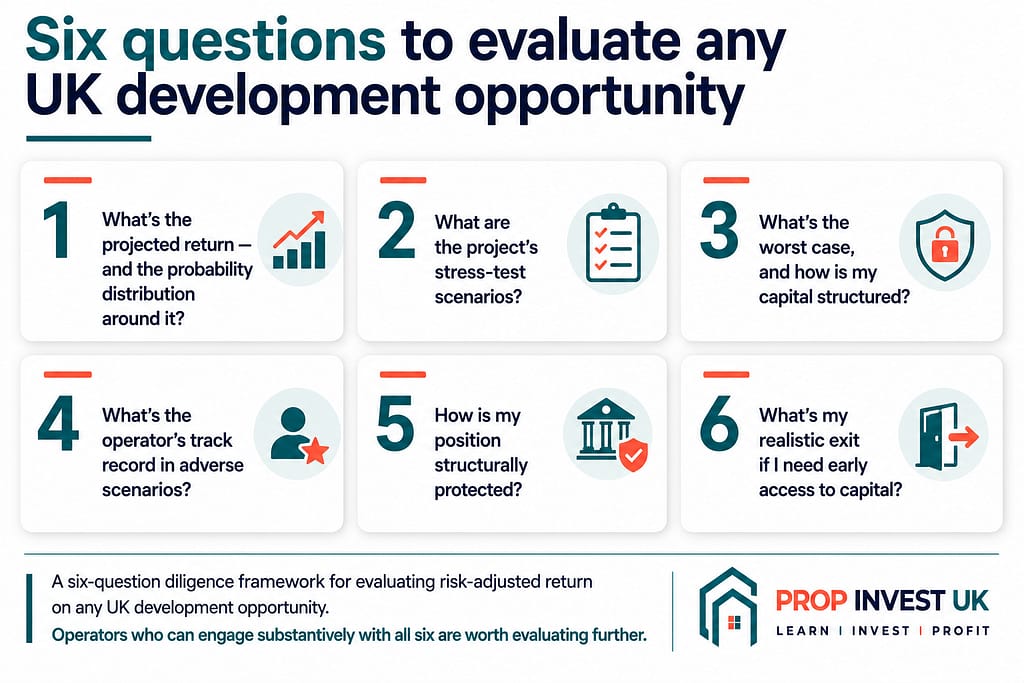
For a UK property investor evaluating a specific development opportunity, six structured questions surface the risk-adjusted return picture honestly.
1. What is the projected return, and what’s the realistic probability distribution around it?
The headline number matters less than the distribution. A 15% projected return with 85% probability of full delivery and 15% probability of extension is materially different from a 20% projected return with 50% probability of full delivery and 50% probability of significant friction.
Capable operators can talk through this distribution. Operators who can only quote the headline number aren’t engaging with the actual risk-adjusted question.
2. What are the project’s stress-test scenarios?
What happens to the investor’s return if:
- Build costs run 10% over budget?
- The project runs 6 months long?
- The exit valuation comes in 10% below model?
- All three happen simultaneously?
A capable operator has modelled these. The stress-test results tell you what the realistic downside scenarios actually produce — and whether your capital is protected in each.
3. What’s the worst case, and how is it structured?
Honest operators can answer “what’s the worst that can happen on this project, and what does it mean for my capital?” with specific answers. The structural protections (legal charges, conservative LTGDV, operator capability, exit strategy) should produce a specific worst-case scenario that the investor can evaluate.
Vague answers (“we don’t think that would happen”) are warnings, not reassurances.
4. What’s the operator’s track record in adverse scenarios?
Every operator has projects that ran into difficulty. The question is how they handled them. Specific examples (named projects, what went wrong, what was done about it, what the investor outcomes were) are evidence. Generic claims aren’t.
5. How is my position structurally protected?
Legal charges, second charges, documentation, personal guarantees where applicable. The structural protections we covered in the security article. These should be specific and verifiable, not vague reassurance.
6. What’s my realistic exit if I need to access capital before the project completes?
UK property development capital partnership is generally illiquid during the project. Some operators offer secondary market liquidity; most don’t. The investor should understand the realistic liquidity position before committing — particularly for investors who may need capital access during the project lifecycle.
How Prop Invest UK approaches risk and risk-adjusted return
Three things are worth knowing about how we structure projects and engage with capital partners on the risk question.
We don’t sell low risk. We don’t claim UK property development is safe, secure, or guaranteed. We present projects with full disclosure of the risk categories above, the structural mechanisms we use to manage them, and the realistic distribution of potential outcomes for the investor’s position.
We structure for resilience, not for headline returns. Conservative LTGDV. Strong margin against GDV. Contingency in the build budget. Realistic timeline assumptions with slack. Second legal charges. Professional documentation. The full structural framework we’ve documented across our content body, applied consistently across the pipeline.
We treat the operator-quality question as the most important diligence variable. The body of investor content we’ve built (foundational education, case studies, market commentary) is itself evidence of the operator’s quality. Investors evaluating us have more material to work with than is available for most UK property operators at our scale — by design. The transparency is the diligence answer.
The combination produces an offer where the risk-adjusted return is structurally favourable — when measured honestly against the realistic distribution of outcomes — but never sold as risk-free. The investors who participate understand this distinction. The investors who don’t, shouldn’t.
In summary
UK property development carries five categories of risk: planning, construction, market, financial/liquidity, and operator. Each has specific mechanisms, specific mitigations, and specific implications for investor capital.
Investor capital is structurally protected at three levels: the project’s underlying conservatism, the investor’s position within the capital stack, and the legal/contractual protections that apply at the investor-operator interface.
The risks investors most often misunderstand are timing risk vs capital loss risk (timing extensions are common, catastrophic capital loss is rare in well-structured projects) and operator risk vs project risk (operator quality matters more than project quality).
The risks investors most often overlook are exit market conditions at completion (which can move materially over a project lifecycle) and operator pipeline concentration (which means individual project outcomes can be affected by broader pipeline health).
Risk-adjusted return in UK property development capital partnership compares favourably to alternative UK investment routes — gilts, cash, equities, BTL ownership, REITs, property funds — when the structural conditions hold. The structural conditions are: capable operator, conservative project structure, properly protected investor position. When any of these fail, the activity becomes a losing proposition.
For investors evaluating any UK property development opportunity:
- Get the realistic probability distribution around the projected return, not just the headline number
- Walk through the stress-test scenarios with the operator
- Understand the worst-case scenario specifically
- Evaluate the operator’s track record in adverse scenarios
- Verify your structural protection
- Understand the liquidity position
An operator who can engage substantively with all six is worth evaluating further. An operator who can’t, isn’t.
If you want to evaluate specific Prop Invest UK opportunities — including the structural risk frameworks and stress-test scenarios that sit behind them — you can join the investor list. We share specific opportunities with capital partners and provide full risk and structural detail on a per-deal basis.
This article is general information only and is not financial advice. UK property development carries risk, including the risk of total loss of capital invested. Outcomes on individual projects depend on planning, construction, market conditions, valuation, refinance availability, and execution factors that vary by deal. Past project outcomes are not indicative of future performance. UK property development capital partnership opportunities are typically not regulated by the Financial Conduct Authority, and investors do not have access to the Financial Ombudsman Service (FOS) or the Financial Services Compensation Scheme (FSCS). Investors should take independent professional advice on their specific circumstances before committing capital.