
Most UK investors with significant pension capital who think about property eventually face the same set of constraints: they want exposure to UK property returns, but they don’t want to become a landlord. They want the tax efficiency of pension-held investment, but they don’t want to navigate the residential property restrictions HMRC imposes on SIPP and SSAS schemes. They want active capital deployment, but they don’t want to spend their retirement years managing tenants, contractors, and compliance. This has led many to explore options like pension property investment without becoming a landlord.
The conventional answers to this dilemma have been imperfect. Direct commercial property in a SIPP requires operational involvement. Property funds and REITs provide exposure but at returns that don’t reflect the underlying property economics. BTL mortgages held outside the pension wrapper face Section 24 burden. Direct development is operationally complex and capital-intensive.
There’s a fourth route that resolves most of these tensions — lending pension capital to property developers on commercial terms. This guide explains how it works, why it sits inside HMRC’s rules for both SSAS and SIPP structures, what the structural protections look like, and why this route has become one of the most coherent UK property capital allocation choices for investors with significant pension capital who don’t want to be landlords.
The core problem
For UK investors who have built substantial pension capital — particularly those in their 50s, 60s, and 70s — the question of how to deploy that capital into property exposure has become harder, not easier, over the last decade.
The historic default route was direct buy-to-let ownership outside the pension wrapper, often funded by a leveraged BTL mortgage with the investor as the landlord. We covered the structural problems with that route in detail in our BTL vs C2R article and UK landlords exiting BTL article. In short: Section 24, EPC C compliance, Renters’ Rights Act, Making Tax Digital, and the 5% SDLT surcharge have made direct BTL ownership structurally challenging — particularly for higher and additional-rate taxpayers — and 200,000+ landlords have exited the sector since late 2024 in response.
The pension-wrapper alternative for direct property is also constrained. SIPPs and SSASs cannot hold residential property directly without triggering severe HMRC tax penalties (we covered this in the SSAS article and SIPP article). Commercial property within the pension wrapper works, but typically requires operational involvement and capital scale that not every pension holder has.
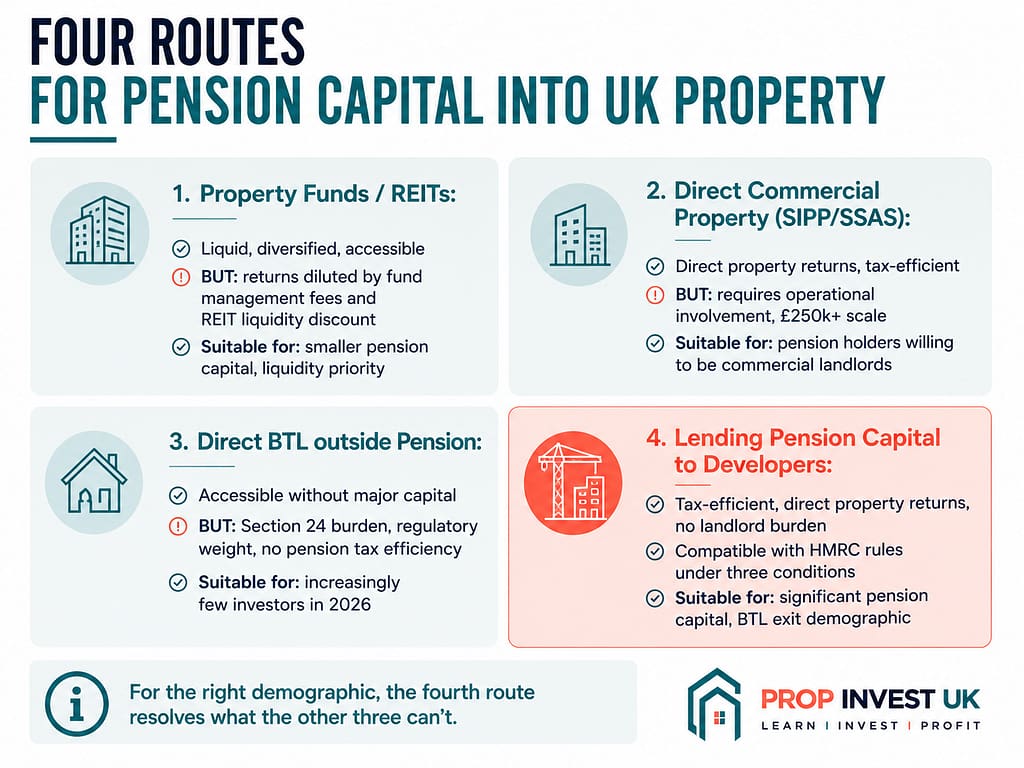
This leaves three traditional options for pension capital seeking property exposure, each with limitations:
Property funds and REITs — accessible, liquid, diversified, and pension-compatible. But returns are typically lower than direct property because of fund management fees and the discounting REITs face for liquidity. Investors get property-correlated returns, not direct property economics.
Direct commercial property in a SIPP or SSAS — preserves the tax efficiency and produces direct property returns. But requires significant capital (typically £250,000+ to be cost-effective), operational involvement, and ongoing administration. Not “without becoming a landlord” — different kind of landlord.
BTL or commercial property held outside the pension wrapper — accessible without significant capital scale, but loses the tax efficiency and brings the Section 24 / regulatory burden that’s pushing other investors out.
For those seeking alternatives, pension property investment without becoming a landlord offers a unique solution that aligns with their financial goals.
The fourth route — lending pension capital to property developers on commercial terms — addresses the limitations of the first three. It preserves the tax efficiency of the pension wrapper, produces direct property-correlated returns (often higher than fund returns), requires no operational involvement, and works at meaningful capital scales for SIPP and SSAS holders.
How “lending pension capital to property developers” actually works
The structural mechanism is straightforward. A pension scheme (SIPP or SSAS) makes a commercial loan to an unconnected property development operator. The pension earns interest income on the loan; the operator uses the capital to fund their development projects.
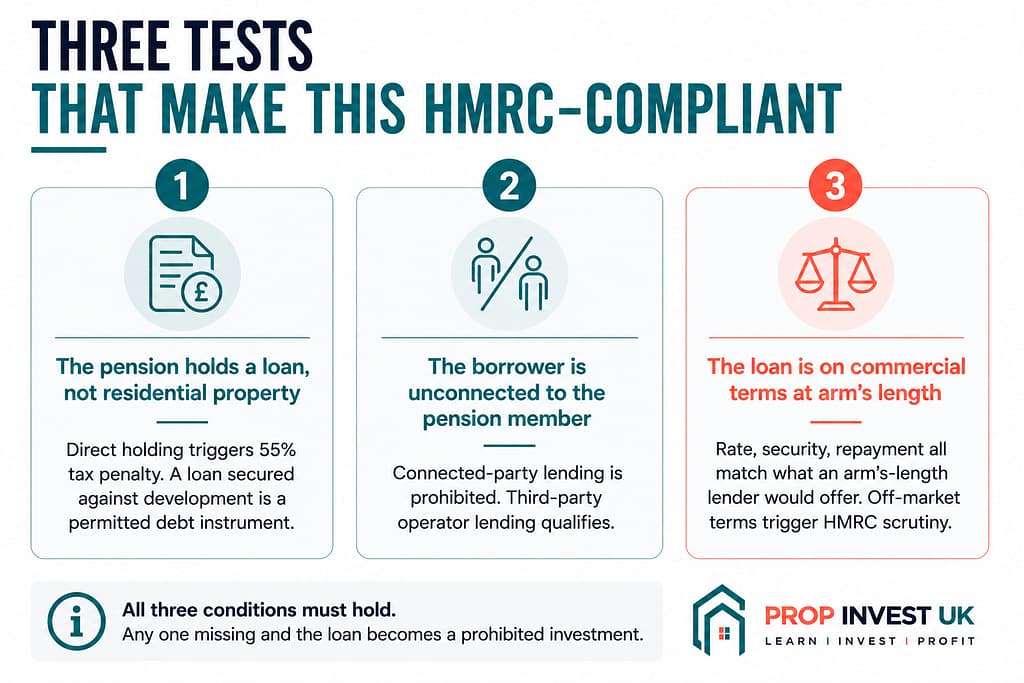
Three structural features make this route compatible with HMRC’s pension rules:
1. The pension holds a loan, not residential property
The HMRC residential property prohibition applies to direct holding of residential property by the pension scheme. A loan secured against a development project — even when that project produces residential units — isn’t direct holding. The pension is holding a debt instrument, not the property itself.
This is the structural distinction that allows pension capital to participate in UK residential development without triggering the 55% tax penalty on prohibited residential investments.
2. The borrower is unconnected to the pension member
For the loan to qualify as a permitted pension investment under HMRC rules, the borrower must be unconnected to the pension member. Connected-party lending (lending from a SIPP/SSAS to the member’s own business, family member, or controlled entity) is prohibited and triggers tax penalties.
Lending to a third-party property development operator like us, where the pension member has no other relationship with the operator beyond the lending arrangement, satisfies the unconnected requirement.
3. The loan is on commercial terms at arm’s length
The interest rate, security, repayment terms, and other features of the loan must be genuinely commercial — what an arm’s-length lender would offer the same borrower. Off-market terms (interest rates above or below market, security weaker or stronger than commercial standards) can trigger HMRC scrutiny.
For typical UK property development capital partnerships, fixed-return rates in the 15-20% per annum range are commercial market rates — supported by the broader market for private property development capital — and second legal charges against the development property are standard security.
When these three features hold, the pension’s loan to the property developer is a permitted investment under HMRC pension rules, producing interest income that accrues tax-free within the pension wrapper.
Where this route sits in the broader pension property landscape
It’s worth being clear about what this route is and isn’t, relative to the other pension property options.
What it is
- A way to access UK property development returns through pension capital
- A permitted investment under HMRC rules for both SIPP and SSAS schemes (subject to provider approval)
- A tax-efficient route — interest income accrues tax-free within the pension
- An operator-led structure — the pension holder isn’t the landlord, the operator is the operator
- Typically a fixed-return loan position with defined timeline and structured exit
What it isn’t
- Not a way to hold residential property directly in a pension (still prohibited)
- Not a guaranteed return product — UK property development carries risk and pension capital is at risk like any other capital
- Not regulated by the FCA (most UK property development capital partnerships are unregulated investments)
- Not appropriate for all pension holders or all pension capital — the structure requires due diligence on the operator, the project, and the suitability for the specific pension’s investment strategy
The distinction matters because pension property investment is governed by both HMRC rules (on what’s permitted) and FCA principles (on suitability and disclosure). The route described in this article is permitted under HMRC rules for both SIPP and SSAS structures — but suitability for any specific pension holder depends on individual circumstances and should be assessed with a regulated pensions adviser.
The five-step process for a pension lending to a property developer
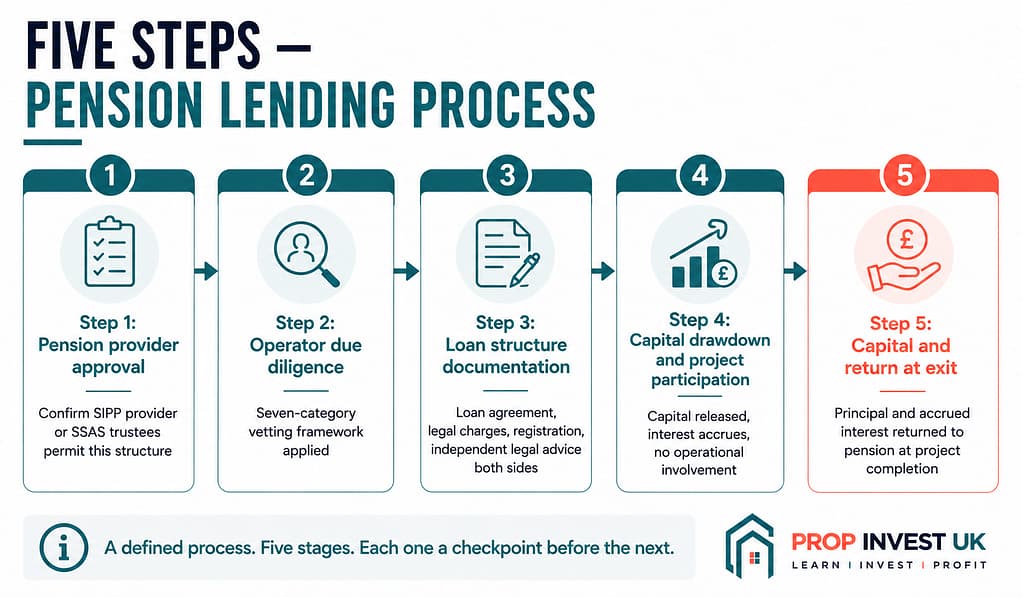
For SIPP and SSAS holders considering this route, the practical mechanics follow a five-step process.
Step 1: Pension provider approval
Not all SIPP and SSAS providers permit loans to third-party property developers within their permitted asset list. For SIPP holders particularly, the provider’s approval is required before any specific loan can be structured.
Typical questions the provider will ask:
- Is the borrower unconnected to the pension member?
- What’s the loan amount, term, and rate?
- What security is being taken?
- What’s the borrower’s track record and financial position?
- What’s the documentation framework?
For SSAS schemes where the members are the trustees, the approval process is more direct but the same questions apply. The trustees need to satisfy themselves that the loan is a permitted investment and is in the interests of the scheme.
Step 2: Operator due diligence
Before any loan is committed, the pension holder (with their adviser) conducts due diligence on the property development operator. The seven-category framework we set out in our operator vetting article applies fully — Companies House, completed projects, financial track record, references, friction handling, deal structure, personal credibility.
For pension capital specifically, this due diligence matters more than for non-pension capital. Pension capital is typically long-term retirement capital that shouldn’t be exposed to the risks of weak operators. The diligence rigour should match the consequence of getting the operator wrong.
Step 3: Loan structure documentation
Once the operator is approved and a specific project is identified, the loan is documented. Typical documentation includes:
- Loan agreement — defining the principal amount, interest rate, term, repayment schedule, default provisions, and operator obligations
- Legal charge documentation — for second legal charges against the property, registered at HM Land Registry
- Personal guarantee documentation — where personal guarantees are part of the structure (deal-specific)
- Pension scheme documentation — recording the loan as a permitted investment of the scheme
Both sides (the pension and the operator) typically have independent legal representation. The operator’s solicitor produces the documents and handles the registration on the SPV side; the pension’s solicitor reviews and confirms registration on the pension’s behalf.
Step 4: Capital drawdown and project participation
Once documents are executed and security is registered, the pension’s capital is transferred to the operator’s project SPV (typically held by the SPV’s solicitor in escrow during the completion process, then released to the SPV’s project account at completion).
During the project lifecycle, the pension’s position is passive — interest accrues at the agreed rate, with no operational involvement required from the pension holder. The operator handles all the project work: planning, build, contractor management, exit execution.
The pension holder receives regular project updates (as we covered in the overrun article, capable operators communicate proactively during projects), but doesn’t make operational decisions.
Step 5: Capital and return at exit
At project completion (or on the agreed loan term, if earlier), the operator repays the principal and accrued interest to the pension. The capital and interest re-enter the pension’s investment account and can be redeployed into the next opportunity, or held in cash, or allocated elsewhere within the pension’s investment strategy.
For pension holders building a series of capital partnership positions across multiple projects, the cycle can become rolling — capital returns from one project become capital for the next, while the pension wrapper continues to provide tax-efficient growth.
Jason’s progression — a worked example
The Jason story we’ve referenced across multiple articles (SSAS, fixed return vs equity, overrun, and security) illustrates this route in practice.
Jason is a company director with a SSAS established for his trading business. He came from a buy-to-let background — built and ran a UK BTL portfolio for years before the structural shifts in the BTL model made the continued ownership less attractive.
When Jason transitioned away from direct landlord activity, his SSAS capital needed redeployment. Direct commercial property in the SSAS was an option, but came with the operational burden Jason was trying to step away from. Property funds and REITs would have provided exposure but at lower returns than the property economics he’d previously been earning directly.
The route Jason chose was capital partnership with us on a series of projects. His SSAS lent capital to project SPVs on fixed-return loan structures, with returns in the 15-20% per annum range, secured by second legal charges against the development properties.
Across multiple projects, the structure has worked as designed:
- The SSAS earned tax-free interest income within the pension wrapper
- Jason had no operational involvement in any of the projects — the operator handled everything
- The structural protections (registered second legal charges, professional documentation) provided the security pension capital deserves
- When projects encountered friction (the Windsor Lodge contractor problems we documented in the overrun article), the structure absorbed it without compromising Jason’s outcomes
After multiple successful fixed-return cycles, Jason eventually progressed to equity participation on some later projects — a decision driven by the relationship history and the demonstrated track record, not by an initial recommendation. This progression is the natural evolution we covered in detail in the fixed return vs equity article.
For Jason, the route accomplished exactly what most pension property investors want: property exposure, pension tax efficiency, capital deployment, structured returns, no operational burden. And specifically — no more being a landlord.
Why this route works particularly well for the BTL-exit demographic
A specific investor demographic has emerged in 2025-2026 as a natural fit for the pension-lending-to-property-developer route: experienced UK landlords with significant pension capital who are exiting (or considering exiting) direct BTL ownership.
The profile typically includes:
- 10+ years of direct UK property experience
- Substantial existing pension capital (£250,000+ in SIPP or SSAS structures, often £500,000+)
- Higher or additional-rate income tax position making Section 24 burden particularly painful
- Operational fatigue with the increased compliance burden of UK BTL in 2026
- Desire to maintain property exposure but without continued landlord operations
- Often heading toward retirement (50s, 60s, 70s) where simplification matters
For this demographic, the structural fit of capital partnership through pension lending is strong:
Property exposure: Maintained through the loan position Operational burden: Removed — operator handles everything Tax efficiency: Restored through the pension wrapper (interest income tax-free) Capital scale: Works at the level of pension capital typically available to this demographic Time horizon: Matches retirement and legacy planning frames better than active BTL ownership Liquidity: Defined timelines (18-30 months per project) with capital return at exit, rather than the indefinite hold of direct property
The cohort of investors making this transition is the cohort the body of investor content we’ve built is most directly serving. Jason is one example. Other capital partners follow similar profiles — typically BTL backgrounds, often SSAS or SIPP capital, exiting direct landlord activity in favour of capital partnership structures that produce comparable or better economics without the operational burden.
The structural protections at the pension-property interface
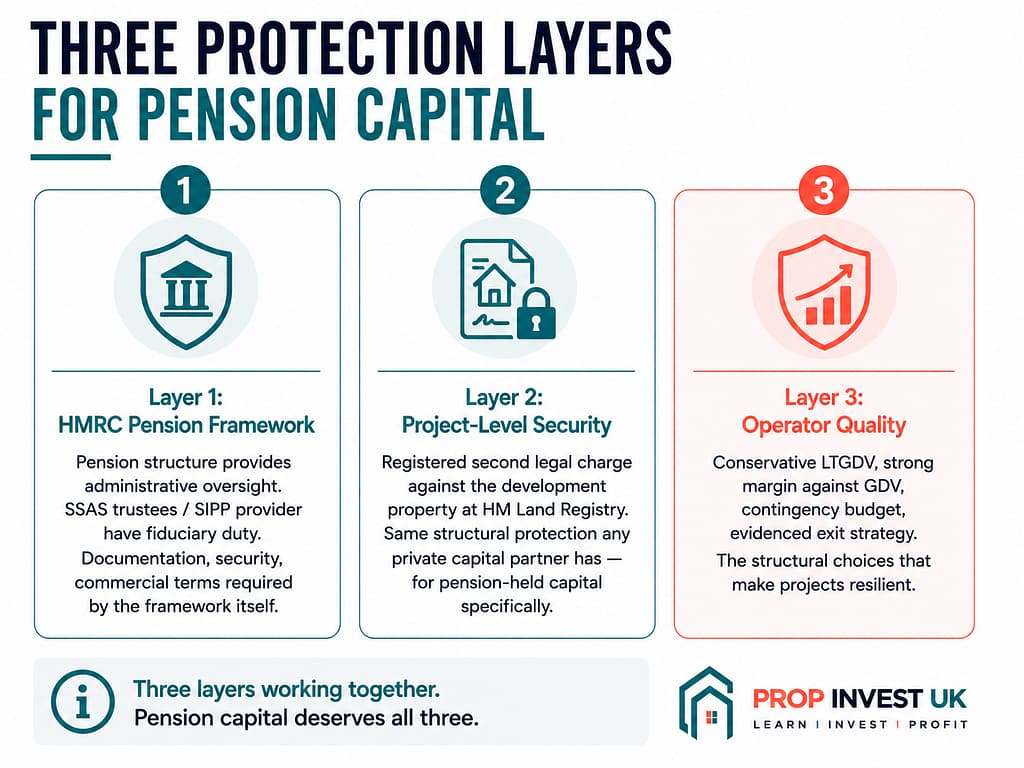
Three layers of protection sit between pension capital lent to a property developer and the underlying project risk.
Layer 1: HMRC pension framework
The pension structure itself provides administrative oversight. The SSAS trustees (or the SIPP provider as trustee for SIPP capital) have fiduciary duty to act in the interests of the scheme. The loan must qualify as a permitted investment, with documentation, security, and commercial terms.
This isn’t equivalent to FCA regulation of the underlying investment, but it provides a meaningful layer of administrative discipline that pure individual-name investments don’t have.
Layer 2: Investor security at the project level
The legal charge against the development property — typically a second charge behind the senior development lender — provides the same structural protection any private capital partner has on a UK development project. We covered this in detail in the investor security article.
For pension capital specifically, the registered second legal charge is the structural feature that lets the pension hold a defensible economic interest in the project’s property collateral while satisfying HMRC’s “loan, not direct holding” framework.
Layer 3: Operator quality and structural project discipline
The third layer is what we’ve documented across the rest of the Prop Invest UK content body — conservative LTGDV, strong margin against GDV, contingency budget, realistic timelines, evidenced exit strategy. The structural choices that produce resilient project outcomes for all capital partners apply equally to pension-held capital.
For pension capital, the operator quality variable matters even more than for non-pension capital. Pension capital is typically irreplaceable retirement capital. The diligence on the operator should match that consequence.
The five questions for a pension considering this route
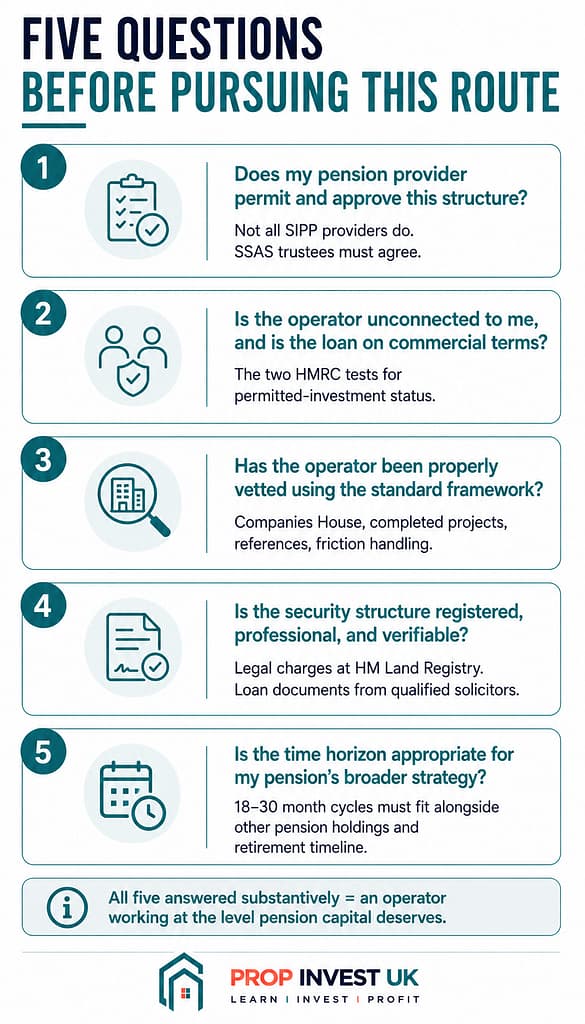
For SIPP and SSAS holders evaluating the lending-to-developer route, five questions surface the suitability and structural soundness.
1. Does my pension provider permit and approve this structure?
Not all SIPP providers permit loans to third-party property developers. Confirm the provider’s approval before committing to any specific project. For SSAS, confirm the trustees (typically the scheme members) are satisfied that the loan qualifies as a permitted investment.
2. Is the operator unconnected to me, and is the loan on genuinely commercial terms?
The unconnected-party requirement and the arm’s-length commercial terms requirement are the two HMRC tests that determine permitted-investment status. Both need to hold throughout the loan’s life.
3. Has the operator been properly vetted using the standard due diligence framework?
The seven-category framework: Companies House, completed projects, financial track record, references, friction handling, deal structure, personal credibility. For pension capital, the diligence rigour should match the consequence of getting it wrong.
4. Is the security structure registered, professional, and verifiable?
Legal charges registered at HM Land Registry. Loan agreements drafted by qualified solicitors. Independent legal review on both sides. The structural protections are only valuable if they’re properly documented and registered.
5. Is the time horizon and liquidity profile appropriate for the pension’s broader strategy?
Capital partnership positions typically run 18-30 months with capital return at exit. For pension capital, this needs to fit alongside other pension holdings, the member’s retirement timeline, and any short-term liquidity requirements within the broader pension strategy.
What this route is and isn’t, summarised
This isn’t a universal pension property strategy. It works particularly well for a specific demographic — significant pension capital, BTL background, operational fatigue, retirement timeline — and produces structural fit that the alternative routes don’t match for that demographic.
It isn’t risk-free. UK property development carries real risk and pension capital is at risk like any other capital. We covered the full risk framework in the risk article. The structural protections reduce risk but don’t eliminate it.
It isn’t suitable without operator quality. Lending pension capital to a weak operator produces worse outcomes than holding cash within the pension. The operator quality decision is the most consequential decision in this route — more important than the project, more important than the rate, more important than the term.
It is, for the demographic it fits, one of the most coherent UK property capital allocation choices available. The combination of tax efficiency, direct property economics, structural protection, and operational simplification is hard to replicate through other routes.
How our Property Group structures pension capital partnership
We’ve structured pension capital partnership positions for multiple SSAS and SIPP-held capital sources over the years. The structure follows the framework described in this article:
- Unconnected-party lending — pension members have no other relationship with us beyond the lending arrangement
- Commercial fixed-return loan structures — typically at rates in the 15-20% per annum range, secured by second legal charges registered at HM Land Registry
- Professional documentation on both sides — loan agreements, legal charges, personal guarantees on deal-specific basis where appropriate
- Independent legal advice both sides — pension’s solicitor and our solicitor coordinating to ensure proper documentation and registration
- Pension provider engagement where required — for SIPP capital, working with the SIPP provider’s administrative process; for SSAS capital, engaging directly with the scheme trustees
The structure has worked across multiple projects and multiple pension capital sources. Jason’s SSAS is one example documented across our content body; other pension capital partners follow similar structures with similar outcomes.
We don’t advise on pension structures. We structure property opportunities. Where pension capital wants to participate, the conversation needs to involve the pension provider, the pension’s adviser, and us — not us alone. That collaborative structure is what produces the alignment between HMRC compliance, operator quality, and project structural protection that pension capital deserves.
In summary
For UK investors with significant pension capital who want property exposure without becoming landlords, the route of lending pension capital to property developers on commercial terms resolves most of the structural tensions other pension property options create.
The mechanism: a SIPP or SSAS makes a commercial loan to an unconnected property development operator. The pension earns tax-free interest income within the wrapper. The operator handles all project work. The pension holder has no operational involvement. The capital and interest return at project exit.
Three features make this route HMRC-compliant: the pension holds a loan (not residential property), the borrower is unconnected (not a connected party), and the loan is on commercial arm’s-length terms (not off-market).
The structural fit is particularly strong for a specific demographic: experienced UK landlords with significant pension capital who are exiting (or considering exiting) direct BTL ownership. For this cohort, the combination of property exposure, pension tax efficiency, operator-delivered execution, and structural protection produces an outcome that other routes can’t replicate.
The five questions worth asking before pursuing this route:
- Does my pension provider permit and approve this structure?
- Is the operator unconnected to me, and is the loan on genuinely commercial terms?
- Has the operator been properly vetted?
- Is the security structure registered, professional, and verifiable?
- Is the time horizon appropriate for my pension’s broader strategy?
An operator who can engage substantively across all five — including providing the documentation, the references, and the regulated advice coordination needed to make this work for pension capital — is operating at the level pension capital deserves. One who can’t, isn’t.
If you have pension capital (SIPP or SSAS) and want to discuss whether capital partnership with us might fit your circumstances — you can join the Prop Invest UK investor list. We share specific opportunities with capital partners and welcome the structural due diligence approach described across our content, including coordination with your pension provider and pensions adviser as part of the structural assessment.
This article is general information only and is not pensions, tax, or financial advice. SIPP and SSAS pension arrangements are subject to specific HMRC rules and tax consequences, and any decision about how to use a pension — including whether to lend pension capital to third-party operators — should be made with regulated pensions advice from an appropriately qualified professional. UK property development carries risk; pension capital is at risk. Past project outcomes are not indicative of future performance. UK property development capital partnership opportunities are typically not regulated by the Financial Conduct Authority, and investors do not have access to the Financial Ombudsman Service (FOS) or the Financial Services Compensation Scheme (FSCS).