
Every UK property development project is funded through a stack of capital layers, known as the property development capital stack, each with a different risk profile, return profile, and position in the payment waterfall. Senior debt at the base. Mezzanine finance above it. Preferred equity above that. Common equity at the top. Most investors evaluating capital partnership opportunities don’t fully understand where their capital sits in this stack — and that lack of understanding is one of the biggest sources of investor mistakes in UK property development.
This guide explains what the capital stack actually is, what each layer does, how the payment waterfall works in practice, where private investor capital typically fits, and how the stack structure determines whether an investor’s position is genuinely protected or structurally vulnerable. Worked example based on the Mozarts conversion at 76 Walter Road, Swansea.
What the capital stack actually is
In UK property development, the “capital stack” refers to the layered structure of funding sources that combine to finance a project. Most projects can’t be funded by a single capital source — the amounts required are too large, and different sources have different risk appetites that fit different positions in the project.
A typical UK property development project of meaningful scale is funded through a combination of:
- Senior debt (the largest layer, lowest cost, lowest risk)
- Mezzanine finance (the gap-filler, higher cost, higher risk)
- Preferred equity / private investor capital (structured returns, defined position)
- Common equity (the developer’s own capital, last position, highest upside)
Not every project uses every layer. Smaller projects may skip mezzanine entirely. Some structures combine multiple roles (a stretch senior facility that incorporates what would otherwise be mezzanine). But the principle holds: project capital is layered, and the layer your money sits in determines almost everything about your position.
The four layers, in order
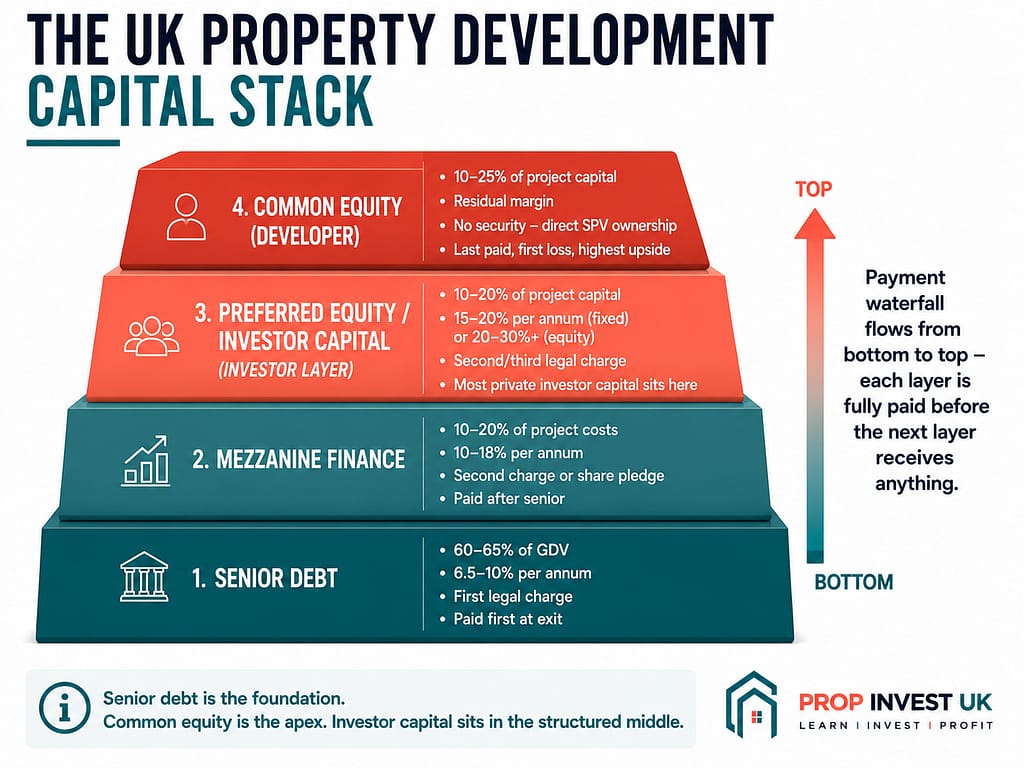
Layer 1: Senior debt (the foundation)
Senior debt is the largest single layer of most UK property development capital stacks. It’s typically provided by a specialist development lender, a challenger bank, or an institutional fund, and it sits at the foundation of the structure.
Key features:
- Typical size: 60-65% of GDV, sometimes stretching to 70% for strong borrowers
- Cost: 6.5-10% per annum (covered in detail in our development finance article)
- Security: First legal charge against the property
- Risk position: Lowest in the stack — paid first at exit
- Repayment: From sale of completed units or refinance onto long-term debt
- Drawdown: Released in stages tied to verified construction progress
The senior lender’s first legal charge gives them the strongest claim on the property. If the project fails and the asset has to be sold, the senior lender is paid in full before any other capital provider receives anything. This priority is why senior debt is the cheapest layer in the stack — the lender’s risk is genuinely lower than every other position.
Senior lenders are conservative by design. They cap LTGDV at conservative levels, demand strong exit strategies, scrutinise developer track record, and require professional documentation throughout. The lending standards reflect both the size of the position and the structural importance of getting it right.
Layer 2: Mezzanine finance (the gap-filler)
Mezzanine finance sits above senior debt in the capital stack, providing additional leverage when the developer’s equity contribution is constrained or when project economics support higher total gearing.
Key features:
- Typical size: 10-20% of total costs, pushing total leverage from 65% LTGDV (senior alone) to 80-90% LTC (senior + mezzanine combined)
- Cost: 10-18% per annum
- Security: Second legal charge behind senior, or share pledge over the borrowing entity
- Risk position: Behind senior, ahead of equity — middle of the stack
- Repayment: After senior is fully satisfied
- Often used when: Developer wants higher leverage without giving up equity
The pricing differential between mezzanine and senior debt — 10-18% vs 6.5-10% — reflects the position differential. Mezzanine sits behind senior in the payment waterfall, meaning the senior debt has to be fully repaid before mezzanine receives anything. In a stressed scenario where the project sells for less than expected, mezzanine can lose part or all of its capital while senior is still fully repaid.
Not every UK project uses mezzanine. For smaller schemes or those with adequate developer equity, the additional complexity and cost of mezzanine isn’t justified. For larger schemes or those where capital efficiency matters, mezzanine can be the difference between a viable project and one that doesn’t proceed.
Layer 3: Preferred equity / private investor capital (the structured layer)
This is where most private investor capital in UK property development actually sits. The layer above mezzanine (or directly above senior if no mezzanine is used) and below the developer’s pure equity.
Key features:
- Typical size: 10-20% of total project capital, often filling the gap between senior+mezz and developer’s own contribution
- Cost: Variable — fixed-return structures often in the 15-20% per annum range; equity structures can produce 20-30%+ in successful project outcomes
- Security: Typically a second legal charge against the property (where no mezzanine is used) or a third charge / share pledge (where mezzanine sits between senior and the private investor layer)
- Risk position: Above all debt, below all equity senior to it; mid-stack position
- Repayment: After all debt is satisfied, in line with the agreed structure (fixed or variable)
- Often takes the form of: Fixed-return loans, preferred equity with priority distribution, or hybrid structures
For investors evaluating UK property development capital partnership opportunities — including our projects with Raf, Jason, and Glenn as documented case studies — this is the layer of the stack where their capital lives. The structural protections we covered in our investor security article apply specifically to this layer.
The key feature of this layer: it sits behind senior debt (which is the same as nearly every other UK development project, because senior takes the first charge), but ahead of the developer’s pure equity. The investor’s position is protected by the project’s margin between final value and total debt — and that margin only gets eaten into after the senior debt and mezzanine (if any) are at risk.
Layer 4: Common equity (the developer’s position)
The developer’s own capital — typically 10-25% of total project costs — sits at the top of the stack. Last to be repaid. First to absorb loss. Highest upside if the project succeeds.
Key features:
- Typical size: 10-25% of total project capital
- Cost: The project’s residual margin (whatever’s left after everyone else is paid)
- Security: None — direct ownership of the SPV’s equity position
- Risk position: Last position, first loss
- Return: Variable — captures the residual margin, which can be substantial in successful projects or zero/negative in stressed ones
Common equity is the position that captures the project’s upside. If the project delivers above plan, common equity is paid above the structured returns of other layers and captures the excess. If the project delivers below plan, common equity is the first capital to be diluted or lost.
For UK property development lenders evaluating who to fund, the developer’s common equity contribution is treated as evidence of skin in the game. A developer with 20% equity in the project has substantial personal incentive to deliver the project successfully. A developer with 5% equity has materially less.
How the payment waterfall actually works
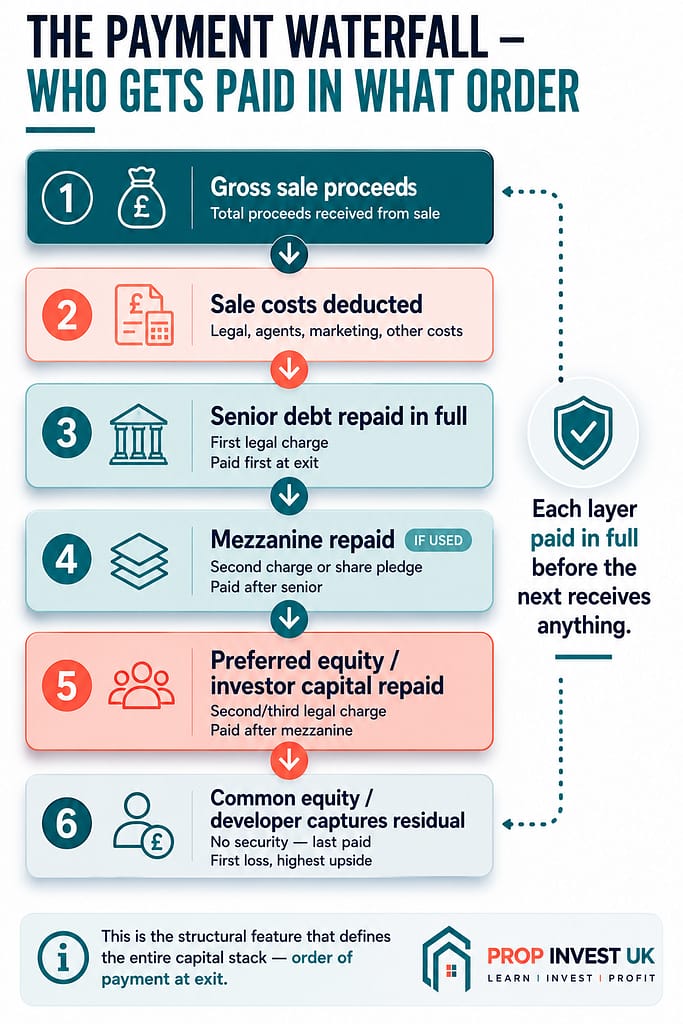
The structural feature that defines the capital stack isn’t the layers themselves — it’s the payment waterfall. The order in which each layer is paid at exit.
The waterfall runs from bottom to top:
- Sale costs (legal fees, agents, marketing) — paid from gross proceeds before any capital provider
- Senior debt (full principal + accrued interest + any fees) — paid in full before any other layer
- Mezzanine finance (if used) — paid in full before any equity
- Preferred equity / structured investor capital — paid according to agreed structure (interest on fixed-return loans, agreed distribution priority on preferred equity)
- Common equity (the developer) — paid last, captures whatever residual is left
Worked example — Mozarts at completion
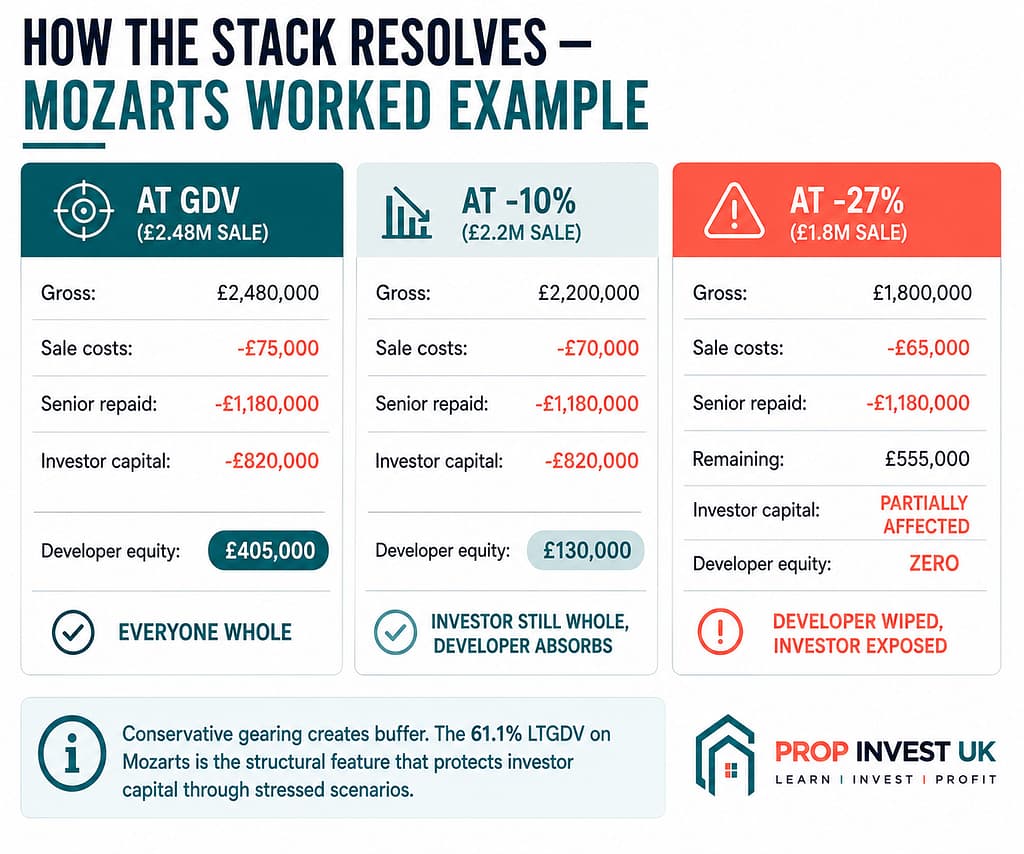
Using illustrative numbers consistent with the Mozarts project structure:
- Projected GDV: £2,480,000
- Senior facility (Signature): £1,100,000
- Investor capital + developer equity: £700,000
If the project sells at GDV:
| Step | £ |
|---|---|
| Gross sale proceeds | £2,480,000 |
| Sale costs (legal, agents, estimated) | -£75,000 |
| Senior lender repaid (£1.1m principal + accrued interest) | -£1,180,000 |
| Remaining for other layers | £1,225,000 |
| Investor capital repaid (with agreed fixed return) | -£820,000 (illustrative — varies by structure) |
| Remaining as developer equity / project margin | £405,000 |
Note: these are illustrative numbers for the purpose of explaining the waterfall — the actual final distribution on any project depends on the specific structures negotiated, the actual sale proceeds achieved, and the agreed terms with each capital provider.
If the project sells at lower than GDV — say £2,200,000 instead of £2,480,000:
| Step | £ |
|---|---|
| Gross sale proceeds | £2,200,000 |
| Sale costs | -£70,000 |
| Senior lender repaid in full | -£1,180,000 |
| Remaining for other layers | £950,000 |
| Investor capital still fully repaid (with agreed fixed return) | -£820,000 |
| Remaining as developer equity | £130,000 |
In this stressed scenario, the senior lender is still fully repaid. The investor’s capital is still fully repaid (because the project’s margin and conservative gearing left enough headroom). The developer’s equity is the layer that absorbs the impact — from £405,000 to £130,000 — but everyone else is whole.
If the project sells at much lower than expected — say £1,800,000 — the developer’s equity disappears entirely and the investor capital may start to be affected. But the project’s structural conservatism (the 61.1% LTGDV on senior debt and the margin against GDV) creates substantial buffer before the investor’s second-charge position is breached.
This is the structural reason conservative LTGDV matters so much. The lower the senior debt as a proportion of GDV, the more buffer exists for the layers above it.
How investor capital is actually protected by the stack
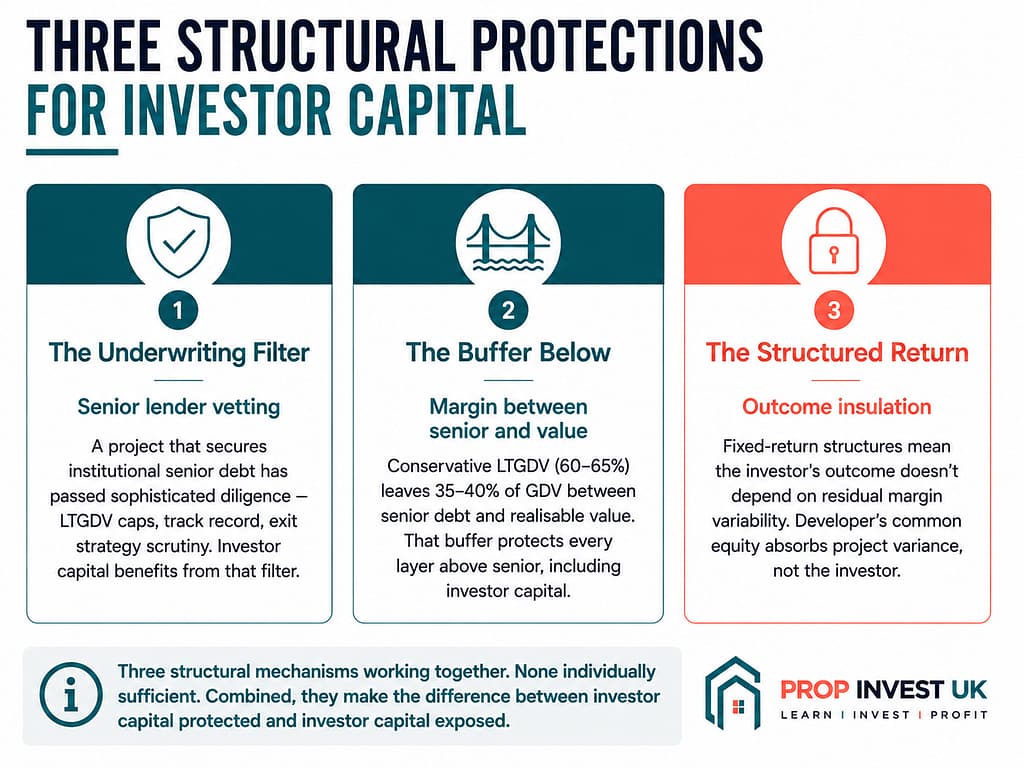
The stack structure provides protection at three levels for private investor capital sitting in the preferred equity / structured investor layer.
Protection 1: Senior debt provides the underwriting filter
Senior lenders won’t fund weak projects. Their underwriting standards — LTGDV caps, LTC caps, developer track record requirements, exit strategy scrutiny — filter out the worst projects before they reach the investor diligence stage.
A project that has successfully raised senior debt has been vetted by a sophisticated institutional lender. That filter doesn’t guarantee project success, but it does mean the project has passed structural diligence that many would-be projects fail.
For investors, the implication is that a project funded by a reputable senior lender is structurally different from a project that couldn’t secure senior debt and is being marketed purely to retail investors.
Protection 2: The buffer between senior debt and investor capital
The senior lender’s conservative LTGDV (typically 60-65%) creates substantial structural buffer between the senior debt position and the underlying property value. That buffer protects everyone above senior — including investor capital.
A project funded at 60% LTGDV has 40% of GDV between the senior debt and the realisable property value. Even if the final value comes in 15-20% below projection, the senior debt is still fully covered and the layers above retain meaningful protection.
A project funded at 75% LTGDV has only 25% of GDV between senior and realisable value. The same value softening puts the senior position close to its limit and significantly reduces the protection for layers above.
This is why we keep emphasising conservative LTGDV throughout the war chest. It’s not just about senior lender safety — it’s about the structural protection of every layer above senior, including investor capital.
Protection 3: The structured return mechanism
For investors in the preferred equity layer specifically, the structured return mechanism (fixed-return loans, preferred equity with priority distribution) means the investor’s outcome doesn’t depend on the project’s final residual margin.
A fixed-return investor gets paid their agreed interest regardless of whether the project produces £500,000 of margin or £50,000. The variability of project outcomes is absorbed by the developer’s common equity, not by the investor.
This structural feature is the main reason the fixed return vs equity article argued that fixed-return positions are particularly well-suited to investors who can’t tolerate variability. The stack structure delivers exactly that risk-shifting outcome.
What this means for evaluating any opportunity
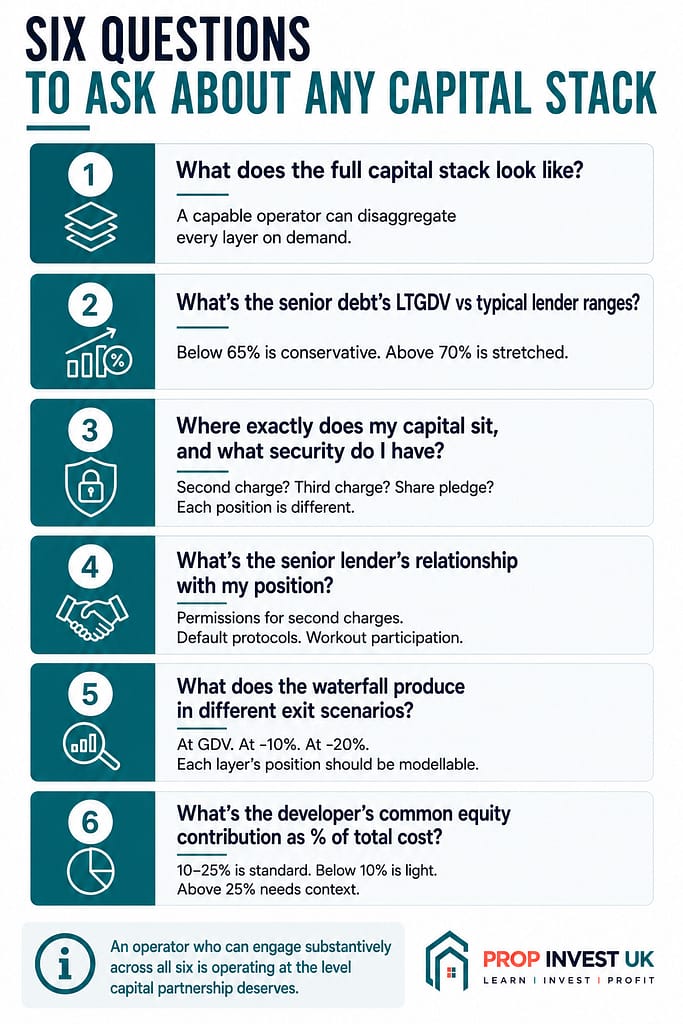
For investors evaluating a UK property development capital partnership opportunity, six specific questions about the capital stack tell you almost everything about the structural soundness.
1. What does the full capital stack look like?
A capable operator can walk through the complete stack. Senior lender identity and facility size. Mezzanine if used. Investor layer structure. Developer equity contribution. If the operator can’t disaggregate the stack on demand, they don’t understand their own project structure.
2. What is the senior debt’s LTGDV, and how does it compare to typical lender ranges?
Below 65% is conservative. Above 70% is stretched. The senior debt’s LTGDV is one of the largest single determinants of how much structural protection exists for the layers above.
3. Where exactly does my capital sit in the stack, and what security do I have?
Second legal charge? Third charge behind mezzanine? Preferred equity with no registered security? Share pledge? Each position has different protection and different priority in the waterfall.
4. What’s the senior lender’s relationship with my position?
Does the senior lender allow a second charge? Some don’t. Does the senior lender’s documentation allow extensions if needed? What happens in a default scenario — does the senior take the asset, or does the investor get notice and a chance to participate in a workout?
5. What does the waterfall actually produce in different exit scenarios?
Run the worked example for the project at projected GDV, at 10% below GDV, at 20% below GDV. The operator should be able to walk through what each scenario produces for each layer — including the investor’s position.
6. What is the developer’s common equity contribution as a percentage of total project costs?
10-25% is standard. Below 10% is light on developer skin in the game. Above 25% is unusually heavy — which can either be a sign of a strong developer or a sign of a project that couldn’t attract investor capital. The context matters.
How Our Group structures the capital stack
For each project presented to capital partners, the full stack is disclosed and documented. Mozarts illustrates the pattern:
- Senior debt: £1,100,000 from Signature, secured by first legal charge, at approximately 7.2% per annum
- Investor capital: £700,000 (combined investor and developer equity layer), with structured returns to capital partners
- LTGDV on senior: 61.1% — well below the upper end of the typical 65-70% range
- Margin against GDV: in the high-20s percent range — substantial buffer against value softening or cost overrun
This is the structure of a project where the capital stack is designed for resilience. Conservative senior gearing. Substantial buffer between senior and final value. Documented investor positions with second legal charges. Developer’s own equity in the position to absorb first loss before investor capital is affected.
Across the broader portfolio, the same structural pattern applies. Conservative LTGDV. Strong margin. Professional documentation. Investor positions protected by second legal charges registered at HM Land Registry. Developer’s own capital in the project alongside investor capital, not instead of it.
The body of investor content we’ve built — from foundational education to case studies to market commentary — sits on top of capital stack structures designed for the kind of resilience that protects investor outcomes through both smooth and stressed project lifecycles.
What weak capital stacks look like (the warning signs)
Three structural patterns are warning signs that an operator’s capital stack is not investor-friendly.
Warning 1: Senior gearing pushed to the upper end of lender ranges
A project funded at 75-80% LTGDV on senior debt has very little structural buffer for the layers above. Investor capital sits behind senior debt that’s already close to its ceiling, with limited margin to absorb cost overruns, sale price softening, or timeline extensions.
For investors, this isn’t necessarily disqualifying — but it should be acknowledged as a material risk factor and reflected in the return required.
Warning 2: No senior debt, retail investor only structure
Some operators raise project capital entirely from retail investors without a senior lender in the structure. The advantage from the operator’s perspective: no senior debt to be repaid first, more flexibility. The disadvantage from the investor’s perspective: the senior lender’s underwriting filter is missing, the structural priority that institutional underwriting brings isn’t present, and the investor is the most senior layer in the stack by default.
Some genuinely strong projects are structured this way — small-scale developments funded by a single sophisticated investor, for example. But “no senior debt” combined with “raising from many small investors” is a pattern worth scrutinising carefully.
Warning 3: Developer with minimal equity contribution
A developer contributing 5% or less of project capital as their own equity has limited skin in the game. The structural incentive to drive the project to a successful outcome is reduced. The project’s resilience to friction is also reduced — common equity is the layer that absorbs first loss, and a thin common equity layer means stress gets passed up the stack quickly.
Operators with substantial common equity contribution (15%+ of project cost) signal real commitment to the project’s outcome. Operators relying entirely on investor capital with minimal own-equity are positioning differently.
In summary
Every UK property development project is funded through a layered capital stack: senior debt at the bottom (largest, cheapest, first-paid), mezzanine in the middle (gap-filler, second priority, higher cost), preferred equity / structured investor capital (the layer where most private investor capital sits), and common equity at the top (developer’s own capital, last paid, highest upside).
The payment waterfall runs from bottom to top. Senior debt is repaid first, in full, before any other layer receives anything. Each subsequent layer is paid only after the layer below is fully satisfied. This priority order is what makes senior debt the cheapest layer (lowest risk) and common equity the most expensive position (highest risk, but also highest upside in successful projects).
Private investor capital in UK development typically sits in the preferred equity / structured investor layer. The structural protections that apply to this layer:
- Senior debt provides the underwriting filter — a project that secures institutional senior debt has passed sophisticated diligence
- The buffer between senior debt and final value protects every layer above senior — conservative LTGDV is the single most important structural feature
- The structured return mechanism isolates investor outcomes from the project’s residual margin variability (for fixed-return positions)
The six questions worth asking any operator about the capital stack:
- What does the full stack look like?
- What’s the senior debt’s LTGDV vs typical ranges?
- Where exactly does my capital sit, and what security do I have?
- What’s the senior lender’s relationship with my position?
- What does the waterfall produce in different exit scenarios?
- What’s the developer’s common equity contribution as a percentage of total cost?
An operator who can engage substantively across all six is operating at the level capital partnership deserves. One who can’t — or whose stack shows warning signs (stretched senior gearing, no senior debt at all, minimal developer equity) — is asking investors to accept structural risk that the layered stack is designed specifically to manage.
If you want to evaluate specific Prop Invest UK opportunities — including the full capital stack structure and waterfall scenarios for each project — you can join the investor list. We share specific opportunities with capital partners and provide full structural detail on a per-deal basis.
This article is general information only and is not financial advice. UK property development carries risk, including the risk of total loss of capital invested. Capital stack structures, project economics, and market conditions vary by deal. Past project outcomes are not indicative of future performance.