
Most investors do not have a capital problem. They have a structure problem. Money sits in underperforming assets, yields tighten, and direct property ownership gradually becomes operationally heavy. What starts as an investment often turns into a second job involving tenants, maintenance, compliance and constant decision-making.
That is one reason professionally managed property development opportunities are attracting greater attention from experienced investors looking for stronger returns and more strategic deployment of capital.
The appeal is understandable, but the market is often misunderstood.
Not every development project represents a strong investment opportunity. Not every operator structures projects rigorously. And not every developer has the experience required to consistently turn a site into a profitable outcome.
Serious investors are not simply asking where the next opportunity is.
They are asking:
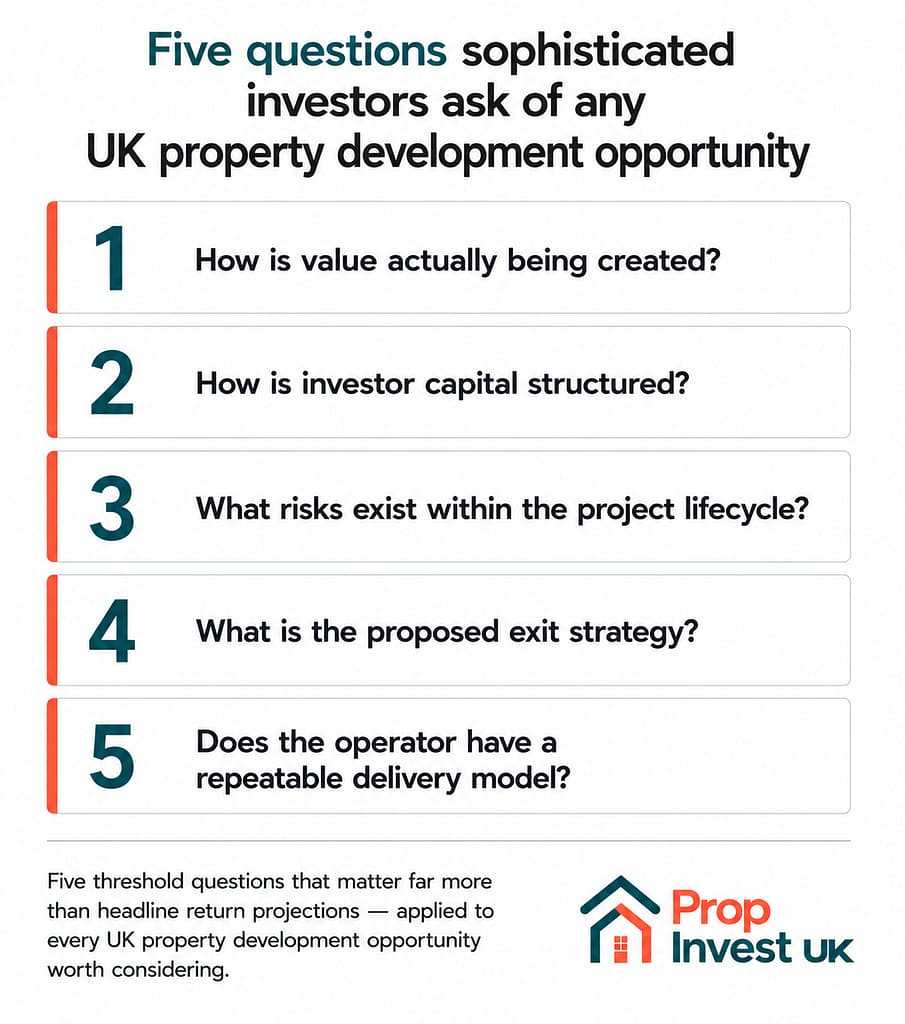
- How is value actually being created?
- How is investor capital structured?
- What risks exist within the project lifecycle?
- What is the proposed exit strategy?
- Does the operator have a repeatable delivery model?
Those questions matter far more than headline return projections.
Why investors are looking beyond traditional property investing
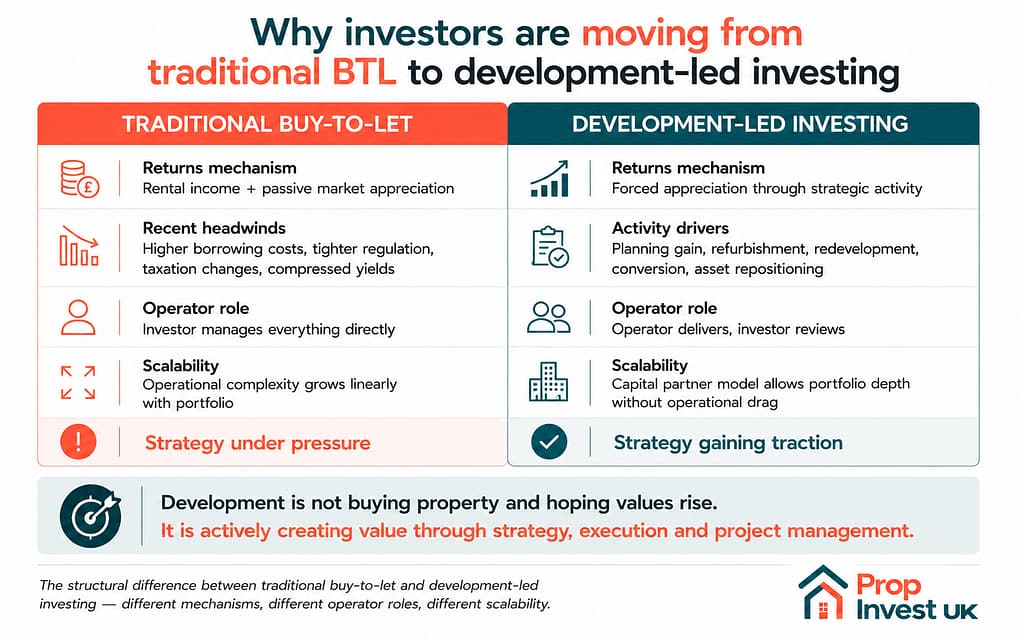
For many investors, traditional buy-to-let investing has become increasingly difficult to scale efficiently.
Higher borrowing costs, tighter regulation, taxation changes and compressed yields have reduced the attractiveness of many conventional rental investments. At the same time, investors still want exposure to property because they understand its long-term wealth-building potential.
Development-led investing offers a different route.
Rather than relying purely on rental income or passive market appreciation, development projects focus on creating value through strategic activity such as:
- planning gain
- refurbishment
- redevelopment
- conversion
- asset repositioning
- improving operational performance
That distinction is important.
Developers are not simply buying property and hoping values rise over time. They are actively creating additional value through strategy, execution and project management.
For investors, this creates exposure to a different part of the property cycle — one where value can potentially be accelerated through disciplined delivery rather than relying solely on market growth.
What separates strong development opportunities from weak ones
The development sector is not short of ambitious marketing.
What is far less common is disciplined project structuring.
Experienced investors understand that a development opportunity should be evaluated as a business plan, not as a property advertisement.
That starts with the numbers.
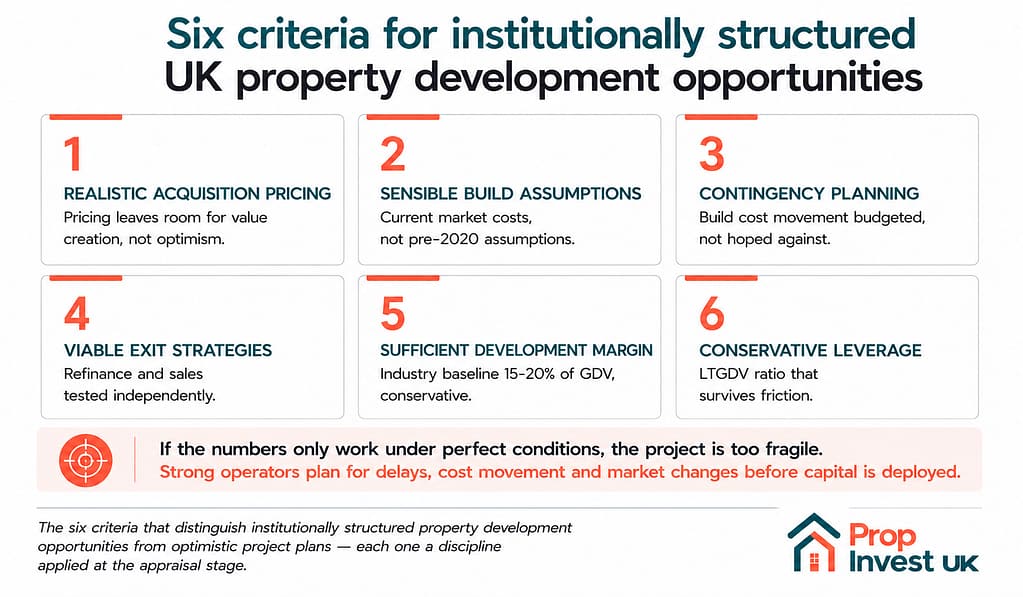
An institutionally structured project should demonstrate:
- realistic acquisition pricing
- sensible build assumptions
- contingency planning
- viable refinancing or sales exits
- sufficient development margin
- conservative leverage
If the numbers only work under perfect conditions, the project is too fragile.
Strong operators plan for delays, cost movement and market changes before capital is deployed.
The investment structure also matters.
Some projects are structured around equity participation and profit share, where investor returns are linked to overall project performance. Others may involve different funding arrangements depending on the development strategy and investor profile.
The key issue is not whether one structure is universally better than another.
The key issue is whether the structure is clear, properly documented and aligned with the realities of the project itself.
Serious investors value transparency far more than exaggerated projections.
Where development value is actually created
Many investors focus only on the completed property.
Experienced developers focus on the process that creates the margin.
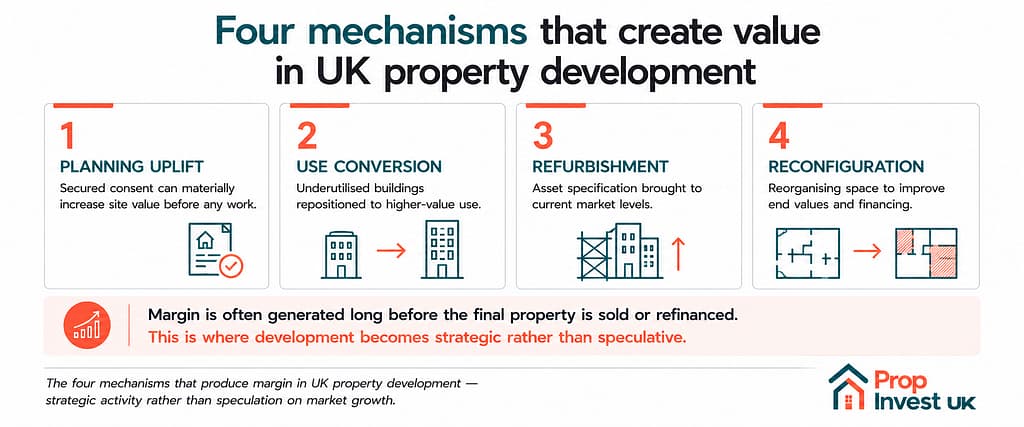
That margin is often generated long before the final property is sold or refinanced.
For example:
- securing planning permission can materially increase site value
- converting underutilised buildings can improve income potential
- refurbishment can reposition assets within stronger rental markets
- reconfiguration can improve end values and financing options
This is where development becomes strategic rather than speculative.
The strongest opportunities are usually found where:
- acquisition pricing still leaves room for margin
- tenant demand remains durable
- local infrastructure supports long-term growth
- redevelopment activity can create measurable upside
Parts of the South West, South Wales and sections of the M4 corridor continue to attract attention for exactly these reasons, with commercial-to-residential conversion opportunities still appearing at margin-viable acquisition prices in secondary towns where rental demand remains structurally underserved. In many cases, values still allow viable development margins while rental demand remains comparatively resilient.
That matters because successful development is not based on optimism alone.
It is based on disciplined acquisition, careful execution and realistic commercial assumptions.
How experienced investors assess opportunities
Sophisticated investors rarely get distracted by presentation alone.
They focus on process, structure and delivery capability.
One of the first areas to assess is project economics.
Does the development still remain commercially viable after accounting for:
- construction costs
- finance costs
- professional fees
- contingency allowances
- planning risk
- refinancing or disposal costs
If margins become too thin, small problems can quickly become expensive.
The quality of the operator is equally important.
A strong developer should be able to demonstrate:
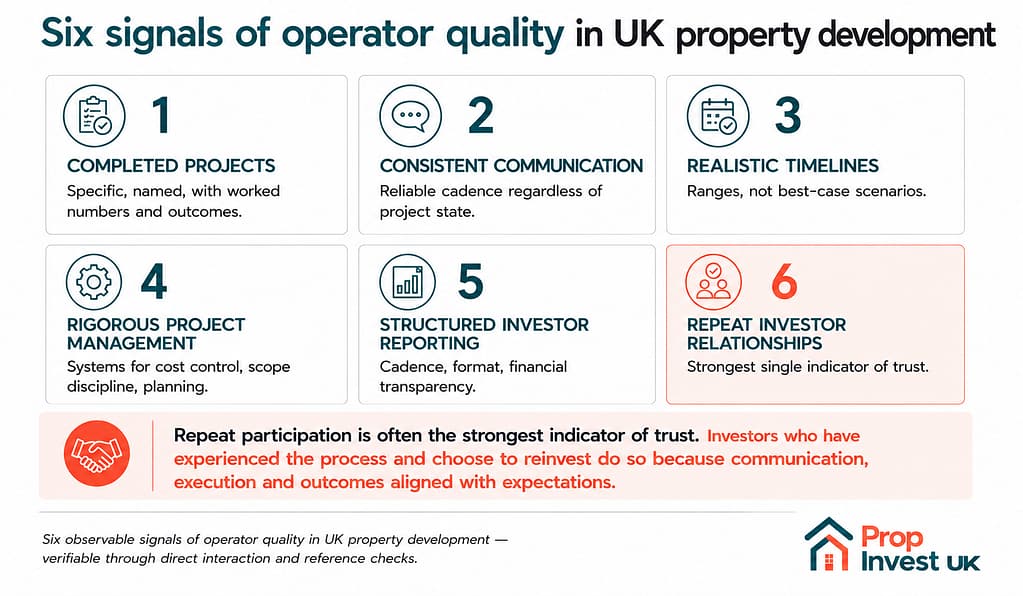
- completed projects
- consistent communication
- realistic timelines
- rigorous project management
- structured investor reporting
- repeat investor relationships
Repeat participation is often one of the strongest indicators of trust.
Investors who have already experienced the process and choose to reinvest usually do so because communication, execution and outcomes aligned with expectations.
Why operator-led development models are gaining traction
Many financially established investors no longer want operational involvement in property projects.
They want strategic exposure without becoming responsible for day-to-day delivery.
Direct ownership can still play an important role within a wider portfolio, but it also creates concentration risk and operational burden. Investors are often exposed to:
- individual tenant risk
- compliance obligations
- maintenance issues
- void periods
- management complexity
Operator-led development partnerships offer a different model.
The operator manages sourcing, due diligence, planning, construction oversight, refinancing or disposal strategy, and investor communication throughout the development lifecycle.
That allows investors to participate as capital partners while the operational delivery remains with the development team.
For many experienced investors, that shift is significant.
It moves property investing away from hands-on administration and towards a more structured allocation of capital.
The risks investors should understand
Property development is not low risk.
Construction costs can rise unexpectedly. Timelines can move. Planning issues can emerge. Market conditions can soften during delivery.
Any operator presenting development as a simple or guaranteed outcome should be approached carefully.
The objective is not to eliminate risk entirely.
That is impossible.
The objective is to manage risk through:
- disciplined acquisitions
- conservative assumptions
- experienced project management
- sensible leverage
- structured investor communication
- alignment between developer and investor interests
This is often where weaker operators become exposed.
Optimism is not a substitute for process.
What serious investors are looking for now
The market has become more selective, and that is ultimately healthy.
Investors are asking better questions about:
- project structure
- communication standards
- operator experience
- development strategy
- capital alignment
- long-term repeatability
They are also looking beyond single projects.
Increasingly, investors want access to repeat opportunities with operators capable of sourcing, structuring and delivering developments consistently over time.
That is where operator-led development partnerships become attractive.
When projects are approached strategically, development can create value through planning, redevelopment and asset repositioning while also creating a pipeline for future reinvestment opportunities.
At Prop Invest UK, the focus remains on professionally managed development opportunities built around clear strategy, disciplined project selection and transparent investor communication.
For serious investors, the most important question is not whether opportunities exist.
It is whether the structure, the operator and the underlying strategy justify the deployment of capital.
If you’re evaluating UK property development investment opportunities and want to receive analysis of current projects — including project structure, security, operator capability, and projected outcomes — you can join the Prop Invest UK investor list. We share specific opportunities with capital partners on the list as they come to market.
This article is general information only and is not financial advice. UK property development carries risk; capital is at risk. Property development investment opportunities are typically not regulated by the Financial Conduct Authority, and investors do not have access to the Financial Ombudsman Service (FOS) or the Financial Services Compensation Scheme (FSCS). Past project outcomes are not indicative of future performance. Specific development opportunities should be evaluated with appropriate professional advice.