
The question every serious investor asks before committing capital to a private property development project: if this goes wrong, what protects me? The answer lives in the property development investor security structure of the deal — the combination of legal documents that define what protects investor capital when something goes wrong.
In UK property development, the answer involves a combination of legal documents — legal charges, debentures, personal guarantees, loan agreements — each with a different role and a different level of protection. Some operators use all of them. Some use none of them. Most use a specific combination that reflects how serious they are about treating investor capital as something to be protected, not just deployed.
This guide explains the security structures available to private investors in UK property development, what each one actually does (and doesn’t do), what charge priority means in practice, and how three real investors — Raf, Jason, and Glenn — are secured on their respective projects.
Why this question matters more than the headline return
When private investors first start looking at UK property development opportunities, the conversation tends to gravitate toward the upside. Projected returns. Development margins. Track records. Exit strategies.
All of those matter. But none of them answer the question that matters most when something goes wrong: if the project can’t repay, what happens to my capital?
The answer to that question lives in the security structure of the deal — the legal documents that define what protects the investor’s position. And it’s the question most operators don’t lead with, because the answer separates serious operators from speculative ones quickly.
Three things to know up front about security in UK private property development:
- No structure eliminates risk entirely. Development carries real risk. Security structures reduce the impact of certain failure modes — they don’t make the project safe.
- The strength of the security matters less than the strength of the underlying project. A first legal charge against a project that doesn’t stack means nothing if there’s no realisable value in the asset. A second legal charge against a project with substantial equity buffer is meaningful even though the charge ranks behind senior debt.
- Different operators offer different security structures. Some offer registered charges. Some offer personal guarantees. Some offer only a loan agreement with no registered security. Knowing what you’re being offered — and what protection it actually provides — is part of evaluating any opportunity.
The four primary security structures used in UK private property development
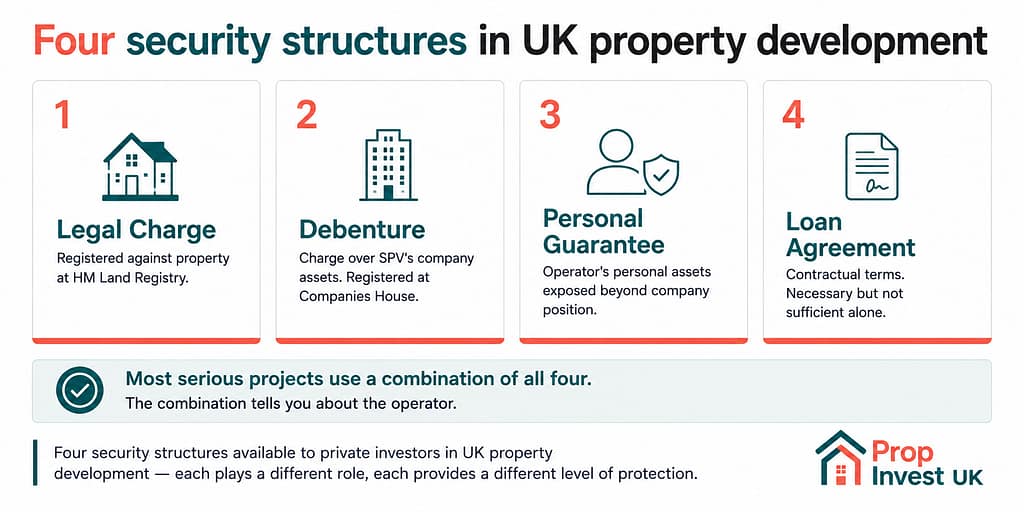
There are four categories of security an investor can receive when participating in a UK private property development project. Most projects use a combination — and the combination an operator uses tells you something about how seriously they think about investor capital protection.
1. Legal charge against the property
A legal charge is a security interest registered against a specific property at HM Land Registry. It works the same way a residential mortgage works — the lender (in this case, the investor) has a registered interest in the property that can be enforced if the borrower defaults.
The critical detail is the priority of the charge:
- First legal charge: ranks ahead of any other secured claim against the property. The first-charge holder gets paid before anyone else if the property is sold or enforced.
- Second legal charge: ranks behind the first charge but ahead of unsecured creditors. The second-charge holder gets paid only after the first-charge holder is fully repaid — but ahead of equity, unsecured loans, and trade creditors.
- Subsequent charges: third, fourth, and so on, in registration order.
In UK property development, the senior development finance lender (the bank or specialist lender funding the largest portion of the project) almost always requires the first legal charge. They won’t lend without it. This is true on virtually every UK development project of meaningful scale.
What this means for private investors: a first legal charge is generally not available on a project that has senior development finance, because the senior lender has already taken that position. The realistic options for an investor are second legal charge (ranking behind the senior lender but ahead of everything else) or no registered charge at all.
A second legal charge is registered at HM Land Registry by the investor’s or the operator’s solicitor, and is verifiable independently via Land Registry search. Once registered, it cannot be moved or removed without the second-charge holder’s consent.
2. Debenture over the SPV’s assets
A debenture is a security document granted by a limited company (typically the Special Purpose Vehicle holding the project) that creates a charge over some or all of the company’s assets.
Debentures usually combine two types of charge:
- Fixed charge — attaches to specific identifiable assets (property, equipment, contracts, intellectual property). The company can’t sell or refinance the asset without the debenture holder’s consent.
- Floating charge — covers assets that change in the ordinary course of business (stock, cash, receivables). It “crystallises” — becomes fixed — on certain trigger events like insolvency or default.
For property development SPVs, the asset that matters most is usually the property itself, which is typically already covered by a separate legal charge. The debenture’s role in this context is to extend the security to other assets the SPV holds — contracts with builders, planning rights, deposits paid, future receivables from sales.
Debentures are registered at Companies House within 21 days of creation. Failure to register on time generally makes the debenture void against a liquidator or administrator — which is why proper legal handling of registration is critical.
For most UK development projects, debentures are taken by the senior lender, not by individual capital partners. But some private investor structures include either a separate debenture or a deed of priority that allocates rights between the senior lender’s debenture and other secured creditors.
3. Personal guarantee from the operator
A personal guarantee is a commitment by an individual — typically a director or shareholder of the operator — to personally repay the loan if the borrowing entity (the SPV) cannot.
The mechanics are straightforward but the implications are significant:
- The guarantor is personally liable for the debt up to the agreed amount
- The guarantor’s personal assets — home, savings, investments — are potentially exposed if the company defaults and the guarantee is called
- Personal guarantees can be limited (capped at a specific amount) or unlimited
- Personal guarantees can be joint and several (multiple guarantors each fully liable) or several (each liable for their share only)
A personal guarantee from an operator on investor capital is one of the strongest signals available in private property development. It demonstrates the operator has personal skin in the game beyond their company’s financial position. It also significantly increases the operator’s incentive to manage the project carefully — because the consequences of failure extend to their personal assets, not just the company’s.
Not every operator offers personal guarantees. Some operators will offer them deal-specific (on certain projects but not others). Some operators decline them entirely as a matter of policy. Investors should know which approach the operator they’re working with takes, and why.
4. Loan agreement and ancillary documentation
Every investor capital position should be governed by a written loan agreement (for fixed-return positions) or shareholders’ agreement (for equity positions). These documents define the contractual terms — interest rate, repayment schedule, default provisions, decision-making rights, exit triggers, dispute resolution mechanisms.
A loan agreement on its own — without any of the registered security above — provides contractual rights but no priority over other creditors. If the borrowing entity becomes insolvent, an investor with only a loan agreement ranks alongside unsecured trade creditors and behind all secured creditors.
This is the most common structure in informal “private lending” arrangements, and it’s also the weakest from an investor protection standpoint. A loan agreement is necessary but not sufficient. Without registered security alongside it, the investor is functionally unsecured.
How charge priority actually works — and why it matters
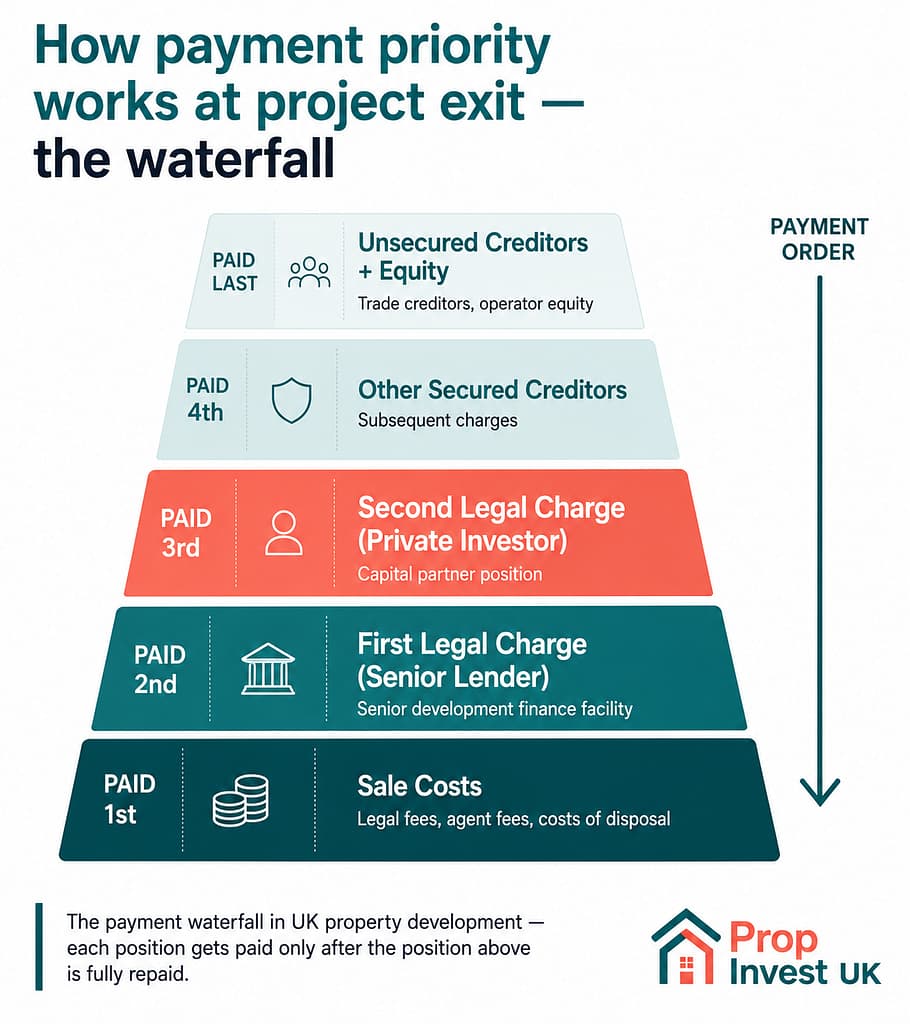
The concept of “priority” determines who gets paid first if something goes wrong. It’s the most important concept in security and the one most often misunderstood.
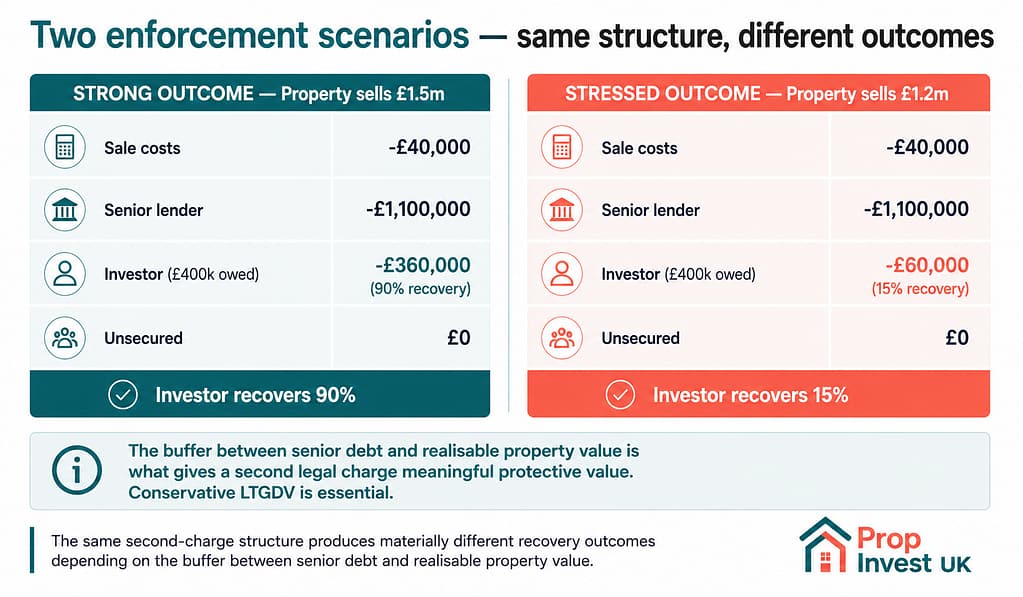
Imagine a project that has the following position when it has to be enforced:
- Property is sold for £1,500,000
- Senior development finance: £1,100,000 outstanding (first legal charge)
- Investor capital: £400,000 outstanding (second legal charge)
- Unsecured trade creditors: £80,000
Payment waterfall:
- Sale costs (legal fees, agents, etc.) — typically £30,000-£50,000 on a project of this size
- First charge holder (senior lender) — receives full £1,100,000
- Second charge holder (investor) — receives whatever remains, up to their £400,000
- Unsecured creditors — receive whatever remains after secured creditors are paid
In this scenario, after sale costs of say £40,000, the senior lender takes £1,100,000, leaving £360,000 for the investor on a £400,000 position. The investor recovers 90% of capital. The unsecured creditors receive nothing.
Now imagine the same project sold for £1,200,000:
- Sale costs: £40,000
- Senior lender: £1,100,000
- Investor: £60,000 (out of £400,000 owed)
- Unsecured creditors: £0
The investor recovers 15% of capital.
And if the project sold for £1,100,000 or less, the investor recovers nothing — because the senior lender’s first charge consumes the entire net proceeds before any second charge holder receives anything.
This is what makes the underlying margin and conservative gearing so important. A second legal charge is genuinely valuable, but its value depends entirely on the buffer between the senior debt and the realisable property value. Conservative LTGDV (loan-to-GDV ratio) on the senior debt — which we covered in detail in our GDV article and our project overrun article — is what gives a second charge meaningful protective value.
A first legal charge is mathematically stronger than a second. But a second legal charge on a project with substantial margin buffer is meaningfully better than no security at all, and often better than first-charge security on a project with thin margins.
What three of our investors actually have — Raf, Jason, and Glenn
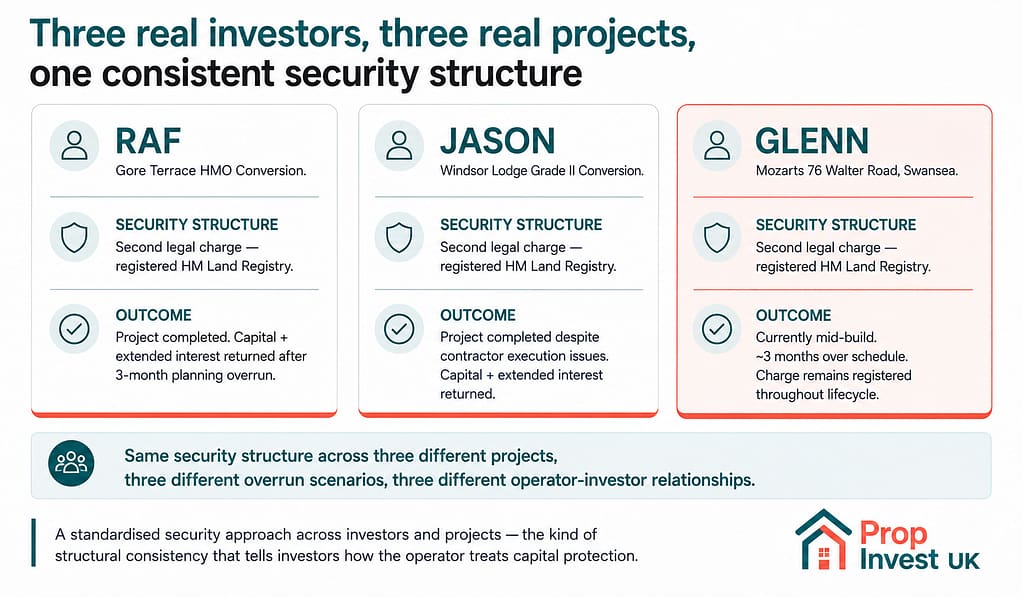
The framework above is general. Real structures applied to real projects make the picture concrete. Here’s what each of the three investors featured in our recent overrun article actually holds as security on their respective projects.
Raf — second legal charge on Gore Terrace
Raf participated in the Gore Terrace HMO conversion under a fixed-return loan structure. His capital position is secured by a second legal charge registered against the property at HM Land Registry, ranking behind the senior development finance facility on the project but ahead of any unsecured claims.
The registration was handled by Raf’s own solicitor, working alongside the SPV’s solicitor, with all documentation properly executed and registered before Raf’s capital was deployed. Raf can independently verify the second legal charge at any time through a standard Land Registry search.
The structural protection: if Gore Terrace had failed to repay (which it didn’t — the project completed and Raf received capital plus extended interest after the three-month planning overrun), the property would have been sold and the proceeds applied first to the senior lender and then to Raf, with the conservative margin against GDV providing meaningful buffer between the senior debt and the realisable property value.
Jason — second legal charge on the Windsor Lodge
Jason’s capital on the Windsor Lodge was secured by the same structure: a second legal charge registered against the property at HM Land Registry, behind the senior facility on that project.
What’s worth highlighting in Jason’s case is the relationship between the security structure and the project’s actual risk profile. The Windsor Lodge was a Grade II listed conversion with significant contractor execution issues — the kind of project where the operator’s competence becomes the largest single determinant of outcome. The second legal charge provided structural protection, but the actual reason Jason’s capital was returned with extended interest was that the operator held the project together through real friction.
This is the broader point worth absorbing: security structures matter, but they don’t replace operator quality. The strongest security on a poorly executed project still produces a worse outcome than weaker security on a well-executed project. Jason had both — strong security and a competent operator. The combination is what protects capital in practice.
Glenn — second legal charge on Mozarts
Glenn’s capital on Mozarts is secured under the same structure: a second legal charge registered against the property at HM Land Registry, behind the Signature senior development finance facility we covered in detail in our commercial-to-residential conversion article.
Mozarts is currently mid-build, with completion expected approximately three months past the original schedule. Glenn’s second legal charge remains registered against 76 Walter Road throughout the entire project lifecycle — from acquisition, through the build phase, through the expected sale or refinance of the completed units. The charge will be released only when Glenn’s loan is repaid in full.
The structural protection on Mozarts is particularly worth examining because of the project’s conservative LTGDV of 61.1%. The senior debt of £1.1m sits well below the projected GDV of £2.48m. Even on a stressed-case scenario where the property had to be enforced, the buffer between the senior debt and realisable property value would provide meaningful headroom before Glenn’s second-charge position was exposed.
What the consistent structure tells investors
Three different projects. Three different overrun scenarios. Three consistent security structures: second legal charge against the property, registered at HM Land Registry, solicitor-handled, independently verifiable.
This consistency is itself a signal. Operators who use varied security structures depending on what they can get away with on any given investor tend to behave differently in difficult situations than operators who apply the same structural discipline regardless of who’s investing. A standardised security approach across investors and projects suggests the operator treats capital protection as a process, not a negotiation.
What investors should evaluate about any security structure offered
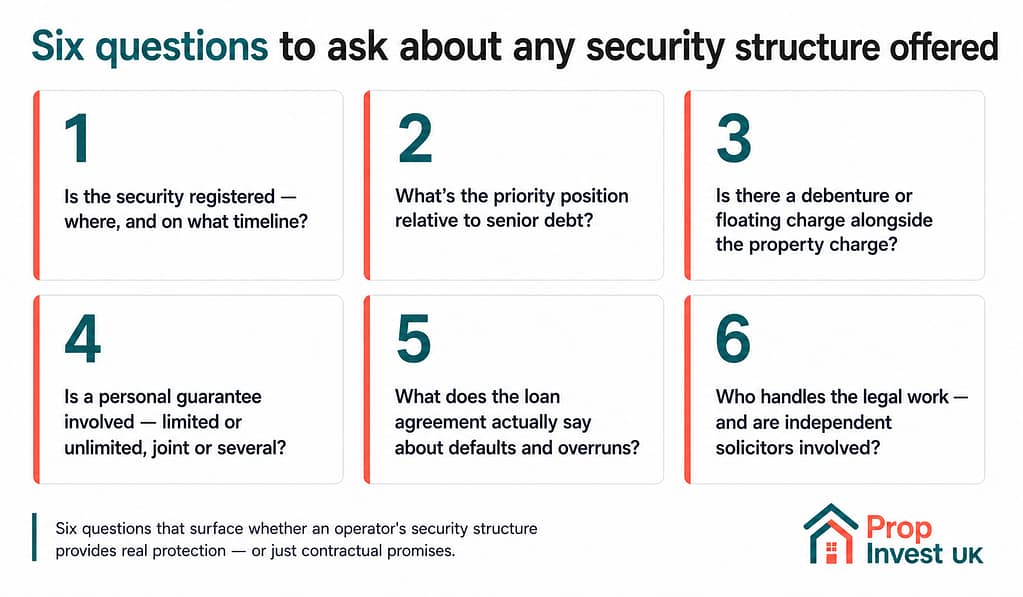
When an operator describes the security on offer for a specific project, six things matter most.
1. Is the security registered?
A legal charge that’s registered at HM Land Registry (for property) or Companies House (for company assets) provides legal priority. An unregistered “charge” or “security” doesn’t. Ask explicitly: will this be registered, where, and on what timeline.
For property-secured positions, the timeline matters. Charges should be registered as part of the completion process, not “soon after.” A charge that’s been promised but not yet registered isn’t security — it’s a promise.
2. What’s the priority position?
First, second, third, subsequent. Each ranks behind the one above in the payment waterfall. The senior lender almost always has the first charge in UK development. Realistically, what’s available to private investors is second charge or no charge at all — and that’s not a flaw of the structure, it’s just how UK development finance works.
A second charge with substantial margin buffer is meaningful protection. A second charge with no margin buffer isn’t. The structure matters, but the underlying project economics matter more.
3. Is there a debenture or floating charge alongside the property charge?
For projects involving SPVs with multiple assets — planning rights, contracts, deposits, future receivables — a debenture or floating charge over the SPV’s broader assets adds incremental protection beyond the property charge alone.
This is less common for individual private investors than for senior lenders, but worth understanding if it’s offered.
4. Is a personal guarantee involved?
Personal guarantees significantly strengthen investor protection because they extend the recourse beyond the company’s assets to the guarantor’s personal position. They’re also significantly more onerous on the operator, which is why not every operator offers them.
If a personal guarantee is offered, ask about scope: is it limited or unlimited, joint and several or several, time-bound or open-ended. The form matters as much as the existence.
If a personal guarantee isn’t offered, ask why. An operator’s reason for not offering personal guarantees may be entirely valid (existing personal guarantees to senior lenders, structural reasons, scale of capital being raised) — or it may signal that the operator isn’t willing to expose personal assets to the project they’re asking you to back. Both answers exist; both are worth understanding.
5. What does the loan agreement actually say?
The loan agreement is where the contractual terms live: rate, term, repayment, default provisions, what happens if the project overruns or underperforms, what rights the investor has to information, what the operator’s obligations are.
Read the loan agreement. If it’s not been provided, ask for it. Operators who can’t provide a clean, professional loan agreement haven’t set up the project at the level of discipline serious investor capital requires.
6. Who handles the legal work?
Solicitors on both sides is the standard. The investor’s solicitor (or a solicitor instructed independently) reviews documents and handles registration. The operator’s solicitor produces the documents and handles registration on the SPV side. Both communicate to ensure the structure is properly executed and registered.
Operators who push investors to use the operator’s own solicitor exclusively, or who suggest skipping independent legal review for speed, are reducing the investor’s protection. Independent legal review is friction worth accepting.
What security cannot do
Three things to be clear about — because some operators sell security as more than it is.
1. Security doesn’t make a bad project good. No security structure rescues a project that doesn’t stack economically. If the GDV is inflated, the margin is thin, the planning is unconsented, or the operator lacks the competence to deliver — no charge protects you from those failures. Security is structural; the underlying project economics matter more.
2. Security doesn’t eliminate the recovery process. If a project fails and security has to be enforced, the recovery process takes time. Property may need to be sold. Legal processes may need to be followed. Even with strong security, recovery is rarely fast — and is sometimes incomplete because the property’s realisable value is lower than expected at the time of enforcement.
3. Security doesn’t replace operator quality. The strongest legal documents in the world don’t compensate for an operator who can’t execute the project they took capital to deliver. Security reduces the consequences of certain failures; competent operation reduces the probability of failure occurring at all.
The right combination is both: strong security on a project where competent operation makes enforcement unlikely to be needed. That’s what serious private property development investing actually looks like.
How we approach investor security at Prop Invest UK
At Prop Invest UK, we structure investor capital positions with the following standard:
- Second legal charges registered at HM Land Registry against the project property, behind the senior development finance lender — applied consistently across investor positions on completed projects (Gore Terrace, the Windsor Lodge, Mozarts and others)
- Solicitor-handled registration on both sides — investor’s solicitor or operator’s solicitor handling registration depending on deal size and investor preference, with all documentation properly executed and registered before capital is deployed
- Personal guarantees offered on a deal-specific basis — not as a standard feature on every position, but available where the project structure and investor preference warrant
- Professional loan agreements governing every fixed-return position, with clear terms on rate, term, repayment, default provisions, communication, and investor rights
- Conservative project structure underlying the security — including conservative LTGDV (Mozarts at 61.1% is illustrative), strong margin against GDV (high-20s percent range on Mozarts), and explicit contingency budgeting
The combination of these features is what gives the second-charge structure meaningful protective value. A second legal charge on a project with conservative gearing and strong margin buffer is materially different from a second legal charge on a project that’s been stretched to the limit on every dimension.
The legal structure is part of the protection. The underlying project economics are the other part. Both matter; neither is sufficient alone.
In summary
Private investors in UK property development can receive several forms of security: legal charges (typically second charge behind the senior development finance lender), debentures over the SPV’s assets, personal guarantees from the operator, and contractual rights under a loan agreement.
Charge priority determines the payment waterfall if the project has to be enforced. Senior lenders typically hold the first charge in UK development. Private investors realistically receive second-charge positions — which are meaningfully protective when underpinned by conservative project economics, and not protective when underpinned by stretched gearing or thin margins.
Three Vernon Property Group investors — Raf at Gore Terrace, Jason at the Windsor Lodge, and Glenn at Mozarts — illustrate the consistent structure: second legal charge against the property, registered at HM Land Registry, solicitor-handled, independently verifiable.
The six questions worth asking any operator about security:
- Is the security registered, where, and on what timeline?
- What’s the priority position relative to senior debt?
- Is a debenture or floating charge involved alongside the property charge?
- Is a personal guarantee offered, and on what terms?
- What does the loan agreement actually say?
- Are independent solicitors involved on both sides?
A developer who can answer all six with specificity is operating at the level of discipline serious investor capital requires. One who can’t, isn’t.
Security structures matter — but they’re part of a broader picture. The strongest security on a poorly executed project produces a worse outcome than weaker security on a well-executed project. The right combination is both: structural protection that gives capital a real defended position, combined with operator competence that makes enforcement unlikely to be necessary.
If you want to evaluate specific Prop Invest UK opportunities — including the security structure that would apply to your capital position — you can join the investor list. We share specific opportunities with capital partners and provide full security and structural detail on a per-deal basis.
This article is general information only and is not financial or legal advice. Security structures and their effectiveness depend on the specific facts of each transaction. Investors should take independent legal advice on security arrangements before committing capital. Development carries risk; capital is at risk. Returns referenced are historical outcomes on specific projects and are not indicative of future performance.