
If you’re searching for property investment for passive income, the first useful thing to know is that the phrase is doing you a disservice.
There is no version of UK property income that is genuinely passive in the sense the word implies — effortless, automatic, requiring nothing of you. Every property generates work somewhere in the chain: sourcing, acquisition, refurbishment, compliance, lettings, maintenance, finance, reporting. The question is never whether that work exists. It’s who does it, how competently, and how clearly your capital is protected while they do it.
This article is an honest look at what “passive” property income actually means in 2026, why the genuinely hands-off models work differently from how they’re usually sold, and how to assess whether an arrangement marketed as passive income is structured to deliver it or just to describe it.
Why “passive income” is the wrong frame
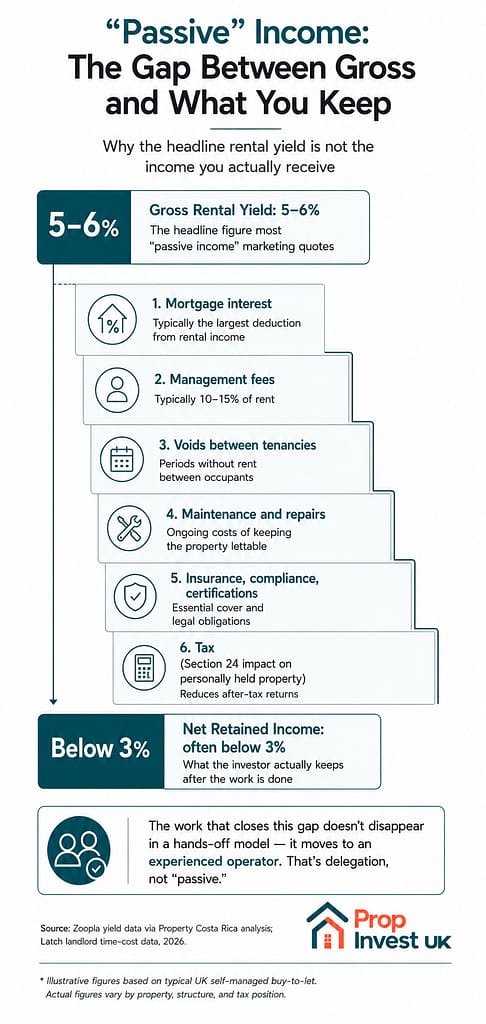
The property industry sells passive income heavily, and the evidence increasingly contradicts the pitch.
Independent UK analysis in 2026 is blunt about it. A self-managing landlord with a three-property portfolio spends 8–15 hours per month on it during normal periods, with spikes during tenant changeovers (📊 source: Latch, February 2026). Average UK rental yields sit at 5–6% gross, but after the realistic stack of costs — mortgage interest, management, voids, maintenance, compliance, tax — the actual retained income often falls below 3% (📊 source: Zoopla data via Property Costa Rica analysis, late 2025). And since the removal of Section 21 under the Renters’ Rights Act 2025, which came into force from May 2026, the administrative and regulatory load on direct landlords has increased further.
The industry’s own honest voices have stopped pretending. Credible UK commentary now routinely frames buy-to-let as “a business rather than a passive investment” (📊 source: Landlord Knowledge, March 2026) and states plainly that “being a landlord is not passive income” (📊 source: Latch, February 2026). The “buy a rental and collect the cheque” model was always more work than advertised. In 2026 it’s more work than ever.
So if the genuinely effortless version doesn’t exist, what are investors actually buying when they pursue hands-off property income? They’re buying delegation — moving the operational work to someone whose business is doing it well. That’s a real and valuable thing. It’s just not the same as “passive,” and the distinction matters because the arrangements that describe themselves as passive most aggressively are often the ones doing the least to earn the description.
What genuinely hands-off property income requires
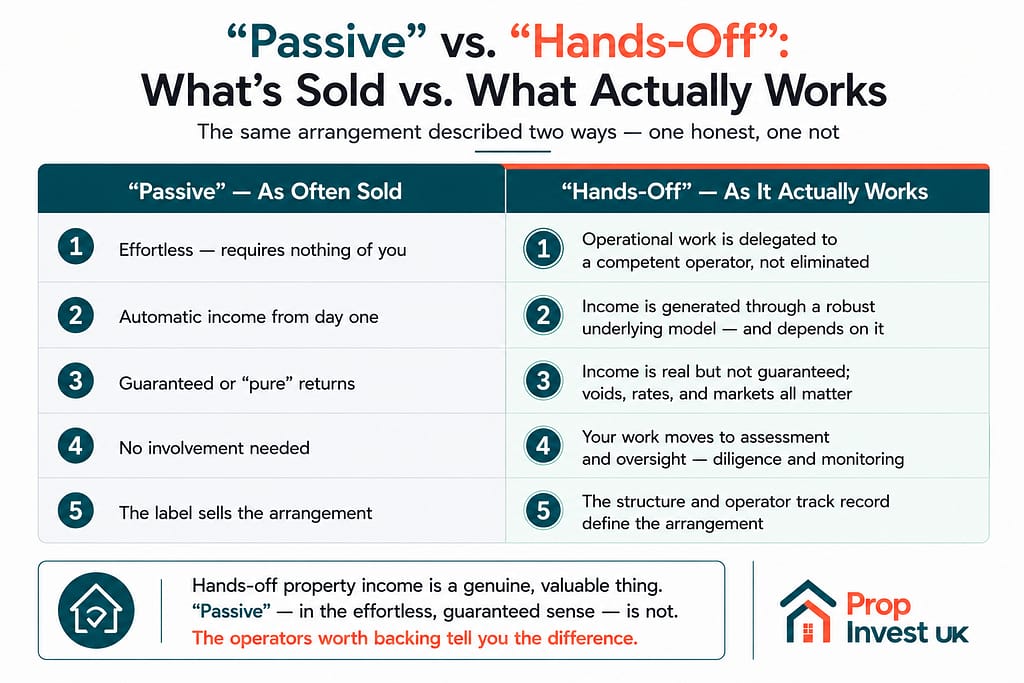
A genuinely low-involvement property income arrangement isn’t one where work disappears. It’s one where the work sits with an experienced operator, the investor’s exposure is clearly structured, and the income is generated from a model robust enough to sustain it. Three things have to be true.
The operational work is genuinely delegated to competent people. Not “you still own and manage the property but an agent helps.” Genuinely delegated means the sourcing, execution, management, and reporting sit with a specialist team whose business is built around doing it. The investor’s role shifts from operating property to selecting operators and maintaining oversight.
The income is generated from a robust underlying model. This is where most “passive income” propositions are weakest. An income stream is only as reliable as the business plan beneath it. A single rental asset bought at full market price, with thin margins and one tenant, produces fragile income. An operator-led model that creates value at acquisition, improves the asset, and produces income from a stronger base produces more resilient income. The robustness of the model determines whether the income survives a void, a rate movement, or a market softening.
The investor’s capital position is clearly protected. Hands-off without structural protection isn’t passive — it’s blind. Genuinely hands-off arrangements have documented structures, defined security or ownership positions, clear reporting, and transparent decision rights. The investor doesn’t do the work, but they can see exactly what their capital is doing and what protects it.
When all three are present, the experience is genuinely low-involvement. The word for that is “hands-off,” not “passive” — because the investor still does real work at the assessment and oversight stages, even if they do none of the operational work.
How income actually gets created in an operator-led model
The “passive income” framing skips the most important question: where does the income come from, and is it robust?
In an operator-led property model, income is created — not just collected — through a sequence of decisions the operator controls.
At acquisition. Buying below open-market value, or buying an asset with unrealised potential, creates a stronger income base than buying a finished asset at full price. The income on the same rent is higher because the entry cost is lower.
Through value creation. Converting underused commercial space to residential, increasing rental density through HMO conversion, or refurbishing tired stock to support higher rents — these operator-led mechanisms produce income that open-market purchase alone can’t. The income comes from the work, not just from owning the asset.
Through structuring the hold. A completed asset refinanced and retained for long-term rental produces ongoing income from a stronger valuation base than direct purchase would have allowed. The development phase creates the equity; the retained asset produces the income.
This matters for anyone seeking hands-off income because the quality of the underlying business plan determines the resilience of the income. A passive-sounding arrangement built on a fragile model produces fragile income. A robust operator-led model produces income that holds up when conditions shift. The label on the arrangement tells you nothing about which one you’re looking at — the underlying model tells you everything.
What to interrogate in any “passive income” property proposition
For any arrangement marketed as property investment for passive income, the questions that distinguish a robust model from a marketed one:
- Who actually does the operational work — sourcing, management, compliance, reporting — and what’s their track record specifically?
- How is the income generated? Is it open-market rental yield on a single asset, or is it produced through operator value creation? What makes it robust?
- What’s the realistic net income after all costs — not the gross headline figure?
- What protects your capital position — ownership, security, legal charge, documented structure?
- What reporting will you receive, how often, and in what format?
- What happens to the income if there’s a void, a rate rise, or a market softening? Does the model absorb it or does the investor?
- What’s the liquidity position — when is your capital committed until, and what’s the exit?
- What’s the operator’s track record on sustaining income through previous arrangements, including through difficult periods?
If an arrangement is marketed as passive but can’t answer these clearly, the “passive” label is doing marketing work, not describing structural reality.
The trade-offs an honest operator names
No genuine analysis of hands-off property income pretends the trade-offs don’t exist.
You’re trusting operator competence. When you delegate the operational work, operator quality becomes the dominant variable. Due diligence on the team matters at least as much as due diligence on the property. This is the central trade-off, and it’s why the questions above focus so heavily on track record.
Your capital is committed. Property is not liquid. Hands-off property arrangements typically commit capital for a defined period, and that’s often part of why they work — the operator can execute a plan without the investor needing to withdraw mid-cycle. Investors who may need rapid access to capital should recognise that property-backed structures are built for planned commitment, not impulse.
Income is not guaranteed. This needs to be said plainly, because it’s the precise point the “passive income” framing obscures. Property income can be affected by voids, rate movements, market shifts, and execution. A robust model and a competent operator manage those risks; they don’t eliminate them. Any arrangement presenting property income as guaranteed or risk-free should be treated with caution — that’s a marketing claim the asset class can’t support.
The honest position is that hands-off property income, properly structured, can be a strong, resilient, low-involvement route into property returns. It is not effortless, automatic, or guaranteed — and the operators worth backing are the ones who tell you that directly rather than selling the passive dream.
Who hands-off property income suits
A genuinely hands-off property income approach, properly assessed, suits investors who:
- Have meaningful capital and limited time, and value their time enough to delegate operational work
- Understand that low-involvement is not the same as no-involvement — the work moves to assessment and oversight
- Are comfortable trusting a properly diligenced operator with execution
- Want resilient income from a robust model, not a headline rate from a fragile one
- Accept the liquidity trade-off that comes with property-backed structures
It’s less suited to investors who want genuinely effortless income with no assessment work, who need rapid liquidity, or who are drawn to the highest “passive” headline figure without interrogating the model beneath it.
What good operator behaviour looks like
The operators worth backing for hands-off property income share consistent behaviours. They don’t promise passive or guaranteed income — they describe how income is generated and what could affect it. They lead with the robustness of the underlying model, not the headline figure. They quote realistic net income, not flattering gross. They have track record of sustaining income through previous arrangements, including difficult periods. And they build genuine reporting and oversight into the relationship, because they understand that a well-informed investor is a long-term investor.
At Prop Invest UK, we work with investors who want hands-off exposure to UK property development as capital partners. The model is development-led: we create value through the development process and, where the asset and market support it, retain completed projects for long-term income. We don’t sell passive income, because no honest operator can — what we offer is structured, operator-led exposure to UK property with the operational work handled by an experienced developer and the investor’s position clearly defined. Any specific opportunity is offered only to investors who qualify under the relevant exemptions and have received the full project documentation.
If you’re assessing property investment for passive income, the most useful shift you can make is to stop looking for “passive” and start looking for “robust and genuinely delegated.” The income that lasts comes from a strong model run by competent people — not from a label on a brochure.
—
About Prop Invest UK
Prop Invest UK is a property development business working with investors who want exposure to UK property development without taking on operational delivery themselves. Each opportunity is sourced, structured, and delivered by an experienced developer, with investors participating as capital partners on a deal-by-deal basis.
Join the investor list to receive details of future opportunities as they become available, subject to investor qualification and project documentation.
—
This article is for general information purposes only and does not constitute financial advice or an offer to invest. UK property investment involves risk, including the risk of capital loss, and income and returns are not guaranteed. Past performance is not a reliable indicator of future results. Property income can be affected by voids, interest rate movements, market conditions, and other factors. Any specific opportunity is offered only to investors who qualify under the relevant exemptions and who have received the full project documentation. If you are uncertain whether an investment is suitable for your circumstances, you should consult an FCA-authorised financial adviser.
—