
“Property secured investment” is one of the most used phrases in UK private capital, and one of the least examined. It tells the reader that capital is backed by property, which sounds reassuring. It says nothing about what kind of security, what kind of property, what ranking the investor holds, or what happens at the moment the security has to actually do its job.
This guide is written for serious investors who want to read the structure rather than the marketing. It defines what the term should mean when it’s used properly, breaks down the security mechanics that distinguish strong arrangements from weak ones, and sets out the questions that turn a glossy proposition into an interrogable one. It does not promote a specific opportunity. It teaches investors how to assess any property secured investment they are shown.
What “property secured” actually means
A property secured investment is capital that has been advanced into an arrangement where the investor’s position is protected by a legal interest in a specific property or pool of property assets. The legal interest is the security. Without it, the word “secured” is doing no work.
The most common form of security in UK property arrangements is a legal charge registered against a specific property at HM Land Registry. A legal charge gives the holder a defined right over the property — specifically, the right to be repaid from the proceeds if the property is sold, and the right to enforce sale through legal process if the underlying obligation isn’t met. It’s the same instrument a clearing bank uses on a residential mortgage, and it’s the bedrock of the UK secured lending market.
The structure has three meaningful features:
- The security is fixed — it attaches to a specific, identifiable property, not to the borrower’s general business assets.
- The security is registered — entered into the public Land Registry record so its existence and priority can be verified independently.
- The security is ranked — first charge holders are paid before second charge holders, who are paid before any unsecured creditors.
When an opportunity is described as “property secured,” the questions that follow are: secured by what, registered where, and at what ranking? The answers determine whether the security is meaningful or decorative.
First charge versus second charge — why ranking is the whole game
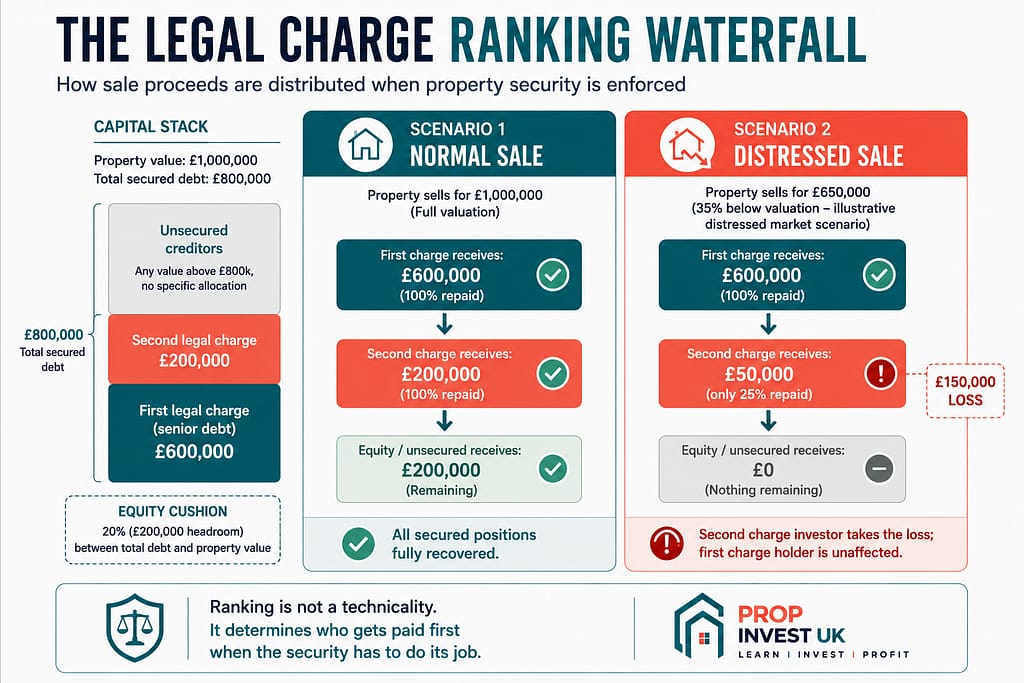
UK property security operates on priority. If a property has to be sold to repay debt, the proceeds are distributed in strict order: first charge holders are paid in full first, then second charge holders from anything remaining, then unsecured creditors from anything left after that.
A first legal charge with no senior debt above it is the strongest investor position available in this market. The investor stands first in line against the property’s value. A second legal charge sitting behind a senior bank loan is a materially different position — the bank gets paid in full before the second charge holder sees a penny. If the property has to be sold into a soft market, second charge investors can lose part or all of their capital while the first charge is fully satisfied.
This is why ranking matters more than the headline interest rate. A 12% return ranking second behind a senior lender with an 80% claim on the asset is structurally weaker than an 8% return holding a first charge with no senior debt above it. Two opportunities can describe themselves identically as “property secured investment” and offer materially different protection.
The other consideration alongside ranking is loan-to-value. If a property is worth £1,000,000 and the secured loan is £700,000, the LTV is 70% — leaving a 30% equity cushion before the investor’s principal is exposed if the market moves against the asset. Lower LTV ratios produce greater cushion and therefore lower risk; higher LTV ratios mean less buffer to absorb property price volatility. The combination of strong ranking plus low LTV is what genuine capital protection looks like in this market.
The categories of property secured investment in UK practice

Several distinct arrangements get described as “property secured investment.” They are not interchangeable.
Direct project lending with a first legal charge. The investor lends to a single-project SPV, secured by a first legal charge over the specific property being funded. This is the cleanest structure and the one with the strongest investor protections, because the security is tied directly to a known, valued asset with verifiable ranking.
Subordinated or second charge project lending. Same structure, but the investor holds a second charge sitting behind senior debt — usually a bank or specialist development lender. The interest rate is typically higher to compensate for the weaker ranking. Whether that compensation is adequate depends entirely on the combined LTV.
Corporate-level secured lending (debentures and asset-backed bonds). The investor lends to a property operating company, secured by fixed and floating charges across the company’s asset base — not to a specific property. Investor protection depends on the breadth and stability of that asset base and on the priority ranking against other creditors. Stronger when the company is large, established, and conservatively geared; weaker when assets are concentrated, leveraged, or shared across multiple loan note holders.
Equity-style participations with secondary security. Some development capital partnerships structure the investor’s primary economic position as a profit share, with a legal charge added as a security overlay. These can be well-structured, but the security is secondary to the equity exposure — the protection mechanism is real but should be assessed on its terms, not treated as the primary investment thesis.
Each of these is a property secured investment. Each carries materially different risk and protection characteristics. The category label tells you almost nothing on its own.
Why investor demand for genuinely secured arrangements is rising
The shift toward asset-backed structures isn’t accidental. UK investors with serious capital have been pulled away from traditional buy-to-let by a sustained tightening of the underlying economics — Section 24 tax treatment, multiple stamp duty increases, EPC regulation, and the operational load of the Renters’ Rights Act 2025 which came into force in May 2026. Around 93,000 landlords exited the UK rental market in 2025 (📊 source: Homenicom analysis via Mortgage Soup, March 2026). At the same time, traditional bank lending against property has tightened materially under Basel IV regulatory capital requirements, leaving experienced developers increasingly seeking private capital partners to fund schemes that would once have sat with clearing banks.
The combination produces a structural market shift: capable operators looking for capital, serious investors looking for asset-backed exposure that doesn’t replicate the operational drag of direct landlord ownership. Property secured investment, when properly structured, sits at the intersection of those two demands.
That structural shift also explains why the language is being used more loosely than it was a few years ago. As demand has risen, so has the volume of operators offering arrangements described as “secured” without the mechanics behind the language doing the actual work. The phrase has, in part, been commoditised. Investor discipline in reading the structure has to rise in proportion.
What good security mechanics look like in practice
Beyond ranking and LTV, several structural features distinguish well-constructed property secured arrangements from weaker ones.
The security is held by an independent trustee. In well-structured arrangements with multiple investors, the legal charge is held by a security trustee with a fiduciary duty to the investors collectively, not by the operator. This matters precisely at the point of distress — when the operator and investors’ interests are most likely to diverge, an independent trustee can enforce without conflict.
The security is properly drafted. A legal charge has to be drafted by specialist property solicitors, registered correctly at HM Land Registry, and supported by appropriate company resolutions and director undertakings. Sparse or generic documentation is itself a structural weakness — the security is only as strong as the paperwork that creates and registers it.
The structure includes step-in or LPA receiver provisions. Strong arrangements include the ability to appoint a Law of Property Act receiver to take control of the property and manage sale or refinance if the underlying obligation fails. This is the practical machinery that converts a registered charge into recovered capital.
The valuation supporting the LTV is independent and current. An LTV figure is only as reliable as the valuation it sits against. Independent professional valuations from RICS-registered surveyors, dated within reasonable proximity to the investment, are the baseline. Operator-prepared valuations or stale comparables are signals to investigate further.
The exit route for the security is realistic. The investor’s capital is repaid when the underlying obligation is repaid — typically through project completion and either sale or refinance. The exit assumption needs to be specific, stress-tested, and grounded in current market conditions rather than last year’s optimism.
When these features are present and the operator can explain each clearly, the security is doing real work. When any of them are vague, missing, or described in marketing language rather than legal terms, the structure deserves slower diligence.
The questions a serious investor interrogates
For any opportunity described as property secured investment, these are the questions whose answers determine whether the security is meaningful:
- What specific property is the security registered against, and where can the registration be verified?
- Is it a first or second legal charge? If second, what senior debt sits above it, and what’s the combined LTV?
- What’s the LTV against an independent professional valuation, and how recent is that valuation?
- Who holds the security — the operator, or an independent trustee?
- What documentation creates and registers the charge?
- What’s the exit route for the underlying obligation, and is it realistic in current market conditions?
- What’s the operator’s track record on previous secured arrangements — specifically, on returning capital to previous investors at the end of previous terms?
If any of these questions can’t be answered clearly with reference to documents rather than marketing, the structure isn’t ready for investor capital — regardless of how attractive the headline return appears.
How property secured investment sits alongside the other routes
For investors building a position across UK property, secured structures occupy a specific role.
Compared with direct buy-to-let ownership, secured investment offers asset-backed exposure without the operational load — no sourcing, no tenants, no compliance, no maintenance. The trade-off is that the investor gives up direct control of the asset and is reliant on the operator’s competence to deliver the underlying project.
Compared with equity participation in development projects, secured investment offers defined downside protection in exchange for capped upside. The equity investor in a project participates in unlimited upside if the project performs strongly; the secured investor’s return is capped at the agreed rate but their downside is protected by the security if the project underperforms.
Compared with public-market property exposure (REITs, property funds), secured investment offers direct asset-specific security and project-level transparency in exchange for illiquidity and operator-specific concentration. Different vehicles for different objectives.
The investors who do best in UK property typically hold a position across multiple structures over time, matching each allocation to a defined role in their wider strategy. Property secured investment, well-structured, is one of those routes — not the only one.
What good operator behaviour looks like across the category
The operators worth backing in this space share a small number of consistent behaviours.
They describe their security structure in plain legal language. They lead with the mechanics, not the headline rate. They use independent trustees and properly drafted documentation. They publish or share LTV figures and independent valuations rather than describing security in qualitative terms. They have track record of returning capital to previous investors on previous arrangements. And they treat investor communication as part of how the structure functions, not as an afterthought once capital is committed.
This isn’t about finding the highest return on offer. It’s about finding operators who treat investor protection as part of how the business is built, not as a marketing claim layered over a weaker structure.
At Prop Invest UK, we work with investors who want professionally managed exposure to UK property development as capital partners on specific projects. We’re not promoting a specific secured product on this page. Any opportunity we make available is offered only to investors who qualify under the relevant exemptions and have received the full project documentation. The purpose of this article is educational — to help investors assess any opportunity they’re shown under property secured investment language, from any operator.
—
About Prop Invest UK
Prop Invest UK is a property development business working with investors who want exposure to UK property development without taking on operational delivery themselves. Each opportunity is sourced, structured, and delivered by an experienced developer.
Join the investor list to receive details of future opportunities as they become available, subject to investor qualification and project documentation.
—
This article is for general information purposes only and does not constitute financial advice, an offer to invest, or a financial promotion of any specific investment opportunity. Property-backed investments involve risk, including the risk of capital loss, and returns are not guaranteed. Past performance is not a reliable indicator of future results. Any specific opportunity is offered only to investors who qualify under the relevant exemptions in the Financial Services and Markets Act 2000 (Financial Promotion) Order 2005 and who have received the full project documentation. If you are uncertain whether an investment is suitable for your circumstances, you should consult an FCA-authorised financial adviser.
—