
Most investors do not have a capital problem. They have a deployment problem. Cash sits in underperforming holdings, markets swing on sentiment, and direct buy-to-let ownership often turns into a second job. That is why real estate development investment opportunities keep attracting serious attention from investors who want property-backed exposure without taking on the day-to-day workload themselves.
The attraction is straightforward. Well-structured development deals can create value through planning gain, refurbishment, change of use, or new-build delivery, while a long-term hold strategy can convert that value into stable rental assets. Done properly, this is not speculation dressed up as strategy. It is a disciplined process of buying well, managing risk tightly, improving the asset, and controlling the exit or retention plan.
Why real estate development investment opportunities stand apart
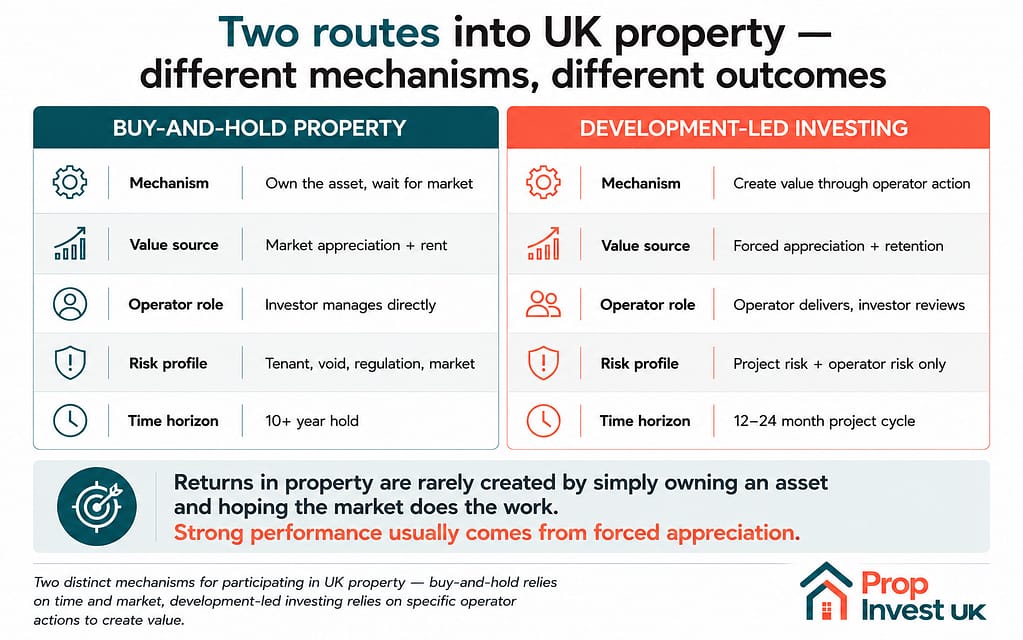
Not all property investment is equal. Buying a single rental flat on the open market is very different from backing a professionally managed development partnership with a defined business plan. One is often reactive and operationally heavy. The other, when structured correctly, is commercial, deliberate, and built around execution.
That distinction matters because returns in property are rarely created by simply owning an asset and hoping the market does the work. Strong performance usually comes from forced appreciation. That means improving the site, changing its use, repositioning the building, increasing its rental quality, or creating a more valuable end product than what was originally acquired.
This is where development-led investing earns its place. It targets value creation first, then long-term income second. For investors who care about capital preservation as much as upside, that sequence is far more compelling than chasing fashionable assets or relying purely on market growth.
What sophisticated investors are actually looking for
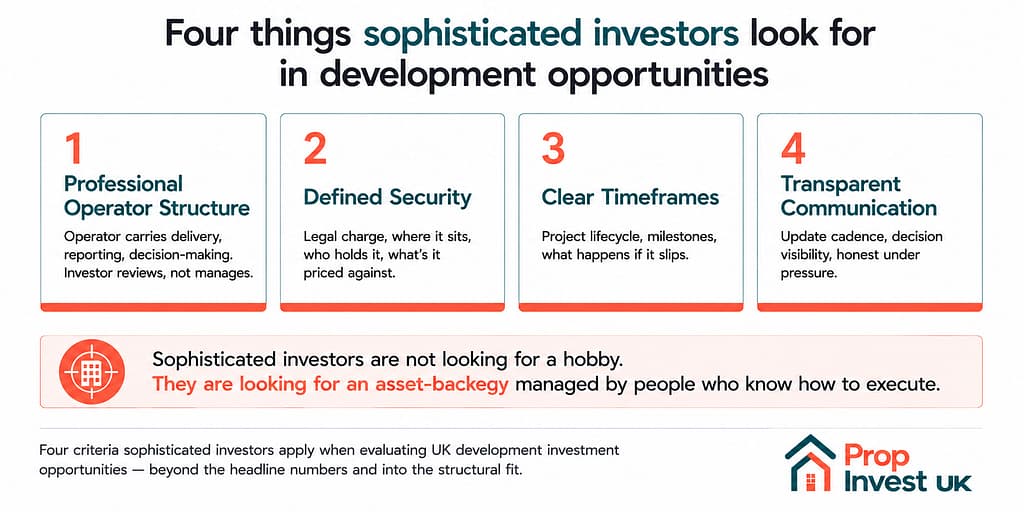
Experienced investors are usually not asking whether property works. They already know it can. The real question is what kind of structure gives them exposure without handing them unnecessary operational risk.
Most affluent investors do not want to source sites, manage contractors, negotiate planning issues, deal with voids, or answer tenant calls. They want professionally structured access to opportunities where the operator is responsible for sourcing, delivery, reporting, and decision-making. They also want clarity on security, timeframes, and how the deal works if conditions change.
That is why the best real estate development investment opportunities appeal to a different type of investor than the typical buy-to-let market. They suit people who value process, transparency, and operator competence. They are not looking for a hobby. They are looking for an asset-backed strategy managed by people who know how to execute.
The opportunities worth paying attention to
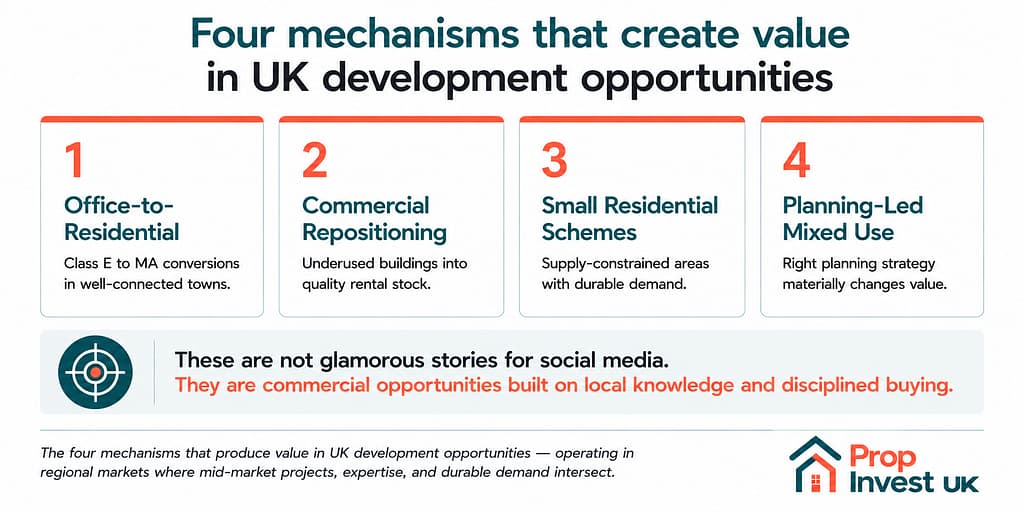
In the UK market, the strongest development opportunities are rarely the loudest. They are often mid-market projects in proven regional locations where demand is durable and the margin comes from expertise rather than headline risk.
That might include office-to-residential conversions in well-connected towns, underused commercial buildings repositioned into quality rental stock, small residential schemes in supply-constrained areas, or mixed-use assets where the right planning strategy materially changes value. These are not glamorous stories for social media. They are commercial opportunities built on local knowledge and disciplined buying.
Regional markets across the South West, South Wales, and the M4 corridor continue to attract attention for that reason. They offer a useful mix of housing demand, transport links, regeneration activity, and pricing that can still leave room for value creation. For investors, this matters more than broad national headlines. Property is local, and successful development is even more local.
Operator quality is the real investment decision
Investors often spend too much time examining the asset and not enough time examining the operator. In development, that is backwards.
A strong site in weak hands can become an expensive lesson. A capable operator, by contrast, can see risk early, negotiate firmly, structure the deal sensibly, and adapt when the project hits friction. Because it will hit friction. Planning delays happen. Build costs move. Timelines shift. The question is not whether there will be problems. The question is who is managing them.
That is why track record matters, but only if you understand what to look for. A credible operator should be able to explain how deals are sourced, how costs are controlled, how downside is considered from day one, and how investors are kept informed. Confidence is not enough. You want process behind it.
This is also where professionally structured property-backed partnerships stand out from vague equity-style arrangements that leave too much to trust. Serious investors want defined security, clear reporting, and a visible operating model. This is how property investment should work when capital is being treated properly.
Risk is not avoided – it is managed

Any honest conversation about development has to start there. There is no such thing as risk-free property investing. What matters is whether risk is understood, priced, and actively managed.
Planning risk, build risk, finance risk, market risk, and exit risk all sit inside development. Pretending otherwise is amateur hour. The more useful question is how each risk is reduced before capital goes into the deal.
That starts with buying discipline. If the site is acquired too aggressively, the project begins under pressure. It continues with conservative appraisals, proper due diligence, realistic build contingencies, and a structure that does not depend on perfect conditions to work. It also requires an operator who understands when to retain an asset for long-term income and when to exit because capital can be better deployed elsewhere.
Investors should be wary of any opportunity sold purely on optimism. Good operators do not just present the upside. They explain the control points. They show why the project makes sense, where the margin sits, and what protections exist if the market becomes less forgiving.
Development profit is only half the story
A lot of investors are drawn to development because of the potential to create value quickly. Fair enough. But the stronger long-term model often combines development with portfolio building.
That means using development activity to acquire or create better-quality rental assets rather than treating every project as a one-off trade. The result is a more durable wealth strategy. Development generates uplift through active execution. Buy-to-let ownership then turns selected assets into long-term income and balance sheet strength.
For investors who want legacy, not just movement, this hybrid approach has real appeal. It aligns short-term value creation with long-term asset retention. It also reduces reliance on a single exit event. In uncertain markets, optionality matters.
This is one reason development-led partnerships have become more attractive to busy professionals, business owners, and SSAS investors. They want property exposure that is commercially managed and capable of combining value-creation through development with long-term asset ownership, without the drag of self-management.
How to judge whether an opportunity is credible
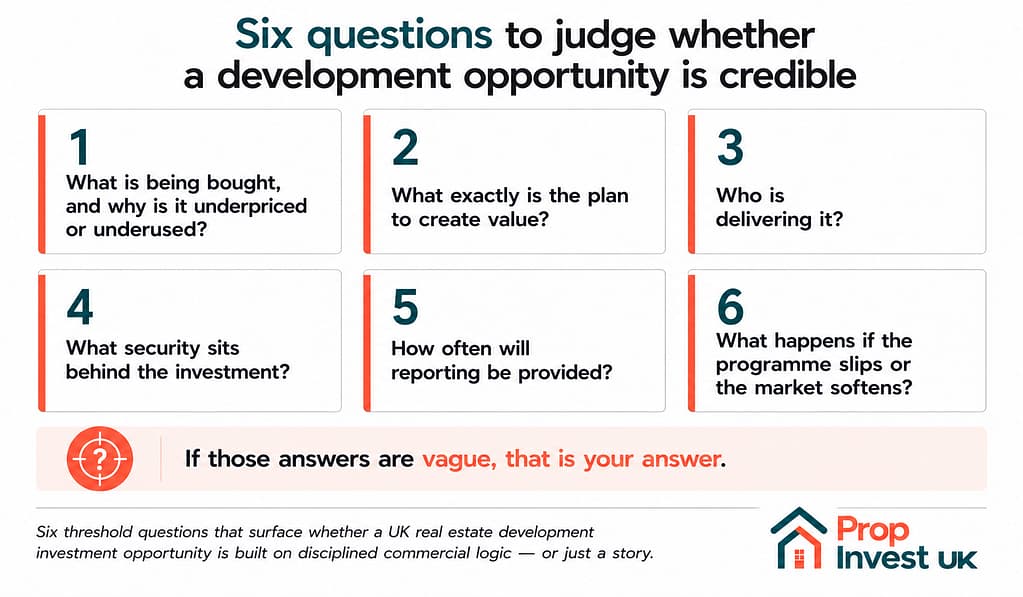
The right questions are usually simple. What is being bought, and why is it underpriced or underused? What exactly is the plan to create value? Who is delivering it? What security sits behind the investment? How often will reporting be provided? What happens if the programme slips or the market softens?
If those answers are vague, that is your answer.
Credible opportunities are normally built on plain facts rather than inflated promises. The numbers should make sense. The location should make sense. The structure should make sense. The operator should be able to show a repeatable method, not just a good story.
At Prop Invest UK, that is the lens we apply because experienced investors do not need theatre. They need disciplined deal selection, strong execution, and transparent communication from start to finish. Anything less is noise.
Who these opportunities suit – and who they do not
Real estate development investment opportunities suit investors who want property-backed exposure with professional oversight. They are well matched to people who value control, asset security, and a hands-off route into development and long-term portfolio growth.
They are less suited to anyone chasing instant liquidity, anyone uncomfortable with project timelines, or anyone who wants to control every operational decision themselves. Development is not passive in the sense of being effortless for the operator. It is operationally intensive. The point is that the investor does not have to carry that burden directly.
That distinction is important. The best partnerships remove unnecessary complexity for the investor while maintaining high standards of execution behind the scenes. That combination is where real value sits.
The market will always produce more noise than substance. There will always be investors buying headlines, chasing trends, or mistaking activity for strategy. The better route is quieter and more commercial: back property you can understand, in locations with real demand, through structures designed to protect capital and operators who know how to deliver. That is where serious property wealth is usually built.
If you’re seriously evaluating whether professionally managed real estate development investment opportunities fit your situation — and want to receive analysis of current UK development opportunities including project structure, security, and projected outcomes — you can join the Prop Invest UK investor list. We share specific opportunities with capital partners on the list as they come to market.
This article is general information only and is not financial advice. UK property development carries risk; capital is at risk. Real estate development investment opportunities are typically not regulated by the Financial Conduct Authority, and investors do not have access to the Financial Ombudsman Service (FOS) or the Financial Services Compensation Scheme (FSCS). Past project outcomes are not indicative of future performance. Specific development opportunities should be evaluated with appropriate professional advice.