
Refinance day is one of the most economically important days in a development project’s life and one of the least often discussed honestly. The valuer who walks through the building decides — within professional judgement and standards — what number the project gets to refinance against. That number drives the senior debt cap, determines whether equity gets paid out, and shapes whether the project delivers its full development margin or a compressed version of it. This article is an operator’s account of what happens on the day, what valuers actually look at, and what discipline at refinance stage means for capital partner outcomes. Understanding the importance of property development refinance valuation is crucial for all stakeholders involved.
Compliance note: This article describes the operator’s perspective on the development refinance process and is general information only. UK property development carries risk, including the risk of total loss of capital invested. Refinance outcomes depend on market conditions, valuer judgement, lender criteria and project-specific factors at the time. Past refinance outcomes are not indicative of future performance.
What refinance actually is, and why it matters
For most investors looking at a property development opportunity, the headline numbers are the acquisition cost, the build cost, the projected GDV, and the expected return. The bridge between those numbers is usually labelled “refinance” or “exit” and treated as if it’s an administrative step.
It isn’t. Refinance is the moment when the projected GDV stops being a projection and becomes an actual number on a valuation report. Everything in the project’s development phase has been built around that number. Senior development debt is sized against it. The investor capital structure depends on it. The development margin — the difference between total project cost and refinanced value — is what gets distributed to investors and equity participants after the senior debt is repaid.
A refinance valuation that comes in at projected GDV delivers the deal economics as designed. A refinance valuation that comes in below projected GDV compresses the margin, which falls on equity and investor returns. A refinance valuation that comes in above projected GDV gives the project some unexpected uplift, which is welcome but not what an operator should ever assume.
The valuer is the person who makes that decision.
This article is about what actually happens on the day the valuer walks the building.
What the valuer is doing
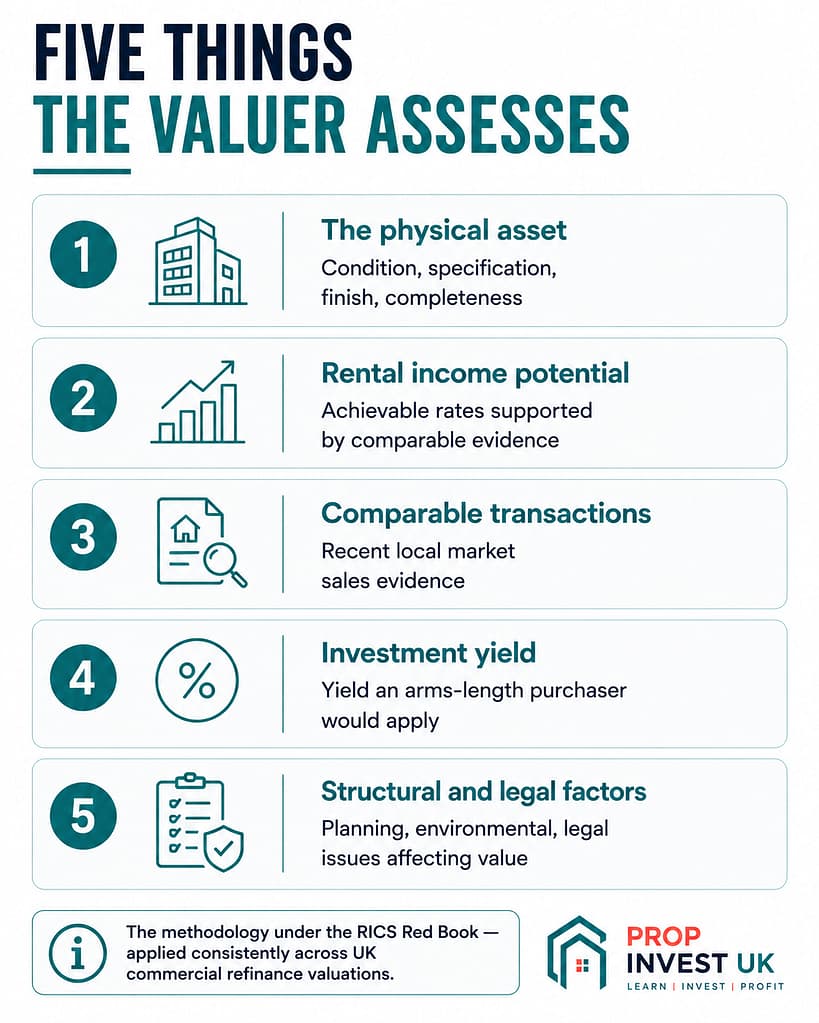
A development refinance valuation, in UK commercial finance terms, is typically a “market value” assessment under the RICS Valuation – Global Standards (the “Red Book”). The valuer’s job is to determine the market value of the completed building based on:
- The physical asset itself — its condition, specification, finish, completeness
- The income-generating potential of the asset based on rental evidence
- Comparable transaction evidence in the local market
- The investment yield that an arms-length purchaser would apply to that rental income
- Any structural, planning, legal or environmental factors that affect value
For a commercial-to-residential HMO conversion, the valuation methodology is usually an investment approach — applying a yield to the achievable rental income — cross-checked against comparable HMO transaction evidence in the same local market.
The valuer arrives at the building, conducts the inspection, returns to their office, drafts the report, and within a defined timeframe (usually a few working days to a couple of weeks) submits the valuation to the lender. The lender uses that valuation to determine the maximum loan facility they will offer, applying their loan-to-value criteria to the valuer’s number.
Everything depends on what the valuer puts in the report.
What they look at first — the obvious things
The valuer’s inspection covers the obvious physical attributes of the building. These are well understood and predictable:
- Floor area: Total internal floor area, measured against the building or the valuer’s tape, used as a sanity check on income and yield calculations
- Room count and configuration: Number of bedrooms, bathrooms, communal areas, kitchen specification
- Condition: General condition of the building, fixtures, fittings, finishes, services
- Compliance status: Building Regulations completion, planning consent compliance, fire safety, HMO licensing where applicable
- Lease and tenancy status: If the building is let, the lease structure and rent passing
- External condition: Roof, walls, windows, parking, landscaping
These are the things any operator expects the valuer to look at and any properly delivered project should pass without issue.
What’s less often discussed is how heavily the valuer weighs the non-obvious things — and that’s where operational discipline on the day matters most.
What they actually weigh — the less obvious things
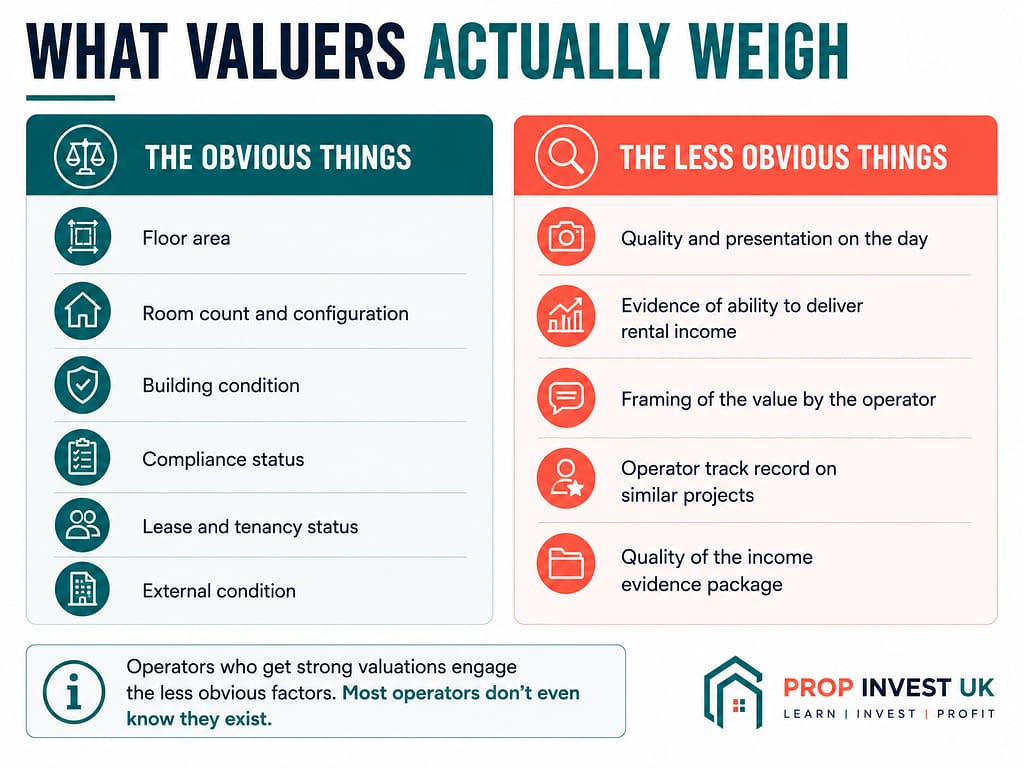
Three categories of less-discussed valuation drivers matter disproportionately for refinance outcomes on development projects.
Quality and presentation
The valuer is human. The valuation report is a professional document, not an emotional one, but the inspection that informs it happens in a real building with real lighting, real cleanliness, real smell, real finish quality.
A building presented for valuation that is clean, well-lit, snagged, properly finished and shows attention to detail will be valued at the upper end of the reasonable range. A building presented for valuation that has obvious finishing issues — paint splashes on skirting, sticky doors, lightbulbs missing, unfinished tiling, dust everywhere — will be valued at the lower end of the reasonable range.
This effect is more significant than it should be. In an idealised world the valuer would look past presentation to the underlying value. In practice, presentation contributes to the valuer’s confidence in the operator and the project, and that confidence translates into the comparable evidence they choose to apply, the yield they accept, and the assumptions they make about rental performance.
For an operator, the implication is clear: the building gets cleaned, snagged, fully finished and properly presented before the valuer arrives. Not for vanity. For valuation outcome.
Proof of ability to deliver the value
On commercial valuations — including HMO and commercial-to-residential conversions — the valuer doesn’t just need to see the building. They need to see evidence that the operator can deliver the income that justifies the value.
For an HMO, that means evidence of:
- Achievable rental rates supported by comparable properties in the same submarket
- Reasonable void assumptions supported by tenant demand evidence
- Operating cost assumptions consistent with the management approach
- Yield assumptions consistent with recent transaction evidence
For a development project being refinanced before letting, this evidence has to be constructed in advance and presented to the valuer. The operator’s track record on similar projects matters. Letting agent comparable evidence matters. The quality of the conversion specification (en-suite vs shared bathroom, double beds vs single, kitchen and communal space quality) matters because it positions the rental rate against the comparable set.
A valuer who is given thorough, well-presented evidence of achievable rental income will value the building against that evidence. A valuer who has to construct the income case themselves, with limited operator input, will tend to be conservative — because conservatism is the professional default when evidence is thin.
This is why operator preparation for valuation day is itself an investor protection. The work of assembling the rental evidence, the comparable transactions, the letting agent commentary, and presenting it to the valuer in a coherent package is the work that produces a robust valuation outcome.
The valuation framing
The third category is the most counterintuitive. Strong valuations don’t come from operators who over-egg the value. They come from operators who don’t over-egg the value — and instead give the valuer something reasonable to work with.
This sounds paradoxical. Why would an operator argue for a lower value when the valuation determines the senior debt cap and the project economics?
Because valuers see operator behaviour. If the operator presents an aggressive value as if it’s the obvious answer, the valuer’s professional instinct is to push back — to look harder at the assumptions, find reasons for the value to be lower, and ultimately produce a number that’s below where reasonable operator-led framing would have landed.
An operator who presents a reasonable, defensible value — one that’s clearly within the range supported by the comparable evidence — gives the valuer permission to land at that number without feeling pushed. The valuer signs the report. The number is delivered. The project economics work.
The discipline is to know what value is genuinely defensible and to present that number. Not the maximum possible. Not the minimum possible. The defensible number, with the evidence behind it.
This requires operator confidence in the project and the market — confidence that comes from having done multiple similar projects in the same region, knowing what they’re worth, and being prepared to demonstrate it rather than oversell it.
What this looked like on Windsor Lodge
These principles aren’t abstract. They came out of specific operator experience, including the refinance of Windsor Lodge — a Grade II listed conversion that wedelivered earlier in the operational history.
Windsor Lodge presented specific refinance challenges. Listed building status means the valuer has to address heritage considerations alongside the normal valuation drivers. The conversion plan had taken a working approach to the heritage requirements — which is itself a credibility signal — but the valuation methodology had to reconcile the listed status with the income-generating use.
The team’s preparation for the valuation involved:
- Full presentation of the building in finished, clean, properly snagged condition
- A comprehensive package of comparable evidence including rental comparables and listed building conversion comparables
- Documentation of the heritage compliance work including consents, statements and any conditions
- A clear, defensible target value that sat within the range supported by the evidence — not above it
The valuation outcome supported the refinance facility the project required. The senior debt cap was set against a valuation that reflected the project’s delivered value. Equity and investor positions were resolved according to the project economics as designed.
The general principles Windsor Lodge confirmed:
- Quality and presentation matter more than they should
- On commercial vals, the valuer needs proof of ability to deliver the value
- Strong valuation comes from not over-egging the value, giving the valuer something reasonable to work with
These are now our standing principles on every refinance.
What goes wrong on refinance day, and why
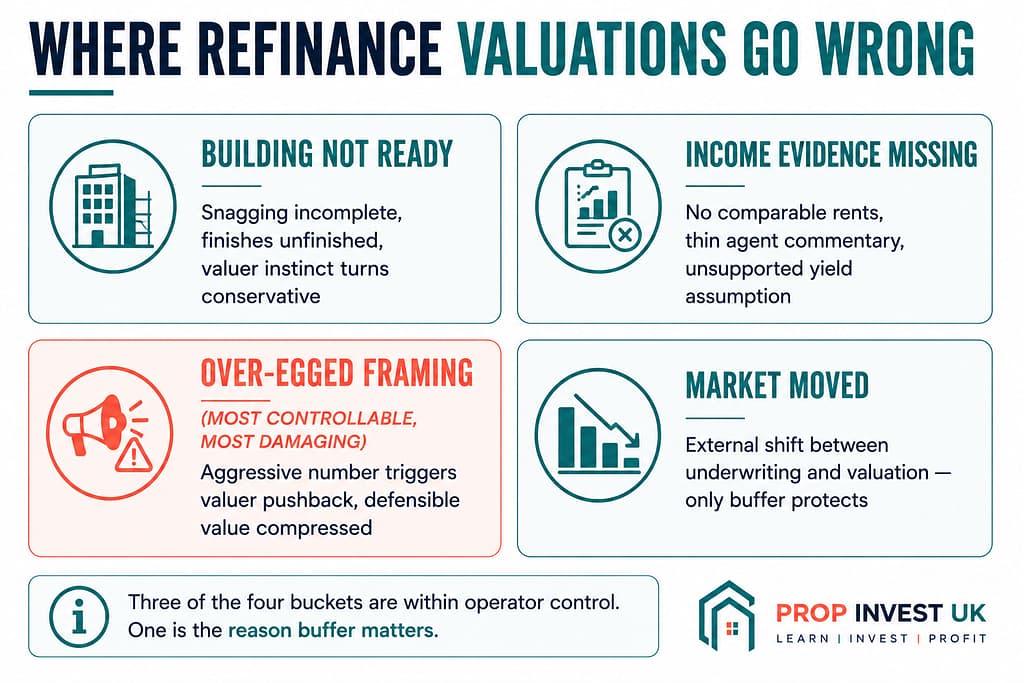
The cases where development projects produce disappointing refinance outcomes generally fall into one of four buckets.
Bucket one: the building isn’t ready for valuation. Snagging isn’t done. Finishes aren’t complete. The building looks like a building still being worked on, because it is. The valuer’s instinct in this case is conservative — they don’t know what the finished value will be because the building isn’t finished. They value what’s in front of them, not what the operator intends.
Solution: don’t book the valuation until the building is genuinely ready. Lost time on the build calendar is not lost time on the project economics — a delayed valuation that lands at the target value is worth more than a rushed valuation that lands below it.
Bucket two: the income evidence isn’t there. The operator hasn’t assembled the rental comparable evidence. The letting agent commentary is thin or generic. The yield assumption is unsupported. The valuer has nothing to anchor a strong income case to and falls back on conservative assumptions.
Solution: do the income evidence work in parallel with the build. By the time the valuation is booked, the operator should have a comprehensive package of comparable rents, agent confirmations, void evidence, and yield analysis ready to share with the valuer.
Bucket three: the operator over-egged the value and the valuer pushed back. Discussed above. The aggressive number framing triggered the valuer’s professional caution, and the resulting valuation came in below the defensible range.
Solution: present the defensible number, with the evidence, and let the valuer agree with it. Don’t argue for a number above the evidence.
Bucket four: market conditions moved. Sometimes the market has shifted between when the project was conceived and when the refinance is being delivered. Yields have widened. Comparable transactions have softened. The defensible value is genuinely lower than the projected GDV at the start of the project.
Solution: this is the one the operator can’t fully control. The mitigation is in the original deal economics — a project that was sized with a margin buffer can absorb some market movement at refinance without breaking the economics. Our on walk-away decisions (covered separately) is partly about ensuring that buffer exists for exactly this case.
What this means for the loan-to-GDV ratio
A lot of investor content talks about loan-to-GDV (LTGDV) as if it’s the central risk metric for a development project. It is one important metric, but the way it’s usually framed misses the refinance dynamic.
The headline LTGDV at project sizing is the ratio of total facility to projected GDV. The Mozarts project, for example, is sized at approximately 61% LTGDV against £2.48m projected GDV.
The LTGDV at refinance is the ratio of senior refinance debt to valuer-determined GDV. This is a different number, calculated against a different denominator, applied by a different lender (typically a term lender rather than a development lender) under different criteria.
A project that delivers its projected GDV at refinance produces a senior refinance LTV that matches the design. The capital stack resolves as planned. Investor returns are paid as designed.
A project that under-delivers at refinance produces a senior refinance LTV that’s still acceptable to the term lender (because the absolute loan amount has been scaled to the lower valuation) but a refinance facility that’s smaller in absolute terms. The shortfall versus the planned refinance facility falls on the equity and investor positions in the stack.
This is why valuation day matters disproportionately for investor capital protection. The investor sits in the part of the stack that absorbs valuation surprise. The operator’s discipline at valuation stage is therefore part of the investor’s risk control.
The six questions to ask any operator about their refinance discipline
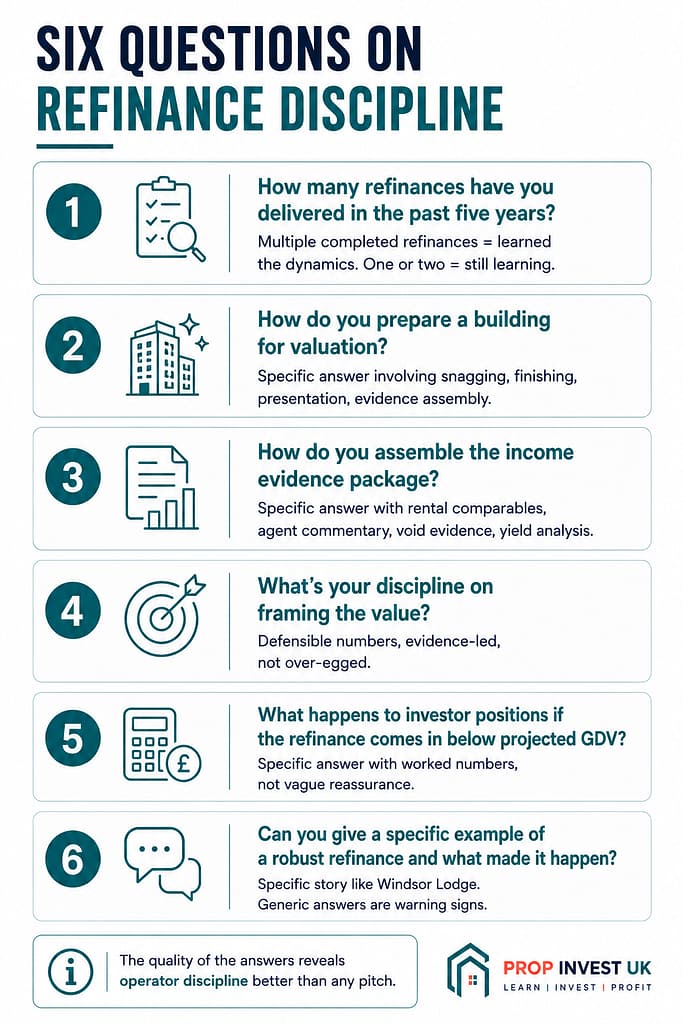
For investors evaluating a property development opportunity, here are six questions on refinance discipline worth asking before committing capital:
- How many refinances have you delivered in the past five years? Operators with multiple completed refinances have learned the dynamics described in this article. Operators with one or two completed refinances are still learning.
- Can you describe how you prepare a building for valuation? A specific answer involving snagging, finishing, presentation, and evidence assembly is what you want to hear. A vague “we make sure it looks good” answer is not.
- How do you assemble the income evidence package for valuers? A specific answer involving rental comparables, letting agent commentary, void evidence and yield analysis is what you want to hear. A “we leave it to the valuer” answer means the operator hasn’t done the work.
- What’s your discipline on framing the value to the valuer? A specific answer about defensible numbers, evidence-led framing and not over-egging is what you want to hear. An “we go in high and see what we get” answer means the operator is gambling with your capital.
- What happens to investor positions if the refinance valuation comes in below projected GDV? A specific answer with worked numbers shows the operator has thought about this scenario. A vague “it would affect the returns” answer means they haven’t.
- Can you give me a specific example of a project where the refinance valuation came in robustly, and what you did to make that happen? A specific story is what you want to hear — like the Windsor Lodge framing in this article. Generic answers are not.
How our Property Group approaches refinance day
Our approach to refinance is built around the principles that Windsor Lodge and subsequent projects have validated.
The building is presented properly. Snagged, cleaned, finished, lit. No exceptions. If the building isn’t ready, the valuation is delayed. Lost time on the calendar is less expensive than a soft valuation.
The income evidence is assembled in advance. Letting agent comparables, rental evidence, void analysis, yield support. The package is presented to the valuer as part of the inspection visit, not left for the valuer to construct from scratch.
The value framing is defensible. We present the number the evidence supports. Not above it. Not below it. The valuer is given permission to agree with a number that’s reasonable, rather than being pushed against a number that isn’t.
The project economics include a buffer. No project that we take to investors is sized so tightly that a soft refinance valuation would break the capital stack. The walk-away discipline at acquisition is partly about ensuring this buffer exists at every stage of the project.
These principles aren’t unique to us — they reflect what any operator should do at refinance stage. The discipline is in actually doing them consistently, on every project, including the projects where time pressure or budget pressure would tempt corners to be cut.
In summary
Refinance day is one of the most economically important days in a property development project’s life. The valuer’s number determines the senior debt cap, the equity outcome, and the realised return to investor capital.
The valuer looks at the obvious things — floor area, room count, condition, compliance — and is generally predictable on those. The valuer also weighs less obvious things: presentation quality, evidence of operator ability to deliver the rental income, and the framing the operator presents the value with. These less obvious factors are where operator discipline produces materially better refinance outcomes.
Our principles from Windsor Lodge and subsequent refinances are:
- Quality and presentation matter more than they should
- On commercial valuations, the valuer needs proof of ability to deliver the value
- Strong valuation comes from not over-egging the value, giving the valuer something reasonable to work with
For investors evaluating a property development opportunity, the operator’s refinance discipline is part of the protection of their capital. The visible deal economics rest on a refinance valuation that has to be delivered. The work of making that valuation robust starts well before the valuer arrives — in the build quality, the evidence assembly, and the framing — and continues on the day itself.
The valuer signs a report. The number on the report determines what gets paid to whom. The operator’s discipline at every stage is what gets the number where it needs to be.
Join the Prop Invest UK investor list for ongoing operational commentary, refinance and exit case studies, and details of capital partnership opportunities. Project-specific information is shared with introduced investors only — joining the list is the first step.
Join the investor list
This article is general information about the development refinance process and the operator’s discipline at valuation stage. It is not financial advice and is not a representation about the outcome of any specific refinance. UK property development carries risk, including the risk of total loss of capital invested. Refinance outcomes depend on the building’s condition at the time, market conditions, valuer judgement, lender criteria and project-specific factors. The Windsor Lodge refinance described is a historic example and is not indicative of future refinance outcomes on other projects. Past project outcomes are not indicative of future performance on current or future opportunities. UK property development capital partnership opportunities are typically not regulated by the Financial Conduct Authority, and investors do not have access to the Financial Ombudsman Service (FOS) or the Financial Services Compensation Scheme (FSCS). Prospective investors should take independent professional advice before committing capital to any property development opportunity.