
Our projects sit in six towns and cities across three connected regions: Swansea, Carmarthen, Frome, Trowbridge, Reading, and Ilminster. None of those is London. None of those is a brand-name regeneration city. That’s the point. This article explains the structural reasoning behind the geography — why these regions, why these markets, and why the data has been pointing here for several years before most national operators noticed.
Compliance note: This article is general market commentary, not financial advice. UK property development carries risk, including the risk of total loss of capital invested. Regional performance varies year to year, and historic regional outperformance is not a forward guarantee. Past project outcomes are not indicative of future performance.
The structural picture: regional UK is outperforming London, and has been for several years
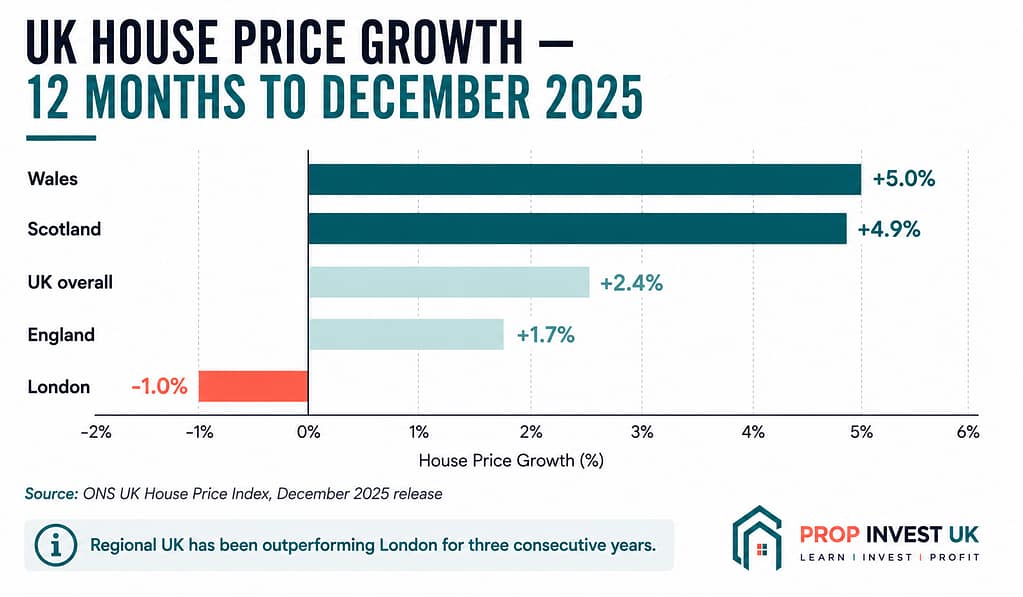
Start with the empirical reality. The conversation about UK property has been London-centric for so long that most investors haven’t updated their mental map. Here is what the data actually says about the year to early 2026.
ONS data for the 12 months to December 2025 shows UK house prices up 2.4% overall, with England up 1.7%, Wales up 5.0%, and Scotland up 4.9%. London — anchor of the national property conversation for thirty years — was at minus 1.0% over the same period.
Zoopla’s April 2026 House Price Index reinforces this: every UK city with house price growth above 3% year-on-year is in the North of England, Scotland, Wales or Northern Ireland. London and the South East both came in at minus 0.2%. Rightmove’s regional asking price data for May 2026 told the same story — the North East up 2.7%, North West up 2.6%, and the South West, South East and London all in negative territory.
Nationwide’s Q1 2026 regional HPI confirmed the trend at a quarterly level. The Outer South East was the weakest performing region. Wales, Scotland and the North continued to lead.
This isn’t a one-quarter blip. The pattern has been visible in regional HPI prints for three consecutive years. Savills’ five-year forecast through 2030 expects “the lower value markets of the Midlands and North of England and Wales, where affordability is less of an issue, to continue outperforming.” Zoopla’s 2026 growth forecast identifies Cardiff, Swansea, Newport and several Scottish cities as the strongest expected performers in Britain.
The thesis is no longer contrarian. It’s consensus among the major UK indices. What’s still contrarian is acting on it at operator level — buying buildings, securing planning, and converting in the specific regional markets where the numbers actually work.
That’s where we operate.
Our footprint: six towns, three connected regions
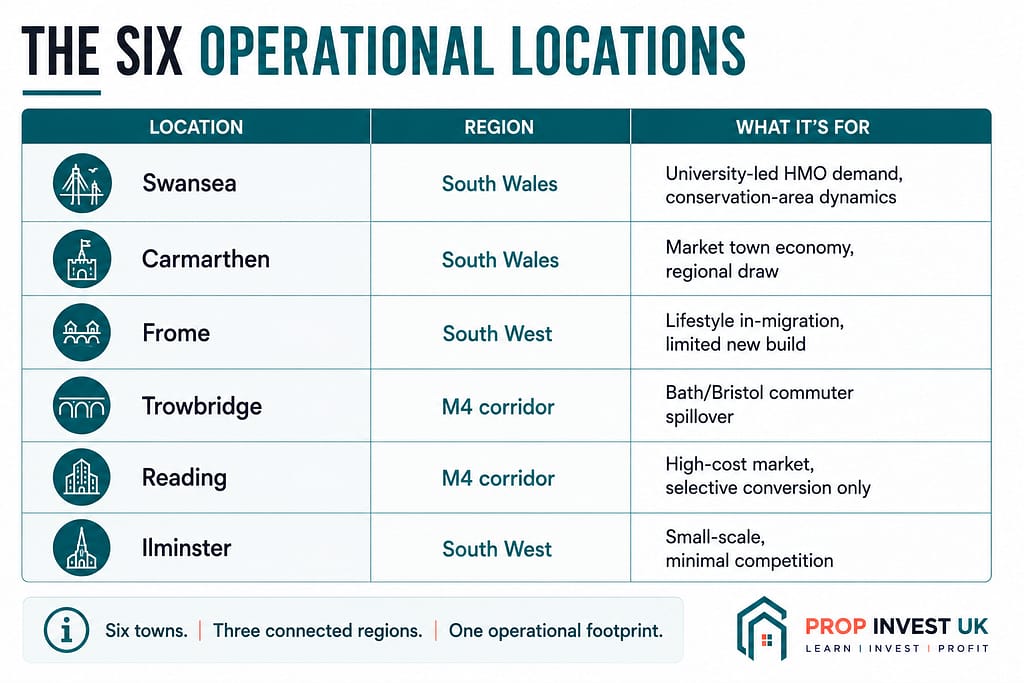
The six locations are not random. They form a coherent geography that an investor can trace on a map and a developer can service from a single operational base.
- Swansea (South Wales) — Our anchor city. Home to Mozarts and 12 Gore Terrace. University-led tenant demand, conservation-area dynamics (Swansea Uplands Article 4 Direction), and a price-to-rent ratio that still works for HMO development.
- Carmarthen (South Wales) — Market town economy, regional draw across South West Wales, working housing stock that supports conversion.
- Frome (South West) — Mendip district, Somerset. Population growth and lifestyle in-migration pressure with limited new build supply.
- Trowbridge (M4 corridor) — Wiltshire county town, twenty minutes from Bath and within commuter range of Bristol and Swindon.
- Reading (M4 corridor) — Largest commercial centre west of London. Tech, financial services and pharma employment base. Rental yields constrained by price, but planning environment and tenant covenant strength make selective conversion work.
- Ilminster (South West) — Somerset market town. Smaller-scale projects with strong local rental demand and limited supply.
These six markets are linked by motorways (M4, M5), rail lines (Great Western Main Line, South Wales Main Line) and a working operational cluster that lets a development team move between sites without the friction of running projects 300 miles apart in unrelated counties.
The regional logic isn’t “we’ll buy wherever we can find a deal.” It’s “we’ll operate where we have contractor relationships, planning relationships and a working knowledge of the local sourcing pipeline.”
That distinction matters enormously to investors. It’s the difference between an operator with a thesis and an operator with a spreadsheet.
Why not London
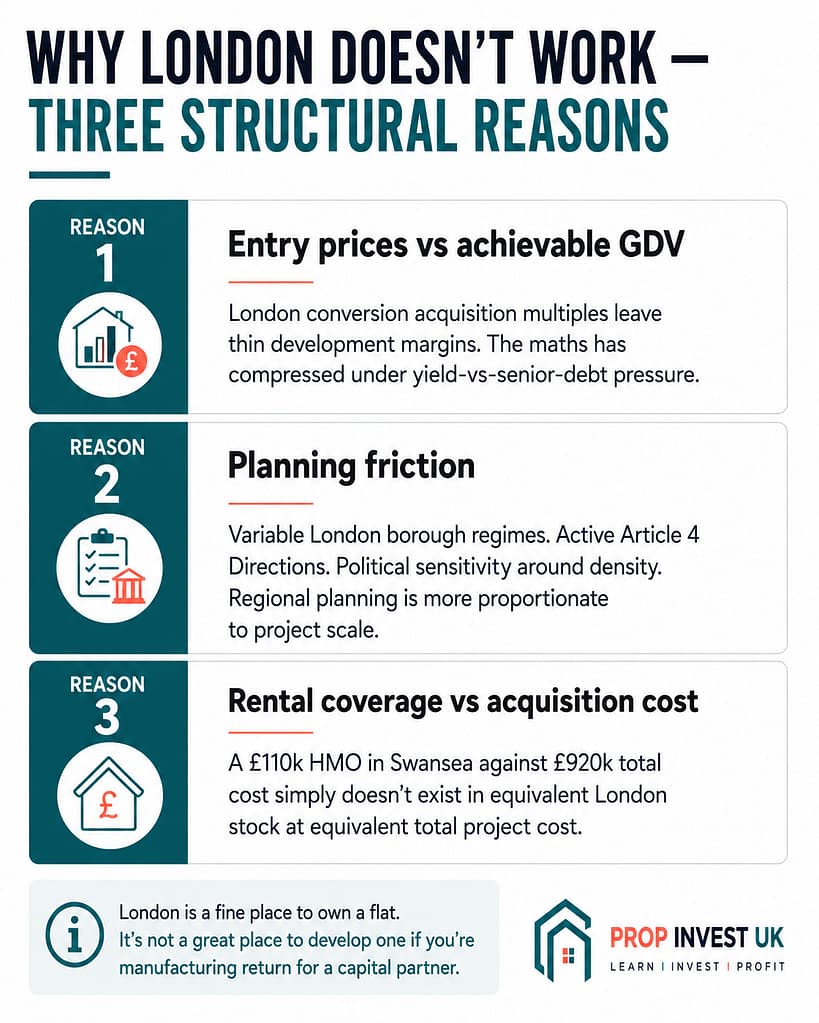
This question deserves a direct answer because it’s the one most investors silently ask first.
London property is not a bad asset. Prime central London still attracts overseas capital, the rental market remains structurally tight, and the long-term demographic underpinning is real. What London is, for a development operator in 2026, is a bad return-on-effort market for the type of work that we do.
Three reasons:
1. Entry prices have decoupled from achievable GDV in conversion work. A commercial-to-residential conversion in a Zone 2 or 3 London location now requires acquisition multiples that leave very thin development margins. The compression of yield against the cost of senior debt has squeezed the maths. Conversion economics work best where acquisition price is materially below comparable residential value per square metre. That gap is wider, more consistently, outside London.
2. Planning friction is higher and more politically charged. London boroughs have variable planning regimes, several have active Article 4 Directions covering broad areas (limiting permitted development rights), and political sensitivity around housing density is elevated. Regional planning authorities are not always more permissive — Swansea Uplands has its own Article 4 Direction, which we’ve covered in a separate piece. But the planning conversation in a regional market is generally more proportionate to the scale of what an operator is trying to do.
3. Rental coverage is weaker against acquisition cost. A 14-bed HMO in Swansea generating £110,000 annual gross rent against a ~£920,000 total project cost (the 12 Gore Terrace economics, in the case study) produces yield characteristics that simply do not exist in equivalent London stock at equivalent total project cost.
Our view: London is a fine place to own a flat. It is not, in 2026, a great place to develop one if you’re trying to manufacture return for a capital partner.
The South Wales case: Swansea and Carmarthen
Wales has been one of the strongest performing UK property regions on a 12-month and three-year view. ONS recorded Welsh house price inflation of 5.0% to December 2025 — more than double the UK average. Welsh private rent inflation hit 5.8% over a similar period, the highest growth among UK nations.
Underneath that headline, two things are happening in South Wales that matter for development operators.
Swansea’s tenant demand is structurally underbuilt. The city has Swansea University, the University of Wales Trinity Saint David, a teaching hospital, and an expanding employment base in financial services and technology around the Swansea Bay City Deal. Demand for high-quality HMO accommodation — particularly purpose-converted en-suite stock at a level above the legacy student house market — runs well ahead of supply.
The Mozarts development at 76 Walter Road is being delivered into exactly this gap: 26 en-suite rooms in a conservation-area location, a five-minute walk from the city centre and the seafront. Detail is in the Mozarts conversion article.
Article 4 controls in Swansea Uplands tighten the supply of new HMO stock. This is counterintuitive but important. The Article 4 Direction restricts the easy conversion of single-family houses into HMOs in the Uplands area, which sounds like a constraint on operators. In practice, it raises the barrier to entry — and protects the value of HMO stock that already has the right planning consents in place. We explained the dynamic in detail in the Article 4 piece.
Carmarthen offers a different version of the same regional thesis at smaller scale. Market town economy, county town status, a working tenant base across local employment and the rural professional sector. The deals are smaller. The acquisition prices are lower. The competitive pressure from national operators is essentially zero.
The M4 corridor case: Trowbridge and Reading
The M4 from London westward through Reading, Newbury, Swindon, Chippenham, Bath, Bristol and into South Wales is the busiest economic corridor in the UK outside the immediate London region. It hosts technology clusters around Reading and Bristol, financial services and life sciences employment across Swindon and Bath, and a deep professional services tenant base across every junction.
What makes the M4 corridor work for our model is not the Reading-Slough commuter narrative — that is a saturated, hyper-competitive market. It’s the stops along the corridor that haven’t been ploughed over by national developers.
Trowbridge is the Wiltshire county town. Twenty-minute drive to Bath. Direct rail to Bristol Temple Meads. The tenant base draws from professionals priced out of Bath and Bristol who want to be inside their employment catchment. Acquisition costs are a fraction of Bath. Conversion stock — older commercial and mixed-use buildings — is available at prices that produce sensible development maths.
Reading is a different proposition. It’s a major commercial centre with high acquisition costs and strong tenant covenant. Our involvement in Reading reflects a specific filter: projects only work where the building has structural conversion advantages (existing layout, height, services routing) that drop the build cost meaningfully below comparable Reading new-build land. Most Reading conversion opportunities don’t pass the filter. The ones that do are unusually attractive precisely because so few operators are willing to do the diligence work to find them.
The South West case: Frome and Ilminster
The South West has been hit harder than the North on house price growth in the most recent prints — ONS data showed parts of the wider South West softening. But underneath the regional aggregate, specific Somerset and Wiltshire markets continue to run strongly on tenant demand fundamentals.
Frome in the Mendip district has experienced sustained lifestyle in-migration from London, Bristol and Bath over the past five years. The town has a working creative and professional employment base, limited new build supply, and a working housing stock — Victorian commercial buildings, former pubs, redundant retail units — that responds well to conversion.
Ilminster sits further west in Somerset. It’s a market town with strong local tenant demand and historically negligible operator competition. Our involvement reflects the model thesis at its cleanest: small-scale, well-sourced, in a market where national developers don’t operate at all.
The South West story isn’t “growth at any price.” It’s “specific towns with specific demand dynamics where the building stock supports conversion and the tenant base supports rental income.”
What ties the three regions together
The headline answer is connectivity. Six locations, three regions, one operational footprint that an experienced development team can service from a single base. The M4 runs from Reading through Wiltshire (Trowbridge), across the Severn into South Wales (Swansea and Carmarthen). The M5 connects Somerset (Frome, Ilminster) to the same corridor. The Great Western Main Line and South Wales Main Line provide rail backbone.
This isn’t a coincidence. It’s an operational filter. we don’t take projects in markets where the team can’t be on site within four hours, where the contractor network doesn’t extend, where the planning relationships haven’t been built over years. That filter sounds like a constraint. In practice, it’s a moat.
A national operator can theoretically work anywhere. In practice, the projects that go wrong are the projects in markets where the operator didn’t have a working contractor base, didn’t know the local planning officer, and was relying on intermediaries to source deals.
Our geography is six towns across three connected regions. That’s not small thinking. It’s the right size for the model.
The operator-level moat that doesn’t show up on a spreadsheet
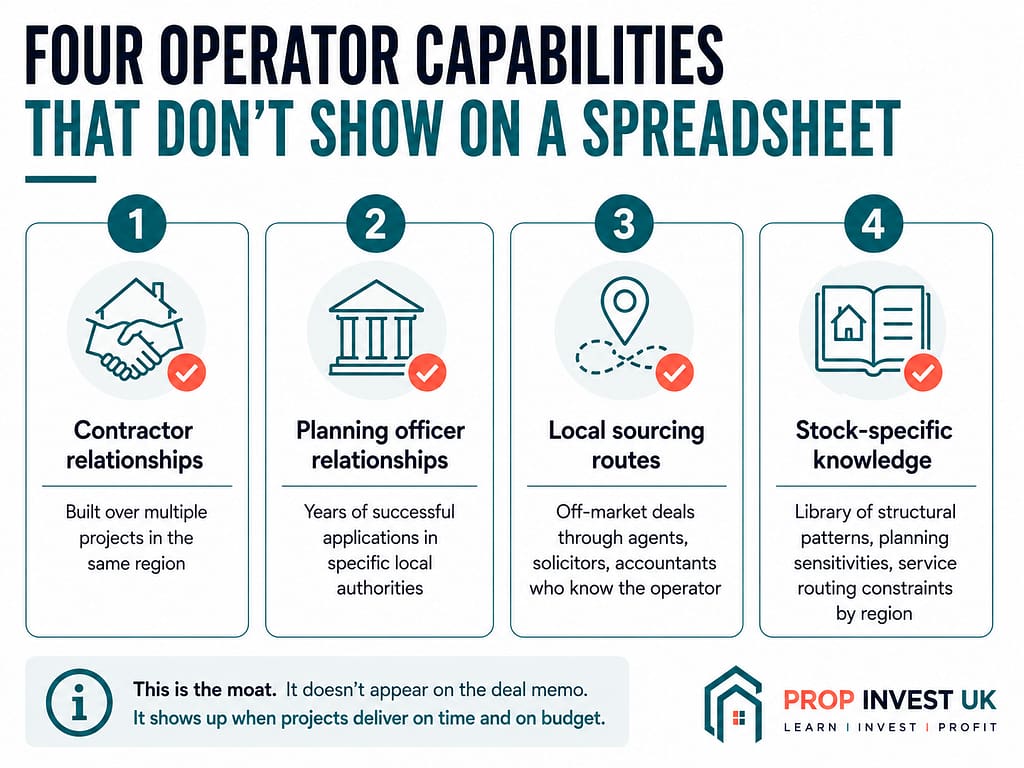
This is the section that matters most to a serious capital partner and is the one most investor-facing content gets wrong.
The numbers on a development project — acquisition cost, build cost, projected GDV, expected return — are visible to anyone with a calculator. What sits underneath those numbers, and determines whether they’re achievable, is the operator-level capacity that no spreadsheet captures.
In our geography, that capacity includes:
Contractor relationships built over multiple projects in the same region. When the Mozarts roof had to come down and be raised, the contractor doing the work had been on our projects before. There was no learning curve. No on-the-fly negotiation. The job got done at the agreed price.
Planning officer relationships in specific local authorities. A developer who has taken three projects through Swansea Council’s planning process has earned a different conversation than a developer arriving with one application and no track record. That doesn’t mean preferential treatment. It means a planning officer who has seen the operator deliver, who answers questions promptly, and who knows the operator won’t waste their time with applications that aren’t ready.
Local sourcing routes. Most deals in regional markets never go to open market. They come through agents, solicitors, accountants and local introducers who have worked with the same operator for years. Our deal pipeline in Swansea is sourced through routes that don’t exist for an out-of-area operator, no matter how well-capitalised.
Knowledge of stock-specific issues. Period buildings in Swansea have known structural patterns. Mendip district commercial conversions have known planning sensitivities. Wiltshire county town stock has known service routing constraints. An operator working the same regions for years builds up a library of knowledge that a national operator working a new market every project simply cannot reproduce.
This is the moat. It’s not visible on the deal memo. It shows up in the difference between projects that get delivered on time and on budget, and projects that don’t.
The walk-away discipline that goes with regional focus
Operating in a defined geography is not enough by itself. The geographic discipline has to be matched by deal-level discipline — and that means saying no to projects that look attractive but don’t quite work.
We walked away from two deals in 2024 and 2025 that illustrate the point. One was a new build in Taunton where the team had done full due diligence, checked the foundations against building control records, and concluded that the numbers couldn’t quite work. The other was a conversion in Warminster — the right type of building, the right location, the right price — where structural inspection revealed conversion was impossible.
A full piece on the two walk-aways is here.
The discipline matters in the context of the regional thesis because it’s what protects the model from drift. An operator with a defined geography can be tempted into deals that don’t quite fit the criteria because “we’re already in the region.” That’s how operators lose money for capital partners. The walk-away discipline is what keeps the geography from becoming a trap.
The investor reality: why this matters at the capital partner level
Most investors evaluating a property development opportunity look at the deal on its own terms. The numbers on Mozarts. The numbers on Gore Terrace. The expected return on a fixed-return loan or the equity participation structure.
That’s necessary diligence but it’s not sufficient. The deeper question is whether the operator’s geographic and operational footprint is what the deal economics implicitly assume.
A Mozarts-style HMO conversion in Swansea, on our numbers, assumes a contractor base that can deliver the work in the budgeted time, a planning environment that the operator understands, and a regional rental market that supports the projected GDV. All three of those assumptions sit on the operator’s regional footprint.
A capital partner who understands this looks at the deal and the geography together. The deal is the surface. The geography is the foundation.
When the foundation is six towns across three connected regions, with an operator who has done multiple projects in each, the deal economics rest on something solid. When the foundation is “we’ll do this deal in a market we’ve never operated in before,” the deal economics rest on a series of optimistic assumptions.
The five questions to ask any operator about regional footprint
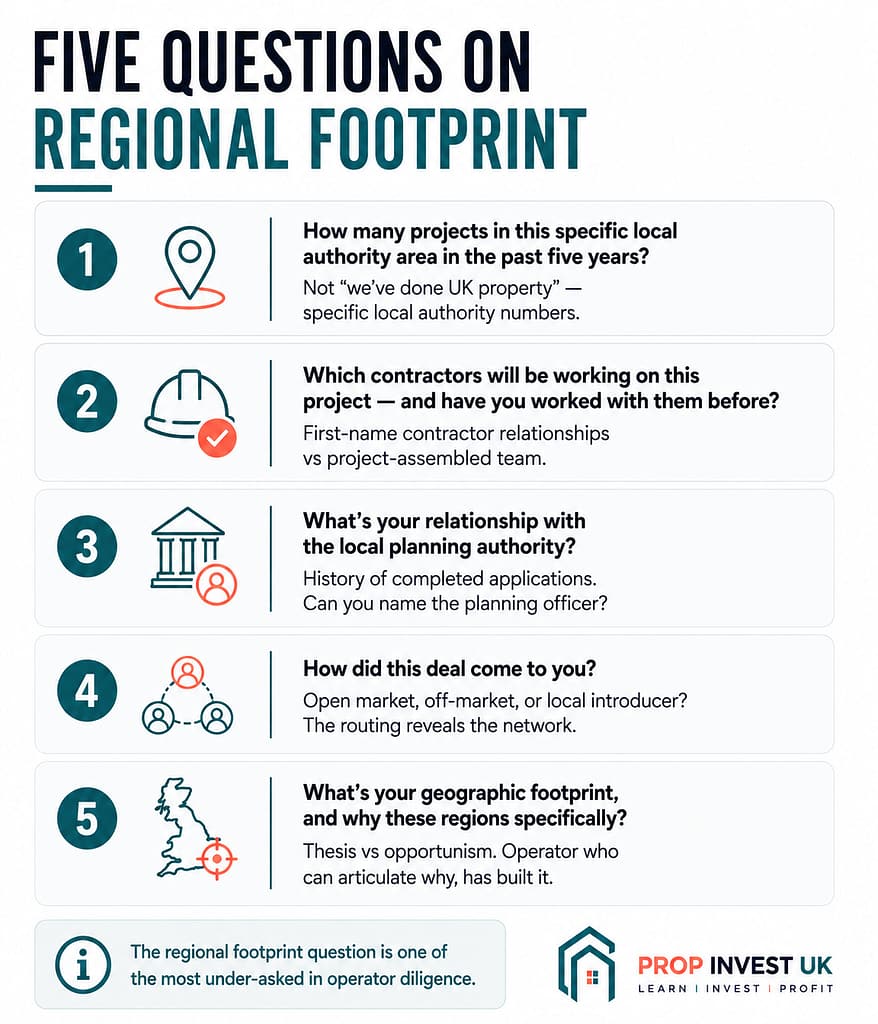
For investors evaluating development opportunities, the regional footprint of the operator is one of the most under-asked diligence areas. Here are the five questions worth asking before committing capital to any project:
- How many projects have you delivered in this specific local authority area in the past five years? “We’ve done property development in the UK” is not an answer. “We’ve completed three projects in Swansea, two in Carmarthen, one in Trowbridge” is.
- Which contractors will be working on this project, and have you worked with them before? A contractor base that the operator knows on a first-name basis is structurally different from a contractor base assembled for this specific project.
- What’s your relationship with the local planning authority? A history of completed projects in the same authority is the strongest evidence. An operator who can’t name the planning officer or describe their previous applications is operating in a market they don’t actually know.
- How did this deal come to you? Open market deals are not necessarily worse than off-market deals — but the routing tells you something about whether the operator has the local sourcing network that justifies their margin on the project.
- What’s your geographic operational footprint, and why? An operator who can articulate why they operate in specific regions, and why not in others, has a thesis. An operator who can’t is taking opportunistic deals and hoping the geography works out.
How we approach the regional thesis
Our geography is the result of a sequence of operational decisions over years, not a positioning exercise.
The South Wales footprint was built around Swansea over multiple projects. Gore Terrace, Mozarts, and additional projects in the pipeline reflect a working knowledge of Swansea’s tenant base, planning environment, contractor market and sourcing routes that took years to build.
The M4 corridor and South West projects extend the footprint along connected motorway and rail routes, allowing the operational team to service multiple sites without losing the focus that comes from working in a defined geography.
The team is clear-eyed about the trade-off. Operating across six markets means turning down deals in other regions that might look attractive on paper. That’s the cost. The benefit is that every deal that we do is in a market where the team’s accumulated knowledge — contractors, planners, sourcing, stock-level patterns — is contributing to the project economics.
Capital partners who participate in our opportunities are participating in projects where the regional footprint is part of the protection. Not the only protection — security structures, due diligence, deal-level economics all matter — but a meaningful part of why projects deliver on their numbers.
In summary
Regional UK has been outperforming London on house price growth and rental inflation for three consecutive years, with Wales and Scotland leading the most recent prints, and the consensus forecast from the major UK indices is for that pattern to continue through 2026 and beyond. That is the empirical foundation of the regional thesis.
We operate in six locations across South Wales, the M4 corridor and the South West: Swansea, Carmarthen, Frome, Trowbridge, Reading, Ilminster. The geography is a deliberate operational footprint, not a marketing claim. Each market has a specific case — tenant demand structure, planning environment, building stock, sourcing routes — that the team has built up over years of working there.
The structural argument is not that regional UK is a higher-return market in some abstract sense. It is that regional UK is where the maths of conversion development still works, where the operator-level moat that doesn’t show up on a spreadsheet is most valuable, and where a development team with the right geographic discipline can build a deal pipeline that justifies an investor’s capital partnership.
The geography is the foundation. The deals are the surface. When both are working, the model delivers. When either one is missing, no operator should be inviting capital partners into the project.
For investors evaluating UK property development opportunities in 2026, the question isn’t whether regional UK is interesting. The data has settled that question. The question is whether the operator’s footprint is genuinely built into the deal economics — or whether the geography is a story being told over a project that doesn’t actually rest on it.
Join the Prop Invest UK investor list for ongoing market commentary, structural analysis of UK property development, and details of capital partnership opportunities as they arise. The list is the route into specific project information — opportunity-level detail is shared with introduced investors only.
This article is general information only and is not financial advice. UK property development carries risk, including the risk of total loss of capital invested. Regional house price performance varies year to year and historic regional outperformance is not a guarantee of future performance. Past project outcomes referenced in this article are not indicative of future performance on current or future opportunities. UK property development capital partnership opportunities are typically not regulated by the Financial Conduct Authority, and investors do not have access to the Financial Ombudsman Service (FOS) or the Financial Services Compensation Scheme (FSCS). Prospective investors should take independent professional advice before committing capital to any property development opportunity.
Sources for market data referenced in this article include the Office for National Statistics UK House Price Index (December 2025 release), Zoopla House Price Index April 2026, Nationwide Q1 2026 Regional House Price Index, Rightmove May 2026 House Price Index, and Savills 2026 UK Housing Market Outlook.