
A Self-Invested Personal Pension is one of the most flexible pension structures available to UK investors who want direct control over how their pension capital is deployed. Where standard workplace pensions offer a pre-set fund menu, a SIPP lets the member direct the investments — within strict HMRC rules.
For UK property investors specifically, the SIPP framework allows direct ownership of UK commercial property within the pension wrapper, with rental income and capital growth accruing free of income tax and capital gains tax. By 2022/23 the UK had more than 1.4 million SIPP subscriptions, and commercial property remains one of the most commonly held alternative assets within SIPP wrappers.
This guide explains what a SIPP is, what property a SIPP can and cannot hold, how SIPP commercial property purchase actually works in practice, how a SIPP can participate in UK property development indirectly, and the regulatory framework every SIPP holder needs to understand before committing pension capital to any property structure.
Important note before reading
This article is for general educational purposes only. It is not financial, tax, or pensions advice. SIPP pension arrangements are subject to specific HMRC rules and tax consequences, and any decision about how to use a SIPP — including whether to set one up, what to invest in, or how to structure a property arrangement — should be made with regulated pensions advice from an appropriately qualified professional.
Prop Invest UK is a property development operator, not a pensions adviser or regulated financial intermediary. Returns referenced in case study material reflect outcomes on specific completed projects and are not indicative of future performance. Development carries risk; capital is at risk.
What a SIPP is
A Self-Invested Personal Pension (SIPP) is a UK pension structure that gives the member direct control over where the scheme’s assets are invested, subject to HMRC’s investment rules and the SIPP provider’s permitted asset list.
It sits within the same broad legal framework as every other UK registered pension scheme — same tax treatment of contributions, same tax-free growth, same access from age 55 (rising to 57 in 2028). What distinguishes a SIPP from a standard personal pension is the breadth of investment options: alongside listed equities, funds, and bonds, a SIPP can hold UK commercial property, commercial land, and a range of other alternative assets.
For UK property investors who want their pension capital to participate in property activity, the SIPP is one of the two primary structures available. The other is a Small Self-Administered Scheme (SSAS), which we covered in detail in our SSAS pensions and property article. The structures share most of the same HMRC rules around property investment, but they suit different investor profiles.
SIPP vs SSAS — the structural difference
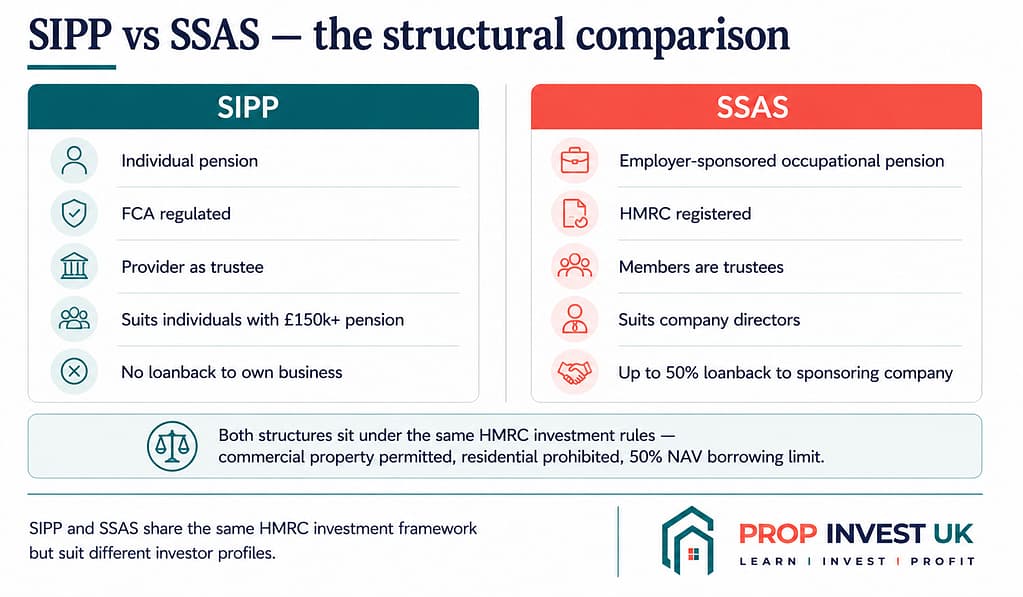
The two structures sit on different foundations:
A SIPP is an individual pension regulated by the Financial Conduct Authority. The SIPP provider holds legal title to the assets as trustee, while the member is the beneficial owner. The member directs the investments, but the provider has fiduciary responsibility and operates within FCA rules (Fox Davidson, 2026).
A SSAS is an employer-sponsored occupational pension scheme established by a limited company for its directors and senior employees. The scheme members are typically also the trustees, giving them direct control over property decisions without a third-party SIPP provider in the chain.
For property purposes, the practical differences are:
- A SIPP suits an individual investor — anyone with significant pension capital who wants property exposure through a pension wrapper. The SIPP provider handles administration; the member directs decisions through the provider.
- A SSAS suits company directors — particularly those who also want the ability to lend pension capital back to the sponsoring business through the SSAS’s loanback facility (which SIPPs don’t have).
- SIPP property purchases require the provider’s consent and involvement throughout — including provider-instructed valuations, provider-managed legal completion, and provider-administered ongoing management.
- SSAS property purchases are more direct because the members are the trustees, though they still require careful administration to maintain compliance.
For most individual investors with substantial pension capital (£250,000+) who want direct property exposure within a pension wrapper, the SIPP is the more accessible structure. For company directors who want both direct property ownership and the ability to recycle pension capital through their business, the SSAS structure offers features the SIPP doesn’t.
Both structures sit under the same HMRC investment rules. Both can hold UK commercial property. Both can borrow up to 50% of net asset value. Both are prohibited from holding residential property directly. The rule framework is identical; the operational structure is different.
What property a SIPP can and cannot hold
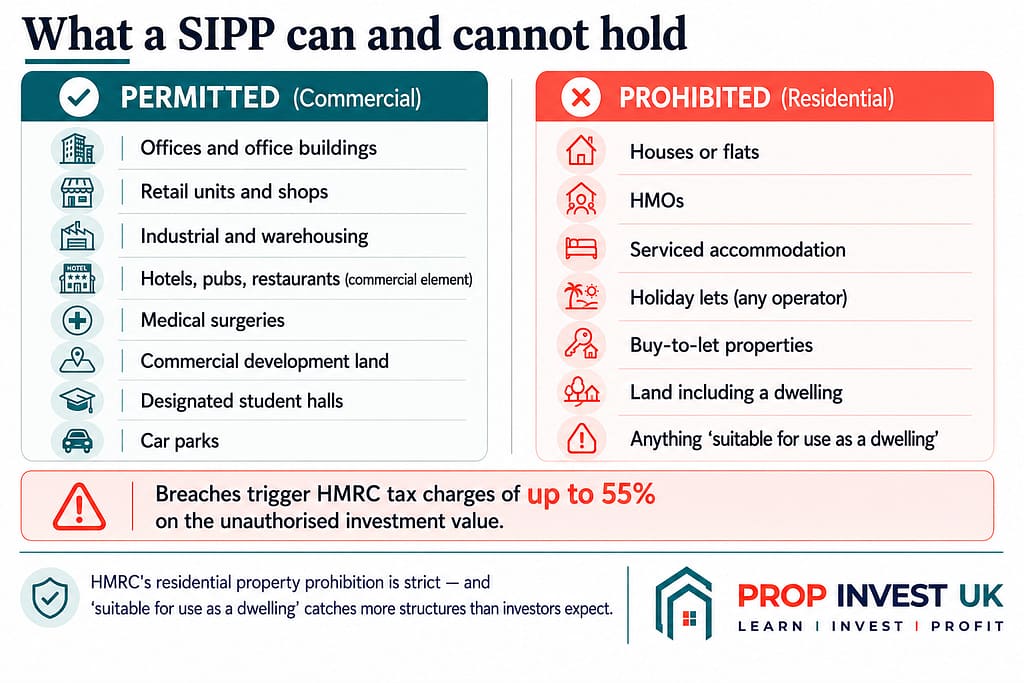
The single most important rule in SIPP property investment: a SIPP cannot directly hold residential property.
This isn’t a soft restriction. Direct residential property held by a SIPP triggers HMRC tax charges of up to 55% on the value of the unauthorised investment (Royal London, 2022). Severe penalties; not the kind of rule any SIPP holder wants to test.
What counts as commercial (and is permitted)
A SIPP can directly own UK commercial property including:
- Offices and office buildings
- Retail premises (shops, retail units)
- Industrial units and warehouses
- Public houses, hotels, and pubs (commercial element)
- Surgeries and medical premises
- Restaurants and commercial hospitality
- Commercial development land
- Forestry and agricultural land
- Designated student halls of residence
- Car parks
The property is held in the name of the SIPP provider as trustee. The scheme can lease it to the SIPP member’s own business (commonly called a “connected party let”), to a third-party tenant on commercial terms, or to multiple tenants in a mixed-use commercial scheme.
Connected party lets are popular among business-owning SIPP holders because the rental payments are tax-deductible for the trading business, while the rental income accrues tax-free within the SIPP. The rent must be at genuine market rate, supported by independent RICS valuation, and reviewed periodically on commercial terms.
What counts as residential (and is prohibited)
A SIPP cannot directly own:
- Houses or flats (any size)
- HMOs (Houses in Multiple Occupation)
- Serviced accommodation
- Holiday lets — classified by HMRC as residential property regardless of how they’re operated commercially (isasipp.com, 2026)
- Buy-to-let properties of any kind
- Land that includes a residential dwelling
- Any building “suitable for use as a dwelling”
The “suitable for use as a dwelling” test catches a lot of structures that investors initially assume must be commercial. A flat that’s been let as serviced accommodation is still residential. A holiday cottage in commercial operation is still residential. An HMO held through a limited company and let on AST agreements is still residential for SIPP purposes.
The borderline cases
Some specific scenarios have nuanced treatment:
Property with a residential element — for example, a shop with a flat above. HMRC’s general position is that the whole property is treated as residential if it’s suitable for use as a dwelling and the residential element shares an entrance or interior access with the commercial element (Royal London, 2022). Narrow exceptions exist for genuinely commercial situations (a caretaker’s flat tied to the commercial use, for example), but these are specific carve-outs, not general rules.
Hotels, guest houses, pubs with residential — require special consideration. Some configurations qualify as commercial; others don’t, depending on the residential element (iPensions Group SIPP Property Notes).
Development land — a SIPP can hold land for commercial development. It can also hold land where residential development takes place, provided the land and any resulting habitable property is disposed of before it becomes habitable. The moment the asset becomes habitable, it falls into the residential category and the SIPP must already have exited.
The practical test for any borderline case is HMRC’s framework around “suitable for use as a dwelling” — and the safest approach for any SIPP holder considering a non-standard structure is to clear it with the SIPP provider’s administrator before any capital moves.
How SIPP commercial property purchase actually works
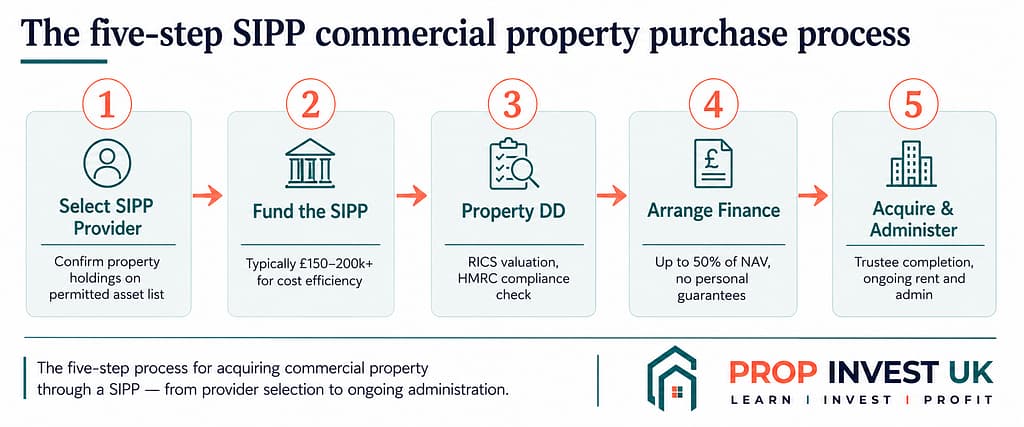
The mechanics of acquiring commercial property through a SIPP follow a specific process. Understanding it matters for any investor evaluating whether the structure fits their position.
Step 1: SIPP provider selection
Not all SIPP providers permit direct commercial property holdings. Those that do typically charge specific property-related fees (acquisition, ongoing administration, sale) on top of their standard SIPP charges. Investors evaluating SIPP property purchase need a provider whose permitted asset list and fee structure supports the activity.
Typical property-handling SIPP providers charge £1,000-£5,000 in property-specific fees across the purchase and ongoing administration process (ProTaxAccountant, 2025).
Step 2: Fund the SIPP
The SIPP needs enough capital to fund the property purchase. UK pension contribution rules in the 2026 tax year allow contributions up to £60,000 annually (or 100% of relevant earnings, whichever is lower), with tax relief at the member’s marginal rate.
For most SIPP property purchases, the capital has accumulated over years rather than being contributed shortly before the purchase. Industry practice typically suggests a SIPP needs at least £150,000-£200,000 of net assets before commercial property purchase becomes cost-efficient given the property-specific fees and administrative complexity.
Step 3: Property identification and due diligence
The SIPP member identifies the commercial property. The SIPP provider conducts due diligence as trustee — verifying the property is genuinely commercial under HMRC rules, instructing an independent RICS valuation, and confirming the structure of any proposed lease (particularly important for connected party lets).
The valuation matters because:
- It determines the price the SIPP can pay
- It supports any borrowing the SIPP takes against the property
- It sets the market rent that connected party leases must reflect
Step 4: Financing (if borrowing)
A SIPP can borrow up to 50% of the SIPP’s net asset value to fund the property purchase. This is the HMRC borrowing limit, and it applies to total scheme borrowing at the time of the loan (Royal London, 2022; Fox Davidson, 2026).
A worked example:
- SIPP with £400,000 of net assets
- Maximum borrowing: £200,000 (50% of NAV)
- Combined with £400,000 of SIPP funds, the SIPP can spend up to £600,000 on a commercial property purchase
A second example illustrating the binding constraint:
- SIPP with £500,000 of net assets
- Target property: £700,000
- Maximum borrowing under HMRC rule: £250,000 (50% of £500,000)
- Lender’s offer at 70% LTV against property: £490,000
- The HMRC limit of £250,000 binds, regardless of what the lender would otherwise offer
The lender’s LTV against the property and the HMRC 50% of NAV rule both apply; the lower of the two determines what the SIPP can borrow. Most SIPP commercial mortgage rates in 2026 sit in the 4-7% range, slightly above standard commercial mortgages because of the additional complexity of pension lending.
Crucially, the SIPP member cannot provide personal guarantees against any SIPP borrowing (iPensions Group). The security has to come from the property itself, and the lender’s liability is limited to the value of the SIPP.
Step 5: Acquisition and ongoing administration
The SIPP provider as trustee completes the purchase, with the property registered in the SIPP’s name. Ongoing administration includes:
- Rent collection (typically into a SIPP property administration account)
- Service charge management
- VAT administration (if the property is VAT-registered)
- Annual revaluation requirements
- Lease renewals and rent reviews
- Building insurance (mandatory)
- Public liability insurance (particularly important for any land or development)
Most SIPP providers offer a property administration service for an additional fee, or the member can appoint a third-party property manager.
The tax position
The reason SIPP commercial property is attractive at all is the tax treatment within the pension wrapper. Three structural features matter.
1. Tax-free growth
All rental income from the commercial property accrues within the SIPP free of income tax. Any capital gain on the property’s eventual sale accrues free of capital gains tax. The compounding effect of tax-free returns over a 15-25 year hold can be substantial.
2. Tax relief on contributions
Contributions into the SIPP receive tax relief at the member’s marginal rate, subject to the annual allowance (£60,000 in 2026) and the lifetime allowance framework as it operates after the 2024 reforms.
For a higher-rate taxpayer making a £20,000 SIPP contribution, the effective cost after tax relief is £12,000 — the government effectively contributes £8,000 to the pension. That £20,000 then grows tax-free within the SIPP, including any rental income from commercial property held within it.
3. Connected party leases
If the SIPP member’s own business leases the property from the SIPP, the rental payments are tax-deductible for the trading business (reducing corporation tax) while the rental income flows into the SIPP tax-free. This is a particularly powerful structural feature for business owners with both significant trading income and significant pension capital.
The rent must be at genuine market rate and supported by independent valuation. HMRC’s anti-avoidance position is strict — undercharging the SIPP triggers tax penalties. A 2024 case saw a business owner fined £120,000 for undercharging their SIPP on a connected party lease (ProTaxAccountant, 2025). Market rent isn’t a guideline; it’s a requirement.
How a SIPP can participate in UK property development
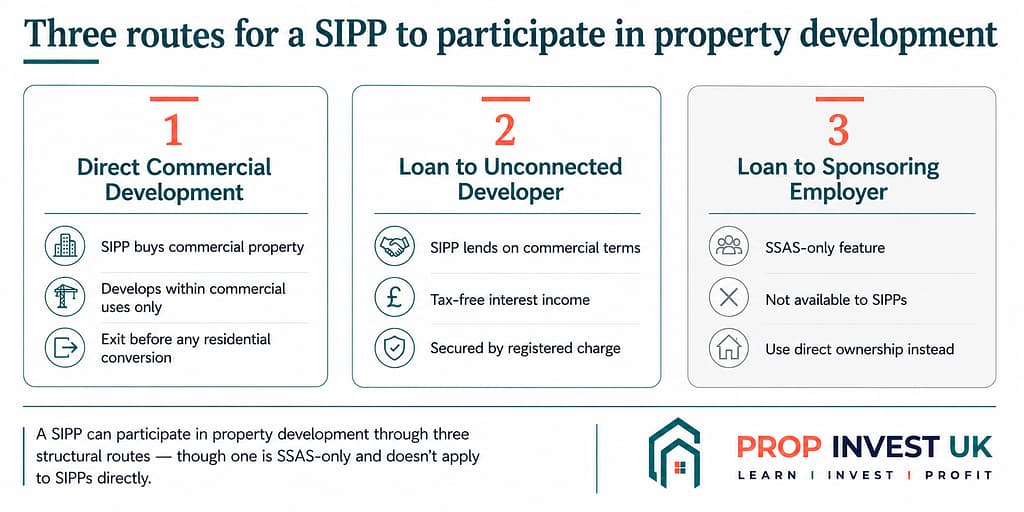
This is where the SIPP framework becomes particularly relevant for the Prop Invest UK audience. Given the residential prohibition, how can a SIPP participate in UK property development — including development that produces residential units at the end?
Three routes. Each has structural implications worth understanding.
Route 1: Direct commercial development inside the SIPP
The SIPP purchases commercial property or commercial development land. The property is then developed — but only in ways that keep it commercial. Office refurbishment, repositioning a warehouse, redeveloping a retail unit into upgraded commercial space.
This works for purely commercial outcomes. It doesn’t work where the development involves conversion to residential — the moment residential use becomes the end position, the SIPP must exit before the property becomes habitable.
Route 2: Loan from SIPP to unconnected property developer
A SIPP can lend money to unconnected third-party property developers on commercial terms. The SIPP earns interest income (tax-free within the wrapper); the developer uses the capital to fund their projects.
The structure works because:
- The SIPP isn’t holding residential property — it’s holding a loan secured against a development project
- The loan is on commercial terms (rate, security, repayment schedule) and at arm’s length to the SIPP member
- The developer (the borrower) is unconnected to the SIPP member, so the connected party rules don’t apply
This is the route most relevant to investors evaluating our capital partnerships through their SIPP. The SIPP holds a fixed-return loan position to the SPV running the project, secured by a second legal charge against the development property as we covered in our investor security article.
For SIPP holders, this route specifically:
- Provides exposure to UK property development returns
- Stays within HMRC’s investment rules (lending to unconnected commercial counterparty)
- Earns tax-free interest income within the pension wrapper
- Carries the structural protection of registered security against the underlying property
Whether any specific SIPP can take this position depends on:
- The SIPP provider’s permitted asset list (not all providers will hold property development loans)
- The provider’s administrative requirements and documentation
- The specific structure and terms of the proposed loan
- The SIPP holder’s own tax and financial advice
Route 3: SIPP lending to a sponsoring employer (does not apply to SIPPs)
This route applies to SSAS structures, not SIPPs. The SSAS loanback facility — where the pension scheme lends up to 50% of its assets to the sponsoring company — is a feature of occupational pension schemes that SIPPs don’t have access to.
For SIPP holders who want exposure to their own trading business’s property activity, the structural route is direct property ownership in the SIPP (with the business as connected tenant), not lending to the business.
The 2027 inheritance tax change
From 6 April 2027, the UK government’s stated intention is to bring unused pension funds — including commercial property owned by a SIPP or SSAS — within the value of the deceased individual’s estate for inheritance tax purposes (Dentons Pensions).
This is a material change for anyone who has used a SIPP to build property-backed wealth specifically as an IHT-efficient inheritance vehicle. Payments of death benefits to a spouse or civil partner remain exempt under the current proposals, but the broader IHT shielding that pensions historically provided is being narrowed.
For SIPP holders with significant commercial property holdings, the practical implications include:
- The pension wrapper still provides income tax and CGT advantages during life — these aren’t affected by the 2027 change
- Estate planning around large pension property holdings needs updating — the assumptions that worked under pre-2027 rules don’t hold afterward
- Spouse/civil partner inheritance remains exempt — but transfers to children, grandchildren, or other beneficiaries enter the IHT framework
Anyone with significant SIPP-held property, or considering establishing a SIPP property strategy specifically for legacy planning, should take regulated advice on what the 2027 change means for their specific position before making structural decisions.
Pooled SIPP arrangements
A SIPP can pool with other SIPPs (or with SSAS schemes, or with individual investors) to jointly own a commercial property. Each scheme owns a share, with rental income split proportionally.
This is useful for larger property acquisitions where a single SIPP doesn’t have sufficient capital. A three-way pool of SIPPs at £150,000 each could acquire a £450,000 commercial property without any single SIPP being capital-constrained.
The structural complications:
- All co-owners must agree on management decisions (rent, lease terms, refurbishment, sale)
- Selling requires coordination — one SIPP wanting to exit may need the others to find a replacement co-owner or buy out the share
- Conflicts between co-owners can create real friction. A 2024 Birmingham case saw pooled SIPP investors clash when one wanted to sell their share, delaying the process and incurring £8,000 in legal fees (ProTaxAccountant, 2025)
For SIPP holders considering pooled arrangements, the structural documentation matters as much as the underlying property — a clear co-ownership agreement, exit mechanism, and decision-making framework agreed before purchase prevents most of the conflict scenarios.
The five questions for any SIPP property decision
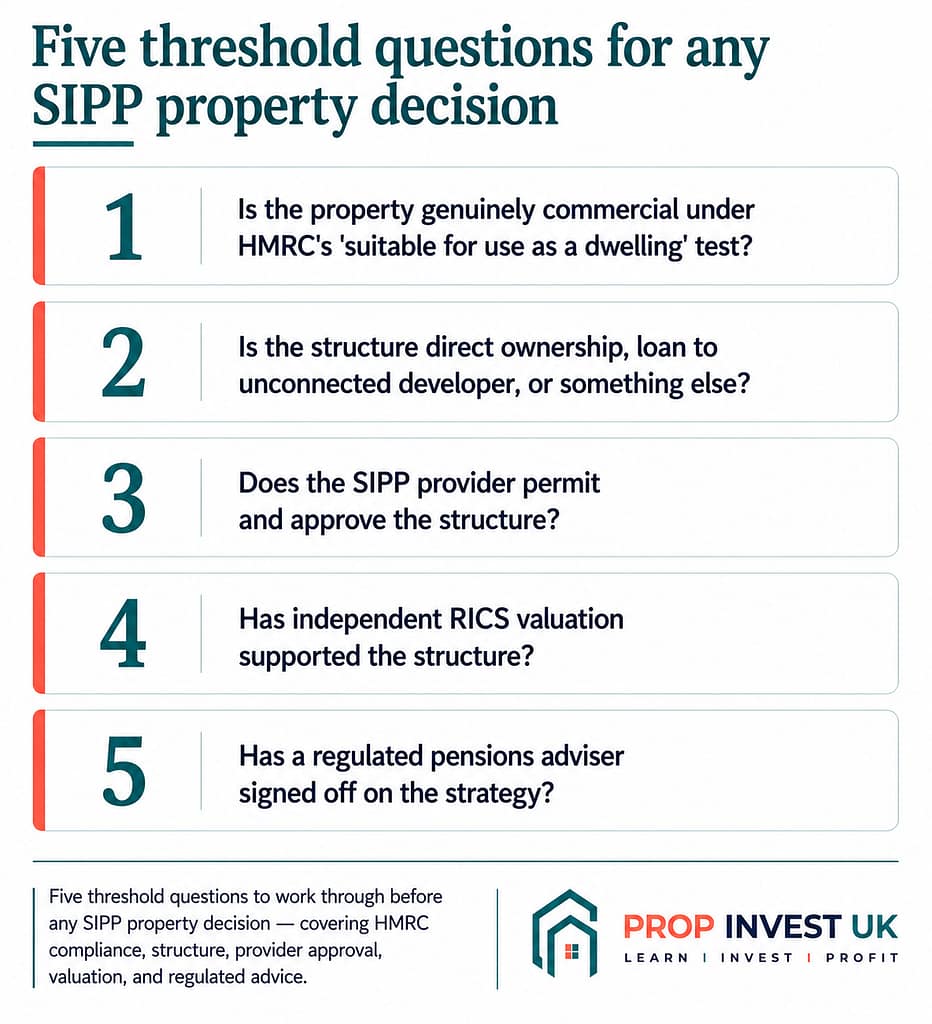
If you have a SIPP, or are considering one, and the conversation involves property, these five questions are the threshold tests.
1. Is the property genuinely commercial under HMRC’s “suitable for use as a dwelling” test?
Not commercial-by-marketing. Commercial under HMRC’s specific framework. If there’s any residential element or pathway to residential use, the SIPP exposure has to be structured accordingly.
2. Is the proposed structure direct ownership, a loan to an unconnected developer, or something else — and which set of rules applies?
Direct commercial ownership, lending to unconnected counterparties, pooled arrangements — each has different documentation, different administrative requirements, and different risk profiles.
3. Does the SIPP provider permit and approve the structure?
SIPP providers have their own permitted asset lists and approval processes. Not every property structure that’s HMRC-compliant is acceptable to every SIPP provider. Approval should happen before commitment, not after.
4. Has independent valuation supported the structure?
For direct property purchases — RICS valuation supporting the price. For connected party leases — market rent valuation supporting the rent. For loans to developers — security valuation supporting the LTV position. Independent valuation is non-negotiable.
5. Has a regulated pensions adviser signed off on the strategy?
SIPP rules are specific, and the penalties for breaches are severe (55% tax charge on residential property breaches; up to 70% penalties in some scenarios). The cost of a regulated pensions adviser is negligible against those penalties. Anyone making material SIPP decisions without regulated advice is taking a risk that doesn’t need to be taken.
How a SIPP might intersect with Prop Invest UK
Prop Invest UK structures property development opportunities and presents them to capital partners. For an investor whose capital sits in a SIPP, the relevant question is whether any specific opportunity is structurally compatible with SIPP rules.
The answer depends on the structure of the specific opportunity:
- A residential development project — for example, a commercial-to-residential conversion that produces flats or HMOs on completion — cannot typically be held directly by a SIPP, because the asset becomes residential before the investor exits.
- A loan to a property development operator on commercial, arm’s-length terms — where the SIPP earns interest income and the developer carries the project — can potentially be structured for SIPP participation. This is Route 2 from the SIPP investment routes section, and it’s the route that fits our capital partnership model most naturally.
- A purely commercial development — where the end use remains commercial — can potentially be held directly by a SIPP.
Whether any specific opportunity is appropriate for any specific SIPP depends on:
- The structure of the opportunity (loan vs equity vs direct asset)
- The terms (rate, security, term, repayment)
- The end-use of the underlying property
- The SIPP provider’s approval
- The regulated advice the SIPP member has taken
We do not advise on SIPP structures. We structure development opportunities. Where an investor wants to explore whether their SIPP could participate in a specific opportunity, the conversation needs to involve the SIPP provider and a regulated pensions adviser alongside us — not instead of us.
In summary
A Self-Invested Personal Pension is one of the most flexible UK pension structures available to investors who want direct control over how pension capital is deployed. For property specifically, a SIPP allows direct ownership of UK commercial property, with rental income and capital growth accruing tax-free within the pension wrapper.
SIPPs are subject to the same HMRC investment rules as SSAS schemes, including a prohibition on direct residential property ownership (with severe tax penalties for breaches), a 50% net asset value borrowing limit, and a requirement for genuine arm’s-length pricing on all connected party transactions.
For UK property development specifically, a SIPP can participate through:
- Direct purchase of commercial property (with conversion to commercial uses only)
- Loans to unconnected property developers on commercial terms (which is the route most relevant to our capital partnership model)
- Pooled arrangements with other SIPPs or SSAS schemes for larger commercial acquisitions
The 2027 inheritance tax change brings unused pension funds, including SIPP-held commercial property, within the IHT framework. Estate planning around large SIPP property holdings needs updating to reflect this.
For investors with significant pension capital who want exposure to UK property development without the complexity of direct development, three things matter:
- Understanding which structures are compliant and which are not
- Engaging a regulated pensions adviser and a competent SIPP provider
- Working with property operators who understand the SIPP framework well enough to structure opportunities appropriately
A SIPP is a long-term wealth vehicle. The decisions made about how it’s used compound over decades. The cost of doing it badly is significant; the cost of doing it well is largely administrative. The difference between those two outcomes is regulated advice and disciplined structuring.
If you have a SIPP and want to discuss whether specific Prop Invest UK opportunities might be structurally compatible with it — you can join the investor list. We share specific development opportunities with capital partners and can connect with your SIPP provider and pensions adviser to discuss structural compatibility on an opportunity-by-opportunity basis.
This article is general information only and is not pensions, tax, or financial advice. SIPP commercial property arrangements are complex and the rules change over time. SIPP holders should take independent professional advice on any property investment decision. Development carries risk; capital is at risk. Past project outcomes are not indicative of future performance.