
South Wales Development Opportunities: A 2026 Regional Thesis
South Wales is one of the most operationally interesting UK property development regions in 2026. The fundamentals are practical rather than speculative — growing employment bases in Cardiff, M4 corridor connectivity in Newport, regeneration and university demand in Swansea, and pricing across all three that still leaves room for disciplined operators to create value through development rather than relying on market appreciation.
This article is a regional thesis on South Wales development opportunities in 2026. It sets out the structural case for the region, differentiates the three primary city markets honestly, names where value is being created and where the risks sit, and grounds the analysis in specific projects that our group has delivered or has in progress across the region. It is written for investors evaluating whether South Wales fits a wider UK property strategy — and what good operator-led work in the region actually looks like.
The 2026 South Wales market in numbers
The structural backdrop, anchored to current data.
Wales average property price reached £211,000 at end-2025, up 3.6% on the previous year (📊 source: UK House Price Index via International Investment, January 2026). The three primary South Wales cities each show distinct dynamics:
- Cardiff: Average property price £269,000 in 2025, up 1.2% year-on-year. Average monthly rent £1,147, up 7.3% (📊 same source). Zoopla forecasts 2.1% house price growth in 2026 (📊 source: Zoopla via Wales247, January 2026). Three universities, the largest professional and public-sector employment base in Wales, BBC Wales’ Central Square hub, ongoing Dumballs Road mixed-use regeneration, and a £140m Cardiff Central Station upgrade starting in 2026.
- Newport: Average property price £226,000 in 2025, up 4.0%. Rental growth 11.9% — the strongest in South Wales (📊 same source). Zoopla forecasts 2.4% house price growth in 2026. Direct M4 corridor connectivity to Cardiff (12 minutes) and Bristol (35 minutes) makes Newport a meaningful commuter and affordability play.
- Swansea: Average property price growth of 4.4% in 2025 — the strongest in the three cities. Rental growth 6.2%. Zoopla forecasts 2.3% house price growth in 2026 (📊 same source). However, Swansea also shows the highest proportion of homes in Wales seeing asking price cuts of more than 5% — a signal of softer demand and greater price sensitivity at the point of sale, which is exactly the dynamic that creates opportunity for operators who can buy below open-market value and create value through execution.
The headline pattern: growth across all three cities exceeds the 1.5% UK forecast average for 2026 (📊 same Zoopla data), with Newport and Swansea outperforming Cardiff on growth rate. This is regional outperformance underwritten by practical drivers — employment, transport, affordability differentials — rather than speculative momentum.

The three cities are not one market
Treating South Wales as a single region is the most common analytical mistake investors make. Cardiff, Newport, and Swansea have distinct profiles, distinct competitive dynamics, and distinct development opportunities.
Cardiff. The broadest economic base, the strongest sales liquidity, and the most competitive development market in the region. Cardiff suits investors and operators with the capacity to compete on larger schemes against established competition, or with the local relationships needed to source genuinely off-market opportunities. The trade-off: stronger competition means tighter acquisition margins, and planning expectations are more demanding than elsewhere in the region.
Newport. Has historically been underrated by investors looking at headline numbers. The 11.9% rental growth in 2025 reflects what the market is finally recognising: Newport is a working commuter market with M4 connectivity that opens both Cardiff and Bristol employment markets while maintaining a 16% pricing discount to Cardiff. For operators, Newport offers room for refurbishment and repositioning schemes where the entry basis still leaves margin for execution. The trade-off: tenant demand is broader and more affordable, but the end-product specification needs to match — over-specifying for the local market wastes capital.
Swansea. Where our group has concentrated its conversion specialism, and where the highest-growth / highest-price-sensitivity combination produces the most operator-opportunity in the region. Swansea has a sizeable university population (Swansea University and University of Wales Trinity Saint David), a public-sector employment base, ongoing waterfront regeneration, and conservation areas (notably Swansea Uplands) where Article 4 directions have removed Class MA permitted development rights — meaning conversions there require full planning consent and the operator capability to navigate it.
Each city rewards different operator capabilities. The most credible South Wales operators don’t try to compete across all three at once — they specialise where their sourcing networks, planning relationships, and contractor capacity actually give them an edge.

Where value is being created — and how
Three mechanisms account for most of the development margin being generated across South Wales in 2026.
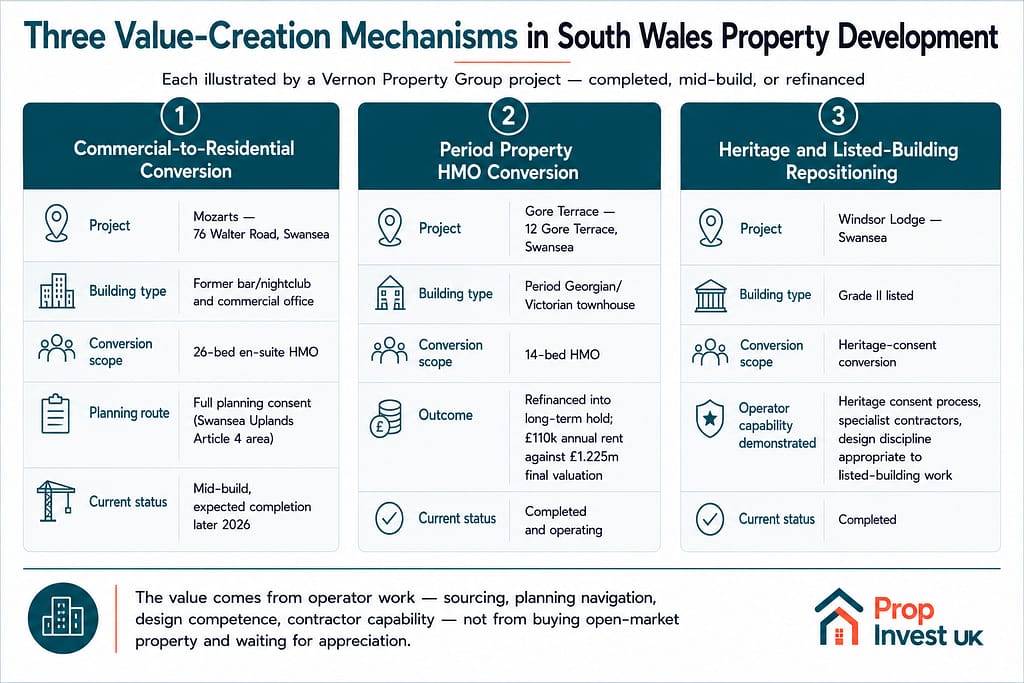
Commercial-to-residential conversion. South Wales city centres carry meaningful inventories of underused commercial space — former retail, vacant offices, redundant light commercial — at pricing materially below the residential potential of the buildings. Conversion through Class MA prior approval (outside Article 4 areas) or full planning consent (inside them) creates new residential stock from buildings that no longer serve their original use, capturing planning and use-class value uplift in the process. Our Mozarts project at 76 Walter Road, Swansea is a current example — a 26-bed en-suite HMO conversion of a former bar/nightclub and commercial office building, delivered under full planning consent because the site sits within the Swansea Uplands Article 4 area. The scheme is currently mid-build, with completion expected later in 2026.
Period property HMO conversion. The Georgian and Victorian townhouse stock in South Wales city centres — particularly Swansea Mount Pleasant, Cardiff Cathays, Newport — converts well into licensed HMO accommodation where tenant demand from students and young professionals supports the rental model. Our Gore Terrace conversion at 12 Gore Terrace, Swansea, is a completed example: a period Georgian/Victorian townhouse acquired in March 2023, converted into a 14-bed HMO, and refinanced into long-term hold producing approximately £110,000 in annual rent against a final valuation of £1,225,000 (📊 source: our portfolio data). The development phase created the value; the retention phase produces ongoing income.
Heritage and listed-building repositioning. South Wales has substantial listed-building stock that requires operator capability beyond standard residential conversion — heritage consent, specialist contractors, sensitive design. Our Windsor Lodge conversion, a completed Grade II listed building project, demonstrates the operator-capability dimension of this work; listed conversions are not appropriate for every operator and produce delivery risk in inexperienced hands, but executed properly they sit in a less-competitive market segment with stronger end-value protection.
The pattern across all three: the value comes from operator work — sourcing, planning navigation, design competence, contractor capability — not from buying open-market property and waiting for appreciation. South Wales is a region where execution matters more than market timing.
Why South Wales is gaining attention from sophisticated capital in 2026
A few structural reasons the region has moved from “regional alternative” to “primary regional thesis” for serious UK property capital.
Pricing discount to comparable English regional markets. Cardiff trades at approximately a 7% discount to the UK national median sale price. Newport and Swansea trade at materially deeper discounts. For the same finished asset specification, capital deployed in South Wales typically produces a stronger yield position than the equivalent capital deployed in Bristol, Bath, or the South East commuter belt.
Infrastructure investment continuing. The £140m Cardiff Central Station upgrade beginning in 2026, the South Wales Metro programme, and ongoing waterfront and town-centre regeneration in all three cities, support the demand side over a multi-year horizon. Infrastructure-led demand tends to compound rather than spike.
Rental yield environment. South Wales gross rental yields on standard buy-to-let typically sit in the 5–7% range (📊 source: Estate Agent Power market analysis, March 2026), with HMO conversion yields meaningfully higher. The Gore Terrace example produces a gross yield of approximately 9% against final valuation — the kind of figure that’s achievable through operator-led value creation, not through open-market acquisition.
Operational efficiency vs other UK regions. South Wales is geographically compact. The three primary cities are within a 45-minute drive of each other. Operators with established contractor relationships, planning officer contacts, and local sourcing networks can run a regional portfolio with materially less operational drag than operators trying to cover the entire UK from a single base.
Regional outperformance pattern. UK regional markets have outperformed London for three consecutive years on house price growth (per Land Registry data referenced in cluster commentary). South Wales sits within that broader regional outperformance pattern but with the additional benefit of M4 corridor connectivity to South West England — making it accessible to investors who think regionally rather than nationally.
The risks that genuinely matter
Strong fundamentals don’t eliminate development risk. The South Wales-specific risks worth being honest about.
Stock type mismatch in secondary locations. The biggest risk on conversion schemes outside Cardiff city centre is delivering the wrong product for local demand. A high-spec city-centre apartment scheme in a market that wants 2–3 bed family rental produces a finished asset that struggles to let or sell at appraisal value. Operator-level knowledge of street-by-street tenant demand is what protects against this — generic regional confidence isn’t sufficient.
Article 4 direction navigation. Significant parts of Cardiff, Swansea, and Newport sit within conservation areas or Article 4 zones that remove permitted development rights. An operator unfamiliar with which specific addresses fall inside or outside these designations can acquire on a Class MA assumption only to discover the planning route is materially harder. Verification before acquisition is non-negotiable.
Heritage and listed-building delivery. Listed-conversion projects in South Wales (and there are many) require specialist heritage consent processes, specialist contractors, and design discipline that standard residential operators don’t carry. Margin on listed work is real but execution risk is materially higher than on standard conversion.
Refinance market for HMOs. Specialist HMO mortgages are available in South Wales but the lender pool is narrower than for standard residential, and refinance valuations are scrutinised more closely. Schemes designed for refinance-and-hold exit need to demonstrate to the valuer that the income, the licence position, and the property condition all support the post-completion valuation.
Tenant demand depth in single-employer towns. Some Welsh towns outside the three primary cities depend on a single major employer or institution. Strong headline rental growth can mask narrow demand depth. Operators working in the wider region — outside Cardiff, Newport, Swansea — need to verify employment-base breadth before underwriting a multi-unit scheme.
These are real risks. They’re also the risks experienced regional operators have built systems to manage. They’re not arguments against the region — they’re arguments for selectivity and operator capability within it.
What good operator work in South Wales actually looks like
The operators worth backing in South Wales share consistent characteristics. They have specific sourcing networks that produce off-market opportunities at materially below open-market value. They understand which planning routes apply to which addresses — Class MA where it works, full planning where it doesn’t, and verified Article 4 status before acquisition. They have contractor relationships specifically experienced in conversion work, not just general residential refurbishment. They design for local market demand, with unit mix and specification matched to tenant evidence at street level. They build refinance optionality into the exit, so completed schemes can be held or sold based on market conditions at completion rather than forced into either route. And they communicate with capital partners through structured reporting that doesn’t go quiet when projects encounter friction.
Our Group operates across South Wales — Mozarts in Swansea (mid-build), Gore Terrace in Swansea (completed and refinanced into long-term hold), Windsor Lodge in Swansea (Grade II listed conversion, completed) — alongside projects in the South West and the M4 corridor. The operational model is development-led: acquire below residential potential, navigate the planning route applicable to the specific building, deliver through contractor relationships specifically experienced in conversion work, and either refinance into long-term hold where the asset and market support it, or exit by sale. Each of the three named projects exemplifies a different element of that model.
For investors evaluating South Wales as part of a wider UK property strategy, the most useful questions aren’t about the region in general — they’re about the specific operator working in it. Where does their sourcing come from? What’s their planning track record on specific Article 4 sites? What’s their refinance history on completed HMOs? Which streets in which cities do they know at the level of detail that distinguishes regional knowledge from regional confidence? Those are the questions that separate operators worth backing from operators chasing regional headlines.
The opportunity, framed honestly
South Wales is not a shortcut to property returns. It’s a region where disciplined operator-led work can produce strong outcomes because the pricing, regeneration, and demand fundamentals support it — but where weak operators produce weak outcomes for the same reasons every UK region punishes weak operators.
The current 2026 dynamic — regional outperformance on growth, accessible pricing relative to comparable English markets, ongoing infrastructure investment, and a development environment that rewards specialist execution — supports the regional thesis for capital that can be matched to capable operators. It does not support a thesis of generalised regional exposure for investors who don’t know which operator they’re backing.
At Prop Invest UK, our regional focus on South Wales, the South West, and the M4 corridor is the result of those structural factors aligning with where our group’s operational capability is actually built. Each opportunity is sourced, structured, and delivered by an experienced developer working in regions and asset types we know in operational depth. Any specific opportunity is offered only to investors who qualify under the relevant exemptions and have received the full project documentation.
For investors considering South Wales exposure, the work isn’t finding the region. It’s identifying the operator whose specific capabilities match the specific opportunity in the specific city — and applying the same diligence framework to that operator that the rest of this cluster sets out.
—
About Prop Invest UK
Prop Invest UK is a property development business working with investors who want exposure to UK property development without taking on operational delivery themselves. Each opportunity is sourced, structured, and delivered by an experienced developer — our group — with a focus on commercial-to-residential conversion and HMO development across South Wales, the South West, and the M4 corridor.
Join the investor list to receive details of future opportunities as they become available, subject to investor qualification and project documentation.
—
This article is for general information purposes only and does not constitute financial advice or an offer to invest. UK property development involves risk, including the risk of capital loss, and returns are not guaranteed. Past performance is not a reliable indicator of future results. Project figures referenced in this article relate to specific Prop Invest UK schemes and do not represent the expected outcome of any specific future investment opportunity. Market data referenced is sourced from third-party providers and is accurate as of the dates cited. Any specific opportunity is offered only to investors who qualify under the relevant exemptions and who have received the full project documentation. If you are uncertain whether an investment is suitable for your circumstances, you should consult an FCA-authorised financial adviser.
—