
Important note before reading
This article is for general educational purposes only. It is not financial, tax, or pensions advice. SSAS pension arrangements are subject to specific HMRC rules and tax consequences, and any decision about how to use a SSAS — including whether to set one up, what to invest in, or how to structure a loan or property arrangement — should be made with regulated pensions advice from an appropriately qualified professional.
Prop Invest UK is a property development operator, not a pensions adviser or regulated financial intermediary. Returns referenced in case study material reflect outcomes on specific completed projects and are not indicative of future performance. Development carries risk; capital is at risk.
What a SSAS is
A Small Self-Administered Scheme (SSAS) is an occupational pension scheme established by a limited company for the benefit of its directors, senior employees, and sometimes family members.
It sits within the same legal framework as every other UK registered pension scheme — same HMRC rules, same tax treatment of contributions, same access age — but with one major distinction: the members are typically also the trustees, which gives them direct control over how the pension’s assets are invested.
That control is the entire point. A standard workplace pension gives you a fund choice from a pre-set menu. A SSAS lets the trustees decide where to deploy the scheme’s capital — within the strict framework of pension legislation.
For UK property investors who are also company directors, this is significant. A SSAS can be used to hold commercial property, lend money to the sponsoring company, and access investment structures that traditional pensions cannot reach. None of that flexibility removes the regulatory framework — but it widens what’s possible within it.
Who can have one
A SSAS is established by a limited company for company directors. Typical SSAS members are:
Understanding the benefits of SSAS pension property can enhance your investment portfolio.
- Company directors and shareholders of UK limited companies
- Senior employees the company chooses to include
- Family members (where the trust deed allows)
A SSAS is generally not appropriate for someone who is not a company director. For self-employed individuals or non-director high earners, a Self-Invested Personal Pension (SIPP) is the comparable structure.
The loan-back facility is a valuable feature of SSAS pension property arrangements.
Most SSAS arrangements need a meaningful starting pension value to be worth the administrative cost. Industry practice typically suggests combined member pension funds of £125,000 or more before the structure becomes cost-efficient, though this varies by scheme administrator.
The headline benefits
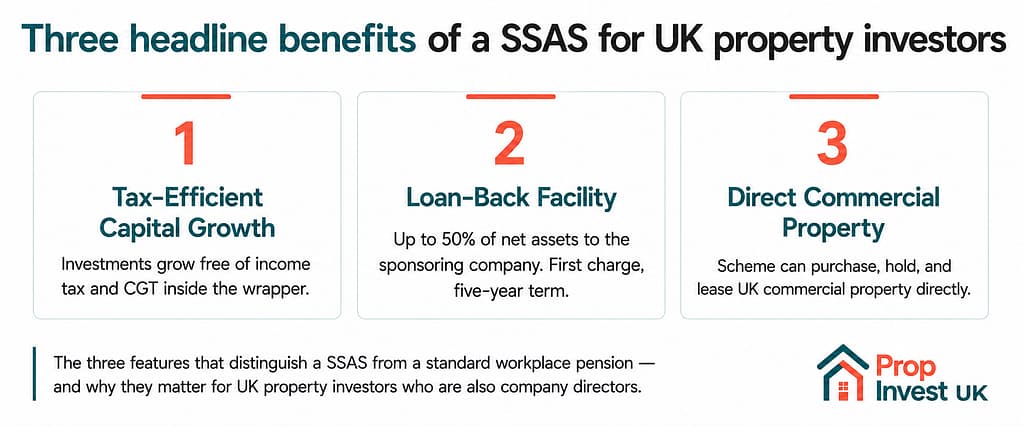
Three structural features make a SSAS attractive to UK property investors:
1. Tax-efficient capital growth
All investments held within a SSAS grow free of income tax and capital gains tax. Rental income from commercial property, interest from loans, and capital gains on investment exits all accrue gross within the scheme. The same tax wrapper that applies to every UK pension applies to a SSAS — but the SSAS can hold assets traditional pensions cannot.
Commercial property types eligible for SSAS pension property include various asset classes.
2. The loan-back facility
Understanding the limits of SSAS pension property can guide better decision-making.
A SSAS can lend up to 50% of its net asset value to the sponsoring company that established the scheme, on commercial terms set by HMRC. Loans to the employer must meet specific authorised loan conditions: a first charge over the loan, a maximum of 50% of net assets, a five-year term, interest at least 1% above base, and level amortisation (Real Estate Investor, 2026).
This is the loan-back that property investor circles often reference — the ability to recycle pension capital back into the operating company to fund property activity, refurbishment, or working capital.
3. Direct commercial property ownership
A SSAS can directly purchase, hold, and lease UK commercial property. The scheme owns the property; the trustees manage it; rental income flows back into the SSAS gross of tax. This is the most powerful and most misunderstood feature of the structure — and it’s where the rules become unforgiving.
What a SSAS can and cannot hold in property
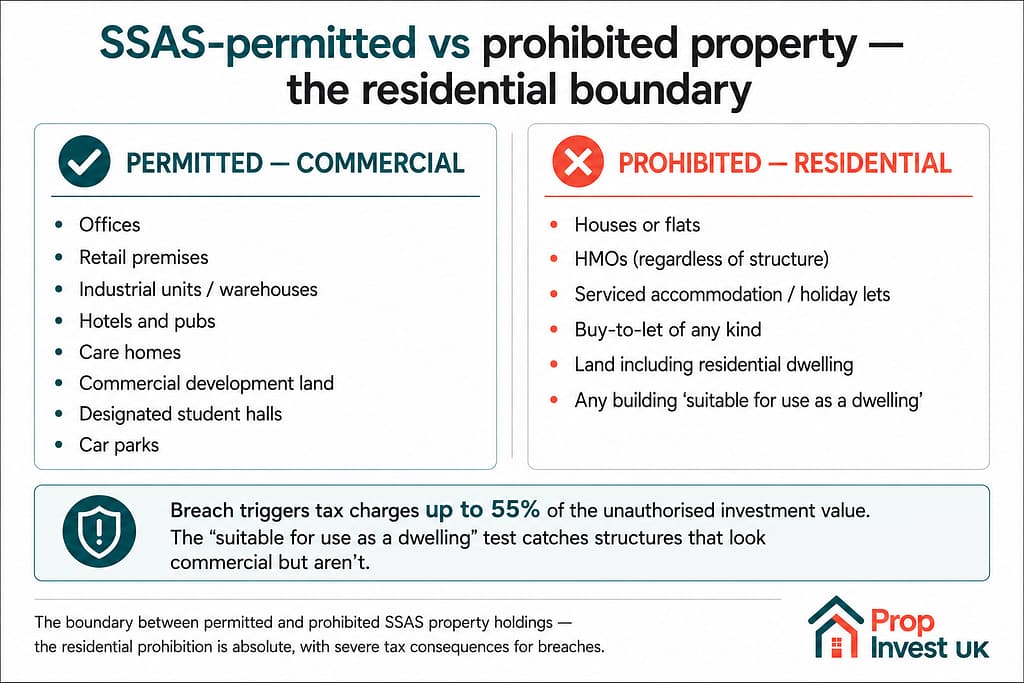
The single most important rule in SSAS property investment: a SSAS cannot directly hold residential property.
This is not a soft restriction. Breaches trigger tax charges of up to 55% on the value of the unauthorised investment, plus a possible scheme sanction charge (Royal London, 2022).
What counts as commercial (and is permitted)
A SSAS can directly own UK commercial property including:
- Offices
- Retail premises
- Industrial units and warehouses
- Hotels and public houses
- Care homes
- Development land (commercial)
- Designated student halls of residence
- Car parks
The property is held in the name of the SSAS trustees. The scheme can lease it to the sponsoring employer (an attractive structure for business owners who want their company to pay rent to their own pension) or to third-party tenants on commercial terms.
What counts as residential (and is prohibited)
A SSAS cannot directly own:
- Houses or flats
- HMOs (Houses in Multiple Occupation)
- Serviced accommodation or holiday lets
- Buy-to-let properties of any kind
- Land that includes a residential dwelling
- Any building “suitable for use as a dwelling”
The “suitable for use as a dwelling” test is the trap. HMRC’s view is that a property is residential if it is used or suitable for use as a dwelling — regardless of how it’s structured commercially. An HMO bought through a limited company, marketed as a commercial enterprise, and let on AST agreements is still a residential property in HMRC’s eyes for SSAS purposes (TLPI, 2026).
The same applies to serviced accommodation and holiday lets. The building could realistically be converted into a family home, so it falls within the residential category for SSAS purposes.
The borderline cases
There are narrow exceptions. A flat above a shop, leased with the shop and occupied by the person trading from the shop, can be acceptable. A caretaker’s flat occupied by an employee of the tenant as a condition of employment can be acceptable. These are specific exemptions, not general rules (Dentons Pensions).
Commercial property under development
A SSAS can hold land or commercial property and have it developed — provided no residential element is added and the property remains commercial throughout. SSAS administrators typically require quotes, planning documentation, and pre-approval before any development work begins (Dentons Pensions).
A SSAS can also purchase or hold land or property for development purposes if it is sold to the company or a third party before becoming habitable. The moment the asset becomes habitable — typically when a certificate of habitation is issued — it falls into the residential category and the SSAS must have already exited (UK Property Accountants, 2026).
Trading is not what a pension scheme is for
If a pension scheme becomes involved in frequent purchase, development, and sale of commercial property, HMRC may deem the activity to be trading rather than investment. Trading activity within a pension scheme loses the tax exemption — gains and income become taxable as they would in any other trading vehicle (Dentons Pensions).
The line between investment and trading is fact-specific. A SSAS holding a single commercial unit for rental income over years is investment. A SSAS buying, developing, and flipping commercial properties on rotation looks like trading. Where a particular activity sits depends on volume, holding period, and intent — and is a question for the scheme’s professional advisers, not a question to guess at.
Borrowing and leverage
A SSAS can borrow money, but only up to 50% of the net asset value of the scheme prior to the borrowing (Royal London, 2022). A scheme with £400,000 of net assets can borrow up to £200,000 — total assets including borrowing of £600,000.
This borrowing cap is calculated before the borrowing event, not after. It applies to the scheme as a whole, not per investment. And it limits the practical scale of leveraged commercial property purchases a SSAS can make on its own.
For a £600,000 commercial property purchase, a SSAS needs at least £400,000 of net assets going in, plus capacity to take on £200,000 of borrowing. For larger purchases, SSASs can co-invest with other pension schemes as tenants in common, splitting the equity and the borrowing requirement (Real Estate Investor, 2026).
How a SSAS can participate in property development
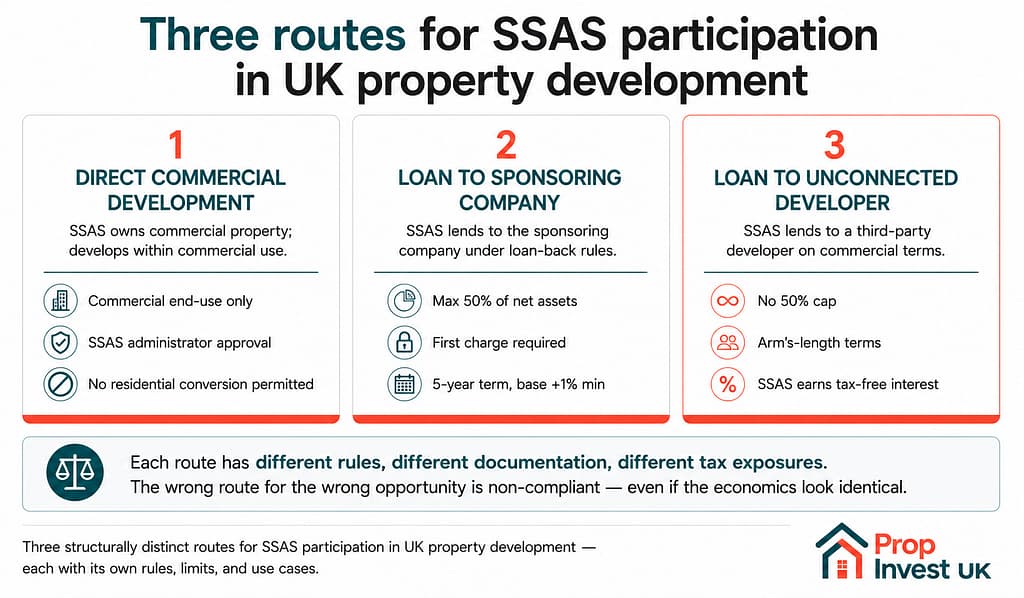
This is the question most SSAS-holding investors actually want answered: given the residential prohibition, how can a SSAS be used to participate in UK property development — including development that produces residential units at the end?
There are three primary routes, each with its own structure and risk profile.
Route 1: Direct commercial development inside the SSAS
The SSAS purchases a commercial property or commercial development land. The property is developed — but only in ways that keep it commercial. Office refurbishment, repositioning a warehouse, redeveloping a retail unit into upgraded commercial space.
This works for purely commercial outcomes. It does not work where the development pathway involves conversion to residential. The moment residential use becomes the end position, the SSAS must exit before the property becomes habitable.
Route 2: Loan to the sponsoring company for residential development
The SSAS makes a loan to the sponsoring limited company under the loan-back facility — up to 50% of net assets, first charge, five-year term, base rate +1% minimum, level amortisation.
The sponsoring company then uses that capital to fund residential property development or investment activity. The SSAS receives interest on the loan (which is taxable income to the company but tax-free income to the SSAS). The residential property is owned by the limited company, not the SSAS — which keeps the SSAS compliant with the residential prohibition.
This is the route many property investors structure: the SSAS funds the limited company; the limited company does the property; the loan is repaid with interest over the term (GoldHouse Accounting, 2025).
Route 3: Loans to third-party property developers
A SSAS can lend money to unconnected third-party property developers on commercial terms. The SSAS earns interest income (tax-free within the scheme); the developer uses the capital to fund their projects (TLPI, 2026).
The structure is fundamentally different from Route 2 because the developer is unconnected to the SSAS member. There’s no loan-back cap (the 50% rule applies only to loans to the sponsoring employer). The lending must still be on genuine commercial terms — interest rate, security, repayment schedule — and must be defensible as a bona fide investment of pension assets.
This route is often used by SSAS members who want development-level returns from property without the operational complexity, the residential prohibition, or the trading risk of holding property directly.
It is also the route through which a SSAS could, in principle, participate as a capital partner in a development project structured by an unconnected developer — provided the structure is a genuine arm’s-length loan and not a disguised equity stake or trading arrangement.
The structural question for any SSAS-funded loan to a developer is not “what’s the return” — it’s “is this defensible as an arm’s-length commercial loan from a pension scheme to an unconnected counterparty, on terms a regulated SSAS administrator would approve.” Any structure that fails that test risks the tax exemption of the SSAS itself.
How this looks in practice — Jason’s story

The abstract framework above is one thing. What it looks like in practice is another. So it’s worth walking through how one of our investors — Jason, a UK limited company director with a background in buy-to-let property investment — has used his SSAS to participate in our development projects over time.
The starting position
Jason came to us in a position many UK director-level investors recognise: significant pension capital accumulated over years of company contributions, sitting in conventional pension structures, generating returns he wasn’t satisfied with. He was already an experienced property investor on the buy-to-let side. He understood property economics, understood leverage, understood that residential rental returns had been compressed by regulatory and tax changes. What he didn’t have was a way to deploy his pension capital into property activity that matched the returns he was achieving outside the pension wrapper.
His situation is structurally common:
- Director of a UK limited company (eligible for a SSAS)
- Established BTL portfolio outside the pension
- Pension capital underutilised relative to his property knowledge
- Comfortable with property risk; uncomfortable with the residential prohibition that locked his SSAS out of the assets he understood best
The conversation Jason needed to have was not with us first — it was with a regulated pensions adviser and a competent SSAS administrator. The structure had to be set up correctly before any capital could move. We were not part of that conversation; we entered the picture only once the SSAS was established and Jason had taken regulated advice on what it could and couldn’t do.
The first loan
Jason’s first deployment of SSAS capital into our project pipeline was a loan from his SSAS to fund part of the capital stack on one of our commercial-to-residential conversions.
The project ran its course, the development completed, the units sold, and Jason’s SSAS received its capital back plus a fixed return of around 20% over the term of the loan. The interest his SSAS earned accrued tax-free within the pension wrapper — which, for a higher-rate taxpayer like Jason, is materially different from earning the same return outside a pension.
For us, the structure was straightforward: a defined-term loan facility, a clear exit (sale of completed units), documented terms. For Jason, the structure was the answer to a problem his BTL portfolio couldn’t solve — meaningful, asset-backed returns on his pension capital, on a development-economics return profile rather than a buy-to-let yield profile.
Repeating the structure
After the first project completed successfully, Jason chose to redeploy the returned capital into a second project. Then a third. Over time — and across multiple projects including the Lodge and Shoe Zone conversions, alongside others — his SSAS has now had circulating capital of around £400,000–£500,000 deployed across our project pipeline. Some of that is original capital; some is reinvested returns; some is new contributions to the SSAS over the years.
The pattern that emerged was the pattern many of our long-term capital partners follow:
- First project: smaller exposure, fixed return, treated as a test of the operator
- Second and third projects: comparable structure, increasing comfort with the relationship
- Later projects: more capital, often deployed faster as new opportunities come to market
The shift to equity participation
In more recent projects, Jason has moved part of his structure from fixed-return lending toward equity participation — taking shares in the development project rather than (or alongside) a fixed-interest loan position.
The reason this is interesting is that it reflects a maturity in the operator–investor relationship. Fixed-return lending is the appropriate structure when an investor is new to an operator — the return is defined, the position is debt rather than equity, the downside is clearer. Equity participation carries different economics: the upside is higher in strong projects, the downside is more exposed to project outcome, and the position is no longer a loan but a stake in the development itself.
Moving from fixed-return lending to equity participation is something investors typically do after they’ve worked with an operator across multiple completed projects. The track record on the early loans creates the confidence to take a different kind of position on later projects.
For SSAS members specifically, the equity participation route needs careful structuring. The SSAS administrator’s view on any specific equity structure matters, and the structure should be reviewed with a regulated pensions adviser before any commitment is made. What works as a defined-term loan does not automatically work as an equity stake — the rules and documentation are different. Anyone considering this shift in their own SSAS strategy should treat it as a separate decision requiring its own professional advice.
What Jason’s story illustrates
Three things worth taking from this:
1. The structure starts with the right professional advice. Jason’s SSAS was set up correctly, with a competent administrator, with a regulated pensions adviser involved at the structural decisions. None of what followed would have worked if the foundations weren’t right.
2. The first project is a test of the operator. Jason didn’t deploy his maximum exposure on project one. He deployed an appropriate amount for an unproven relationship, watched how we executed, watched how communication worked, watched how the exit played out. The relationship deepened because the early projects performed — not because we asked for more capital before earning it.
3. The structure evolved as the relationship matured. What started as a single fixed-return loan has become a longer-term capital partnership across multiple projects, with the structure of each new deployment matching where the relationship is at that point. This is what the “Preferred Capital Partner” tier of our offer looks like in practice — and it’s typically what serious investors with substantial pension capital are looking for: a developer they can deploy with repeatedly, not a one-off transaction.
Returns of around 20% on completed projects reflect outcomes on those specific projects. They are not indicative of returns on future projects. Development carries risk, and any specific project’s outcome depends on planning, construction, market conditions, and execution factors that vary by deal.
The connected-party rule
Anything a SSAS does with a connected party — a member, a member’s family, the sponsoring company, an associated company — must be on genuine commercial, arm’s-length terms.
SSAS pension property can significantly impact legacy planning for investors.
If a SSAS leases a commercial property to a connected tenant (for example, the sponsoring company), the rent must reflect market rate, supported by an independent RICS-qualified valuation. Rent reviews must be on commercial terms in line with the lease provisions (Dentons Pensions, 2026).
If a SSAS lends to the sponsoring company, the loan must meet HMRC’s authorised loan conditions (first charge, max 50% of net assets, five-year term, base rate +1%, level amortisation).
If a SSAS uses a connected business to undertake development or refurbishment, quotes from at least two unconnected businesses are typically required for comparison (Dentons Pensions).
The principle behind every connected-party rule is the same: a pension scheme exists to provide retirement and death benefits, not to be a tax-advantaged vehicle for siphoning value out of pension assets into the hands of members or connected parties. Anything that looks like value stripping triggers tax charges.
It’s worth noting that in Jason’s case, the structure works precisely because Vernon Property Group is an unconnected counterparty to him and his SSAS. He is not a director or shareholder. His SSAS is lending to an unconnected developer, on arm’s-length terms. That separation is what makes the structure clean.
The 2027 inheritance tax change
From 6 April 2027, the UK government’s stated intention is to bring unused pension funds — including commercial property owned by a SIPP or SSAS — within the value of an individual’s estate for inheritance tax purposes (Royal London, 2022; Dentons Pensions).
This is a material change for anyone who has used a SSAS to build property-backed wealth specifically as an IHT-efficient inheritance vehicle. Payments of death benefits to a spouse or civil partner remain exempt under the proposals, but the broader IHT shielding that pensions historically provided is being narrowed.
Anyone with significant SSAS-held assets, or considering establishing a SSAS for long-term legacy planning, should take regulated advice on what the 2027 change means for their specific position before making structural decisions. Anyone reading this in 2026 has time to plan — but the planning needs to happen now, not after.
The five questions to ask before doing anything with a SSAS in property
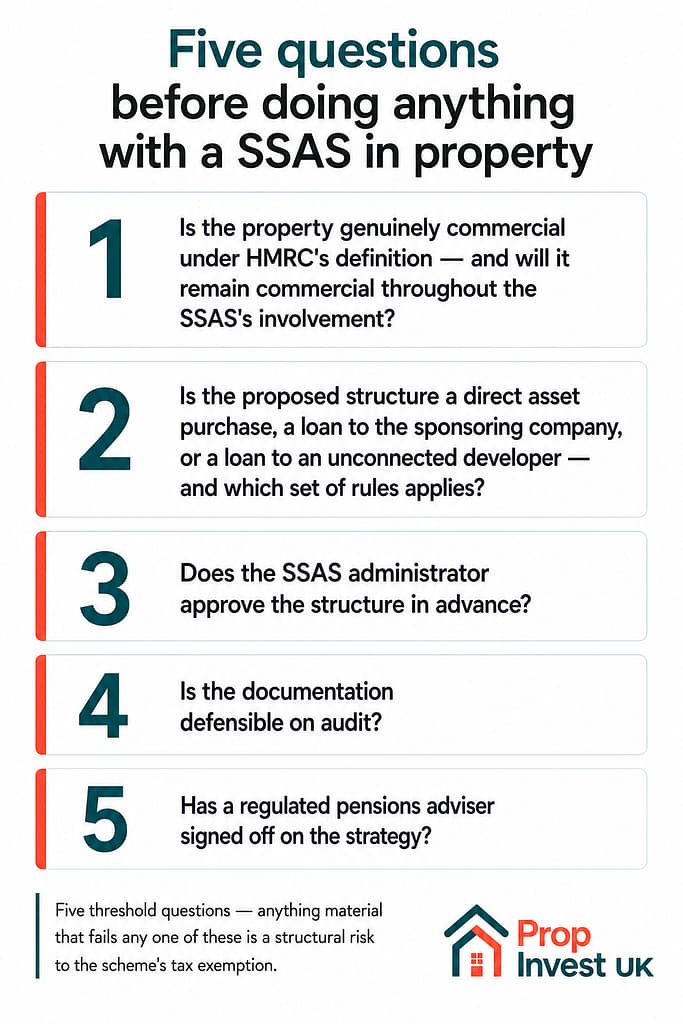
If you have a SSAS, or are considering one, and the conversation involves property, these five questions are the threshold tests.
1. Is the property genuinely commercial under HMRC’s definition — and will it remain commercial throughout the SSAS’s involvement?
Not commercial-by-marketing. Commercial under HMRC’s “suitable for use as a dwelling” test. If there’s any pathway to residential use, the SSAS exposure has to be structured around that.
2. Is the proposed structure a direct asset purchase, a loan to the sponsoring company, or a loan to an unconnected developer — and which set of rules applies?
Each route has different limits, different documentation, different tax exposures. A structure that’s compliant as a loan to an unconnected developer might be non-compliant as a loan to the sponsoring company, and vice versa.
3. Does the SSAS administrator approve the structure in advance?
SSAS administrators are responsible for ensuring the scheme remains compliant. Anything material — property purchase, loan, development work — should be approved by the administrator before it happens, not after. Administrators who refuse to authorise a structure are usually right.
4. Is the documentation defensible on audit?
Connected-party rents at market rate with RICS-supported valuations. Loans with proper facility documentation, security, and amortisation schedules. Lease agreements with clear terms. The structure has to look right on paper because HMRC audits look at the paper, not the intent.
5. Has a regulated pensions adviser signed off on the strategy?
SSAS rules are specific and the penalties for breaches are severe. The cost of a regulated pensions adviser is negligible against the 55% tax charge for a misjudged investment. Anyone making material SSAS decisions without regulated advice is taking a risk that doesn’t need to be taken.
How a SSAS might intersect with Prop Invest UK
Prop Invest UK structures property development opportunities and presents them to capital partners. For an investor whose capital sits in a SSAS, the relevant question is whether any specific opportunity is structurally compatible with SSAS rules.
The answer depends on the structure of the specific opportunity:
- A residential development project — for example, a commercial-to-residential conversion that produces flats on completion — cannot typically be held directly by a SSAS, because the asset becomes residential before the investor exits.
- A loan to a property development operator on commercial, arm’s-length terms — where the SSAS earns interest income and the developer carries the project — can potentially be structured for SSAS participation, subject to the scheme administrator’s approval and regulated advice. This is the route Jason has used.
- A purely commercial development — where the end use remains commercial — can potentially be held directly by a SSAS.
Whether any specific opportunity is appropriate for any specific SSAS depends on:
- The structure of the opportunity (equity, debt, direct asset, fund interest)
- The terms (rate, security, term, repayment)
- The end-use of the underlying property
- The SSAS administrator’s view
- The regulated advice the SSAS member has taken
We do not advise on SSAS structures. We structure development opportunities. Where an investor wants to explore whether their SSAS could participate in a specific opportunity, the conversation needs to involve the SSAS administrator and a regulated pensions adviser alongside us — not instead of us.
In summary
A SSAS is one of the most powerful pension structures in UK law for company directors, and for property investors specifically. It offers tax-efficient capital growth, the ability to hold commercial property directly, and structured routes to lend pension capital back to the operating business or to third-party property operators.
It is also one of the most rule-bound structures, with severe tax consequences for breaches and a specific prohibition on directly holding residential property — including HMOs, holiday lets, and serviced accommodation, regardless of how they’re structured commercially.
For investors with significant pension capital who want exposure to UK property development without the complexity of direct development, three things matter:
- Understanding which structures are compliant and which are not
- Engaging a regulated pensions adviser and a competent SSAS administrator
- Working with property operators who understand the SSAS framework well enough to structure opportunities appropriately
A SSAS is a long-term wealth vehicle. The decisions made about how it’s used compound over decades. The cost of doing it badly is significant; the cost of doing it well is largely administrative. The difference between those two outcomes is regulated advice and disciplined structuring.
Investors like Jason — who set up the structure correctly, took regulated advice, started with appropriate exposure on the first project, and built the relationship across multiple completed deals — are now operating in a position that’s hard to replicate without that disciplined start.
If you have a SSAS and want to discuss whether specific Prop Invest UK opportunities might be structurally compatible with it, you can join the investor list. We share specific development opportunities with capital partners and can connect with your SSAS administrator and pensions adviser to discuss structural compatibility on an opportunity-by-opportunity basis.
This article is general information only and is not pensions, tax, or financial advice. Returns referenced reflect outcomes on specific completed projects and are not indicative of future performance. Development carries risk; capital is at risk.