
A property opportunity can look excellent on paper and still fail when tested. The brochure clears the first 30 seconds; the legal pack, the planning position, the build costs, the finance structure, the operator’s track record and the exit assumptions are where the real assessment happens. The investors who do well in UK property are not the ones who recognise good deals — they are the ones who systematically rule out bad ones.
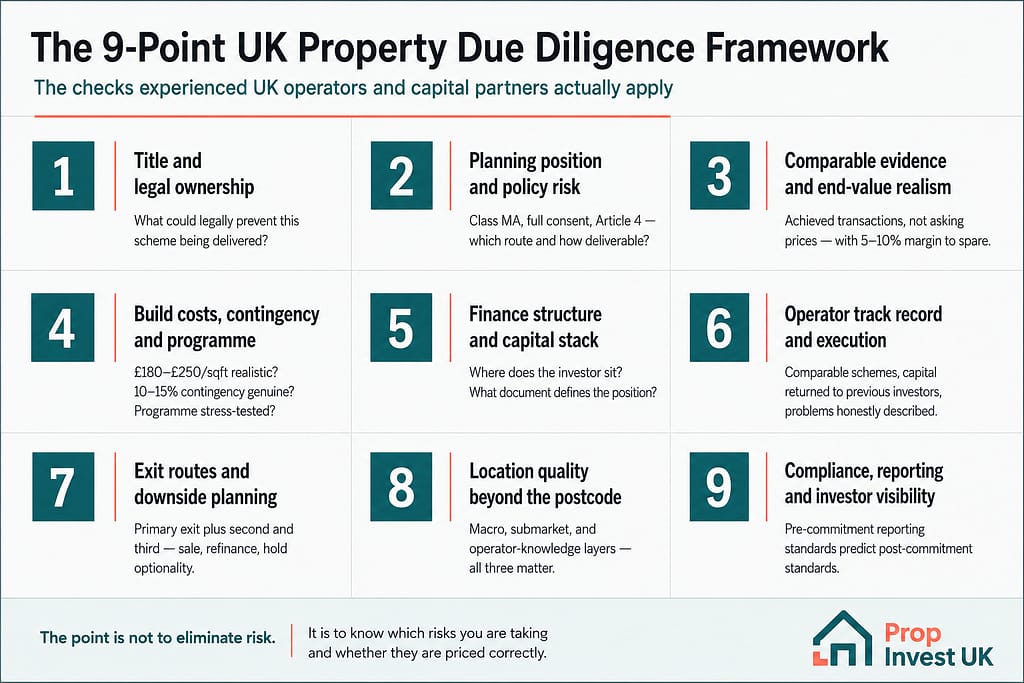
This article sets out the nine due diligence checks that experienced UK property operators and capital partners actually use. Each is grounded in the specific mechanics that matter in 2026, not in generic advice. It is the framework Vernon Property Group applies internally before committing to any acquisition, and the standard a serious investor should hold any operator to before committing capital.
Property due diligence is not a box-ticking exercise. It is the single most important determinant of whether capital returns or doesn’t. Most property mistakes are not caused by bad markets — they are caused by weak underwriting at the start.
1. Title and legal ownership
Start with the legal position because it determines what’s actually possible. You need to know who owns the asset, whether the title is clean, and what restrictions sit on the property that could affect development, refinance, or sale.
Specifically: covenants restricting use, rights of way, ransom strips affecting access, easements over services or land, restrictive use clauses, and any unusual title defects flagged by the Land Registry. Some of these can be worked around through indemnity insurance or deed of variation; others are deal-breakers. The distinction has to be made before exchange, not after.
For assets being acquired through an option, conditional contract, or partnership structure, the legal position underneath the headline arrangement needs to be understood in plain English. Local authority searches typically take two to three weeks and cost £100–£250 (📊 source: industry-standard UK conveyancing pricing, 2026); when an opportunity moves faster than that, something is being skipped.
The diagnostic question: what could legally prevent this scheme being delivered, and where would that show up in the legal pack?
2. Planning position and policy risk
The single area where inexperienced investors most often get caught. There is a material difference between sites with genuine planning support and sites where the case is speculative.
Where consent is in place, the quality of that consent matters as much as its existence. Conditions attached to consent, reserved matters still to be discharged, Section 106 obligations, Community Infrastructure Levy exposure — all can materially alter scheme viability between the date consent is granted and the date works start.
Where consent is not yet in place, the local policy context determines the probability of obtaining it. Is the scheme aligned with the current local plan? Have similar applications nearby been supported or refused? Are there highways, design, ecology, heritage, or amenity concerns that could weaken the case? Is the site in an Article 4 area where permitted development rights have been removed?
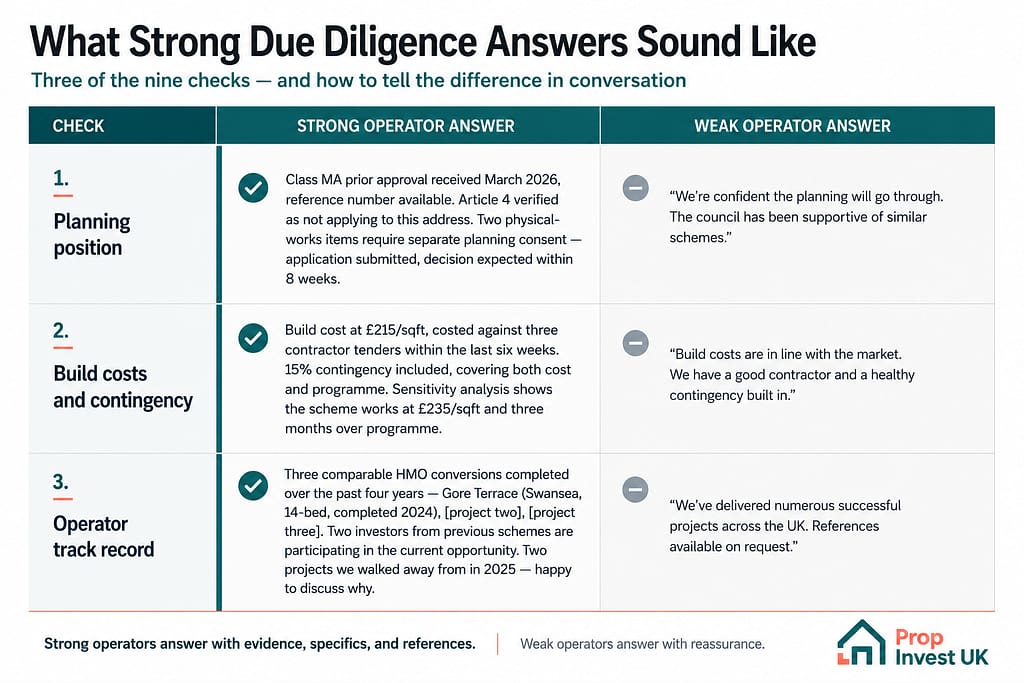
For commercial-to-residential conversions specifically, the route choice between Class MA prior approval and full planning consent — and whether the building’s history of Class E use exceeds the two-year qualifying period — sits at the heart of the planning assessment. Operators who don’t know which route applies to a specific building they’re proposing to acquire haven’t done the work.
3. Comparable evidence and end-value realism
Overpaying at acquisition is one of the easiest ways to damage a scheme. Overstating gross development value is one of the easiest ways to make a weak deal appear investable. Both come from weak comparable analysis.
Disciplined comparable work means looking at what has actually transacted — not asking prices, not optimistic agent appraisals — in the immediate vicinity, in comparable condition, over the past 12 months. For development schemes, that means GDV evidence on completed comparable units, ideally from the same operator team or from comparable schemes in the same micro-location.
For rental-led hold strategies, the same discipline applies to rents. Asking rents on portals are aspirational; achieved rents on completed lettings are evidence. Void assumptions need to reflect realistic local market conditions, not a perfect-occupancy spreadsheet.
The test isn’t whether the comparables support the appraisal. It’s whether the comparables support the appraisal with margin to spare — typically 5–10% below the operator’s assumed exit value, so the scheme still works if the market softens between acquisition and exit.
4. Build costs, contingency and programme realism
The cost plan needs to reflect the job in front of you, not a template applied across schemes.
For standard UK residential development in 2026, build costs typically sit in the £180–£250 per square foot range, more for higher specification, conversions involving structural complexity, or listed buildings. Cost movement during a 12–18 month project of 5–10% is the realistic operating assumption — not 0%, not 2%. Operators without strong contractor relationships absorb that movement themselves; operators with weak appraisals pass it through to contingency and beyond.
Contingency itself needs to be genuine. Industry standard is 10% of build cost as a minimum, 15% on more complex schemes such as conversions or listed buildings. A 5% contingency on a complex conversion is a deal that hasn’t priced its execution risk honestly.
Programme matters as much as cost. Delays don’t just test patience — they alter finance costs, holding costs, and exit timing. A six-month planning delay on a leveraged development can move the project from profit to loss before any work has started. A realistic appraisal stress-tests programme assumptions, not just cost ones.
The diagnostic question: does this appraisal still work if build costs come in 10% over plan and the programme slips three months? If not, the contingency isn’t real.
5. Finance structure and capital stack
A strong property can still be a poor investment when the finance is badly structured.
The areas worth interrogating: senior debt terms (LTV, LTGDV, interest rate, fees, refinance trigger conditions), drawdown conditions and how they line up against build milestones, interest exposure during the build period, the order of repayment across the capital stack, and the documentation supporting each layer.
The investor’s specific position within that stack determines the actual risk profile. Equity at the top of the stack carries different risk than mezzanine debt below it, which carries different risk than secured first-charge lending. The investor needs to know exactly where their capital sits, what document defines that position, and what enforcement rights exist if things don’t go to plan.
A specific red flag worth knowing about in 2026: operators relying on investor deposits or capital to fund pre-construction or break-ground costs because senior debt isn’t yet arranged. This is structurally different from investors participating alongside a properly financed scheme. Financial liquidity at the operator level is part of due diligence on the deal.
6. Operator track record and execution capability
The asset matters; the people controlling the outcome matter more. An excellent site in weak hands produces a weak result. A modest site in capable hands often outperforms.
Track record needs to be specific, not generic. What comparable schemes has this operator delivered? In what locations? Through what market conditions? How were problems handled when they arose? What does their previous-investor relationship history look like — are they working with the same capital partners across multiple projects, or starting from cold each time?
Any operator can present the projects that worked. The more revealing question is how they describe the projects that didn’t — the planning refusal that required a redesign, the conversion that hit structural problems on survey, the build that ran six months over. Operators who can explain difficult projects with the same clarity they apply to successful ones have done real work. Operators who only present wins haven’t.
For capital partnerships specifically, the operator’s track record on returning capital to previous investors is the most direct evidence of competence in that role. Property reputation generally and capital-partner track record specifically are not the same thing.
7. Exit routes and downside planning
Every deal needs a primary exit. Serious underwriting tests the second and third.
The diagnostic: if the primary exit doesn’t work — the sales market softens, refinance terms tighten, planning is delayed — what’s the contingent route, and does it still produce an acceptable outcome? A scheme designed for sale-only exit, into a sales market that doesn’t cooperate at completion, has limited options. A scheme designed with refinance-and-hold as a real alternative has materially more flexibility.
The strongest UK development models in 2026 build optionality at the exit stage as a deliberate structural feature, not as a fallback. The same completed asset that can be sold can also, in most cases, be refinanced at the post-completion valuation and held for long-term rental — converting the development margin into both equity release and ongoing income. Schemes designed with that optionality from the outset are more resilient than schemes that improvise at completion.
Downside planning isn’t pessimism. It’s professional practice. Capital protection comes from understanding what happens when conditions are less favourable than the appraisal assumes — not from hoping they won’t be.
8. Location quality beyond the postcode
Location matters, but the typical commentary on it is too broad to be useful. A strong postcode does not automatically support a strong scheme; a less fashionable area can support a profitable one if the underlying fundamentals are right.
Useful location work happens at three levels.
Macro level. Transport links, employment drivers (multiple, not single), school demand, supply pipeline, regeneration commitments, local authority disposition toward development. Single-employer towns and single-university markets carry concentration risk that headline yield figures don’t disclose.
Submarket level. Which streets outperform within the wider area? Which blocks have management issues? Which micro-locations have proven resale and rental depth? The market is genuinely hyper-local, especially in residential property.
Operator-knowledge level. Local contractor relationships, planning officer experience, sourcing access, demand evidence at the street and building level. This is the layer external investors can’t easily replicate themselves, which is exactly why operator quality and location quality are linked in practice.
For investors focused on regions like the South West, South Wales and the M4 corridor, broad regional confidence means little if the scheme sits in the wrong pocket of the local market. The operator’s specific knowledge of the immediate area is part of the location assessment.
9. Compliance, reporting and investor visibility
The final check is often dismissed as administrative. It isn’t.
Investor reporting standards before commitment are the strongest predictor of reporting standards after. If the operator’s pre-commitment communication is structured, specific, and grounded in documents, the post-commitment reporting usually follows. If the pre-commitment communication is glossy, vague, or focused on tone over substance, the post-commitment reporting tends to disappoint.
Specifically: how are funds handled and where do they sit (escrow, client account, project SPV)? How frequently is progress reported, in what format, naming what specific project milestones? What legal documentation supports the arrangement and the reporting obligation? What happens if the operator and investor’s interpretation of progress diverges?
Transparency is a commercial discipline. It allows investors to monitor capital, identify issues early, and make decisions based on evidence rather than reassurance. In a professionally run arrangement, reporting is part of how the structure works, not an afterthought layered on top.
How to apply the framework in practice
The value of these checks is not in reading them once. It is in applying them consistently to every opportunity.
A disciplined investor reviews any UK property opportunity through the same lens: legal clarity, planning strength, valuation realism, cost and programme discipline, finance structure, operator quality, exit flexibility, location depth, and reporting standards. Most opportunities won’t score perfectly across all nine. Property is not that neat.
The point isn’t to eliminate risk — every property opportunity carries it. The point is to identify which risks are present, whether they’re priced correctly in the appraisal, whether the operator has the capability to manage them, and whether the structure protects investor capital if they materialise.
That’s the difference between disciplined investing and being sold a story. The framework doesn’t tell you which opportunities to back. It tells you which questions to answer before committing capital — and which opportunities aren’t ready for it because the answers aren’t there yet.
At Prop Invest UK, this is the framework we apply internally to every Vernon Property Group acquisition before we proceed. The same nine checks we use ourselves are the standard we expect investors to apply to any operator they’re considering — including us.
—
About Prop Invest UK
Prop Invest UK is a property development business working with investors who want exposure to UK property development without taking on operational delivery themselves. Each opportunity is sourced, structured, and delivered by an experienced developer, with investors participating as capital partners on a deal-by-deal basis.
Join the investor list to receive details of future opportunities as they become available, subject to investor qualification and project documentation.
—
This article is for general information purposes only and does not constitute financial advice or an offer to invest. UK property investment involves risk, including the risk of capital loss, and returns are not guaranteed. Past performance is not a reliable indicator of future results. Any specific opportunity is offered only to investors who qualify under the relevant exemptions and who have received the full project documentation. If you are uncertain whether an investment is suitable for your circumstances, you should consult an FCA-authorised financial adviser.
—