
Trebanos was a single auction lot that most developers wouldn’t have bid on. Four problems had stacked up against it: a corner with historic subsidence, Japanese knotweed in the garden, a flood-zone designation, and a single title covering what was effectively two separate semi-detached houses — meaning neither could be mortgaged independently. The acquisition price reflected the friction. The structural work happened at HM Land Registry, not on site: the title was split into two separate mortgageable titles, producing roughly £120,000 of value uplift on a £130,000 acquisition before a single physical change was made. The remaining three problems were priced, treated, and managed. This case study explains what was bought, what was solved, and what the numbers actually show.
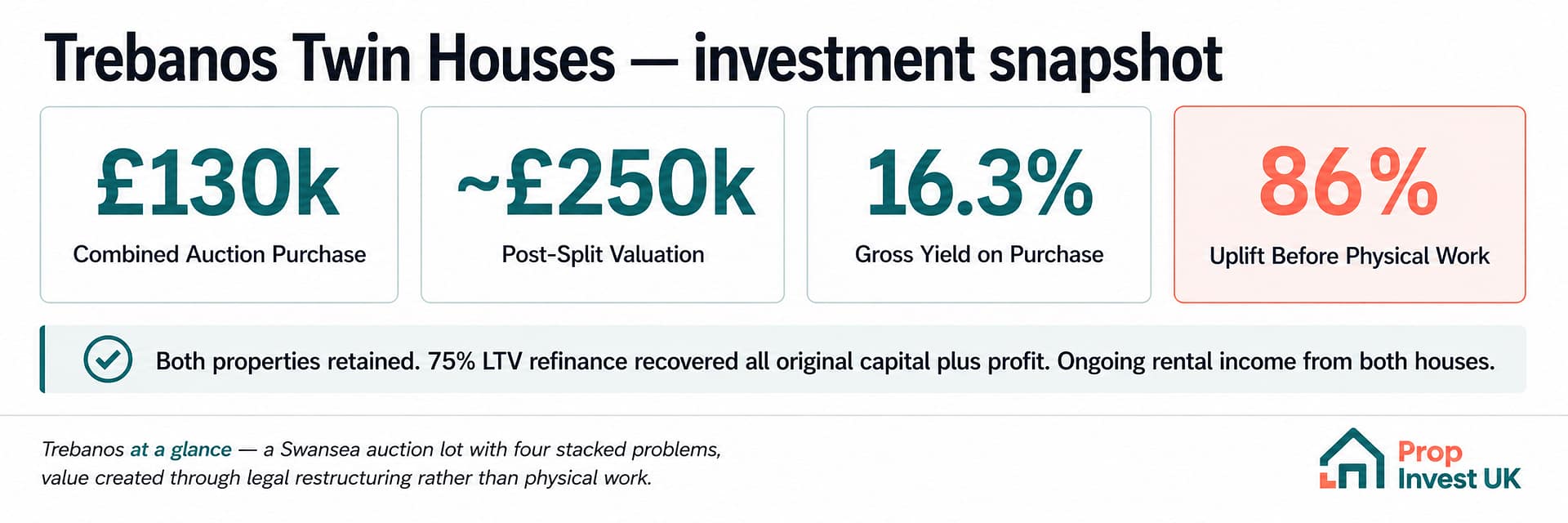
Investment snapshot
- Project type: Twin semi-detached houses, single auction lot
- Location: Trebanos, Swansea Valley, South Wales
- Acquired: Auction purchase
- Purchase price: £130,000 (for both properties on a single title)
- Value created at title split: ~£120,000 (86% uplift before physical work)
- Performance: 16.3% gross yield on purchase price
- Refinance: 75% LTV producing ~£195,000 — all original capital recovered plus profit
- Current status: Both properties retained for ongoing cashflow
The opportunity
Trebanos came to market as a single auction lot — two semi-detached houses sharing one HM Land Registry title. The combined asking price reflected the auction listing’s complications, not the underlying value of the bricks.
This kind of lot is exactly the type of property that most buyers walk past:
- It can’t be mortgaged in its current legal form — a single title covering two physically separate dwellings creates lender headaches that most high-street institutions won’t touch
- The geographic location had multiple complicating factors stacked together (subsidence history, knotweed, flood-zone designation)
- Each individual problem would be enough to deter casual buyers. Four problems stacked together kills bidding interest entirely
That stacking of friction is what made the price available. The properties themselves were structurally and commercially sound in everything except the legal-structure-plus-historical-baggage combination that determined the listing price.
The deal was sourced through Vernon’s auction network and on-the-ground knowledge of the Swansea Valley market. The same lot in a standard residential transaction would have priced significantly higher; the auction format and the stacked problems suppressed competition.
The challenge
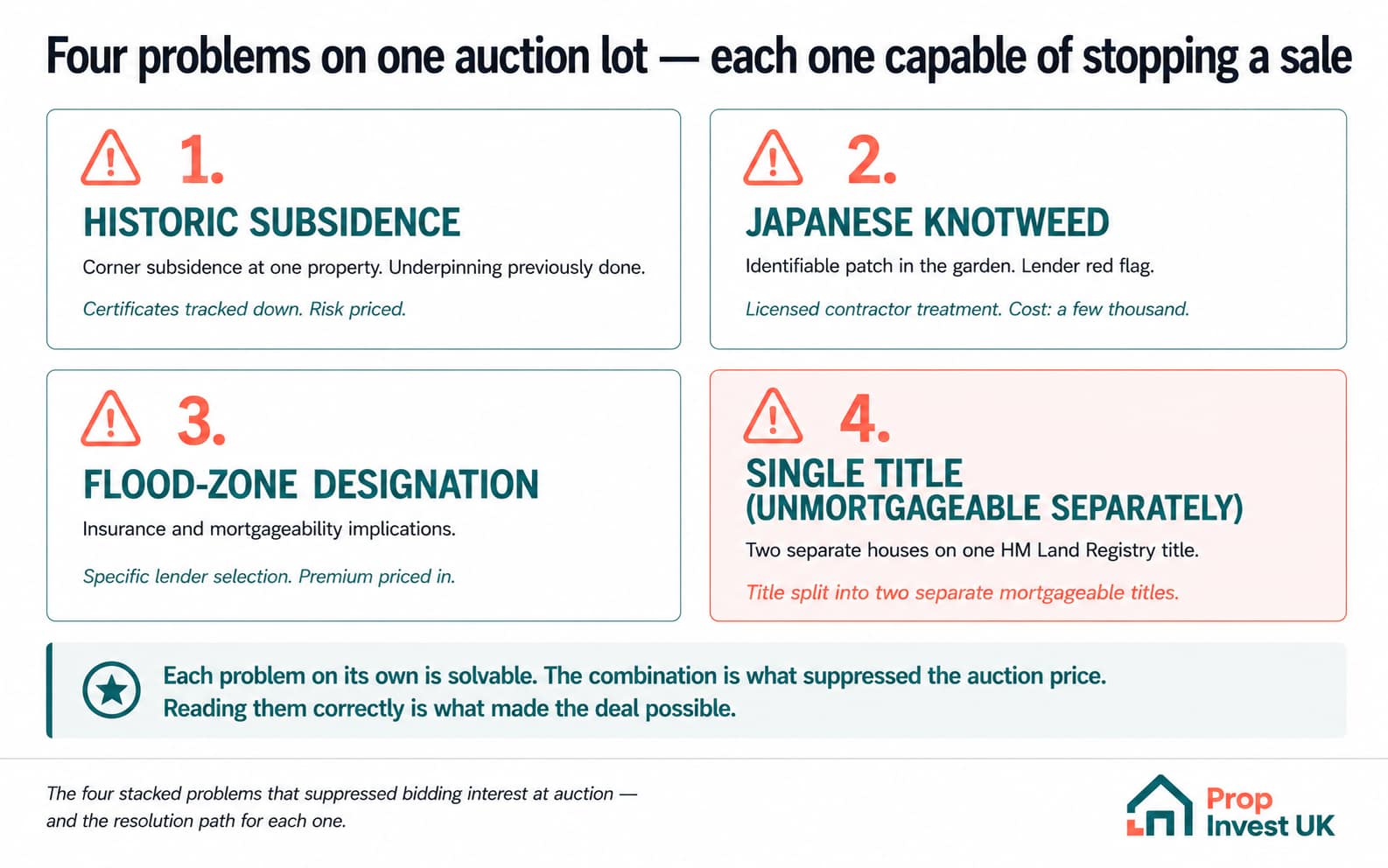
Four distinct problems on a single lot — each one capable of stopping a sale on its own.
Problem 1 — Historic corner subsidence. One of the properties had subsided at a corner at some point in the past. The previous owners had underpinned it. The remediation work was done, but the certificates and engineering sign-off were not readily available — meaning the next buyer would inherit an unproven remediation history.
Problem 2 — Japanese knotweed. Present in the garden. Identifiable, contained to a specific patch, and treatable through standard licensed contractor processes — but a major lender red flag at the point of mortgage application.
Problem 3 — Flood-zone designation. The properties sat in a designated flood zone. Insurance and mortgageability both have specific implications when a property is flood-zoned, and most standard lenders apply rules that exclude or premium-rate these.
Problem 4 — The single title. The two physically separate semi-detached houses sat on one HM Land Registry title. Neither property could be sold independently. Neither could be mortgaged independently. The lot was effectively unmortgageable as it stood.
Each problem on its own is solvable. The combination is what suppressed the price. The work was to assess whether each problem was solvable, price each one accurately, and execute the legal restructuring that unlocked the value.
The strategic solution
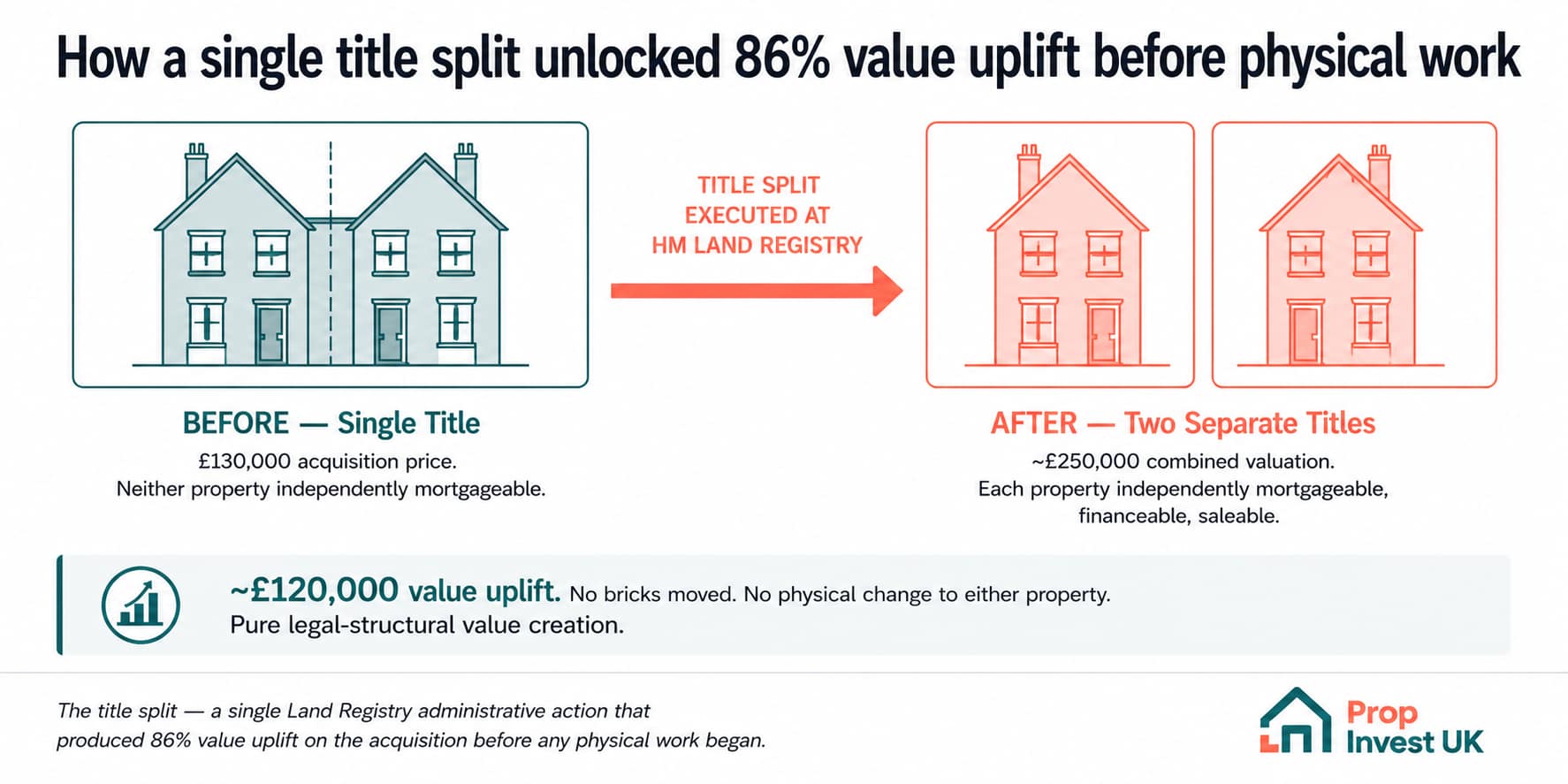
The primary value-creation mechanism here was a legal structural change at HM Land Registry — not a physical change to the buildings.
The title split
The single Land Registry title was split into two separate titles, one for each semi-detached property. This was administrative work executed through proper legal process — solicitor instruction, Land Registry application, certificates of title issued separately for each property.
The economics of that single action:
- Acquisition price: £130,000 (for both properties combined on one title)
- Post-split valuation: ~£250,000 (two independently mortgageable properties)
- Value uplift from title split alone: ~£120,000
86% uplift before any physical work had been done. No refurbishment yet. No structural alterations. The properties were physically identical the day after the title split to the day before. The value came from the legal restructuring that made them independently saleable, independently mortgageable, and independently financeable.
Pricing and treating the other three problems
With the title split unlocking the headline value, the remaining three problems were priced and managed through standard professional process:
Subsidence certificates: Tracked down the historic underpinning certificates and engineering sign-off. Confirmed remediation was completed, properly certified, and would not be a barrier to future mortgageability. Cost: minimal — primarily professional time chasing the documentation.
Japanese knotweed: Engaged a licensed contractor for treatment. Identifiable patch, clear treatment plan, standard licensed remediation. Cost: a few thousand pounds, manageable within project budget.
Flood-zone designation: Managed through insurance and finance structuring. Standard lenders excluded; specific lenders with flood-zone-aware policies engaged. The risk was priced into the finance arrangement, not pretended away.
Each problem had a defined solution path, a defined cost, and a documented outcome. None of them were “make it disappear” — each was “price it correctly and manage it properly.”
The numbers
Total investment
| Item | Amount |
|---|---|
| Auction purchase price (combined lot) | £130,000 |
| Title split (solicitor + Land Registry) | ~£2,000 |
| Japanese knotweed treatment | ~£3,000 |
| Subsidence documentation recovery | minimal |
| Insurance/finance structuring | included in standard project costs |
| Total investment (excl. refurb) | ~£135,000 |
Performance
| Metric | Value |
|---|---|
| Gross yield on purchase price | 16.3% |
| Both properties producing rental income post-completion | yes |
Post-split / post-completion value
| Metric | Value |
|---|---|
| Post-title-split valuation | ~£250,000 |
| Value uplift from title split alone | ~£120,000 |
| Uplift as % of acquisition | 86% before physical work |
Refinance position
| Metric | Value |
|---|---|
| Refinance at 75% LTV | ~£195,000 |
| Original capital deployed | £130,000 |
| Capital recovered through refinance | ~£195,000 |
| Outcome | All money out plus profit, both properties retained |
The refinance produced more than the original investment — meaning the project crossed into “money-out-plus” territory rather than just no-money-left-in. Both properties remain in the portfolio producing ongoing rental income.
Why this case study matters
Trebanos is included in the case study set because it demonstrates what the brand calls strategic acquisition discipline applied to a multi-problem asset. The lot was technically available to anyone bidding at the auction. It was practically unavailable to most bidders because the stacked problems looked insurmountable from the outside.
The disciplines this project demonstrates:
- Problem assessment, not problem avoidance. Each of the four problems was a defined, solvable issue with a known cost. Reading them correctly is what made the deal possible.
- Value creation through legal structure, not physical work. The headline £120k uplift came from a title split, not a refurbishment. Most operators focus on the physical work and miss the legal/structural value-creation routes entirely.
- Pricing risk rather than ignoring it. The flood zone, subsidence, and knotweed weren’t hidden — they were priced into the acquisition and managed through the project. No pretending the problems didn’t exist.
- Off-market sourcing through operator networks. The lot came through Vernon’s auction network — not Rightmove — which is consistent with the broader sourcing pattern across the project portfolio.
This kind of deal isn’t common. The combination of multiple solvable problems, a legal-structure opportunity, and an auction format that suppressed competition is rare. But the disciplines that find and execute this kind of deal are repeatable — and they’re the same disciplines applied to the conversion projects, the HMOs, and the standard refurbishments.
How this fits the wider portfolio
Trebanos sits alongside the larger conversion work at Mozarts and the HMO conversion at 12 Gore Terrace, and represents the strategic acquisition end of the project mix — properties where the value-creation mechanism is the operator’s ability to read a complex situation correctly, not just to manage a refurbishment well.
The portfolio combines:
- Strategic acquisition projects (Trebanos, the walked-away deals, the auction lots with stacked problems) — where the operator earns the margin at the point of purchase through problem assessment
- Conversion projects (Mozarts, the commercial-to-residential pipeline) — where the operator earns the margin through planning consent and physical reconfiguration
- Refurbishment projects (Evans Terrace and similar) — where the operator earns the margin through disciplined execution on standard residential stock
All three apply the same evaluation framework — set out in How We Evaluate and Structure a Property Development Deal — but the route to value differs. That mix is what builds a balanced portfolio rather than a one-trick approach.
How we approach this kind of project at Prop Invest UK
The lens we apply to multi-problem acquisitions: each problem has to be defined, priced, and have a clear solution path before acquisition proceeds. If any one problem is open-ended or genuinely insurmountable, the deal doesn’t happen — regardless of how attractive the headline price looks.
For projects of this complexity, our discipline is set out across How to Vet a Property Operator and What Security Do Private Investors Actually Get — both of which apply directly to how investor capital sits within strategic acquisition projects.
Want to receive analysis of current UK property opportunities?
If you want to receive analysis of current UK property development opportunities — including project structure, security, operator capability, and projected outcomes — you can join the Prop Invest UK investor list. We share specific opportunities with capital partners on the list as they come to market.
This article describes a completed project at Vernon Property Group and is general information only, not financial advice. UK property investment carries risk; capital is at risk. The figures shown relate to this specific completed project and are not indicative of future returns on any other opportunity. Property development opportunities are typically not regulated by the Financial Conduct Authority, and investors do not have access to the Financial Ombudsman Service (FOS) or the Financial Services Compensation Scheme (FSCS). Specific development opportunities should be evaluated with appropriate professional advice.