
Most operator content shows projects that happened. The deals that didn’t happen are often more revealing. This article walks through two opportunities that our group worked up to inspection and property development due diligence stage in 2024 and 2025 — a new build in Taunton and a conversion in Warminster — and the reasoning behind the decision to walk away from both. Walk-away discipline is the unglamorous foundation of investor capital protection.
Compliance note: This article is general information about the operator’s diligence process, not financial advice. UK property development carries risk, including the risk of total loss of capital invested. The examples described reflect specific deals at specific points in time and are not indicative of how every future opportunity will be evaluated. Past operator decisions are not indicative of future performance.
Why walk-away stories matter
The investor pitch from most property operators is structured around the deals that worked. Case studies of completed projects. Track records of delivered returns. A pipeline of opportunities in development.
This is fine as far as it goes. It is also the easy part.
The harder, more revealing question is: what does the operator say no to? What gets through diligence, all the way to the inspection or the structural survey, and then doesn’t proceed? What are the filters that catch projects which look attractive on paper but shouldn’t be funded?
For a capital partner committing money to a development opportunity, the answer to that question is more diagnostic than any completed project. Anyone can show off a finished conversion. The discipline of walking away from a deal you’ve already spent money diligencing is a different kind of competence — and it’s the one that determines whether your capital is protected from the projects that should never have happened.
This article walks through two such decisions from our recent pipeline. The first is a new build in Taunton. The second is a conversion in Warminster. Both went deep into the diligence process. Both didn’t proceed. The reasoning matters more than the headline.
Deal one: the Taunton new build
The Taunton opportunity was a partially completed new build site. Foundations were in. The previous owner had walked away from the project. We were approached as a potential takeover developer.
On surface assessment, the deal had attractive features:
- A region within our South West operational footprint
- Existing foundations meaning a meaningful proportion of groundworks cost was already absorbed in the acquisition price
- A defensible exit route — new build residential into a known regional tenant and owner-occupier market
- An acquisition price that, at headline level, looked workable against projected GDV
Our process on opportunities of this shape doesn’t start at “what does the deal look like on a spreadsheet.” It starts with structural diligence. For a part-built site, the most critical question is: what’s under the ground, and was it done correctly?
Foundations are unforgiving. A new build that proceeds on incorrectly executed foundations either fails inspection later or — worse — passes inspection and creates structural issues over the life of the building. For a developer taking over a partially completed project, every other diligence question is secondary to verifying the work already done.
Our process here was to verify against the building control record. Building control inspections are part of the formal construction regulatory process. They produce a documentary trail. For groundworks already complete, that documentary trail is the evidence base.
We obtained the building control records, reviewed them against the foundations on site, and confirmed that the work under the ground had been executed to the recorded standard.
That sounds like a green light. The structural diligence had passed. The previous operator’s groundworks were sound.
The problem was further up the deal.
The Taunton numbers — and why they didn’t quite work
Once structural diligence had cleared, we ran the full project economics. Acquisition cost. Estimated build cost to complete from the existing foundation stage. Senior debt cost. Soft costs and contingency. Projected GDV at completion.
The numbers were close. Close enough that an operator under pressure to deploy might have proceeded.
They were not close enough for us.
Our discipline on a project of this kind is that the development margin needs to be large enough to absorb at least one significant adverse event without destroying the project economics. That means construction cost overrun, an unfavourable refinance valuation, a delay in sale that extends senior debt cost — any of these can happen in a normal-course development. The deal needs to be priced with enough margin that a single adverse event doesn’t turn a viable project into a problem project.
On the Taunton numbers, the buffer wasn’t there. Everything had to go right for the deal to deliver a sensible return. If construction costs ran 10% over budget — well within the normal range for a development project — the margin would be squeezed to the point where the project was being delivered for the benefit of the senior lender and the contractors, with little left over for equity or investor returns.
Our view: close is not enough.
There is a kind of operator discipline that says “the deal is workable, let’s get on with it.” That discipline has built many UK property businesses and lost many capital partners’ money. Our discipline is the opposite: if the margin is thin, the deal is no. Because the next adverse event will turn a thin margin project into a loss-making project, and the loss falls on the capital stack.
The team walked away. The diligence work on the structural verification — building control records, site inspection, valuation cross-check — was sunk cost. The opportunity to deploy capital into a viable-on-paper project was passed over.
Walking away cost us money. It did not cost the investor list anything, because no investor capital had been raised against the deal.
That is what walk-away discipline does. It absorbs operator cost so that investor capital doesn’t get committed into projects that shouldn’t proceed.
Deal two: the Warminster conversion
The second walk-away is a different shape and tells a different story.
The Warminster opportunity was a conversion deal that, on every metric that we use to source projects, was a textbook fit.
- The right type of building — a commercial property that on layout, age and structure looked well-suited to residential conversion
- The right location — a Wiltshire market town within our operational footprint, with a tenant base for the kind of accommodation the conversion would produce
- The right price — the acquisition cost sat at a level that, on initial assessment, produced sensible development maths even before optimisation
This was a deal that came through our normal sourcing routes and passed every initial filter. It went into formal diligence.
The structural inspection is the critical milestone for any conversion project. Commercial buildings being converted to residential need to support the new use across multiple structural dimensions — load-bearing capacity for residential layouts (typically denser internal walls than commercial), ceiling height for residential building regulations, service routing for bathrooms and kitchens, fire compartmentation, sound separation between dwellings.
A building that looks right on the outside and works on first internal walkthrough can still be wrong at the structural level. The inspection has to confirm it.
Our inspection of the Warminster building was thorough. The team commissioned the right structural assessment.
The inspection revealed structural issues that made conversion impossible.
This is the harder kind of walk-away. The deal had every external indicator of being viable. It came through trusted sourcing routes. The price was right. The location was right. The market was right. Everything was right except for what the building’s structure could actually support.
A different operator under deployment pressure might have responded by trying to re-engineer the conversion plan — fewer units, different layouts, a partial conversion. Sometimes those re-engineering exercises work. Often they don’t, because they involve compressing the project economics around the structural constraint, and the maths starts to deteriorate.
Our view: when a conversion is structurally impossible at the cost level the deal was priced at, the deal is no. The structural reality is the structural reality. No amount of creativity in layout planning fixes a building that physically can’t support the use you’re trying to put into it.
The team walked away. Inspection costs were sunk. The opportunity was passed on.
What both walk-aways have in common
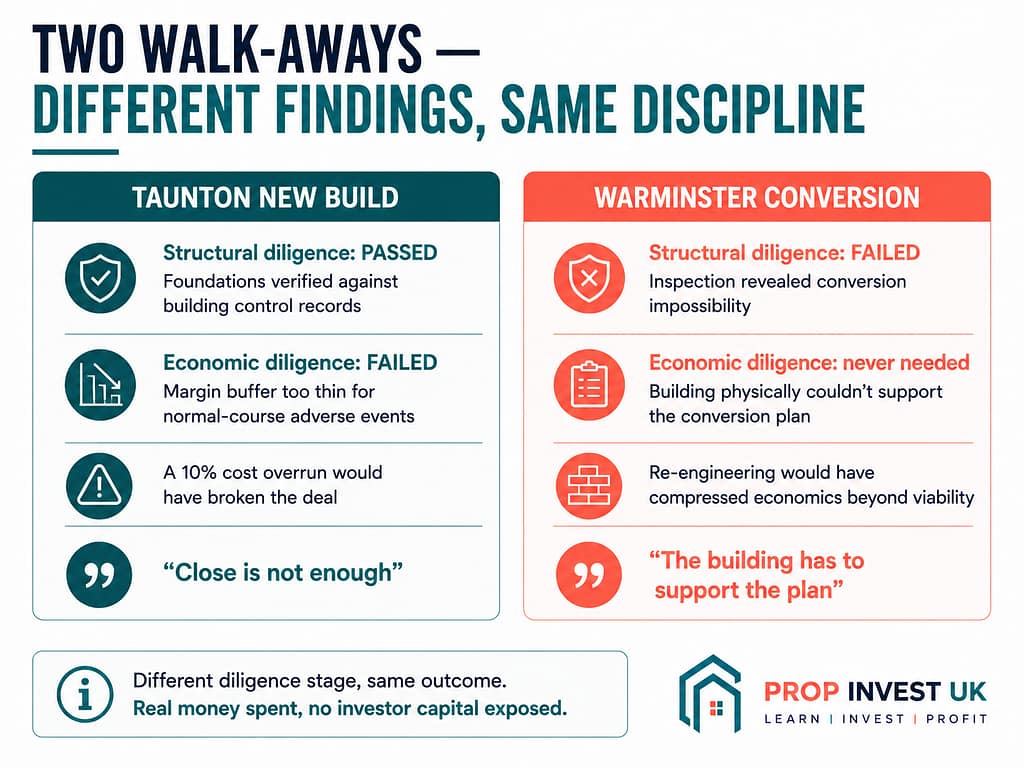
The Taunton and Warminster decisions look different on the surface — one was a numbers problem, the other a structural problem — but they have the same underlying discipline.
Both walk-aways happened after meaningful diligence cost had been spent. This matters. The cheap walk-away is the one where the operator declines a deal at the introduction stage without doing any work. That kind of “discipline” is just inactivity. The discipline that matters is walking away from a deal you’ve already invested in — diligence costs, team time, opportunity cost — because the deeper investigation has revealed why the deal shouldn’t proceed.
Both walk-aways protected capital that hadn’t yet been committed. This is the entire point. Our process keeps deals in the operator’s pre-investor-introduction pipeline through the full diligence sequence. Investor capital is not invited into a project until the diligence has completed and the project economics confirm the deal should proceed. When the diligence kills the deal, no investor was ever exposed.
Both walk-aways accepted operator cost to avoid investor risk. The diligence spend on the Taunton building control verification and the Warminster structural inspection was real money that we paid and didn’t recover. That cost is the operator’s cost. It is not the investor’s cost. The trade-off is fundamental to how the model works: the operator absorbs the cost of finding out which deals shouldn’t proceed, so that the capital partners participate only in the deals that should.
The deals that don’t happen versus the deals that do
There is a useful comparison between the two walk-aways and two completed projects that illustrate why the discipline matters.
Gore Terrace is the unicorn deal — the 14-bed HMO conversion in Swansea that refinanced at 75.23% LTV against a £1.225m valuation, fully covering the £921,538 total project cost. No money left in. The reason that worked was that the building, the price, the conversion plan and the rental market all aligned. Every part of the deal supported every other part of the deal.
Mozarts is the 26-bed conversion currently mid-build, covered in the conversion case study. The deal is running ~3 months over original schedule. Capital partners on the project are receiving pro-rata extra interest for the extension period. The project is over budget on time, not over budget on cost. The reason the project remains viable despite the schedule slip is that the underlying economics were built with enough margin to absorb that slip.
The contrast with the Taunton walk-away is direct. The Taunton numbers didn’t have the buffer that the Mozarts numbers had. If we had proceeded on Taunton and the project ran 3 months over schedule — a normal-course outcome — the deal economics would have moved from thin to underwater. The same adverse event that Mozarts is absorbing within its budgeted contingency would have broken Taunton.
The contrast with the Warminster walk-away is different. Warminster wasn’t an economic margin problem — it was a structural impossibility problem. The closest parallel in the completed pipeline is Windsor Lodge (the Grade II listed conversion that successfully refinanced and where the building’s character actually supported the conversion plan). The difference between Warminster and Windsor Lodge is that Windsor Lodge’s structural reality matched the conversion plan. Warminster’s didn’t.
In both cases, the walk-away is what kept the comparison meaningful. Our completed pipeline isn’t selected from the projects that “got lucky” — it’s selected from the projects where the diligence confirmed the deal worked. The walk-aways are the other side of the same discipline.
What investors should understand about the operator pipeline
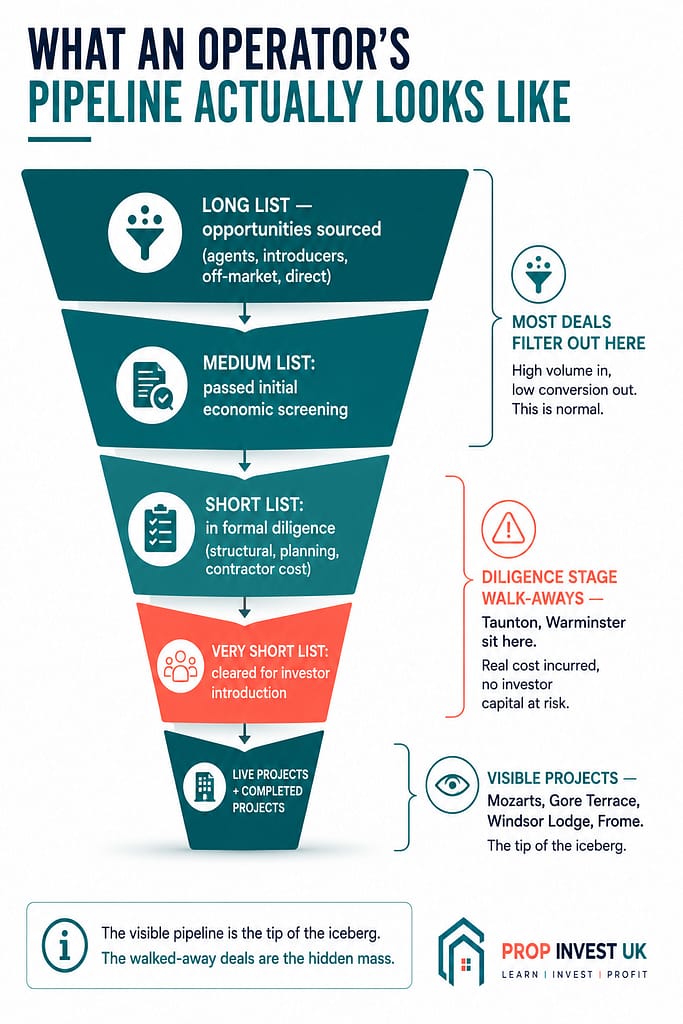
Most investors picture an operator pipeline as a list of approved projects waiting for capital. That’s not quite right. Our pipeline at any moment looks more like this:
- A long list of opportunities sourced through agents, introducers, off-market routes and direct outreach
- A medium list of opportunities that have passed initial economic screening
- A short list of opportunities in formal diligence — structural inspections, planning verification, contractor cost validation
- A very short list of opportunities cleared for investor introduction
- Live projects under construction
- Recently completed projects
The walk-aways happen at the diligence stage. They are an integral part of the pipeline — not a failure of the process, but the process working correctly.
For an investor evaluating the operator, the visible pipeline (live and completed projects) is only the tip of the iceberg. The hidden mass of the iceberg is the deals that didn’t proceed. That hidden mass is where the protection of investor capital actually sits.
An operator with no walk-aways in recent history is either lucky, dishonest, or proceeding into deals that shouldn’t proceed. None of those is the operator you want.
An operator with walk-aways at the structural diligence stage — like these two — is showing you that the process is working.
The cost of saying no, and why it’s an investor protection
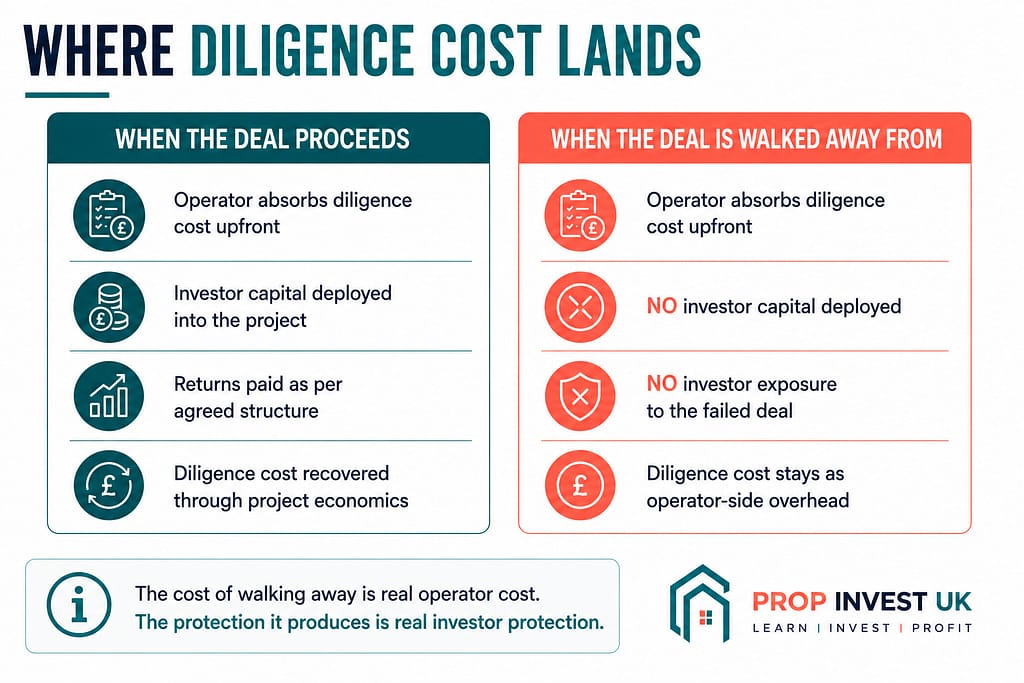
There is a real cost to walking away from a deal after diligence. We paid real money for the building control record review on the Taunton site, for the time spent assembling the project economics, for the structural inspection on the Warminster building, and for the team hours absorbed across both processes.
That cost is part of the operating cost of running the model. It’s the cost of having a deal pipeline that produces protected returns rather than opportunistic ones.
From an investor’s perspective, this cost is invisible. The investor never sees the line item. The investor only sees the projects that proceed, the ones that have been through diligence and cleared. The cost of producing that filtered pipeline is absorbed by the operator on a project-by-project basis.
The investor question that matters here is: what does the operator’s diligence cost discipline look like, and are they willing to walk away from deals after spending it?
Our answer: yes, and the Taunton and Warminster deals are recent examples.
The seven questions to ask any operator about walk-away discipline
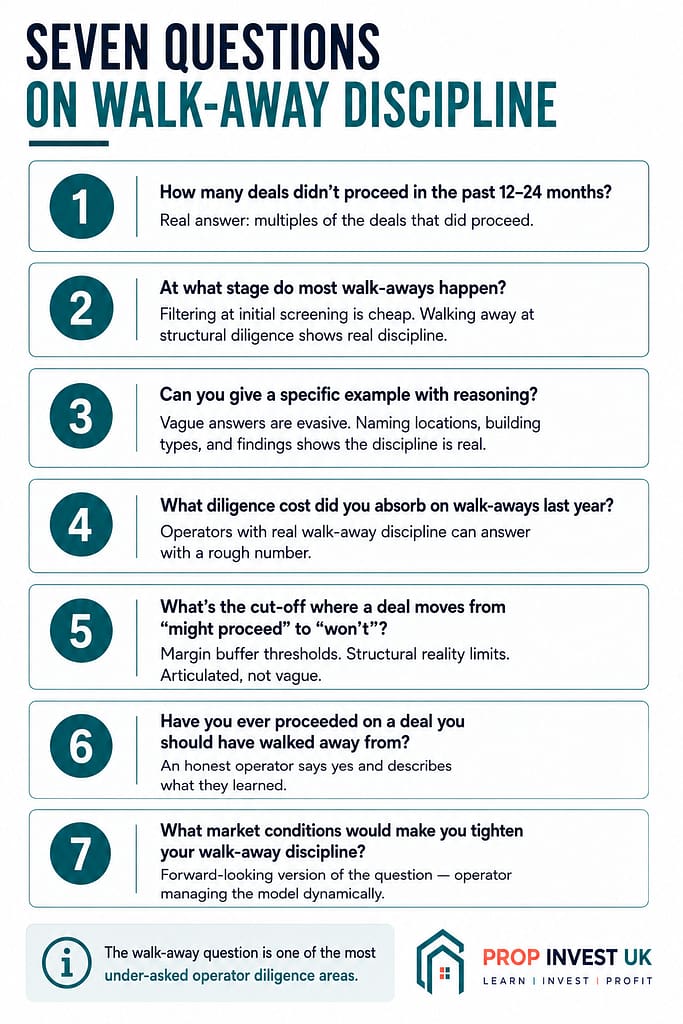
For investors doing diligence on an operator before committing to a capital partnership opportunity, the walk-away question is one of the most under-asked diligence areas. Here are the seven questions worth asking:
- How many deals have you looked at in the past 12-24 months that didn’t proceed? A real answer will be a number that’s larger than the number of deals that did proceed — typically several multiples larger. An operator who claims most of their deals “make it through” is either filtering too lightly at the front end or claiming a higher hit rate than the model supports.
- At what point in your process do most walk-aways happen? A pipeline that filters at initial screening is fine but cheap. A pipeline that walks away from deals at structural diligence stage — after spending real money — is showing operational discipline.
- Can you give me a specific example of a deal you walked away from, and the reasoning? Vague answers here (“we walked away from a few deals that didn’t quite work”) are evasive. Specific examples — naming the location type, the building type, the diligence finding, the decision — show the discipline is real.
- What’s the diligence cost you absorbed on walk-aways in the past year? Operators with real walk-away discipline can answer this question with a rough number. Operators who can’t are either not tracking it or not actually walking away often.
- What’s the structural cut-off where a deal goes from “might proceed” to “won’t proceed”? Our cut-off on a deal like Taunton was the margin buffer — close was not enough. Every operator should be able to articulate their cut-off in similar terms.
- Have you ever proceeded on a deal that, in hindsight, you should have walked away from? An honest operator will say yes and describe what they learned. An operator who claims a perfect record on this question is not being honest about their history.
- What changes in market conditions would make you more willing to walk away from a deal? This is the forward-looking version of the question. An operator who can articulate how their walk-away discipline tightens or loosens with market conditions is showing they’re managing the model dynamically.
How we approach walk-away discipline
Our process is built around the assumption that most opportunities that look attractive at first contact will not pass full diligence. The model deploys capital into the small minority of deals that clear every diligence stage. That requires accepting a high walk-away rate and absorbing the operator cost of running diligence on deals that don’t proceed.
The team’s discipline on margin is “the buffer has to be real.” Thin margin deals get walked away from at the economic diligence stage, before structural inspection is even commissioned. The Taunton deal was unusual in that its structural diligence cleared — the foundations were sound — but the economic margin discipline killed the deal at the next stage.
The team’s discipline on structural reality is “the building has to support the plan.” A conversion plan that requires the building to be something it isn’t doesn’t proceed. The Warminster deal hit this filter at structural inspection.
Both filters cost real money to operate. Both filters protect investor capital from being committed to projects that shouldn’t have happened.
This is the unglamorous, expensive, operator-cost side of running a development model that capital partners can rely on. It doesn’t show up in the marketing. It doesn’t have a celebration moment. It is the foundation on which everything else rests.
In summary
Most operator content shows projects that happened. The deals that didn’t happen are often more revealing of operator discipline.
We walked away from a new build in Taunton and a conversion in Warminster in the recent operational cycle. The Taunton walk-away happened after structural diligence cleared and economic diligence revealed that the margin buffer was too thin to absorb normal-course adverse events. The Warminster walk-away happened at structural inspection, when the building was found to be unable to support the conversion plan.
Both walk-aways happened after we had absorbed real diligence cost. Both happened before investor capital had been committed to either deal. Both protected the integrity of the capital partner pipeline by removing deals that shouldn’t proceed.
For investors evaluating a property development operator in 2026, the walk-away discipline is one of the most diagnostic things to ask about. The visible pipeline of completed and live projects is the tip of the iceberg. The hidden mass of the iceberg is the deals that didn’t proceed. That hidden mass is where capital protection actually sits.
Close is not enough. The building has to support the plan. The margin has to be real. Those are the rules. They cost money to enforce. They are what keeps the model from going wrong.
Join the Prop Invest UK investor list for ongoing operational commentary, case studies of completed projects, and details of capital partnership opportunities as they arise. The list is the route into specific project information — opportunity-level detail is shared with introduced investors only.
This article is general information only and is not financial advice. UK property development carries risk, including the risk of total loss of capital invested. The diligence processes described reflect the operator’s discipline on specific deals at specific points in time and are not a guarantee that all future opportunities will be evaluated identically. Past walk-away decisions are not indicative of future operator behaviour. Past project outcomes are not indicative of future performance on current or future opportunities. UK property development capital partnership opportunities are typically not regulated by the Financial Conduct Authority, and investors do not have access to the Financial Ombudsman Service (FOS) or the Financial Services Compensation Scheme (FSCS). Prospective investors should take independent professional advice before committing capital to any property development opportunity.