
The UK property market in 2026 is rewarding a different kind of investor than it did five years ago.
Cheap debt is gone. Capital appreciation has slowed nationally and split sharply by region. Rental demand remains robust but regulated more tightly than ever. The straightforward buy-to-let model that produced reliable income for two decades is producing it less reliably now. And in the gap that’s opened up, a different model — operator-led, development-focused, regional, hands-off for the investor — is gaining clear ground.
This article is a market commentary on where UK property investment actually sits in mid-2026, what the data is telling us, and what serious investors are doing with it. It synthesises the shifts the cluster has covered piece by piece — regional outperformance, hands-off models, regulation, finance environment, planning reality — into a state-of-the-market view. Every claim is anchored to current source data.
The headline picture: modest growth, sharp regional divergence
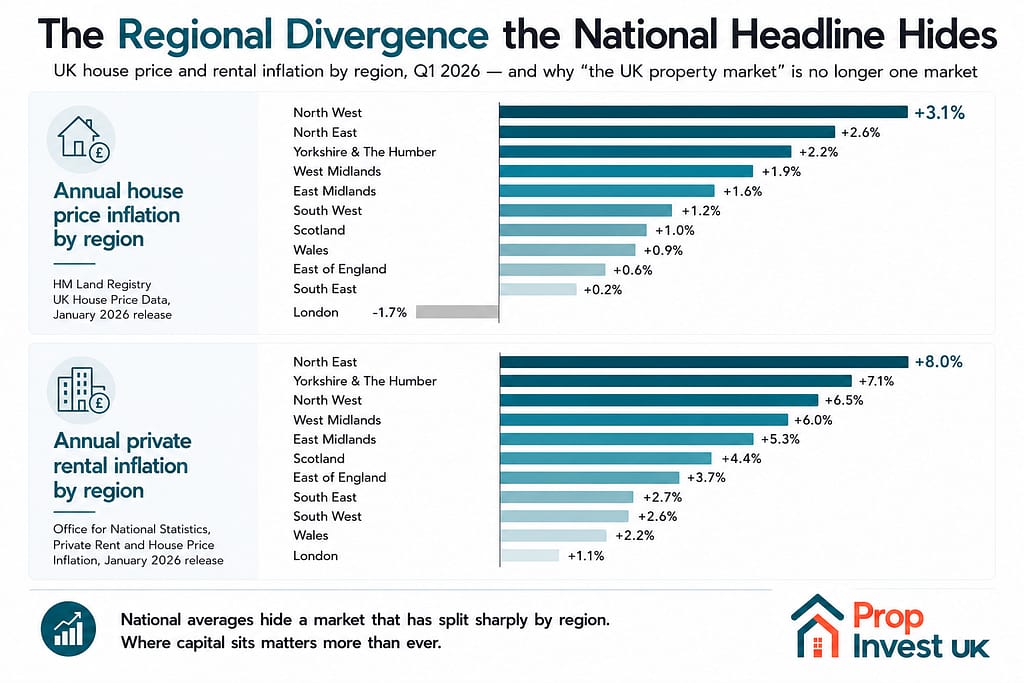
UK house price growth in 2026 is modest by historical standards and sharply divided by region.
Q1 2026 saw an average rise of 1.6% across the four major UK house price indices (📊 source: Viewber Q1 2026 composite report, April 2026). Nationwide’s index showed 2.2% annual house price inflation at the end of Q1. Savills forecasts approximately 2% growth for 2026 overall, with a longer-term forecast of nearly 25% cumulative growth by 2030 (📊 source: Savills 2026 forecast, January 2026).
That headline understates what’s actually happening underneath. The Land Registry’s January 2026 data showed a 4.8 percentage point spread between the strongest and weakest regions: the North West up 3.1% annually, London down 1.7% (📊 source: HM Land Registry UK House Price Data, January 2026 release).
The pattern is straightforward. Affordable regional markets are outperforming. London and the South East are underperforming. And the “UK property market” as a national concept is becoming less useful as a frame — what’s happening in Liverpool isn’t what’s happening in Westminster, and the gap is widening.
For investors, this matters because the national headline rate is the rate that almost nobody actually experiences. The investor in a North West regional scheme is operating in a +3.1% market; the investor in central London is operating in a -1.7% market; both call themselves “UK property investors.” Knowing which sub-market your capital is actually exposed to is now the basic credibility test.
Rental demand: still strong, moderating slightly, regionally divergent
The rental market has been the quieter story of the last 18 months — and the one that matters more for income-led strategies.
ONS data showed UK private rents up 3.5% in the 12 months to January 2026, down from 4.0% the previous month (📊 source: ONS Private Rent Inflation, January 2026 release). The average UK private rent reached £1,367 per month. The regional spread is, again, the headline story underneath the national number: rental inflation hit 8.0% in the North East and just 1.1% in London (📊 source: same ONS release).
The moderating pace at the national level is notable — rents are still rising, but at a pace closer to general inflation than the steep increases of 2022–2024. That moderation doesn’t mean weakening demand. It means the catch-up phase that followed the post-pandemic supply shortage is normalising. Demand remains structurally strong because the underlying drivers — household formation, household size shrinkage, undersupply in the right places, slower owner-occupier formation given mortgage costs — haven’t changed.
For investors, the practical takeaway is that rental income remains a viable strategy in the regional markets where supply is genuinely constrained. It is meaningfully harder in the markets where rental inflation is already low and tenant protection has been tightened. The Renters’ Rights Act 2025, which took effect from 1 May 2026, ended Section 21 no-fault evictions and added regulatory load that’s already showing up in landlord exit data.
The finance environment: tighter, more selective, capital costs higher
The Bank of England’s Bank Rate stood at 3.75% at the start of Q2 2026, with average mortgage rates sitting just under 5% (📊 source: Viewber Q1 2026 composite report, April 2026).
That’s lower than the 5.25% peak of 2023 but materially higher than the sub-1% world of 2009–2021. The structural effect: every property investment now needs to clear a higher hurdle to make sense. A scheme that worked with development finance at 6% and exit refinance at 3% in 2020 doesn’t necessarily work with development finance at 8–9% and exit refinance at 5% in 2026.
Lender behaviour has tightened alongside the rate environment. Basel IV regulatory capital requirements have pushed clearing banks toward more conservative underwriting on development lending, particularly on smaller and mid-sized schemes. The capital that’s filled the gap has come from specialist development lenders, private credit, and increasingly from private investor partnerships. The total volume of UK development capital hasn’t shrunk — it’s restructured, moving from clearing banks toward specialist and private sources.
For investors, the implication is that the operators who can access capital today are a smaller, more disciplined group than the operators who could access capital in 2019. That’s a filter the market is applying for you. The schemes that get funded in 2026 have generally passed more scrutiny than the schemes that got funded five years ago.
The buy-to-let exit: structural, not cyclical
The most-discussed UK property trend of the last two years is the contraction of the buy-to-let sector. The numbers behind the headline:
Approximately 93,000 landlords exited the UK rental market in 2025 (📊 source: Homenicom analysis via Mortgage Soup, March 2026). Savills estimated that roughly 254,000 previously let properties were listed for sale in the year to March 2026 — about 697 a day. Tax changes (Section 24 mortgage interest restriction, stamp duty surcharges, capital gains regime tightening), regulatory load (Renters’ Rights Act, EPC requirements, licensing schemes), and rising operating costs have compressed the economics of personally held buy-to-let to the point where many landlords have concluded the model no longer earns its place in their capital position.
This is a structural shift, not a cyclical one. The tax treatment isn’t being reversed. The regulatory direction isn’t softening. And the operational reality of running personal buy-to-let in 2026 is materially harder than it was when most current landlords bought their first properties.
The relevant question is what happens to the capital those exiting landlords are releasing. Some of it leaves the asset class entirely. Some of it consolidates into larger, more professionally managed positions. And a growing share is moving toward operator-led structures where the capital partner has property exposure without the operational ownership — exactly the shift the cluster’s other articles have been mapping. The 93,000 figure isn’t just an exit story. It’s a redirection story.
What’s gaining ground: operator-led, development-focused, regional

The model gaining capital in 2026 has a specific shape.
Operator-led, not investor-managed. The capital partner participates in projects sourced, structured and delivered by an experienced developer. The day-to-day operational work — sourcing, planning, contractor management, lettings, compliance, reporting — sits with the operator, not the investor. The capital partner’s role shifts to selecting operators, assessing structures, and maintaining oversight through reporting cycles.
Development-focused, not pure income. The model creates value through the development phase rather than relying on open-market acquisition plus market appreciation to produce return. Commercial-to-residential conversions, HMO conversions, refurbishment-led repositioning, and small-scale new-build infill schemes are the dominant project types. The development phase creates equity; the retained or refinanced asset produces ongoing income.
Regional, not London-centric. The South West, South Wales, the M4 corridor, the North West and the Midlands are producing the schemes with viable economics. London and prime central markets are increasingly producing returns that don’t justify the capital required for the deal size to make sense. The ONS rental inflation data — North East +8.0%, London +1.1% — is one signal of where the regional shift is showing up in rents; the Land Registry’s price data is another.
Hands-off for the investor, not absence of governance. The arrangements gaining credibility are the ones with documented structures, defined security or ownership positions, clear reporting cadence, and transparent decision rights. “Hands-off” describes the investor’s operational role, not their level of scrutiny. Operators offering genuinely hands-off arrangements build oversight into the structure as a feature, not a friction.
This isn’t a passing fashion in UK property. It’s the model the structural shifts of the last five years have made commercially sensible.
What this means for serious investors
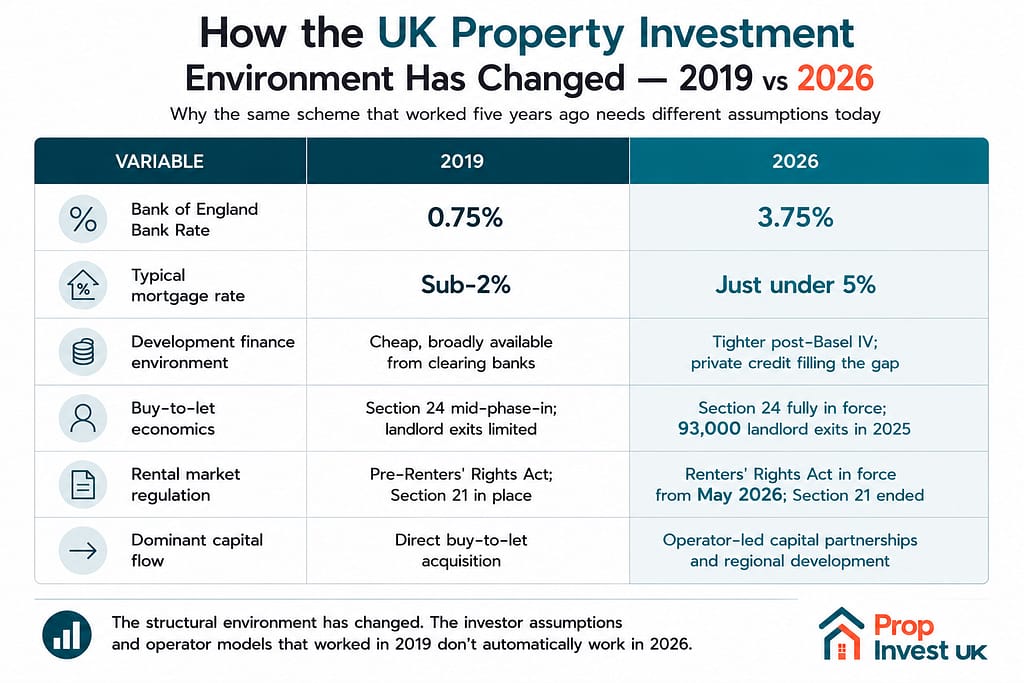
The standard for sound UK property investment has risen. The genuine question for any allocation in 2026 is not whether property still works — it does — but whether the specific scheme, operator, structure, and exit assumption hold up against the current market reality.
The investors doing well in this market generally share five characteristics:
- They’ve stopped thinking nationally and started thinking regionally and at micro-market level
- They’ve moved from open-market acquisition toward operator-led, development-focused strategies
- They’ve moved from direct landlord operations toward structured capital partnerships with experienced operators
- They underwrite to current 2026 cost and finance assumptions, not 2019 ones
- They apply consistent diligence frameworks to every opportunity, regardless of how attractive the headline appears
The investors finding 2026 difficult are usually doing the opposite — still operating on national assumptions, still trying to manage directly while the regulatory load makes it harder, still using cost assumptions from a different rate environment, and still selecting schemes on headline rather than structural basis.
Where the next 12 months are likely to go
A few reasonable expectations for the rest of 2026 and into 2027, based on the current direction of travel.
House price growth will stay modest nationally with the regional divergence widening. The Savills 2% forecast for 2026 looks reasonable; the cumulative ~25% by 2030 forecast assumes the structural housing undersupply continues to support pricing, which it almost certainly will. But the spread between best and worst regional performance is likely to keep widening.
Rental demand will stay structurally strong. The supply contraction from landlord exits, combined with continued slow owner-occupier formation given mortgage costs, supports continued rental demand. The Renters’ Rights Act will continue to shape what kind of landlord can operate profitably, but it won’t reduce tenant demand.
Interest rates will likely ease, but not return to the 2010s baseline. A Bank Rate trajectory toward 3.0–3.5% over the next 12–18 months is the consensus expectation; a return to sub-1% would require a genuine recession. That means the higher hurdle rate for property investment is the new normal, not a temporary feature.
Operator-led structures will keep gaining share. The structural factors driving capital toward professional operators — regulatory load, time pressure on individual investors, finance complexity, planning expertise required — aren’t reversing. The model will continue to attract capital that was previously in direct buy-to-let.
Regional focus will keep deepening. The investors who matter in UK property in 2027 will know specific submarkets in specific cities in specific regions, not “UK property” generally. Regional knowledge is becoming the central operator competence.
How Prop Invest UK reads the market
Our view: the market has become harder to operate in casually, and clearer for investors who want exposure through experienced operators.
Vernon Property Group works in commercial-to-residential conversion and HMO development across the South West, South Wales and the M4 corridor — three of the regions where the current market dynamics are most favourable to disciplined operator-led work. The schemes we evaluate are tested against current 2026 cost benchmarks, current finance market conditions, and realistic regional demand evidence. The capital partners we work with want structured, transparent exposure to that work without taking on the operational delivery themselves.
The market we’re operating in is the same one this article describes. The view we take of it is the same as the one a disciplined investor reading the same data would take. That alignment isn’t coincidental — it’s the result of the same shifts that are reshaping the market reshaping the operators who survive in it.
—
About Prop Invest UK
Prop Invest UK is a property development business working with investors who want exposure to UK property development without taking on operational delivery themselves. Each opportunity is sourced, structured, and delivered by an experienced developer, with investors participating as capital partners on a deal-by-deal basis.
Join the investor list to receive details of future opportunities as they become available, subject to investor qualification and project documentation.
—
This article is for general information purposes only and does not constitute financial advice or an offer to invest. Market data referenced is sourced from third-party providers and is accurate as of the dates cited. UK property investment involves risk, including the risk of capital loss, and returns are not guaranteed. Past performance is not a reliable indicator of future results. Forward-looking statements about the property market reflect current consensus expectations and are subject to revision as conditions change. Any specific opportunity is offered only to investors who qualify under the relevant exemptions and who have received the full project documentation. If you are uncertain whether an investment is suitable for your circumstances, you should consult an FCA-authorised financial adviser.
—