
In UK property investing circles, you’ll hear three letters thrown around constantly: BRR. Buy, refurbish, refinance. The end state of a successful BRR is what insiders call “no money left in“ — A “no money left in” deal is the most-discussed and least-consistently-delivered outcome in UK property investing — the moment a property is refinanced and every penny of original capital returns to the investor while they continue to own the property as a rental asset.
The strategy is taught widely. Books, courses, masterminds, weekend bootcamps. What the marketing doesn’t tell you is how rarely the strategy actually delivers on its promise. The deals that genuinely produce a true no-money-left-in outcome are called unicorn deals — because they’re so rare most experienced investors never complete one.
This guide explains what “no money left in” actually means at the maths level, why it’s so structurally difficult to achieve in the UK market, why most BRR deals fail at the refinance stage rather than the build stage, and the operational disciplines that allow serious operators to deliver unicorn deals consistently when most cannot.
The mechanics of “no money left in”
Most property investors are familiar with the standard buy-to-let model: you put down a 25% deposit on a £200,000 property, get a 75% mortgage for £150,000, and the £50,000 deposit stays in the deal as your equity position. Over time the property appreciates and the rent pays down the mortgage, but the £50,000 of original capital remains tied up in that single asset.
A no-money-left-in deal works differently. The investor:
- Buys a property below its post-refurbishment market value — typically using cash or short-term bridging finance
- Refurbishes the property to increase its value
- Refinances onto a long-term buy-to-let mortgage at 75% LTV of the new (higher) value
- Rents the refurbished property to a tenant
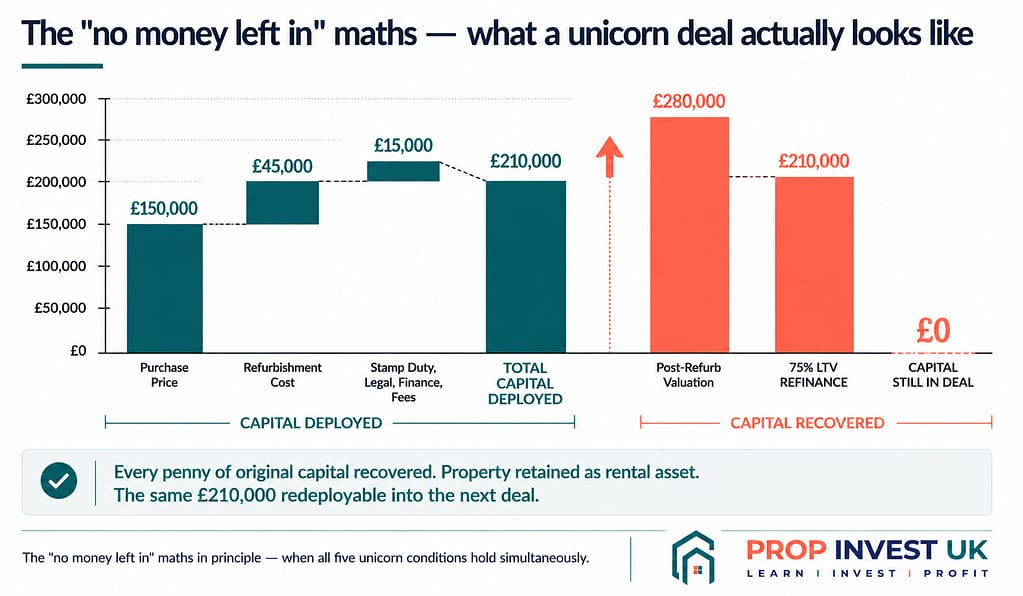
The critical step is the refinance. If the new value is high enough, the 75% LTV mortgage releases enough capital to repay the original purchase price, all refurbishment costs, all fees, all finance costs — and leaves the investor with zero capital still deployed in the property.
The maths, in principle:
| Element | £ |
|---|---|
| Purchase price | £150,000 |
| Refurbishment cost | £45,000 |
| Stamp duty, legal, finance, fees | £15,000 |
| Total capital deployed | £210,000 |
| Post-refurbishment valuation | £280,000 |
| 75% LTV refinance | £210,000 |
| Capital recovered | £210,000 |
| Capital still in the deal | £0 |
The investor now owns a £280,000 property generating rental income, with their original £210,000 fully recovered and redeployable into the next deal. The same capital can be used again, and again, and again. This is the outcome the BRR strategy is built around — and it’s what makes “no money left in” the most-discussed and least-delivered concept in UK property investing.
It’s also why so many people talk about it and so few actually do it.
Why these deals are called unicorns

In active investor circles — particularly the property investor masterminds, forums, and networks where strategies like BRR are discussed seriously — the phrase “unicorn deal” has become the standard term for a true no-money-left-in outcome.
The reason is structural. For a deal to produce a clean no-money-left-in result, all of the following have to be true simultaneously:
- The purchase price has to be substantially below market value — typically 25-35% below the post-refurbishment value
- The refurbishment scope has to add real value, not just cosmetic improvement — and has to be delivered on budget
- The post-refurbishment valuation has to come in at the modelled level — the surveyor instructed by the BTL lender has to support the value the investor is forecasting
- The rental income has to support the 75% LTV mortgage’s affordability requirements — typically 125-145% rental coverage of mortgage interest at stress-tested rates
- All costs combined have to come in at or below 75% of the final valuation
Miss any one of those five conditions and the deal stops being a unicorn. It might still be a profitable BRR — but it leaves capital in the deal, often substantially more than the investor was expecting.
The industry commentary on this is consistent. As one US-focused BRR analyst put it bluntly when describing the realistic deal universe: “Most retail-priced properties don’t work for BRRR. They leave no margin to stay inside the 70-75% ARV constraint after costs” (Ridge Street Capital, 2025).
In the UK specifically, the structural difficulty is compounded by three factors most education programmes don’t discuss honestly.
Difficulty 1: Below-market acquisitions are rare and competitive
The first condition — buying substantially below market value — is the foundation of every unicorn deal. But in 2026 the UK property market is not awash with mispriced opportunities. Most properties on Rightmove and Zoopla are priced at or above current market value. The properties that sell at 25-35% below value tend to fall into one of three categories: auction lots (highly competitive, dominated by experienced bidders), distressed sales (limited and erratic), and off-market opportunities sourced through deep operator networks.
For an individual investor without an established sourcing pipeline, finding even one viable below-market acquisition can take six to twelve months of active searching. For an operator with the right networks and the right reputation, deal flow is consistent — but only because the operator has spent years building the relationships that surface those deals before they hit the open market.
Difficulty 2: Refurbishment scope and execution
Most BRR education emphasises the maths of the refinance. It under-emphasises the operational difficulty of delivering refurbishment to budget and timeline.
A £45,000 refurbishment that runs to £58,000 doesn’t just reduce the deal’s profit — it pushes the total project cost above the refinance ceiling. The investor either ends up with capital stuck in the deal, or has to use additional capital to bridge the gap. Either way, the unicorn evaporates.
Refurbishment cost overruns are common, not rare. They come from contractor pricing, supplier issues, hidden conditions revealed once work begins (particularly in older properties), planning conditions, and changes in specification during the build. Operators who consistently deliver refurbishment to budget have built the systems — contractor relationships, project management, supplier networks, quality control — to do so. Operators new to the activity usually haven’t.
Difficulty 3: The refinance valuation
This is where most BRR deals fail.
The investor’s model assumes a post-refurbishment value of £280,000. The lender instructs an independent RICS-qualified surveyor to value the property. The surveyor’s valuation isn’t a negotiation — it’s a professional opinion based on comparable sales evidence. If the surveyor values the property at £255,000 rather than £280,000, the 75% LTV refinance releases £191,250 instead of £210,000.
The £18,750 gap doesn’t get filled by the lender. It has to be filled by the investor’s capital — meaning £18,750 stays in the deal that was supposed to be a unicorn.
Conservative surveyors, slow regional comparable evidence, and lender pressure to be cautious on valuations all push outcomes toward this scenario. As the industry warns: “Most BRRRR failures are realized at the time of refinancing due to misaligned expectations. Conservative appraisals and incorrect analysis from project onset can leave 20-40%+ of equity on the table” (Ridge Street Capital, 2025).
For an investor expecting a clean no-money-left-in outcome, even a small valuation shortfall is the difference between unicorn and ordinary BRR.
Why most BRR deals leave money in
If you sit through a typical BRR education programme, the case studies presented are almost always genuine unicorn outcomes — because those are the deals that make compelling stories. The deals that left £15k, £25k, or £40k in the property aren’t featured in the marketing material.
But in active UK property investor communities — where investors share real outcomes honestly — the data tells a different story. Industry voices estimate that genuine no-money-left-in deals represent only a small fraction of all BRR completions. The rest leave some capital in the deal — sometimes a small amount, sometimes more than the investor’s original deposit.
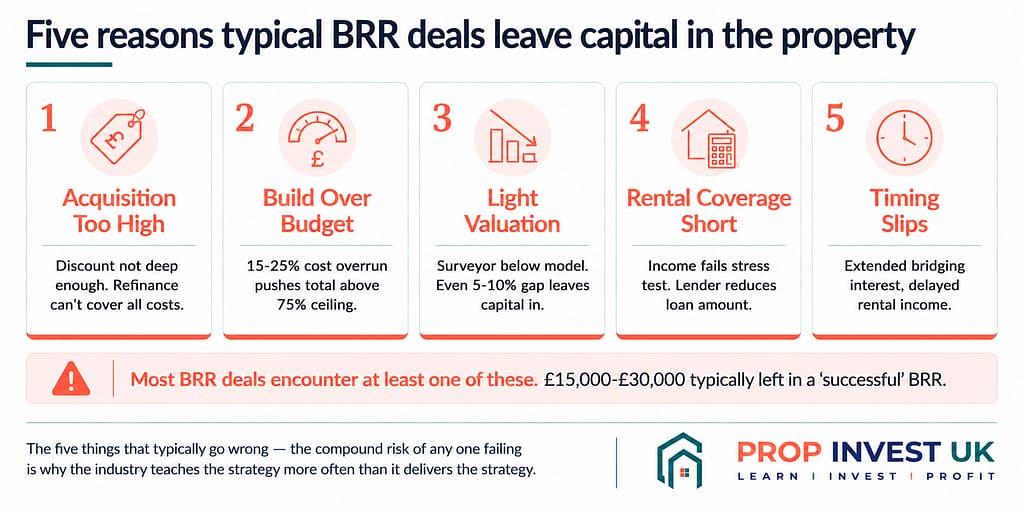
Five things typically go wrong:
1. Acquisition too close to market value. The deal is bought at a discount, but not a deep enough discount. After all costs are added, the refinance can’t cover them.
2. Refurbishment over budget. The build comes in 15-25% over the original budget. The extra cost can’t be recovered through the refinance because it pushes the total above the 75% ceiling.
3. Valuation comes in light. The surveyor’s professional opinion is below the investor’s modelled value. Even modest shortfalls (5-10%) can leave significant capital in the deal.
4. Rental coverage falls short. Even when the valuation supports the LTV, the rental income may not support the affordability stress test. The lender reduces the loan amount accordingly. Capital gets stuck.
5. Timing problems. The deal completes the refinance later than planned. Additional months of bridging interest, additional months of holding costs, additional months before rental income kicks in. The accumulated friction eats the deal’s headroom.
Most BRR deals encounter at least one of these. A typical “successful” BRR in the UK leaves £15-30k in the property — better than a standard BTL where the entire deposit is locked, but nowhere near the zero-capital outcome the strategy promises.
A unicorn deal is what happens when none of the five things go wrong. They’re rare for the same reason mathematical compounding is powerful — failure rates compound across multiple independent conditions, and a true unicorn requires success across all of them.
How serious operators consistently deliver unicorn deals

This is the part of the article that matters most for investors evaluating UK property operators. Anyone can describe what a unicorn deal is. Far fewer can describe how they deliver them consistently.
Five operational disciplines that let serious operators produce no-money-left-in outcomes when most operators can’t — and which we apply across our project pipeline:
1. Deal sourcing depth and operator network
Our project pipeline is built primarily on off-market and below-market acquisitions sourced through a deep operator network across South Wales, the South West, and other regional UK markets. Auction lots where competition is structurally lower due to property complexity (commercial conversions, listed buildings, Article 4 areas). Distressed disposals from landlords exiting the buy-to-let market. Off-market sourcing through estate agent, broker, and solicitor relationships built over years.
The point isn’t that every deal we look at is a unicorn. The point is that enough of them are to make consistent unicorn delivery possible. Operators sourcing deals from Rightmove cannot do this. The competitive market doesn’t produce unicorn deals at scale.
2. Conservative acquisition pricing discipline
A unicorn deal starts at acquisition or it doesn’t happen at all. Our pricing discipline is built around acquiring at levels that leave structural room for refinance to clear all costs. Deals that don’t show this room at acquisition aren’t pursued, regardless of how interesting the project looks otherwise.
This is the discipline that produces uncomfortable conversations with vendors and sometimes loses deals to higher bidders who’ll regret the price later. The deals we walk away from are part of what makes the deals we complete work.
3. Build cost control through established contractor relationships
Our refurbishment and conversion programmes run through established contractor relationships built over years of repeat work. Long-term relationships with builders, electricians, plumbers, structural specialists, and other trades produce two things that one-off deals cannot: realistic upfront pricing (because the trades trust the work pipeline and don’t pad quotes for risk) and consistent delivery (because the trades have learned how we expect work to be done).
Most BRR overruns happen because operators are using contractors transactionally. Our contractor base is relational. The same builders work multiple projects across years. The cost certainty that produces is what protects the refinance ceiling from getting breached.
4. Valuation defensibility through specification and comparables
Refinance valuations come in light when surveyors can’t support the value the operator is forecasting. They come in at value when the property and the comparables support it.
Our approach to refurbishment specification is targeted specifically at producing a property that comparable sales evidence supports at the modelled valuation. The kitchen and bathroom specifications, the layout choices, the external works — all chosen with the surveyor’s professional judgment in mind. The comparable evidence is researched and presented to the valuer as part of the refinance process.
This isn’t manipulation of the valuation — surveyors form their own independent professional opinions. It’s making sure the property and the supporting evidence give the surveyor the best possible basis for supporting the value the operator believes is correct.
5. Pipeline approach rather than individual deal optimisation
The single most underappreciated discipline in delivering unicorn deals consistently is treating the activity as a continuous pipeline rather than a series of individual deals.
Operators who pursue individual deals optimise each one in isolation. The result is concentration on the most exciting deals (which usually means the most overpaid acquisitions) and avoidance of the deals that are less glamorous but more reliably unicorn-shaped.
Our pipeline approach means deals are evaluated against the full portfolio of activity across the year. Some projects deliver unicorn outcomes. Some don’t quite. Some deliver substantial unicorn-plus outcomes where the investor recovers more than originally deployed. The pipeline average is what matters — and across the pipeline, the discipline produces no-money-left-in outcomes far more consistently than the individual-deal approach the industry teaches.
What this means for investors
For an investor evaluating whether to participate in our projects — or any UK property operator’s projects — the unicorn framework has practical implications.
When the operator claims no money left in
Ask specifically: what percentage of your completed projects have produced a true no-money-left-in outcome? If the honest answer is 100%, you’re probably being misled. If the honest answer is 5-15%, the operator is in the same place as most of the industry. If the honest answer is materially higher — and the operator can evidence specific completed projects supporting the claim — that’s a meaningful operator quality signal.
When the operator’s deals don’t claim unicorn outcomes
This is fine, and usually more honest. Most UK BRR deals leave some capital in the property. An operator who’s honest about leaving £20-30k in deals is more trustworthy than one who claims every deal is a unicorn.
What matters is that the structure of what’s actually being offered — the projected return, the timeline, the security, the operator’s track record — supports the investment case independently of unicorn marketing.
When the investor is the capital partner, not the deal owner
For Prop Invest UK investors specifically — who participate as capital partners rather than as direct deal sponsors — the unicorn outcome accrues to us as the operator, not directly to the investor. The investor’s return is the agreed fixed return or equity share as documented in the project structure.
But the operator’s ability to deliver unicorn deals matters to the investor for two reasons:
First, an operator who consistently delivers unicorn outcomes is recycling capital into more projects than an operator who doesn’t. More project flow means more opportunities to deploy investor capital, more diversification across projects, and a more sustainable long-term operation.
Second, an operator who can consistently buy below market, refurbish to budget, and refinance at modelled values is the same operator who can structurally protect investor capital across project lifecycles. The disciplines that produce unicorn deals are the same disciplines that produce strong project margins, conservative LTGDV, and reliable investor outcomes.
The strategic implication for due diligence
When evaluating a UK property operator (using the seven-category framework in our vetting article), one specific question separates serious operators from the rest:
Walk me through your three most recent completed BRR projects. What was the final capital position at refinance, and what did your investors receive compared to your original projections?
A capable operator can answer this with specific numbers across multiple projects. A weaker operator cannot — because they don’t track the data, or because the data wouldn’t reflect well on them.
In summary

A “no money left in” deal is the most-discussed and least-consistently-delivered outcome in UK property investing — the moment a property is refinanced and every penny of original capital returns to the investor while they continue to own the property as a rental asset.
In active property investor circles these deals are called unicorns — because they’re rare. Most BRR deals leave some capital in the property, often substantial amounts. True unicorn outcomes require five separate conditions to all hold simultaneously: below-market acquisition, on-budget refurbishment, supportive refinance valuation, rental coverage for the mortgage’s affordability test, and timing discipline. Miss any one and the unicorn evaporates.
The reason most operators can’t deliver unicorn deals consistently is that the disciplines required — deep deal sourcing networks, conservative acquisition pricing, established contractor relationships, valuation defensibility, and pipeline thinking — take years to build and don’t transfer quickly from one operator to another.
For investors evaluating property opportunities, the relevant questions are:
- What percentage of the operator’s completed projects have produced true no-money-left-in outcomes?
- Can the operator name specific completed projects where this was achieved?
- What disciplines explain the operator’s consistency (or inconsistency) on this outcome?
- How does the operator’s unicorn track record relate to the structural protection of capital partners on each project?
An operator who can answer these with specific evidence is operating at a different level than the property investor masterminds and education programmes that teach the strategy without delivering it. The investor who finds an operator like that — and works with them across multiple projects — is in a different category from the investor still trying to source their first unicorn alone.
If you want to participate as a capital partner in projects structured around the no-money-left-in disciplines described in this article — you can join the Prop Invest UK investor list. We share specific opportunities with capital partners and welcome the due diligence process described across our content.
This article is general information only and is not financial advice. UK property development carries risk; capital is at risk. Outcomes on individual projects depend on planning, construction, market conditions, valuation, refinance availability, and execution factors that vary by deal. Past project outcomes are not indicative of future performance.