
Every property development project carries timing risk. Costs can run over budget. Construction can take longer than planned. Sales can take longer than expected. These risks aren’t theoretical — UK industry data shows that, across a fifteen-year period, an average of 42% of construction projects experienced time overruns and 46% experienced cost overruns. Understanding these is crucial for investors. The impact of property development project overruns can significantly affect project viability. Additionally, they can result in unexpected financial strain and long-term implications on investment returns.
For investors evaluating UK property development opportunities, the question isn’t whether projects sometimes run over. It’s how a competent operator handles it when they do — and what that means for investor capital.
This guide explains the most common causes of overruns in UK property development, how a well-structured project absorbs them, what investors should expect to see in a project’s financial model to know it can survive friction, and three real investors whose capital was affected by overrun scenarios — and what actually happened to their returns.
Why this is the question investors should be asking
Most early-stage conversations between investors and property developers focus on the upside. The projected GDV. The development margin. The targeted return. The completion date.
Those are the right questions to start with. But they’re not the questions that decide whether an investor walks away whole when a project goes sideways.
A 2024 study covering UK construction projects from 2003 to 2018 found that 42.1% of construction projects experienced time overruns and 46.1% experienced cost overruns (London South Bank University, 2024). These aren’t outlier figures from a difficult market — they’re the structural reality of construction as an industry.
More recent data points the same way. Savills reports 43% of London office developments due for delivery by 2026 are running late, with 20% delayed by more than twelve months (Estates Gazette). Analysis of London new-build supply shows that the time from planning application to construction start has stretched to 25.7 months on average — the longest in over a decade (Property Reporter).
The implication for investors: the question isn’t whether the project you’re being asked to back will encounter friction. The probability is around 1-in-2 that it will. The question is whether the project is structured to absorb that friction without destroying investor capital — and whether the operator handles it in a way that keeps investor capital whole.
A developer who can’t answer “what happens if this overruns” with detail and evidence is asking you to invest in a project that depends on perfect execution. A developer who can, and who has a track record of doing exactly that on real completed projects, is asking you to invest in something different entirely.
Investors must pay close attention to property development project overruns as they can influence overall investment returns.
The five most common causes of overruns in UK property development
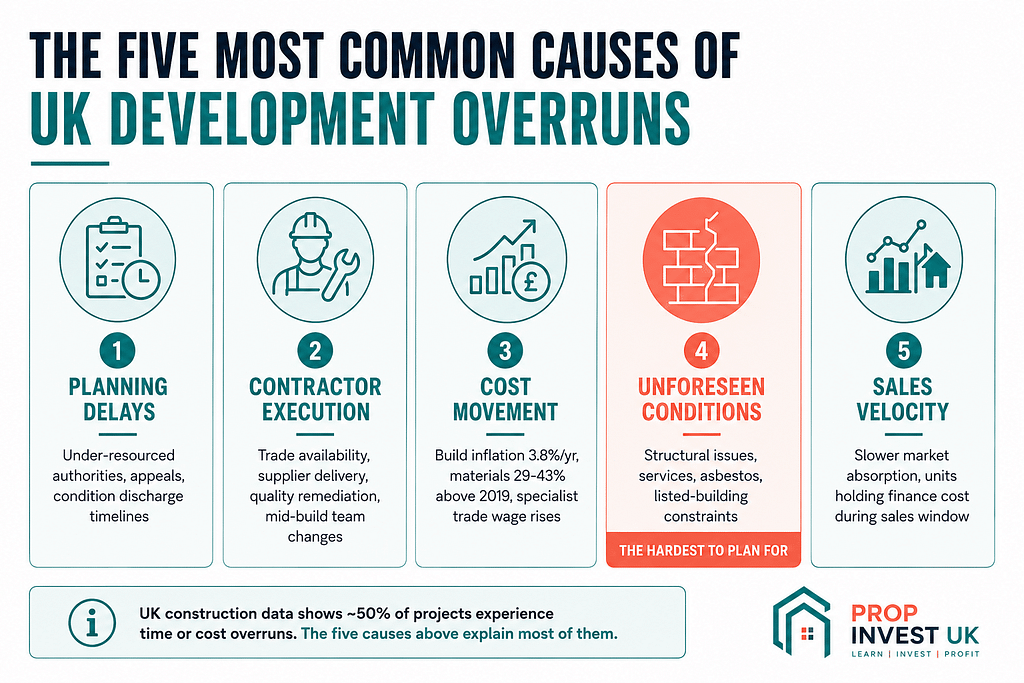
Understanding what actually causes overruns matters because it tells you which risks to look for on any specific project — and which mitigations a competent developer should have in place.
1. Planning delays
The single most common cause of pre-construction delay in UK development. Planning authorities are under-resourced. Decisions get appealed. Conditions take longer to discharge than budgeted. In conservation areas and Article 4 designations, the planning process is materially longer and more uncertain than in straightforward residential or Permitted Development zones.
Planning delays are the most predictable category of friction. They show up before construction starts, they’re visible in real time, and they can be modelled. A well-structured project assumes longer planning timelines than the optimistic base case — particularly in regulated planning environments.
2. Contractor and trade execution issues
Once construction is underway, the operator’s biggest source of timing risk is the contractor and subcontractor base actually doing the work. Specialist trades booked elsewhere. Suppliers missing delivery dates. Quality issues that require remedial work. In some projects, the operator ends up changing contractors mid-build because the original team isn’t capable of delivering the work the project requires.
This is the category of overrun risk most likely to separate competent operators from weaker ones. Planning delays affect everyone equally. Contractor management is a developer skill — and projects that involve difficult build environments expose that skill (or the lack of it) quickly.
3. Construction cost movement
Build costs in the UK have not reverted to pre-2020 levels. BCIS data shows construction inflation running at 3.8% annually in early 2026, with material costs still 29-43% above 2019 levels. Specialist trades — electricians, mechanical engineers, structural specialists — have continued to secure double-digit wage increases in some categories.
For a development project budgeted twelve months before construction starts, cost movement during the planning phase can erode the development margin meaningfully. Projects with thin margins against GDV are most exposed; projects with strong margins can absorb it.
4. Unforeseen conditions in existing buildings
For commercial-to-residential conversion projects and refurbishment of listed or older buildings, the largest single source of build programme overrun is conditions hidden inside the structure that don’t become visible until walls and ceilings come down. Structural issues. Service routing problems. Compliance gaps with current building regulations. Asbestos or contamination. In listed buildings specifically, conservation officer interventions on materials and methods can require workarounds that weren’t in the original programme.
The deeper into a building’s age and listed status the project goes, the higher the probability of significant unforeseen conditions. Operators experienced in this category build the risk into their programme assumptions. Operators new to it usually don’t.
5. Sales velocity at the back end
Even after practical completion, the project isn’t finished from the investor’s perspective until the units are sold (or refinanced onto long-term debt). If the sales market is slower than the model assumed at acquisition, units sit on the market longer, the project carries more finance cost during the sales window, and the investor’s capital remains deployed longer than planned.
UK 2026 conditions have lengthened the average sales window for new-build units in many regional markets. Projects modelled on 2021-2022 sales velocity assumptions are running over on the back end even when the construction phase finished on time.
What an overrun actually costs
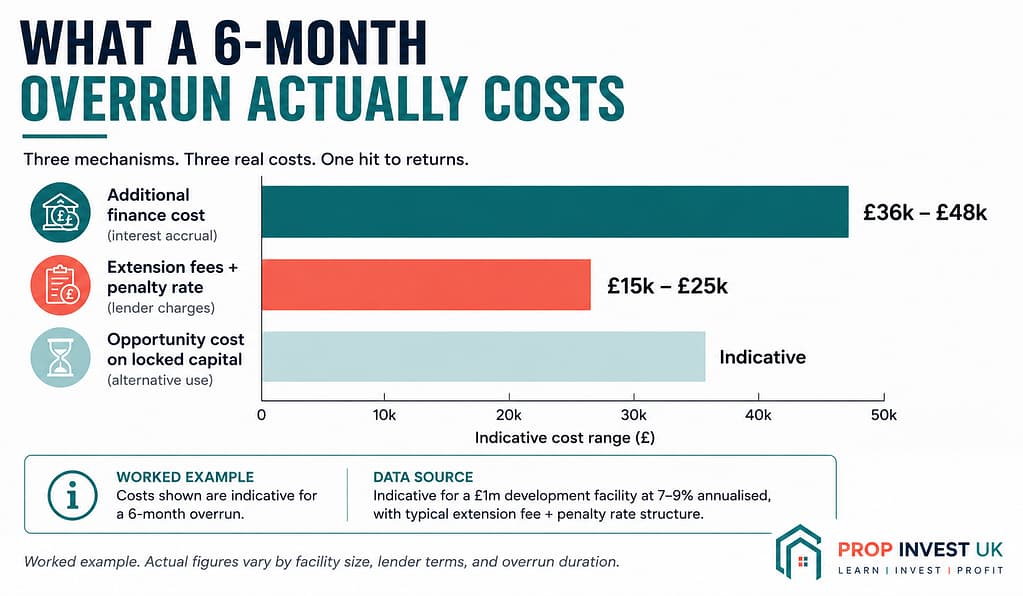
Overruns affect investor returns through three mechanisms — not all of which are obvious from the outside.
Mechanism 1: Additional finance cost
Every month a project runs over, the senior finance facility continues to accrue interest. For a project funded with £1m of bridging or development finance at roughly 7-9% annualised, every month of overrun adds £6,000-£8,000 of finance cost to the project.
Across a six-month overrun, that’s £36,000-£48,000 of additional finance cost — directly eroding the development margin.
Mechanism 2: Extension fees and penalty rates
Most development finance facilities have a hard end date. Running past that date typically triggers extension fees (1-2% of the loan balance) and may attract penalty rates (1.5-2x the standard monthly rate during the extension period).
A project that overruns its planned facility term, then has to extend the facility for three months, may pay both an extension fee and an elevated rate during the extension. The combined cost can add several percentage points to the effective annualised cost of the facility.
Mechanism 3: Investor capital deployed longer
Capital deployed in a project is capital that can’t be deployed elsewhere. An investor whose £100,000 was modelled to return in 18 months but actually returns in 24 months has their capital tied up for six additional months.
For fixed-return investors, this longer deployment period means additional interest at their agreed rate (positive on return, but their capital is still locked up). For equity investors, the longer deployment compresses the annualised return on what was earned. Different structures absorb this differently — which is the next point.
How investor structure affects overrun outcomes

The structure through which an investor participates in a project changes how overruns affect their position. We covered the difference between fixed-return loans and equity participation in our fixed return vs equity article — overrun scenarios are where the structural difference matters most.
Fixed-return loan position
Investors should always incorporate property development project overruns into their risk assessments.
The investor’s return is contractually defined as interest at an agreed rate over the term of the loan. If the project runs three months over its modelled term but the project itself remains viable and able to repay, the loan term is extended and the investor continues to earn interest at the same agreed rate for the extension period.
In practical terms: an overrun on a viable project means a fixed-return investor receives more total interest than originally modelled, not less. The capital is locked up for longer, which has an opportunity cost — but the headline return increases.
This is the structural feature that protects fixed-return capital in friction scenarios. Provided the project can repay at the end (and the structural features below are what make sure it can), the fixed-return investor’s return scales with the time their capital is deployed.
Equity position
The investor’s return is the project’s residual margin. Every cost of the overrun — additional finance cost, extension fees, compressed annualised return — directly reduces the equity investor’s outcome.
A project that was modelled to produce £800,000 of margin and an equity investor’s share of £130,000 might produce £600,000 of margin and £100,000 to the same investor if it runs six months over. The capital is still returned, but the equity return shrinks.
Why this matters for structure choice
The asymmetry between fixed-return and equity in overrun scenarios is one of the strongest arguments for starting an investor relationship with fixed-return participation. On a smooth project, equity earns more. On a project that encounters friction, fixed-return outperforms — sometimes substantially.
For an investor in their first project with a new operator, fixed-return participation has built-in resilience to overruns. That resilience matters most before the operator’s track record is directly evidenced.
Three real stories — how this actually plays out
The framework above is one thing. Real examples are another. So here are three projects where overruns happened, three investors whose capital was affected, and what actually happened to their returns.
Story 1 — Raf at Gore Terrace
Gore Terrace is an HMO conversion in our completed portfolio. The project encountered planning delays during its lifecycle that pushed completion three months past the original schedule. Planning conditions took longer to discharge than the base case assumed — exactly the most common category of friction described above.
Raf had participated in the project as a capital partner under a fixed-return loan structure, with his return paid at his agreed rate in the 15-20% per annum range. When the project ran three months over schedule, the loan term was extended for those three months at his original agreed rate, pro-rata.
The outcome: Raf received an additional three months of interest at his fixed return rate. His total return on the project was higher than the original modelled return, because the loan was outstanding for longer than originally projected. Capital and full interest returned on the extended timeline, with no reduction from the original structure.
Throughout the three-month extension, Raf was kept fully informed of the project’s status, the reasons for the delay, and the revised completion timeline. There were no surprises at the back end — the extension was communicated in advance, agreed in writing, and tracked through to delivery.
Story 2 — Jason at the Windsor Lodge
The Windsor Lodge was a different category of project entirely. Grade II listed building, deep refurbishment requirements, complicated conservation officer involvement, and — most challenging of all — a sequence of contractors who weren’t capable of delivering the work to the standard the building required. The project pushed through significantly more friction than Gore Terrace.
A weaker operator would have lost the Windsor Lodge. It’s the kind of project where the building itself, the regulatory environment, and the contractor base combine into a problem set that overwhelms most developers. What it actually took to deliver was the kind of operational resilience that’s the hardest thing to evidence about an operator until you see it under pressure.
Jason, who featured in our SSAS pensions and property article as one of our long-term capital partners, had a fixed-return loan position in the Windsor Lodge. The project ran significantly past its original schedule due to the build complexity and the contractor changes. Jason’s loan term was extended to match the actual project timeline, with his return continuing to accrue at his agreed rate (in the 15-20% range) pro-rata for the entire extension period.
The outcome for Jason: more total interest earned than the original model showed, because his capital was deployed for longer. Capital and full extended interest returned. And, as importantly, evidence of how the operator handles the hardest category of overrun — the kind that comes from execution friction inside the build itself, not just from external planning delays.
For Jason specifically, the Windsor Lodge was part of the relationship history that led him to move from fixed-return-only participation into equity participation on later projects. He’d seen how the operator handled the hardest case. The trust that supported equity participation on subsequent projects was earned, not assumed.
Story 3 — Glenn at Mozarts
Mozarts is the 76 Walter Road conversion in Swansea — the 26-bed en-suite HMO in an Article 4 conservation area we covered in detail in our commercial-to-residential conversion article. The project is currently in build, with completion now expected approximately three months past the original schedule.
Glenn participated in Mozarts as a fixed-return capital partner, at his agreed rate in the 15-20% per annum range. With the project tracking three months past the original schedule, Glenn’s loan term is being extended to match the actual completion timeline.
The outcome Glenn is now expecting: an additional three months of interest at his fixed-return rate, paid pro-rata for the extension period. His total return on the Mozarts deployment will be higher than the original modelled return — for the same reason as Raf at Gore Terrace and Jason at the Windsor Lodge. The project is structured so that an overrun translates into additional interest earned, not into compromised investor outcomes.
Throughout the extension, Glenn has been kept fully informed of the project’s status, the reasons for the revised timeline, and the expected new completion date. The communication pattern is consistent across all three of these examples: more frequent updates during friction, not less. Specific information, not reassurance.
What these three stories illustrate
Three different projects. Three different causes of overrun. Three different investors. One consistent outcome: capital returned plus extended interest at the agreed rate, with the investor informed throughout.
This is what the structural features below are designed to produce. Not the avoidance of friction — that’s not realistic in property development — but the absorption of friction in a way that doesn’t compromise investor outcomes.
How a well-structured project absorbs overruns
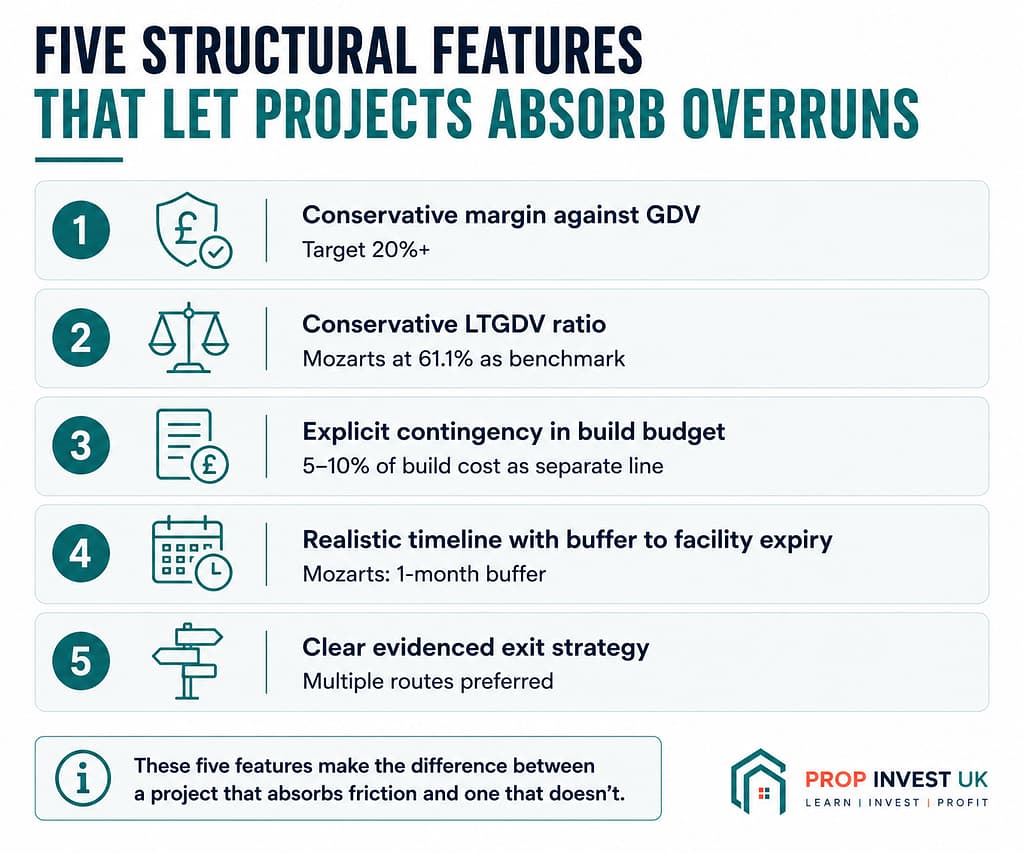
The fact that overruns are statistically likely doesn’t mean every project that overruns destroys investor capital. The difference between a project that survives overruns and one that doesn’t comes down to structural choices made before the project starts.
Five structural features matter most.
1. A conservative margin against GDV
This is the single most important structural feature. We covered margin against GDV in detail in our GDV article — UK developers typically target 15-20% margin against GDV in the current market, with anything below that providing little buffer for friction.
A project with a 25% margin against GDV can absorb a 5-7% cost overrun and still return capital plus reasonable profit. A project with a 10% margin can’t — even modest friction destroys the margin entirely.
Mozarts carries a margin against GDV in the high-20s percent range. That margin exists specifically because the planning complexity (Article 4 conservation area, 26-bed HMO consent) suppressed competition at acquisition and allowed the deal to be acquired with substantial room above the development cost. That room is what gives the project the ability to absorb friction — including the three-month overrun currently in progress — without compromising Glenn’s fixed-return position.
2. Conservative loan-to-GDV (LTGDV) ratio
Senior debt sized at the lower end of lender ranges creates project resilience. A project funded at 60-65% LTGDV has more equity buffer than one funded at 70-75% LTGDV. If costs run over or sales come in lower than modelled, the conservative gearing absorbs the impact before investor capital is exposed.
Mozarts is funded at 61.1% LTGDV — well below the 65-75% upper range typical for residential development. That conservatism is deliberate and exists precisely to provide the kind of buffer that overruns require.
3. Built-in contingency in the cost model
A competent development model includes contingency budget — typically 5-10% of build cost — set aside specifically to absorb unforeseen costs that emerge during construction. This isn’t optimism padding; it’s an explicit line item that funds the cost of dealing with the unexpected.
The Windsor Lodge story is particularly illustrative here. A Grade II listed build with contractor changes mid-project is exactly the scenario where contingency budget gets deployed. The contingency line is what allowed the project to absorb the additional cost of switching contractors and bringing in trades capable of delivering the work — without compromising the structural position of capital partners like Jason.
When investors evaluate a project’s cost breakdown, the absence of a clear contingency line item is a warning sign. So is a contingency line that’s been “borrowed against” before construction has started — meaning the project is already running tight on the buffer that’s supposed to absorb friction.
4. Realistic timeline assumptions with built-in slack
Project timelines should not be modelled on the fastest possible execution. They should be modelled on realistic execution with a buffer for the friction that statistically arises. A 12-month construction programme modelled to complete in exactly 12 months is a programme that will overrun. A 12-month programme modelled with a buffer between completion and facility expiry has built-in slack for typical overruns.
Mozarts illustrates this. The senior loan facility was termed with a one-month buffer between scheduled completion and facility expiry. With the project now running approximately three months past the original schedule, that buffer is being managed actively — through facility extension on commercial terms, not through emergency action.
5. A clear and evidenced exit strategy
Bridging and development finance facilities exit either through sale of completed units or refinance onto long-term debt. The strength of the exit strategy directly determines what happens if the project finishes late.
A project with a strong exit — multiple potential buyers, multiple potential refinance products, clear demand evidence — can absorb a delayed completion because the exit window can be extended without breaking the structure. A project with a weak exit — narrow buyer pool, single refinance product, optimistic demand assumptions — cannot.
When we explored bridging finance in detail in our bridging article, exit viability was identified as the primary underwriting consideration for UK bridging lenders in 2026. The same priority applies to investor evaluation: a project’s exit strategy is what determines whether overruns are absorbed or amplify into capital loss.
What happens in a severe overrun
The structural features above protect against typical overruns — the 3 to 9 month delays and 5-10% cost increases that are statistically common. A severe overrun — 12+ months or 20%+ cost overrun — requires different mechanisms.
Three things tend to happen in a severe overrun scenario:
1. Refinance onto development exit finance
If the project has completed (or nearly completed) but the original finance facility has expired before sales can clear inventory, a development exit finance product can refinance the project onto a 12-18 month bridging facility specifically designed for completed-but-unsold stock.
This is now a mainstream product in UK property finance. Development exit finance prevents distressed sales by giving the developer time to hold completed stock for the right price rather than discount to clear within the original facility window.
2. Equity injection from operator or capital partners
In severe cost overrun scenarios, additional equity is sometimes injected into the project to maintain senior debt covenant compliance. This is typically funded either by the operator’s own capital or by capital partners who agree to participate in a follow-on raise. The terms of any follow-on raise should reflect the changed risk profile of the project at that point.
For investors already in a project, the question of whether they’re invited to participate in a follow-on raise — and on what terms — is part of how the operator handles severe overruns. Excluding existing investors from a follow-on raise on terms more favourable than their original position is a sign of an operator managing the relationship badly.
3. Restructured exit or extended hold
For projects unable to sell at modelled prices in modelled timeframes, the strategic answer may be to restructure the exit entirely. Holding completed units as rental assets rather than selling. Refinancing onto a long-term mortgage product and extending the investor relationship into a different structure. These restructurings should always involve the existing capital partners in the conversation rather than being decided unilaterally.
What investors should expect from the operator in this scenario
Three things matter most in a severe overrun:
- Communication frequency — increased, not decreased. The operator should be reaching out more, not less.
- Honesty about the situation — what’s actually happening, what the options are, what the operator is doing about it.
- A clear restructuring proposal with explicit terms — not vague reassurance.
This is consistent across the Gore Terrace, Windsor Lodge, and Mozarts examples. None of the three were severe overruns by the definition above — they were normal overruns absorbed by normal structural features. But the communication pattern that runs through all three is the same one that matters most in a severe overrun scenario: more communication during friction, specific information rather than reassurance, and a structured path forward agreed with the investor in advance.
An operator who goes quiet during a difficult phase is signalling something. An operator who communicates more proactively during friction than during smooth running is signalling something different — and is the one worth backing again on future projects.
What investors should ask before committing capital
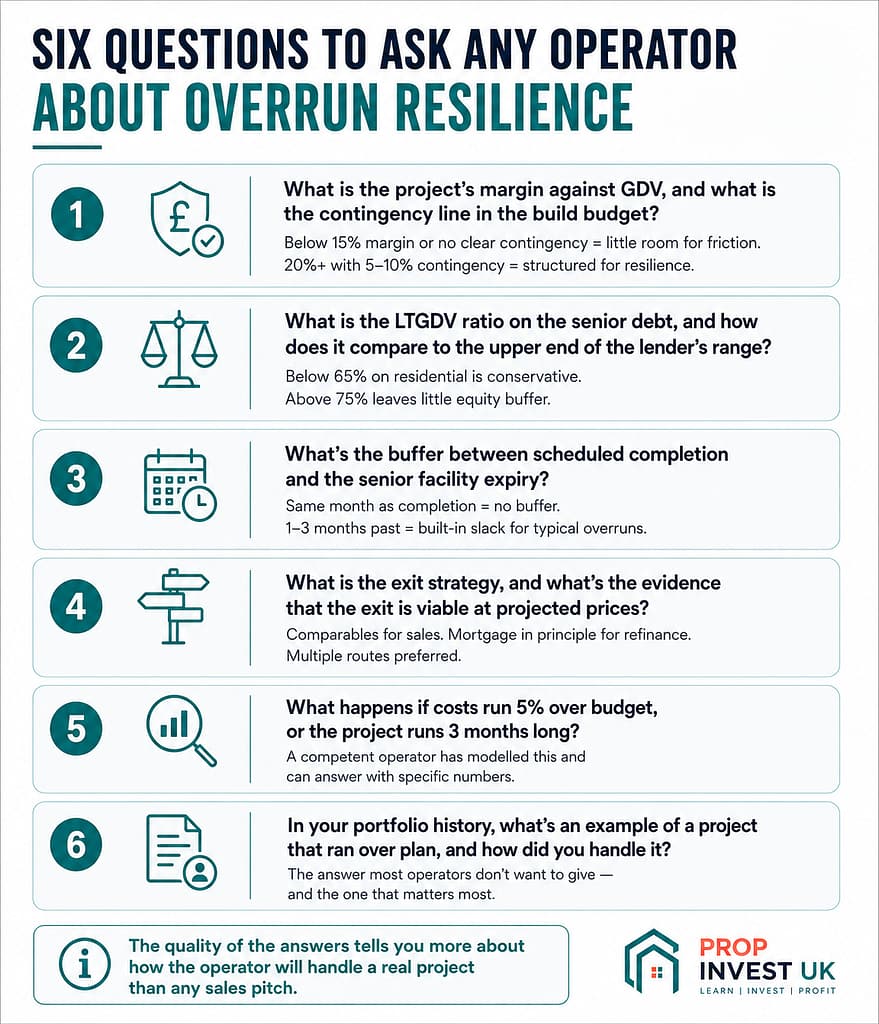
Six specific questions to ask any operator about overrun scenarios. The quality of the answers tells you more about how the operator will handle a real project than any sales pitch.
1. What is the project’s margin against GDV, and what is the contingency line in the build budget?
If the answer is below 15% margin or no clear contingency exists, the project has little room to absorb friction. If the answer is 20%+ margin with 5-10% contingency, the project is structured to absorb the friction that statistically arises.
2. What is the LTGDV ratio on the senior debt, and how does it compare to the upper end of the lender’s range?
Below 65% on residential is conservative. Above 75% leaves little equity buffer. Tell me what the lender will allow and where this project sits within that.
3. What’s the buffer between scheduled completion and the senior facility expiry?
A facility that expires the same month as scheduled completion has no buffer. A facility termed 1-3 months past scheduled completion has built-in slack for typical overruns.
Ultimately, property development project overruns should be managed proactively to ensure investor satisfaction.
4. What is the exit strategy, and what’s the evidence that the exit is viable at projected prices?
Comparables for sales exits. Mortgage in principle for refinance exits. Multiple potential exit routes is better than one. A vague “we’ll sell them” is not an exit strategy.
5. What happens if costs run 5% over budget, or the project runs 3 months long? Walk me through the stress-test scenarios.
A competent operator has modelled this and can answer with specific numbers. An operator who can’t model the stress-test on demand hasn’t done the work.
6. In your portfolio history, what’s an example of a project that ran over plan, and how did you handle it?
This is the question most operators don’t want to answer — and the answer matters most. An operator with a track record longer than two years has projects that ran over. How they describe handling those situations tells you more about the operator than any marketing copy.
For us, the answers to question 6 are projects like Gore Terrace, the Windsor Lodge, and Mozarts — different categories of overrun, different magnitudes, the same structural pattern for handling them, and the same outcome for capital partners.
How we structure Prop Invest UK projects to absorb overruns
At Prop Invest UK, we structure every project we present to capital partners with overrun resilience built in from acquisition, not bolted on after problems emerge.
Specifically:
- Margin against GDV is targeted at 20%+ where possible — and we’ll walk away from deals where the margin doesn’t allow room for friction
- LTGDV ratios sized below the upper end of lender ranges — Mozarts at 61.1% is illustrative of the level of conservatism we target
- Build budgets include explicit contingency line items — typically 5-10% of build cost, separated from base cost rather than blended in
- Facility terms extend beyond scheduled completion — Mozarts has a one-month buffer between target completion and facility expiry; the current three-month overrun is being managed through facility extension on commercial terms
- Fixed-return investor positions extend pro-rata when projects overrun — the same structure that delivered additional return for Raf at Gore Terrace, for Jason at the Windsor Lodge, and that Glenn is now seeing on Mozarts
- Capital partners receive proactive communication during projects — including increased communication frequency when issues arise, not decreased
We don’t claim to deliver projects without friction. Two of the three case studies above involved real overrun scenarios, and a third is currently mid-overrun. What we claim is that we structure projects so they survive friction without compromising investor outcomes — and that the track record of completed projects evidences that structural approach in practice.
In summary
Property development overruns are statistically likely. UK industry data suggests around 1-in-2 projects experience time or cost overruns. The question isn’t whether the project an investor backs will encounter friction — it’s whether the project is structured to absorb that friction without destroying investor capital, and whether the operator handles it in a way that keeps investors whole.
The structural features that matter most are: a strong margin against GDV, conservative LTGDV, explicit contingency in the build budget, realistic timeline assumptions with built-in slack between completion and facility expiry, and a clear evidenced exit strategy.
The investor structure matters too. Fixed-return positions earn additional interest when projects extend, scaled pro-rata at the agreed rate. Equity positions are exposed to margin compression in overrun scenarios. Different investor profiles fit different structures — and starting an investor relationship with fixed-return participation builds in resilience to friction before track record is established.
Three projects — Gore Terrace, the Windsor Lodge, and Mozarts — illustrate the pattern in practice. Different overrun causes (planning delays, build complexity with contractor changes, and an active project still in build) and three different investors (Raf, Jason, and Glenn). One consistent outcome: capital returned plus extended interest at the agreed fixed rate, with each investor kept informed throughout.
The six questions worth asking any operator before committing capital:
- What’s the margin against GDV and the contingency budget?
- What’s the LTGDV ratio versus the lender’s upper range?
- What’s the buffer between completion and facility expiry?
- What’s the exit strategy and the evidence for it?
- What do the stress-test scenarios show?
- How have you handled past projects that ran over plan?
An operator who answers these with detail, evidence, and honest acknowledgement of friction is operating at the right level of discipline. One who can’t, isn’t.
If you want to evaluate specific Prop Invest UK opportunities and see the stress-tested project models that sit behind them — including the overrun scenarios and contingency structures — you can join the investor list. We share specific opportunities with capital partners and can walk through the underlying models on request.
This article is general information only and is not financial advice. Development carries risk; capital is at risk. Returns referenced are historical outcomes on specific projects and are not indicative of future performance. Outcomes on individual projects depend on planning, construction, market conditions, and execution factors that vary by deal.