
Property development and property investment, also referred to as what-is-property-development-and-investment, are two distinct activities that often get blurred into a single phrase. The blur matters, because the right strategy for any investor depends on understanding which one they’re actually doing — and which one suits the capital, the risk appetite, and the time horizon they have to work with.
This article exists to do one thing well: define both terms clearly, explain how they combine in practice, and signpost the deeper questions an investor will reach next.
Understanding what-is-property-development-and-investment is crucial for effective financial planning in real estate.
The two activities, defined cleanly
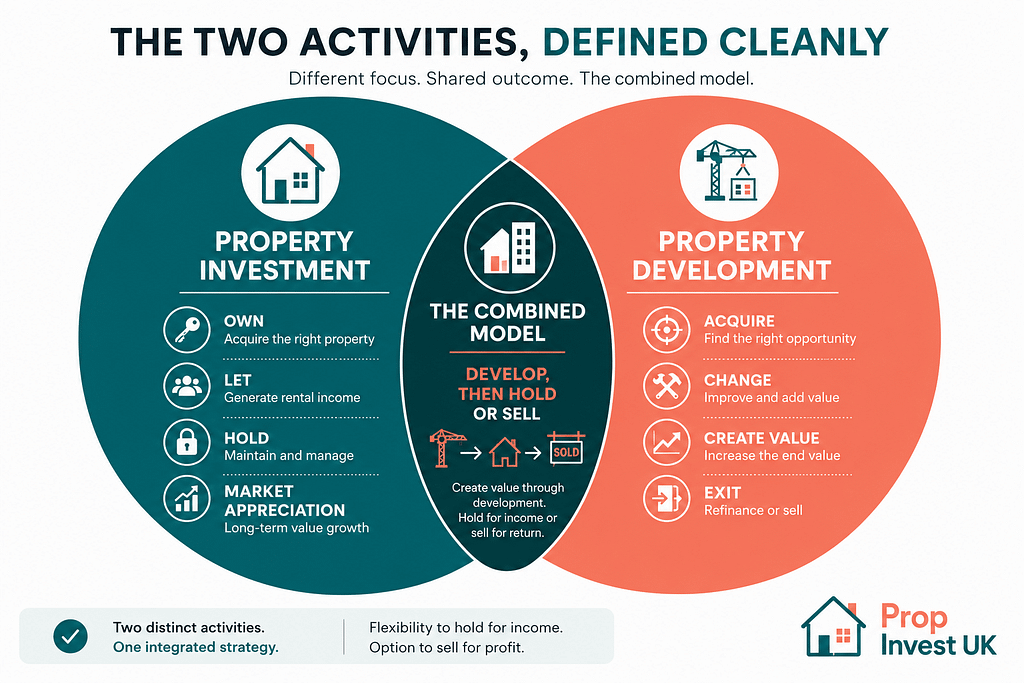
Property investment is acquiring property and holding it for income, capital appreciation, or both. The classic example is buy-to-let. The investor buys an asset that is already in a usable, lettable condition and earns a return from rental income plus any rise in capital value over time. The activity is essentially passive in nature, even where management is professionalised: the value comes from owning the asset, not from changing it.
Property development is acquiring property or land and actively changing it to create value — through planning consent, refurbishment, conversion, extension, or new build. The asset at the end of the process is different from the asset at the start: more valuable, more lettable, more saleable, or all three. Development is project-based, time-bound, and execution-dependent. The value comes from what the operator does to the asset, not just from owning it.
The distinction matters because the two activities have very different return profiles, risk structures, and capital requirements. Investment returns tend to be steady, modest, and scalable through portfolio size. Development returns tend to be larger per project, riskier, and dependent on the operator’s competence rather than the market doing the work.
Why the combined approach exists
In practice, the most sophisticated UK property operators don’t choose between the two activities. They sequence them.
The model: a property or site is acquired with development potential, the development work is carried out to create value, and the completed asset is then either sold to release capital, or refinanced and retained as part of a long-term income-producing portfolio. The first phase is development; the second phase is investment. The combination is what experienced operators mean when they refer to “property development and investment” as a single strategy.
What makes the combination commercially powerful is the order of operations. Buying a stabilised, fully-priced asset and waiting for the market to appreciate is one return profile. Buying with development potential, executing the development, and then holding the stabilised asset is a different return profile entirely — the development creates the equity, and the long-term hold compounds it.
This is the structural reason serious operators tend to build durable wealth from property while passive investors often struggle to keep pace with cost-of-capital pressures. The model has multiple value-creation events per asset, not one.
If you want to understand the mechanics of how that value gets created in more depth, the four profit levers in UK property development covers it in detail.
The 2026 UK context
The reason this strategy is getting more attention from serious investors in 2026 sits in current UK market conditions.
Traditional buy-to-let — investment in its simplest form — is under sustained regulatory and economic pressure. The Renters’ Rights Act 2025, which came into force in May 2026, has materially shifted the operational burden on landlords. Section 24 tax treatment, multiple stamp duty increases, and EPC regulation changes have all compressed the net returns available from straightforward residential rental ownership. The 2025 figure of approximately 93,000 landlord exits from the UK rental market is one signal of how the simpler version of property investment has become harder to make work.
At the same time, the UK development market itself is going through a structural shift. SME developers — once delivering 40% of UK new homes, now delivering 10–12% — are the segment government policy is now actively trying to revive through planning reform, simplified rules for medium-sized sites, and “grey belt” land release. For investors with capital and a longer time horizon, this is a more interesting environment than it has been in years: capital-constrained development operators are increasingly looking for private capital partners to fund schemes that would once have sat with clearing banks.
The combination — pressure on simple buy-to-let, opportunity in development capital — is why “property development and investment” has shifted from being a niche phrase to a strategy worth understanding properly.
What the combined model means for investors

For an investor approaching this space, there are two questions that follow immediately from the definitions above:
First: do you want to participate in the development phase, the investment phase, or both? The development phase is higher return, higher risk, project-bound. The investment phase is steadier, longer-duration, more dependent on the quality of the underlying asset. The two are different exposures even when they sit in the same project, and the right answer depends on what role property is meant to play in your wider wealth position.
Second: do you want to run the activity yourself, or participate through an experienced operator? Running it yourself means becoming the developer and the landlord — building a sourcing pipeline, contractor relationships, planning experience, finance relationships, and a tenant management operation. Participating through an operator means selecting the right partner and the right structure, and accessing the underlying activity without taking on the operational weight.
For most investors with capital but limited operational appetite, the second answer is more commercially sensible. The deeper version of that question is covered in how to invest in real estate development, which walks through what capital partnership looks like in practice and the structural questions that matter most when evaluating an operator.
What good looks like — a brief framework
A credible property development and investment strategy, at a high level, has four things going on at once:
- The acquisition is disciplined. The property is bought below open-market value, with a clear value-creation angle that another buyer didn’t spot. The operator can explain the angle in a sentence.
- The development plan is realistic. Build cost projections sit inside current 2026 benchmarks (£180–£250 per square foot for standard residential). Planning assumptions are grounded. Contingency is genuine, not nominal.
- The structure is transparent. The investor can answer where their capital sits, what security supports it, and what document governs their position before committing.
- The exit is optional. The plan supports either sale or refinance-and-hold at completion, so the operator isn’t forced into a poor market at a fixed moment.
Strategies that hit all four are resilient across market conditions. Strategies that miss one or more are progressively more dependent on luck. The five structural questions every serious investor asks goes into the assessment framework in more detail.
Who this strategy suits
Property development and investment, structured properly, suits investors who:
- Have meaningful capital to deploy but limited time to run operational property activities directly
- Are looking for returns above what passive buy-to-let or stabilised commercial property can offer in 2026
- Are willing to accept the longer time horizons and project risk that development carries, in exchange for higher potential returns
- Value asset-backed strategy with transparent structure over passive market exposure
It is not the right strategy for investors who need short-term liquidity, who can’t tolerate project-level risk, or who want fully passive market-tracking exposure (an index fund or a REIT may be the better fit there).
For those it does suit, the route into the strategy is more important than the strategy itself. Backing the wrong operator with the right strategy goes badly. Backing the right operator with a coherent strategy and a sensible structure is how the model produces what it’s meant to produce — durable property-backed returns that compound over time.
At Prop Invest UK, the model is built around exactly that combination: development to create value, retention into long-term hold where the asset and market support it, and a regional portfolio that grows through both phases rather than restarting each time.
If you’ve worked through this article and want to go deeper, the natural next steps are the cluster articles linked above — on how to invest as a capital partner, the four profit levers in development, and the structural questions every investor should ask. Each one takes a specific part of the picture further.
Considering professionally managed UK property development?
Prop Invest UK works with serious investors who want exposure to UK property development without taking on operational delivery themselves. Each opportunity is sourced, structured, and delivered by an experienced developer, with investors participating as capital partners on a deal-by-deal basis.
Join the investor list to receive details of future opportunities as they become available.
Past performance is not a reliable indicator of future results. Property development involves risk, including the risk of capital loss, and returns are not guaranteed. The information on this page is for general information purposes and does not constitute financial advice or an offer to invest. Any specific opportunity is offered only to investors who qualify under the relevant exemptions and have received the appropriate project documentation.