
In 2025, an estimated 93,000 buy-to-let landlords exited the UK private rental sector. The pattern is becoming hard to dismiss: why UK landlords are exiting buy-to-let in such numbers is now a structural question, not a cyclical one. A further 110,000 are forecast to leave during 2026, around 700 ex-rental homes are listed for sale every day, and 15% of all UK property listings are ex-rental stock.
The official numbers are clear and the trend has been running for years. What’s less visible is the underlying pattern — who’s leaving, why now, what they’re doing with the capital, and what their decisions tell the property investors who remain.
This guide walks through the 2026 numbers, the structural drivers behind the exits, the three categories of landlord most affected, and where the capital being released from BTL is actually flowing. For UK property investors evaluating their own position, the patterns matter more than the headlines.
The 2026 numbers
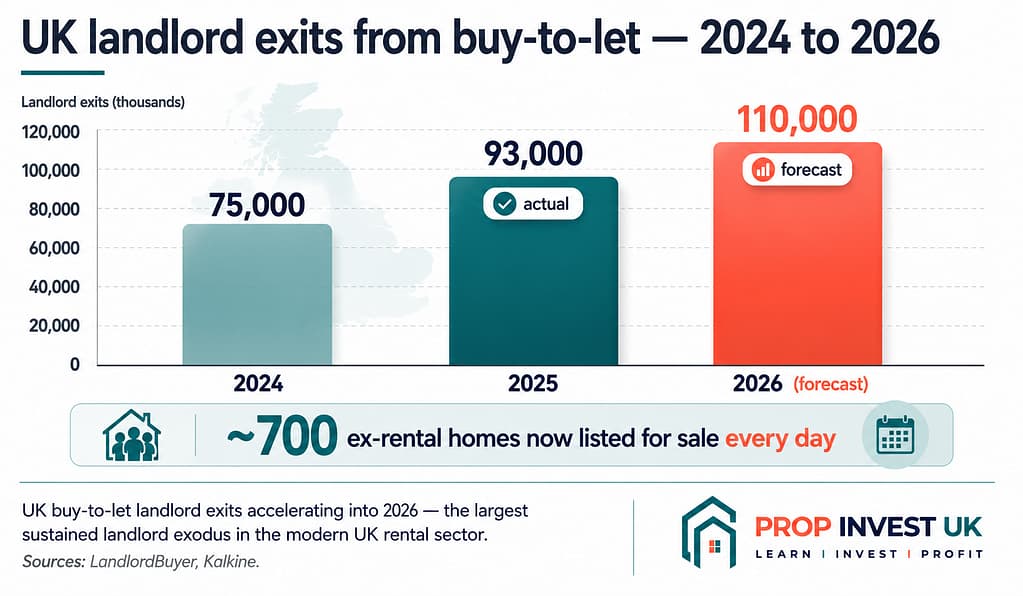
The scale of the UK landlord exit has become difficult to dismiss as cyclical noise.
Annual exits:
- 2025: ~93,000 buy-to-let landlords left the sector (LandlordBuyer, 2025)
- 2026 forecast: ~110,000 additional landlord exits (Kalkine, 2026)
Cumulative position:
- Approximately 290,000 properties sold out of the rental sector between April 2021 and October 2024
- A further 18,000 properties moved out of the rental market between Q4 2025 and early 2026
- ~700 former rental homes now listed for sale every day
- ~15% of all UK property listings are ex-rental stock, up from ~10% a year earlier
Landlord intent surveys:
- 41% of landlords indicated they were likely to sell some properties in the next year (NRLA survey early 2026 — up from just 19% in the 2023-24 survey) (August App, 2026)
- 31% of landlords are now planning to reduce their portfolio
- 16% intend to sell all of their rental properties within two years
- 73% of landlords expect the Renters’ Rights Act to have a negative impact on their letting activity
- In London specifically, 39% of landlords are considering leaving the market entirely within the next year (Elliot Leigh, 2026)
The new landlord side of the equation:
- Only 4% of landlords say they are actively investing in new properties right now
- The imbalance between landlords selling and landlords buying continues to widen (Introducer Today, 2026)
This is not a small adjustment to portfolio behaviour. Approximately 200,000 properties have moved out of the rental sector in the 18 months between Q4 2024 and the 2026 forecast. The total UK rental stock has fallen meaningfully. The number of new landlords replacing exiting ones is a fraction of the outflow.
The pattern has slowed slightly in early 2026 (rental inflation has eased from 4% to 2% year-on-year, suggesting the supply-side pressure has stabilised somewhat) — but the structural direction hasn’t reversed, and the underlying drivers remain in place.
Why now — the five structural drivers
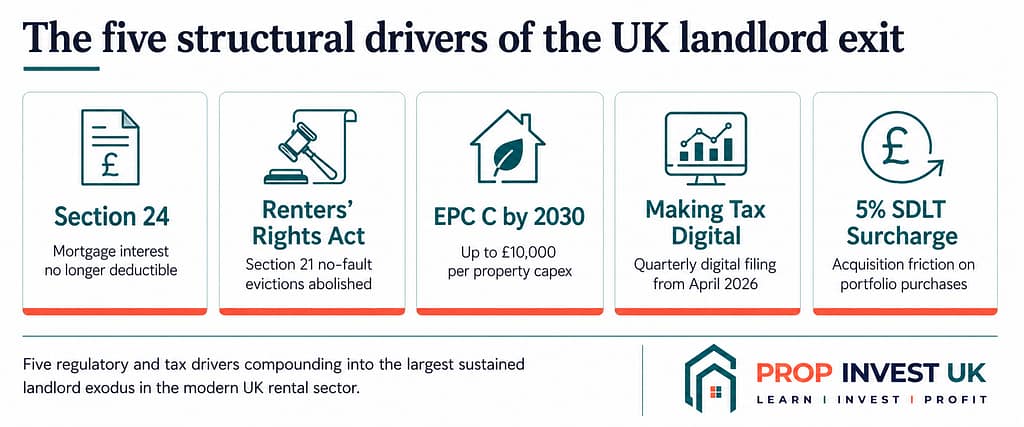
The 2025-2026 acceleration of landlord exits sits on a stack of structural drivers that have been building for nearly a decade. Some are fully phased in. Some are still tightening. Combined, they explain why the BTL model that worked through the 2010s no longer works for many UK landlords in the current cycle.
We covered the technical detail of these drivers in our BTL vs C2R article. The summary version, in the context of why landlords are exiting now specifically:
Driver 1: Section 24 — fully in force since April 2020
Mortgage interest is no longer deductible for individual residential landlords. For higher and additional-rate taxpayers, this typically increases real tax burden by 30-50% on the same actual cash flow. Worse, it can push landlords into higher tax brackets purely on the gross income calculation, even when their genuine income hasn’t changed.
For leveraged BTL landlords in particular — who borrowed against rental income through the 2010s expecting the tax treatment to remain — Section 24 has fundamentally changed the post-tax economics of every property they hold.
Driver 2: The Renters’ Rights Act — Royal Assent October 2025
The single biggest catalyst of the 2025-2026 acceleration. The Renters’ Rights Act received Royal Assent in October 2025 and is being brought into force in stages, with the abolition of Section 21 “no-fault” evictions commencing in 2026 (August App, 2026).
For many landlords, particularly smaller portfolio holders, this is the change that flipped the risk-return calculation. Without the Section 21 backstop:
- Tenancies that go wrong take longer to resolve (average court possession now 33.8 weeks from claim to order)
- The cost of evicting non-paying tenants has risen materially (estimated £3,000+ in court fees and legal costs)
- The flexibility to reposition or sell vacant properties has been reduced
- The “manage-and-recover” assumption underpinning the BTL model has changed
For landlords who built portfolios assuming Section 21 would remain, the Act has structurally changed the operational model.
Driver 3: EPC C by October 2030 — substantial capital expenditure required
The Department for Energy Security and Net Zero confirmed in February 2026 that all privately rented properties must achieve an EPC rating of C by 1 October 2030. Non-compliance fines have risen to £30,000 per property (up from £5,000), with a £10,000 cost cap on required improvements.
For older rental stock — particularly Victorian and Edwardian terraced properties common in regional UK markets, and pre-WW2 housing in London suburbs — the upgrade cost is substantial. Many landlords are looking at £6,000-£10,000+ per property of compliance spend over the next four years, none of which produces meaningful additional rental income.
For portfolio landlords with 5-15 older properties, the total compliance bill alone can be £30,000-£150,000. For some, this is the calculation that turns continued ownership into a net loss position.
Driver 4: Making Tax Digital — administrative burden from April 2026
From 6 April 2026, landlords with combined gross income from rental properties and self-employment over £50,000 must use MTD-compatible software and submit quarterly digital updates to HMRC. The threshold drops to £30,000 from April 2027 and £20,000 from April 2028.
For smaller landlords who managed annual self-assessment in spreadsheets and submitted once a year, MTD requires new software, new processes, and quarterly engagement with HMRC throughout the year. The administrative cost matters less than the signal it sends — landlording has become an actively-managed compliance operation, not the passive-income side activity it was sometimes positioned as.
Driver 5: The 5% SDLT surcharge — acquisition friction
The 5% SDLT surcharge on additional properties makes building or rebalancing a BTL portfolio materially more expensive than it was a decade ago. For a landlord considering selling one property and buying another, the SDLT cost on the new purchase creates a structural disincentive to portfolio churn — making the “sell entirely” option more attractive than the “rebalance” option for some.
The combined effect
Each driver in isolation would create some landlord exits. The combination — tax burden up under Section 24, regulatory complexity up under the Renters’ Rights Act, capex requirements up under EPC C, admin burden up under MTD, acquisition cost up under the SDLT surcharge — has compounded into the largest sustained landlord exodus in the modern UK rental sector.
The 2025-2026 surge reflects the timing of three of these drivers hitting simultaneously: the Renters’ Rights Act passing in October 2025, EPC C finalisation in February 2026, and MTD enforcement starting April 2026. Landlords who had been holding through earlier changes are now hitting the point where the cumulative burden has become unsustainable.
The three categories of landlord most affected
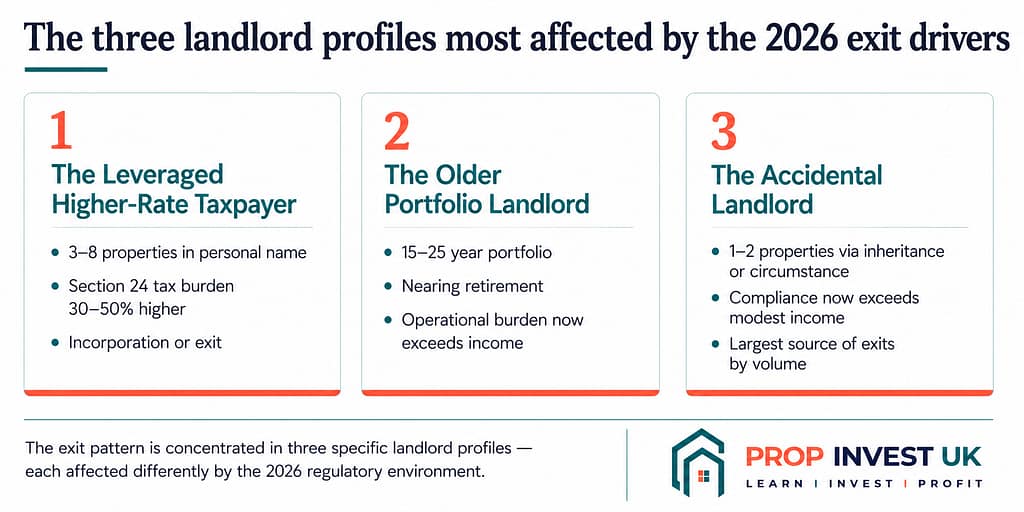
Not all UK landlords are exiting at the same rate. The exit pattern is concentrated in three specific landlord profiles.
Category 1: The leveraged higher-rate taxpayer
The single category most affected by Section 24. A landlord who borrowed substantially against rental income through the 2010s, holds 3-8 properties in their personal name, and is a higher-rate (40%) or additional-rate (45%) taxpayer.
For this profile, Section 24 has dramatically increased real tax burden. EPC compliance adds another layer of capital expenditure. The Renters’ Rights Act removes operational flexibility. The combination is structurally unsustainable on most leveraged BTL portfolios.
The strategic response: either incorporate into a limited company (restoring mortgage interest deduction at the cost of SDLT and CGT on the transfer) or exit. Many are choosing exit because incorporation is itself expensive and complex, and the underlying regulatory environment continues to tighten.
Category 2: The older portfolio landlord nearing retirement
A landlord who built a portfolio over 15-25 years, now in their 50s-70s, with significant equity and properties largely paid off (or with low LTV).
For this profile, the financial pressure is less acute — they’re often not heavily leveraged and the Section 24 impact is smaller. But the operational burden has grown. The Renters’ Rights Act has made tenancy management more complex. The EPC compliance work on older properties is substantial. The administrative burden under MTD adds further to the running cost of the operation.
For landlords nearing retirement, the trade-off is now: continue managing a complex operation with rising compliance costs, or sell, pay CGT, and simplify. Increasingly the latter is the choice — particularly for landlords whose adult children aren’t interested in inheriting the portfolio operations.
Category 3: The accidental or part-time landlord
A landlord who became a property investor through inheritance, life circumstances (couldn’t sell so let it out), or a small side-investment of one or two properties.
For this profile, the operational complexity now far exceeds what the income justifies. A landlord with one rental property earning £15,000-£18,000 gross is being asked to engage in quarterly digital filing, manage EPC C compliance, navigate Renters’ Rights Act procedures, and absorb Section 24 tax burden — all for limited net income that may be barely above what they’d earn from a cash deposit at current rates.
This category is the largest single source of UK landlord exits by number. The exits are individually small but cumulatively significant — and they’re the most permanent because once these landlords leave, they typically don’t return.
Where the capital is going
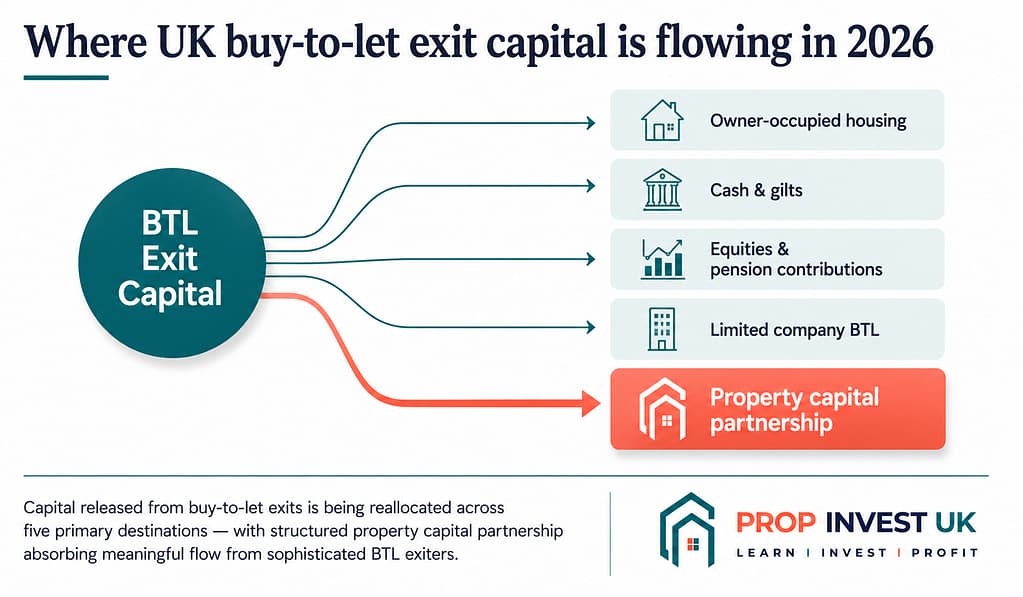
Capital released from BTL exits isn’t disappearing from the UK economy — it’s being reallocated. Five primary destinations.
Destination 1: Owner-occupied housing
Many BTL properties are being bought by first-time buyers and home-movers rather than by other landlords. The exit of ~200,000 properties from the rental sector between Q4 2024 and 2026 has materially helped first-time buyers compete for affordable stock (particularly two-bedroom flats and modest terraces) at the cost of reduced rental supply.
For the BTL seller’s capital after CGT, the funds typically flow into one of the categories below.
Destination 2: Cash and gilts
The simplest reallocation. After selling a BTL property, paying CGT, and clearing mortgages, the residual capital goes into easy-access savings, fixed-term deposits, or UK government bonds.
At 2026 rates (cash savings 3-4%, 10-year gilts 4.3%), this isn’t an ambitious reallocation but it’s a low-risk one. For older landlords near retirement, this is often the preferred route — simplification rather than reallocation into a new active investment.
Destination 3: Equities and pension contributions
A meaningful portion of BTL exit capital is being reallocated into pension contributions (where the 40% or 45% tax relief on contributions effectively recoups some of the Section 24 burden) and into equity investments through ISAs and general investment accounts.
For higher-rate taxpayers specifically, the pension contribution route is structurally favourable: contribute £20,000, effectively cost £12,000 after relief, with tax-free growth thereafter. For investors who don’t already use the £60,000 annual pension allowance, BTL exit capital can be channelled into pension over multiple tax years for substantial tax benefit.
Destination 4: Limited company BTL
For landlords with significant existing portfolios who want to remain in property ownership, the move to a limited company structure restores mortgage interest deduction at the cost of corporation tax on profits.
The friction is real (SDLT on the transfer, CGT triggered, ongoing accountancy costs), but for landlords with 5+ leveraged properties the long-term economics often justify it. This is now the standard route for serious portfolio landlords who want to remain operationally active.
Destination 5: Property capital partnership
The destination that matters most for the Prop Invest UK audience. BTL landlords with continued property conviction but operational fatigue are increasingly moving capital into property development capital partnership structures — lending to specialist operators rather than owning rental properties directly.
The structural appeal:
- Operator handles all compliance, tenancy management, build delivery
- Returns structured as interest income or equity participation, not rental income (Section 24 doesn’t apply)
- Defined project timelines (18-30 months typical) with capital return at exit
- Structural protection through second legal charges, professional documentation
- Higher gross returns (typically structured in the 15-20% per annum range on fixed-return positions) than the post-tax yields available on direct BTL ownership
We covered the technical detail of these structures in our investor security article and fixed return vs equity article. The case studies of Raf at Gore Terrace, Jason at the Windsor Lodge, and Glenn at Mozarts evidence what the capital partnership structure looks like for investors who’ve made this transition.
What this means for the UK rental market
The aggregate effect of sustained landlord exits has implications that ripple across the UK property landscape.
Rental supply is shrinking. The ~200,000 properties that have moved out of the rental sector since late 2024 represent a meaningful reduction in available rental stock. Average UK rents grew 5% through 2025 and are forecast at similar levels for 2026 (dbrinvest, 2026) — driven directly by the supply contraction.
Tenancy endings are dominated by landlord sales. The NRLA describes landlord sales as the single biggest cause of tenancy endings in the UK, accounting for “nearly three times as many cases as any other reason” (August App, 2026).
The new supply gap is being filled slowly. Build-to-Rent (BTR) institutional investment has tried to fill some of the gap, but Cushman & Wakefield’s 2026 forecast notes that “viability issues have and will continue to impact the level of new supply coming forward” — meaning BTR can’t grow fast enough to replace the BTL stock leaving the sector.
Rent affordability is becoming a political pressure point. With rental supply shrinking and rents rising faster than wages, the political pressure to intervene further in the rental market continues to build. This in turn creates ongoing regulatory uncertainty for remaining landlords — which feeds back into more exits.
The cycle is structurally self-reinforcing in the medium term: regulatory pressure → landlord exits → supply contraction → rent rises → political pressure → more regulation → more exits.
What this means for property investors evaluating the landscape
For UK property investors looking at the 2026 environment, the landlord exodus is more than a market statistic. It’s a structural signal about where capital should and shouldn’t be.
Signal 1: Direct BTL ownership is structurally challenged
If 31% of existing landlords are planning to reduce portfolios and 16% intend to exit entirely within two years, the model isn’t broken for some investors — it’s structurally challenging for most. New entrants into leveraged individual-name BTL in 2026 face the same structural headwinds that are pushing existing landlords out. The model doesn’t reset for new participants.
Signal 2: The structural rental supply shortage will persist
The 200,000+ rental property loss since late 2024 won’t be replaced quickly. BTR development is constrained. New landlords aren’t entering at scale. The supply shortage that’s pushing rents up is structural, not cyclical — and likely to persist through 2026-2030.
For operators delivering new rental supply (including through commercial-to-residential conversion), the demand environment is structurally favourable.
Signal 3: Capital partnership structures benefit from the BTL exit pattern
The capital being released from BTL exits is looking for new homes. A meaningful fraction of that capital, particularly from sophisticated landlords with continued property conviction, is flowing into capital partnership structures with property developers.
This is the strategic shift our content body is structured around. The investors who participate in Vernon Property Group projects — Raf, Jason, Glenn, and others — typically have BTL backgrounds and have made exactly this reallocation: from direct ownership to capital partnership.
Signal 4: Operator quality becomes the decisive variable
In a market where capital is moving from passive ownership to active investment with operators, the operator’s quality determines the investor’s outcome more than any other single factor.
We covered the seven-category operator vetting framework in our vetting article. For investors making the transition from BTL ownership to capital partnership, applying that framework to potential operators is the most important decision in the reallocation process.
The five-question framework for landlords considering the exit decision
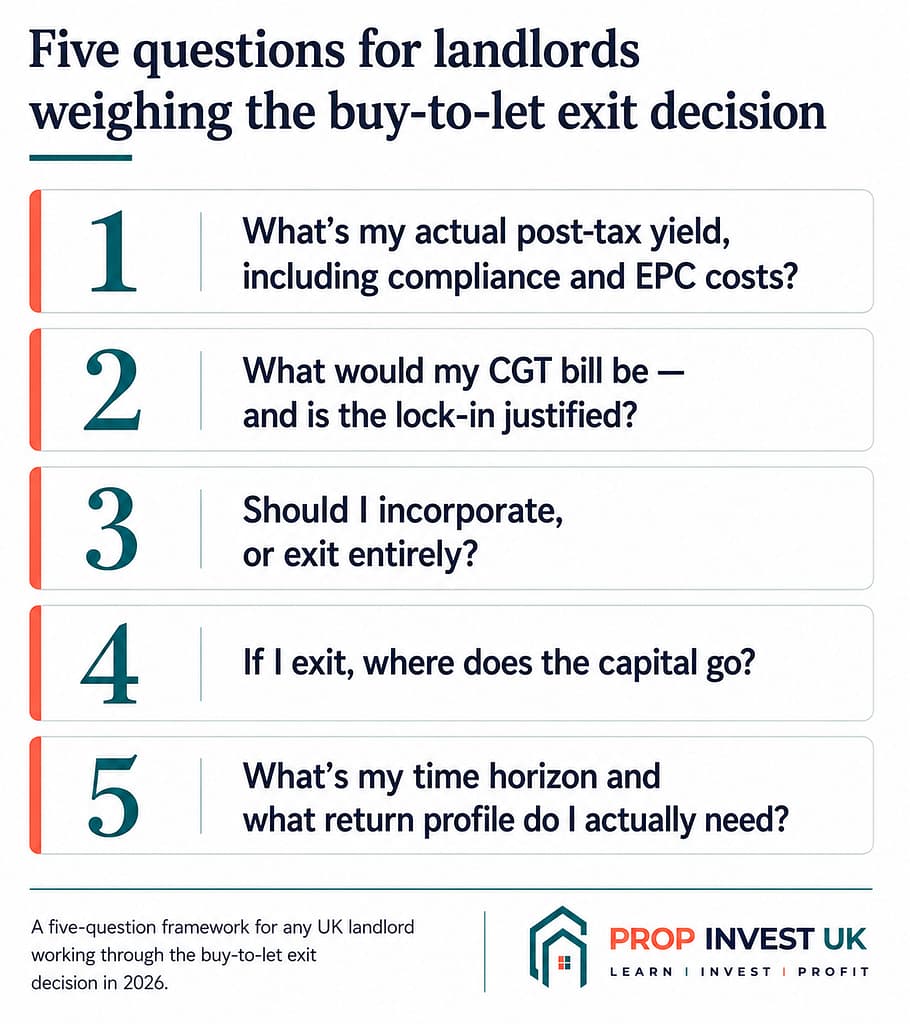
For a UK landlord currently weighing whether to exit BTL — or how to restructure their position — five questions worth working through.
1. What’s my actual post-tax yield, including ongoing compliance and capital costs?
Most BTL landlords underestimate the real cost of holding their portfolios in 2026. Section 24 burden, void and maintenance costs, agent fees, ongoing compliance, expected EPC compliance spend, MTD software, longer void periods under the new framework. Calculate net yield honestly — including a sinking fund for EPC C compliance by 2030 — and compare to alternative investment returns.
2. What would my CGT bill be if I sold, and is the lock-in justified?
For long-held BTL properties with substantial capital gains, the CGT exit cost (currently 18% basic / 24% higher rate on residential property) is material. Run the numbers on the post-CGT capital position to evaluate what “selling” actually nets you — and what reallocating that capital might produce over the next 5-10 years.
3. Should I incorporate or exit entirely?
For substantial leveraged portfolios, limited company incorporation can be the right answer. For smaller portfolios or accidental landlords, the incorporation friction (SDLT, CGT, accountancy) often outweighs the long-term benefits, and exit is simpler.
4. If I exit, where does the capital go?
Cash and gilts? Pension contributions? Equities? Limited company BTL? Property capital partnership? Each route has different return profiles, tax treatments, and operational complexity. The reallocation choice often matters more than the exit decision itself.
5. What’s my time horizon and what return profile do I actually need?
Investors near retirement may prioritise simplicity and capital preservation. Investors with longer horizons can absorb more operational complexity for higher returns. Match the destination to the profile, not the other way around.
In summary
The UK landlord exodus from buy-to-let is not a cyclical adjustment. It’s a structural reallocation driven by the cumulative effect of Section 24, the Renters’ Rights Act, EPC C requirements, Making Tax Digital, and the 5% SDLT surcharge.
The 2025 exit of ~93,000 landlords and the 2026 forecast of ~110,000 more represents the largest sustained landlord exodus in the modern UK rental sector. Around 700 ex-rental homes are being listed for sale every day. 15% of all UK property listings are ex-rental stock.
Three landlord profiles are most affected: leveraged higher-rate taxpayers, older portfolio landlords nearing retirement, and accidental or part-time landlords. The capital being released is flowing into owner-occupied housing, cash and gilts, equities and pensions, limited company BTL, and increasingly into property capital partnership structures.
For UK property investors evaluating the landscape:
- Direct BTL ownership faces structural headwinds that won’t reset for new entrants
- The rental supply shortage is persistent and likely to extend through 2030
- Capital partnership structures are absorbing meaningful flow from BTL exits
- Operator quality is the decisive variable in the new allocation choices
The investors who do well in this environment aren’t the ones who fight the structural tide — they’re the ones who understand it and reallocate accordingly.
If you’re a UK landlord weighing the exit decision and want to discuss how capital partnership in property development might fit your position — you can join the Prop Invest UK investor list. We share specific opportunities with capital partners and welcome the structural due diligence approach described across our content.This article is general information only and is not financial, tax, or legal advice. UK tax law, rental regulations, and property markets change over time. Investors and landlords should take independent professional advice on their specific circumstances. Development carries risk; capital is at risk. Past project outcomes are not indicative of future performance.