
Windsor Lodge is a Grade II listed hotel on Mount Pleasant in Swansea, acquired in 2024 for £275,000. By then it had spent years sliding — damp, structural neglect, over forty original sash windows most contractors wouldn’t quote on, a hospitality licence attached to a building unfit for occupation. Most operators had walked past it. The acquisition was priced to reflect that distressed, regulated state; the value was created by restoring it to a specification competing modern stock cannot match. The restoration ran 15 months — three more than scoped — partly because heritage work cannot be rushed, and partly because a contractor problem pushed the build £50,000 over budget. Conservative acquisition pricing absorbed that without compromising the finish. The building is now valued at £1,750,000, lets at £155,000 a year as a 21-bedroom hotel, and is refinanced and held long-term. This case study explains what was bought, what was done, and what the numbers show.
Investment snapshot
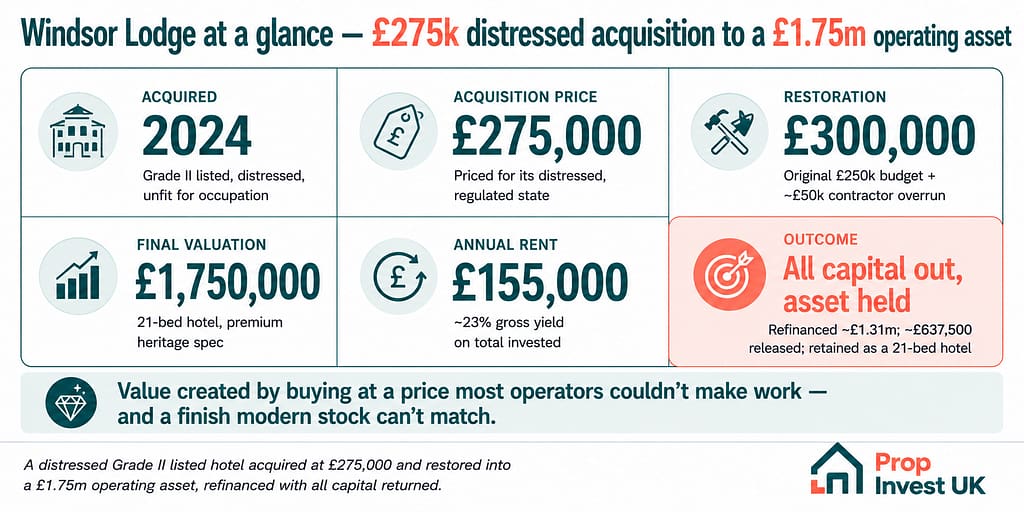
- Project type: Grade II listed hotel — heritage restoration and repositioning
- Location: Mount Pleasant, Swansea
- Acquired: 2024
- Acquisition price: £275,000
- Restoration / build: £300,000 (original £250,000 budget plus a ~£50,000 contractor overrun)
- Total invested: ~£675,000 (including development finance, fees and funding costs)
- Final valuation: £1,750,000
- Annual rental income: £155,000
- Timeline: 15 months (originally scoped for 12)
- Current status: Completed, refinanced, operating as a 21-bedroom hotel
- Held in: FECV Property Assets Ltd (long-term Vernon Property Group portfolio)
The opportunity
Windsor Lodge has been a hotel in Swansea for over a hundred years — Victorian proportions, period detailing, a corner position on one of the city’s principal streets. The kind of building that anchors a neighbourhood.
By the time we found it, it had spent years sliding. Damp. Structural neglect. Decades of overdue maintenance compounding on each other. Over forty original sash windows, each one a small craftsman’s puzzle, most past the point where a modern contractor would even quote on them. It was a Grade II listed building carrying a hospitality licence, unfit for occupation, on a principal commercial street — and most operators had already walked past it.
That combination is exactly why the acquisition price was where it was. The regulatory complexity that frightens off most operators is not a problem to be avoided; it is the mechanism by which acquisition prices fall to a level where a disciplined operator can create meaningful value. By the time we reached the table, most buyers had withdrawn — which is the point at which the development margin starts to make sense for an operator equipped to do the work.
The challenge
There were two distinct challenges, and it is worth being straight about both.
The first was the heritage work itself. A Grade II listed restoration carries listed building consent obligations administered through Cadw and the local authority, conservation oversight at every stage, restrictions on materials and methods, and specialist craftsmen for traditional techniques. That means extended timelines for both approvals and construction, and higher costs throughout the build. None of that is a surprise on heritage work — it is priced in from the start.
The second challenge was less predictable: the contractors underperformed. The restoration had been budgeted at £250,000 and scoped for twelve months. Contractor problems pushed it to £300,000 — roughly £50,000 over — and contributed to the build running to fifteen months. We are not going to dress that up as a planned decision. Part of the extension was deliberate, because heritage finishing genuinely cannot be rushed; part of it was a real contractor problem that cost time and money.
What mattered was that the project could absorb it. The acquisition had been priced conservatively enough — £275,000 against an end value many multiples higher — that a £50,000 overrun did not threaten the margin or force a compromise on the finish. That buffer is not luck. It is the direct result of pricing the deal correctly at acquisition, which is the discipline the whole project turns on.
The strategic solution
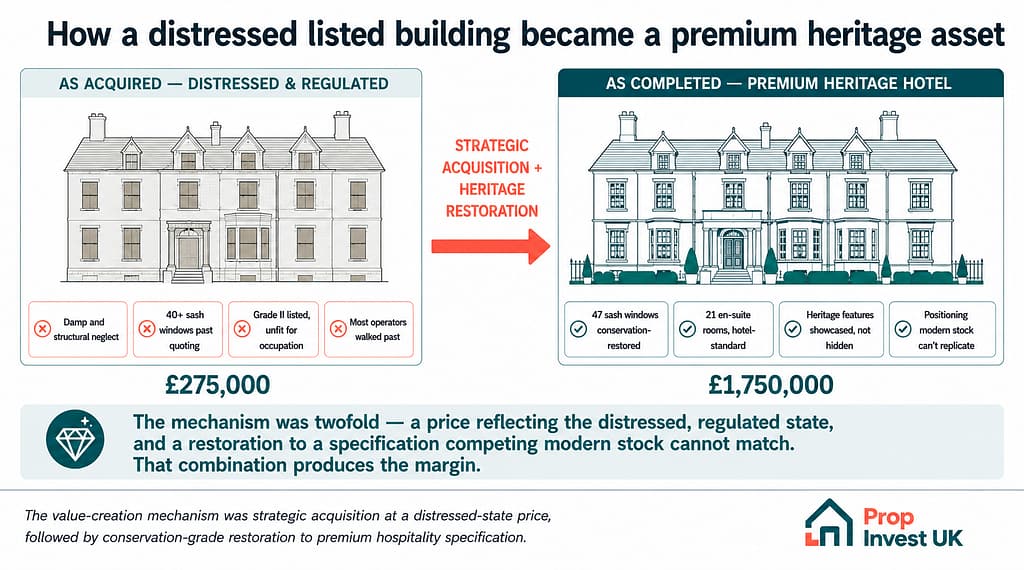
The value-creation mechanisms here, in order of impact:
- Strategic acquisition — buying at £275,000, a price reflecting the building’s distressed and regulated state rather than its restored potential.
- Refurbishment and repositioning — restoring the building to a specification that produces premium hospitality positioning: heritage character, authentically restored, that competing modern stock cannot replicate.
The restoration ran as a 15-month project in three phases.
Months 1–4 — Planning and heritage compliance
Working through listed building consent. Specifying every alteration in detail. Securing approval for modern systems — heating, electrical, fire safety — that needed to integrate sensitively with the building’s period character. This phase took longer than initially scoped, which is normal for Grade II work and which had been priced into the cost and timeline assumptions from the start.
Months 5–12 — Restoration and fit-out
The defining work was the restoration of over forty original sash windows, each requiring individual assessment and conservation-grade repair by specialist craftsmen using traditional techniques. Slow work that cannot be shortcut. In parallel, twenty-one en-suite bedrooms were built out, each combining period character with contemporary hotel-standard comfort. Communal areas were restored to showcase the building’s heritage features rather than hide them, with modern systems integrated using methods that preserved sightlines and original detail.
Months 13–15 — Completion to specification
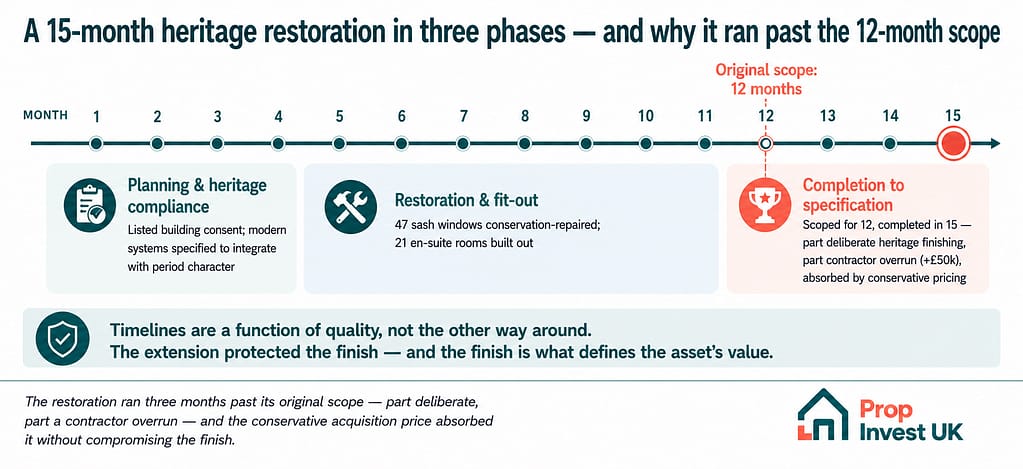
The project was scoped for twelve months and completed in fifteen. As set out above, part of that was a deliberate refusal to rush the heritage finish and part was a genuine contractor overrun. Either way, the operating logic held: rushing the heritage work would have compromised the finish, which would have compromised the rental rate, which would have compromised the asset value. The maths of taking the extra time made the asset significantly more valuable on completion than hitting the original deadline ever would have.
This is the principle the project demonstrates most clearly, and the one we hold across the portfolio: timelines are a function of quality, not the other way around. A project that finishes on time but at a lower specification frequently underperforms one that takes longer to finish properly. The forty-seven restored sash windows are the visible example — they extended the build, and they are also now the feature that defines the asset’s premium positioning. A modern hotel with PVC windows is a budget property; a Victorian hotel with restored period sashes is a premium one. For more on how programme slippage is handled without compromising the outcome, see what happens when a property development project overruns.
The numbers
Total investment
| Item | Amount |
|---|---|
| Acquisition price | £275,000 |
| Restoration / build (incl. ~£50,000 contractor overrun) | £300,000 |
| Development finance, fees & funding costs (estimated) | ~£100,000 |
| Total invested (approx.) | ~£675,000 |
The finance line is an estimate based on development finance at approximately 1% per month across the 15-month build on a staged drawdown, plus entry and exit fees, refinance/mortgage fees, and the cost of investor capital. Acquisition, restoration, valuation and rental figures are confirmed; the finance figure is the one estimated line and can be replaced with the exact funding cost.
Performance
| Metric | Value |
|---|---|
| Annual rental income | £155,000 |
| Gross yield on total investment | ~23% |
| Gross operating yield on final valuation | ~8.9% |
Post-completion value
| Metric | Value |
|---|---|
| Acquisition price | £275,000 |
| Total invested (approx.) | ~£675,000 |
| Final valuation | £1,750,000 |
| Value created over total invested | ~£1,075,000 |
| Uplift on total investment | ~159% |
Refinance position
| Metric | Value |
|---|---|
| Final valuation | £1,750,000 |
| Refinance at ~75% LTV | ~£1,312,500 |
| Total invested (approx.) | ~£675,000 |
| Capital position | All invested capital returned at refinance; surplus of ~£637,500 released; asset retained |
| Outcome | Completed, refinanced, retained and operating as a 21-bedroom hotel |
From a £275,000 acquisition to a £1,750,000 final valuation — not because the market moved, but because the building was acquired at a price most operators could not make work, restored by craftsmen who could do work most operators cannot get done, and completed without compromise.
The proper investor view is against total invested, not acquisition price alone. On approximately £675,000 all-in — acquisition, the £300,000 restoration including the contractor overrun, and estimated finance costs — the £1,750,000 valuation represents roughly £1,075,000 of value created. The refinance at around 75% LTV produced approximately £1,312,500, which cleared the development finance, returned all invested capital, and released a substantial surplus while the building was retained as an income-producing asset generating £155,000 a year. This is what disciplined heritage restoration produces when the underlying acquisition is correctly priced and the build is executed properly — even when a contractor problem adds £50,000 along the way.
Why this case study matters
Windsor Lodge is in the case study set because it shows what conservative acquisition pricing actually buys you: the ability to absorb a real problem without the investor outcome suffering.
The capital partner on this project, Jason, participated through his SSAS pension. When the contractors underperformed and the build ran £50,000 over budget across an extended timeline, the question that matters to an investor in that position is not whether something went wrong — on a fifteen-month heritage build, something usually does — but how the operator handles it. In this case, the overrun was absorbed by the buffer built in at acquisition, the heritage finish was protected, and the asset still completed at a valuation that comfortably cleared all capital at refinance. Jason’s position was never at risk from the overrun, because the deal had been priced so that it didn’t need to be.
The disciplines this project demonstrates:
- Pricing risk in at acquisition. Construction surprises happen. Specialist heritage work takes longer than budget allows. The discipline is not preventing this — it is pricing it in from the start so the project absorbs the slippage without compromising the outcome, and structuring investor expectations accordingly. This is the kind of judgement worth testing in any operator, which we set out in how to vet a property operator.
- Refusing to compromise the finish to hit a date. The forty-seven restored sash windows extended the build and now define the asset’s value. An operator who rushes that finish to hit an arbitrary deadline produces a cheaper building.
- Honesty about friction with capital partners. The contractor problem was real. The way it was handled — absorbed, disclosed, the finish protected — is the part an investor should care about.
Heritage restoration is also not only a commercial story. A Grade II listed building was saved from continuing deterioration — one that, left to slide, would eventually have become irrecoverable. Traditional craftsmanship was deployed at scale: sash window restorers, conservation-grade plasterers, heritage roofers, specialist joiners — skills becoming harder to find, and every project that uses them keeps that supply chain alive for the next building that needs it. Twenty-one rooms of quality accommodation now operate on a principal Swansea street, supporting the local tourism economy. A piece of Welsh architectural history is back in working use rather than slowly disappearing behind boarded windows.
How this fits the wider portfolio
Windsor Lodge sits at the heritage-restoration end of the project mix, demonstrating the same operating pattern as the rest of the portfolio at a different scale and through a different mechanism:
- Heritage restoration (Windsor Lodge) — value created through strategic acquisition of a distressed listed asset and conservation-grade restoration to premium specification
- Conversion projects (12 Gore Terrace, Mozarts) — value created through use change, density, and secured income
- Strategic acquisition / legal-structure projects (Hanover Street, Trebanos Twin Houses) — value earned at the point of purchase and through legal restructuring
- Completion projects (Trowbridge 7 Flats, a lender-referred completion in Somerset) — value created by finishing what another party could not
The pattern across all of them is consistent: strategic acquisition where complexity has suppressed the price, professional execution to a specification that creates value most operators cannot replicate, and long-term portfolio retention where the asset supports it. The valuation that underpins a refinance on any of these — including the £1,750,000 that anchors Windsor Lodge — is the gross development value, or end valuation, against which the lending and the margin are measured.
How we approach this kind of project at Prop Invest UK
Windsor Lodge is the kind of project we structure as a developer partnership. Investors participate as capital partners — sourcing, planning, construction, and operation are handled by the development team. The strategy is explained in advance, reporting is regular, and the investment timeline and exit are defined before capital is deployed.
On heritage work specifically, the discipline that protects capital is the one this project demonstrates: price the acquisition conservatively enough that the inevitable surprises of a listed restoration can be absorbed without compromising the finish or the investor’s position. For capital partners, the structure is typically a fixed-return position secured against the property at HM Land Registry — set out in what security private investors actually get.
If you want to receive analysis of current UK property development opportunities — including project structure, security, operator capability, and projected outcomes — you can join the Prop Invest UK investor list. We share specific opportunities with capital partners on the list as they come to market.
This article describes a completed project at Vernon Property Group and is general information only, not financial advice. UK property investment carries risk; capital is at risk. The figures shown relate to this specific completed project and are not indicative of future returns on any other opportunity. Property development opportunities are typically not regulated by the Financial Conduct Authority, and investors do not have access to the Financial Ombudsman Service (FOS) or the Financial Services Compensation Scheme (FSCS). Specific development opportunities should be evaluated with appropriate professional advice.